• Submit Poetry
  • Support SCP
  • About Us
  • Members
  • Join
Saturday, July 18, 2026
Society of Classical Poets
  • Poems
    • Beauty
    • Culture
    • Satire
    • Humor
    • Children’s
    • Art
    • Ekphrastic
    • Epic
    • Epigrams and Proverbs
    • Human Rights in China
    • Music
    • Performing Arts
    • Riddles
    • Science
    • Song Lyrics
    • The Environment
    • The Raven
    • Found Poems
    • High School Poets
    • Terrorism
    • Covid-19
  • Poetry Forms
    • Sonnet
    • Haiku
    • Limerick
    • Villanelle
    • Rondeau
    • Pantoum
    • Sestina
    • Triolet
    • Acrostic
    • Alexandroid
    • Alliterative
    • Blank Verse
    • Chant Royal
    • Clerihew
    • Rhupunt
    • Rondeau Redoublé
    • Rondel
    • Rubaiyat
    • Sapphic Verse
    • Shape Poems
    • Terza Rima
  • Great Poets
    • Geoffrey Chaucer
    • Emily Dickinson
    • Homer
    • Henry Wadsworth Longfellow
    • Dante Alighieri
    • John Keats
    • John Milton
    • Edgar Allan Poe
    • William Shakespeare
    • William Wordsworth
    • William Blake
    • Robert Frost
  • Love Poems
  • Contests
  • SCP Academy
    • Educational
    • Teaching Classical Poetry—A Guide for Educators
    • Poetry Forms
    • The SCP Journal
    • Books
No Result
View All Result
Society of Classical Poets
  • Poems
    • Beauty
    • Culture
    • Satire
    • Humor
    • Children’s
    • Art
    • Ekphrastic
    • Epic
    • Epigrams and Proverbs
    • Human Rights in China
    • Music
    • Performing Arts
    • Riddles
    • Science
    • Song Lyrics
    • The Environment
    • The Raven
    • Found Poems
    • High School Poets
    • Terrorism
    • Covid-19
  • Poetry Forms
    • Sonnet
    • Haiku
    • Limerick
    • Villanelle
    • Rondeau
    • Pantoum
    • Sestina
    • Triolet
    • Acrostic
    • Alexandroid
    • Alliterative
    • Blank Verse
    • Chant Royal
    • Clerihew
    • Rhupunt
    • Rondeau Redoublé
    • Rondel
    • Rubaiyat
    • Sapphic Verse
    • Shape Poems
    • Terza Rima
  • Great Poets
    • Geoffrey Chaucer
    • Emily Dickinson
    • Homer
    • Henry Wadsworth Longfellow
    • Dante Alighieri
    • John Keats
    • John Milton
    • Edgar Allan Poe
    • William Shakespeare
    • William Wordsworth
    • William Blake
    • Robert Frost
  • Love Poems
  • Contests
  • SCP Academy
    • Educational
    • Teaching Classical Poetry—A Guide for Educators
    • Poetry Forms
    • The SCP Journal
    • Books
No Result
View All Result
Society of Classical Poets
No Result
View All Result
Home Poetry

‘Blind Watchmaker’: A Poem by Warren Bonham

March 11, 2025
in Poetry, Science
A A
21
poems 'Blind Watchmaker': A Poem by Warren Bonham

.

Blind Watchmaker

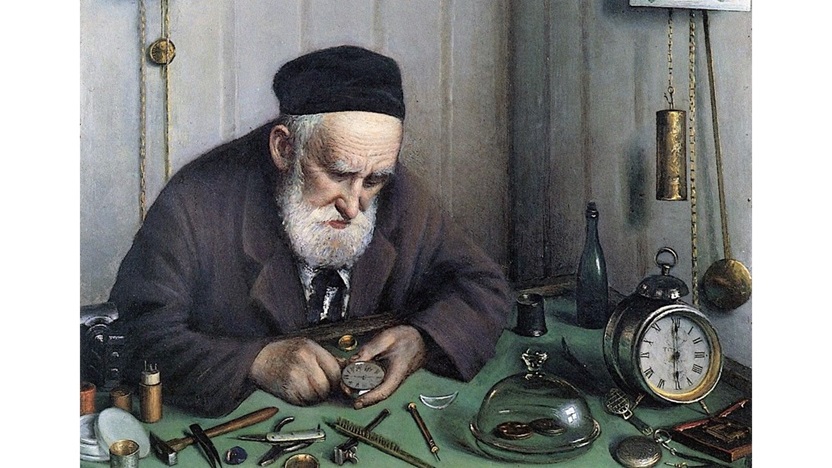
A blind watchmaker tinkered for billions of years
without blueprints for making his intricate gears.
So, he failed many times but got up when he fell
and was shocked when he made not a watch, but a cell.

From that cell, which he made from primordial slime,
every creature evolved through the passage of time.
On a planet like ours, this was bound to unfold
through an unguided process, or so we’ve been told.

But the knowledge we gain from new questions we ask
shows blind watchmakers useless at their assigned task.
It seems more and more likely that we were designed
by a being possessing a limitless mind.

The Big Bang would have fizzled without someone there
who began time and made all there is from thin air.
And with three billion letters in our DNA,
it’s impossible chance had a big part to play.

And if physical laws were not quite so refined
then all known time and space would begin to unwind.
And there’s no way that randomly mutated genes
can make novel molecular-level machines.

If our minds remain open, the more we will find
that our science is clearer with God intertwined.
Every day, the skies speak, and the heavens declare,
if we’re willing, we’ll hear them say “God’s everywhere.”

.

.

Warren Bonham is a private equity investor who lives in Southlake, Texas.
ShareTweetPin
The Society of Classical Poets does not endorse any views expressed in individual poems or commentary.
Read Our Comments Policy Here

RandomPoems

Living Master: Jeremy Lipking
Beauty

‘The Night When Heaven Cried’ by Sam Gilliland

January 10, 2018

  I have been here before, when heaven cried, All my love and longing locked up inside, Where the green...

‘Dear Blabby’s Advice for the Clueless’: A Poem by Roy E. Peterson
Humor

‘Dear Blabby’s Advice for the Clueless’: A Poem by Roy E. Peterson

August 2, 2025

. Dear Blabby’s Advice for the Clueless _I want to write a column _Like Abigail Van Buren To give out...

Next Post
‘Cherry Tree’ and Other Poetry by Shindy Cai

'Cherry Tree' and Other Poetry by Shindy Cai

‘A Fisherman’s Life’: A Poem by Pamela Ruggiero

'A Fisherman’s Life': A Poem by Pamela Ruggiero

‘Mussolini’s Minions’: A Poem by Mary Jane Myers

'Mussolini’s Minions': A Poem by Mary Jane Myers

Comments 21

  1. jd says:
    1 year ago

    Love it! Such a clear, rhymed and well-metered explanation of the truth. “God intertwined” is a lovely thought.

    Reply
    • Warren Bonham says:
      1 year ago

      I’m glad you enjoyed this one! God “intertwined” seems obvious to me, but not yet to everyone.

      Reply
  2. T. M. Moore says:
    1 year ago

    Well done, Warren, both in form and theme. C. S. Lewis wrote that the project of the modern scientific endeavor is not to get the facts in but to keep God out. But I think people today are becoming much more open to the idea you proffer. And by putting it in such a lilting, quizzical meter, I’m sure many would delight in and benefit from reading and meditating on your poem. Hopefully, some will find their way here to read it. It would be delightful to hear you read this.

    Reply
    • Warren Bonham says:
      1 year ago

      I need to step up my game on the C. S. Lewis front. I pretty much stopped at Narnia but I’ve recently learned that he was an accomplished poet in addition to everything else that he was good at. I’m very glad you enjoyed this one.

      Reply
  3. David Paul Behrens says:
    1 year ago

    I love the theme of this poem. It could be the universe was created so that God will have something to do. Of course, I’m only speculating. Being mere mortals, it is all beyond our comprehension.

    Reply
    • Warren Bonham says:
      1 year ago

      Why God did all of this is a question I’ve never pondered. Having the humility to recognize that we are mere mortals is something many people never seem to get past (a group that seems to include many scientists).

      Reply
  4. Cynthia Erlandson says:
    1 year ago

    “or so we’ve been told,” indeed. For human beings with such comparatively limited brains, to think we’re smarter than “ a being possessing a limitless mind” is as absurd as the watchmaker theory. I think the anapestic meter you’ve chosen is appropriate because it lends humor to the absurdity. Nice job, Warren.

    Reply
    • Warren Bonham says:
      1 year ago

      I’m fortunate to have been born when I was. I was initially drawn to the Watchmaker concept (don’t judge me) but many recent scientific advancements point in the other direction and have re-opened my eyes.

      Reply
  5. Rachel Meyer says:
    1 year ago

    Love this!

    Reply
    • Warren Bonham says:
      1 year ago

      Thanks so much for saying that!

      Reply
  6. C.B. Anderson says:
    1 year ago

    Warren, if you haven’t already, you should listen into some of the many podcasts in which Stephen Meyer has participated. Michael Behe is also very good. Together they are great and will likely give you greater understanding of why your position on this matter is quite tenable.

    Reply
    • Warren Bonham says:
      1 year ago

      I still have a lot to learn, but if it hadn’t been for those guys, I would have kept marching down the wrong road.

      Reply
  7. Gigi Ryan says:
    1 year ago

    Dear Warren,
    I have always loved analogies and parables for their effectiveness in making concepts more within reach of understanding.
    When the stories are put to verse, it is even easier for the reader to get drawn in to think logically.
    Your concluding couplet is my favorite – the Truth and the the way you communicated.
    Gigi

    Reply
    • Warren Bonham says:
      1 year ago

      Thanks! In the last couplet, the key word for me was “willing”. The skies have been loudly declaring for a very long time. We just need to turn off our noise cancelling headphones and so we can hear them.

      Reply
  8. Margaret Coats says:
    1 year ago

    Well done, Warren! If we are willing to use our intelligence, we see that nature is intelligible. That’s what science is all about. Blind design is the untenable position. Your Big Bang couplet is splendid, as is the shocking appearance of the first cell. And there is meaningful artistry in “novel molecular-level machines,” more than in many uses of internal slant rhyme, as creatively satisfying as these may be. “Novel,” while meaning “new” or “original,” can also imply “fictional,” supporting your statement that there is no way for the described random process to happen. A nice touch, as is your allusion to one of the Psalms in the next-to-last line. The poem is enjoyable because the human intellect not only likes to discover truth, but to review modes of thinking as they are explained, and see the truth itself well-stated.

    Reply
    • Warren Bonham says:
      1 year ago

      You have once again adeptly peeled back the layers. You focused on my favorite couplet (molecular-level machines) and expressed the meaning more clearly than I could have. The idea for that couplet came from Michael Behe (as CB surmised) and his work on “irreducible complexity”. We’re fortunate that some great work is being done by some incredibly intelligent scientists like Behe, and it is finally gaining some traction.

      Reply
  9. Roy Eugene Peterson says:
    1 year ago

    Excellent poem, Warren. Well-conceived, worded and rhymed. Your logic is impeccable, and your theology is so well stated. Science is for mortals with flawed results. It took an infinite intellect to make a world.

    Reply
    • Warren Bonham says:
      1 year ago

      Thanks! It seems that many scientists believe themselves to somehow be infallible.

      Reply
  10. Rusty Rabon says:
    1 year ago

    Wow, Warren! What a wonderful way of showing the indispensability of God in all of creation. I thought it was a very creative transition to begin with a seeming affirmation of evolution without God to an echo of Psalm 8 that “God’s everywhere.” Thanks for sharing this!

    Reply
    • Warren Bonham says:
      1 year ago

      The poem basically follows the path I took (I’m ashamed to say). I’m very glad you enjoyed it.

      Reply
  11. Janice Canerdy says:
    1 year ago

    I have asked often~~sometimes in an exasperated tone~~”How could anyone,
    having looked at a tiny part of this world, doubt that there is a God?” Your truly excellent (in every respect) poem has addressed this issue in a definitive and
    deep BUT down-to-earth manner. Doubters should read your poem!

    Reply

Leave a Reply Cancel reply

Your email address will not be published. Required fields are marked *

  1. Ganga Unnikrishnan on National Poetry Month Limerick ChallengeJuly 18, 2026

    Urzsula

  2. Ganga Unnikrishnan on National Poetry Month Limerick ChallengeJuly 18, 2026

    Thank you so much Ursula

  3. Geoffrey Smagacz on ‘Ben Franklin’s Copper Fugio Cent’: A Poem by Geoffrey SmagaczJuly 18, 2026

    Thank you, Margaret

  4. Margaret Coats on ‘The Anonymous Soldier’: A Poem by Lucy LindJuly 18, 2026

    Good questions, Lucy. As the sestet to your sonnet, they help evoke honor for fallen warriors named and for the…

  5. Margaret Coats on ‘The Ballad of Zebulon Pike’: A Poem by M.D. SkeenJuly 18, 2026

    A fine ballad on a military man turned frontiersman whose story isn't often heard. You do your state proud, M.…

Subscribe to Daily Poems

Enter your email address to subscribe to this blog and receive notifications of new posts by email.

Join 1,596 other subscribers

Recent Poems

  • ‘An American Dash’: A Poem by Linda Ellis
  • ‘The Anonymous Soldier’: A Poem by Lucy Lind
  • ‘For Those We Never Meet’: A Poem by Aneesh Agarwal
  • ‘Ben Franklin’s Copper Fugio Cent’: A Poem by Geoffrey Smagacz
  • Three Brief Poems by Luxorius, Translated by Joseph S. Salemi
  • ‘The American Spirit’: A Poem by Dusty Grein
  • ‘The Ballad of Zebulon Pike’: A Poem by M.D. Skeen
  • ‘We Are the Ones’ and Other Poetry by Cheryl Corey
  • ‘My Pyjamas!’ and Other Poems by Susan Jarvis Bryant
  • ‘A Snowy Egret’: A Poem by Bruce Dale Wise
  • ‘The Swearing-in of Calvin Coolidge’: A Sonnet by Robert W. Crawford
  • ‘Ballad of the Sequoia’: A Poem by Lauren V. Leon
  • ‘The 51st State’: A Poem by James Sale
  • ‘La Uva’ (The Grape): A Poem by Michael Pietrack
  • ‘There’s Blood that Flows Within the Stripes’: A Poem by Lauren V. Leon
  • ‘Birdsong’: A Poem by Jeffrey Essmann
  • ‘The Melody That Lingers On’ and Other Poetry by John McPherson
  • ‘American Dreams’: A Poem by Adam Sedia
  • ‘An American Fabius’: A Poem by John Hernandez
  • ‘Vernal Clinic’ and Other Poetry by C.B. Anderson
  • ‘Omaha Beach’ and Other Poetry by Bradford Skow
  • ‘Music to Part the Veil’: A Poem by T.M. Moore
  • ‘A Gentleman’s Guide to Losing a War’ and Other Poetry by Arnon Peterson
  • ‘Black Shuck’: A Poem by Martin Briggs
  • ‘When the Last World War II Veteran Passes Away’: A Poem by N.S. Boone
  • ‘A Fallow Year at Worthy Farm’: A Poem by Paul A. Freeman
  • ‘Outstanding in Afghanistan’: A Poem by Jared S. Chang
  • ‘250 More’: A Poem by Miguel Moreno
  • ‘Americans Cross the Rubicon’: A July 4th Poem by Brian Yapko
  • ‘Two Fateful American Coin Flips’: A Poem by James A. Tweedie

Categories

  • Acrostic
  • Alexandroid
  • Alliterative
  • Art
  • Best Poems
  • Blank Verse
  • Chant Royal
  • Classical Poets Live
  • Clerihew
  • Covid-19
  • Deconstructing Communism
  • Educational
  • Epic
  • Epigrams and Proverbs
  • Essays
    • Interviews with Poets
    • Poetry Reviews
  • Featured
  • From the Society
  • Great Poets
    • Dante Alighieri
    • Edgar Allan Poe
    • Emily Dickinson
    • Geoffrey Chaucer
    • Henry Wadsworth Longfellow
    • Homer
    • John Keats
    • John Milton
    • Robert Frost
    • William Blake
    • William Shakespeare
    • William Wordsworth
  • Human Rights in China
  • Limerick
  • Love Poems
  • Music
  • Pantoum
  • Performing Arts
  • Poetry
    • Beauty
    • Children's Poems
    • Culture
    • Ekphrastic
    • Found Poems
    • High School Poets
    • Humor
    • Riddles
  • Poetry Challenge
  • Poetry Contests
  • Poetry Forms
    • Curtal Sonnet
    • Haiku
  • Poetry Readings
  • Rhupunt
  • Rondeau
  • Rondeau Redoublé
  • Rondel
  • Rubaiyat
  • Sapphic Verse
  • Satire
  • Science
  • Sestina
  • Shape Poems
  • Short Stories
  • Song Lyrics
  • Sonnet
  • Symposium
  • Terrorism
  • Terza Rima
  • The Environment
  • Translation
  • Triolet
  • Video
  • Villanelle

Quick Links

  • About Us
  • Submit Poetry
  • Become a Member
  • Members List
  • Support the Society
  • Advertisement Placement
  • Comments Policy
  • Terms of Use

Welcome Back!

Login to your account below

Forgotten Password?

Retrieve your password

Please enter your username or email address to reset your password.

Log In
No Result
View All Result
  • Poems
    • Beauty
    • Culture
    • Satire
    • Humor
    • Children’s
    • Art
    • Ekphrastic
    • Epic
    • Epigrams and Proverbs
    • Human Rights in China
    • Music
    • Performing Arts
    • Riddles
    • Science
    • Song Lyrics
    • The Environment
    • The Raven
    • Found Poems
    • High School Poets
    • Terrorism
    • Covid-19
  • Poetry Forms
    • Sonnet
    • Haiku
    • Limerick
    • Villanelle
    • Rondeau
    • Pantoum
    • Sestina
    • Triolet
    • Acrostic
    • Alexandroid
    • Alliterative
    • Blank Verse
    • Chant Royal
    • Clerihew
    • Rhupunt
    • Rondeau Redoublé
    • Rondel
    • Rubaiyat
    • Sapphic Verse
    • Shape Poems
    • Terza Rima
  • Great Poets
    • Geoffrey Chaucer
    • Emily Dickinson
    • Homer
    • Henry Wadsworth Longfellow
    • Dante Alighieri
    • John Keats
    • John Milton
    • Edgar Allan Poe
    • William Shakespeare
    • William Wordsworth
    • William Blake
    • Robert Frost
  • Love Poems
  • Contests
  • SCP Academy
    • Educational
    • Teaching Classical Poetry—A Guide for Educators
    • Poetry Forms
    • The SCP Journal
    • Books

© 2025 SCP. WebDesign by CODEC Prime.