


By Sandeep Kumar Mishra
There are two things that came to my mind when I read the book Hare Krishna by Mahathi: First, in this modern era in which every person thinks himself a poet, the shape, size and sweetness of the traditional poetry has been lost. Now, it is an amalgamation of some freakish phrases, totally irrelevant imagery and thoughts, and odd googled words to make it distinctive. If you write traditional metrical poems, you will be accepted here and there only after many polite rejections. Almost every editor proudly proclaims, “Please don’t send rhymes of any kind.”
What do Sir Walter Raleigh, Christopher Marlowe, Robert Burns, William Blake, William Wordsworth, Percy Bysshe Shelley, Robert Browning, Edwin Arlington Robinson, Robert Frost, Joyce Kilmer, and many more have in common? They all are considered great poets but you should know that they mainly wrote poetry in blank verse, sonnets, ballads, odes, or lyric style, they gave vent to the feelings and what they observed in their surroundings and its effect on body and soul. But their poetry is not worthy to be read or get published according to the modern Editor. Why? It is because the editors are like-minded persons and lack a broad mindset. It is an indication of our present state of mind, a result of modern life devoid of emotional depth and lack of insight into the loveliness of nature and its impact on us. Who can correct them? They are the Editors, “the powerful dads of all poets.”
All great poets are true observers of surroundings. Thoughts are not a combination of an irrelevant stream of ideas, which you call modern poetry, but have a sequence. As poetry is inspired by environment or is a reaction to the present situation and may have some impressions of our past, our very nature, thoughts and principles, still it is best expressed in rhythmic form. Otherwise, the true objective of poetry is lost. In the words of William Wordsworth, “Poetry is the spontaneous overflow of powerful feelings and emotions recollected in tranquility.” The order of poetical forms and traditions demands tranquility. In this respect, Mr. Mahathi has followed this best path to express transcendental ideas.
Now, I come to the second point. The themes of the current literary genres have been sexual love, hate, fantasy, violence, LGBT (unnatural relationships), which show our degradation and a lack of the lofty elements which a reader used to find in poetry. Literature, in its all forms, is an art. As with all arts forms of some elevation, the great literature, as we labeled it, has somewhat a touch of greatness (epic elements) which intends to enlighten the reader amidst life’s suffering. Instead of writing, upon these narrow modern topics, if you choose an age old story, and narrate it in your natural and original way, it is more the need of the hour and more enjoyable. After reading a poem you should not feel the burden of the story or theme but have a solution to it.
This book Hare Krishna accomplishes this forcefully and authentically with some naturally flowing verses. This translation will help the non-Hindu to understand the true meaning of Hindu philosophy which has survived since antiquity.
Krishna is a descent of the divine, the god worshiped by every Hindu around the world. Krishna appeared on this earth almost 5,000 years ago in Mathura, located in Northern India, 91 miles south of New Delhi. Krishna is a child, cowherd boy, friend, servant, and killer of demons. For the Western world, Krishna can easily be passed off as a mythological figure created by a fiction writer. But for most Hindus, he is a god in the form of a human. Krishna is the speaker of the Bhagavad Gita (“the song of God”) which is the most referenced and commented-on scriptural text in India. The Gita serves as the guidebook for many Hindus and non-Hindus on how to live a life of devotion to God, while also cultivating a healthy detachment from the things of this world. In the past and even in the present, plaintiffs and defendants have sworn on the Gita in the courts of law in India. Krishna’s life has become the subject matter of textbooks in Hinduism classes in many universities and the subject of debate among philosophers and theologians.
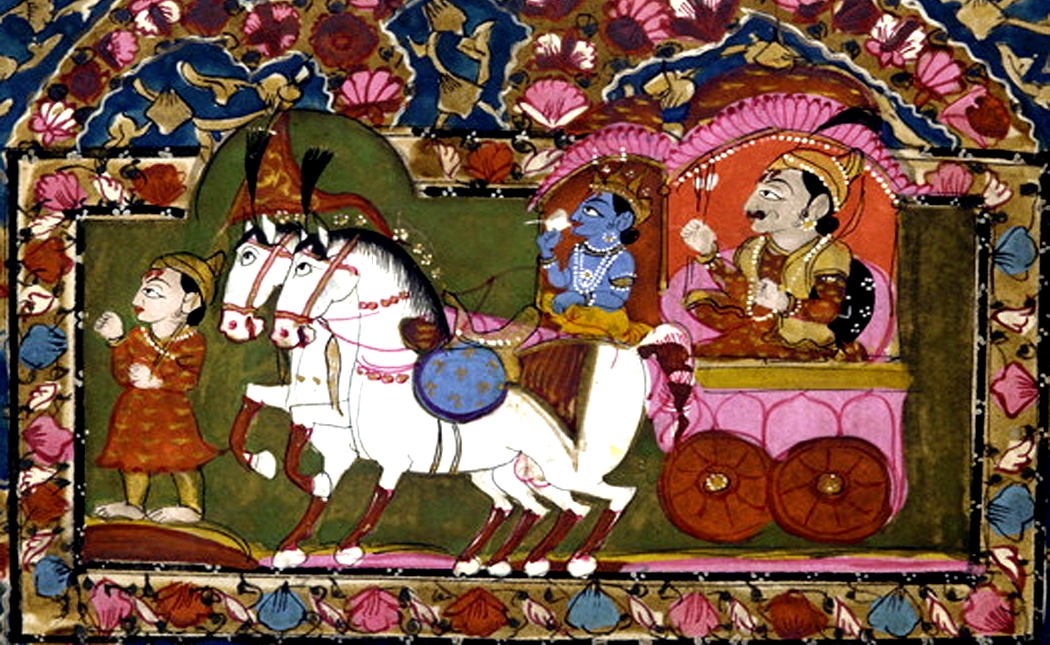
One of the most endearing qualities demonstrated by Krishna during his earthly manifestation was his willingness to relate to his devotees in multiple capacities. Even though he is the supreme deity according to the Gita and other ancient texts, he always experiences great joy in the service of his devotees. In the role of a child, he would carry the shoes of his father. Similar to Jesus washing the feet of his 12 disciples during the last supper, Krishna, with great joy, washed the feet of great saintly persons. The most prominent act of service demonstrated by Krishna was immediately after he spoke the Gita, when he drove Arjuna’s chariot, he obeyed, like a servant, every order of Arjuna.
What about the versification or rhyme and music and the original intended ideas, are they not lost in the translation? It demands great scholarship, devotion and purity of diction which is free of any artificiality. Mr. Mahathi has done a great job in this regard as he has devoted himself like a sage to the reading of scriptures. Metaphor becomes reality, reality becomes metaphor, and the most abstract concepts are anthropomorphized. The poet shifts perspective. You can feel the sound of thunder-
Whence started thin trickles of rain
To soon become a storm.
Lightnings had flashed in continuum
As thunders clapped “Om, Om”
There is a quiet grandeur of the lines. Clearly, the beauty in his work was not achieved through glossing over or minimizing difficulty, but rather through beautifully composing words that leap effortlessly from the tongue.
He’s like sapphire welkin shrouded
By silver clouds and like
An idyllic night besmeared by Moon’s
Ambrosial delight
Looking around with lotus eyes
Little Krishna oft smiled
Like a lightning bright and like a cloud
Raining, again he cried.
The gentle words wash across the reader like a satisfying ocean. I just want to sing these poems, or join in the singing, because I think they’re singing themselves already. A constantly shifting metaphoric microscope reveals exquisitely beautiful details:
The streets that once fluttered and bounced
With vernal charms now looked
Like autumn woods, graceless
And sad, to horror hooked!
At the age of innocence, he’s God-
A man: with sweet fragrance
Of love; that turns into foulness
With thickening flesh’s malevolence
It is not the beauty of the book itself, though there is something remarkably pristine about its writer, or that the words are spectacularly elegant. His poems remind us that the ways we imagine the past are intimately connected to the ways we imagine and move into the future. However alienated we might feel from our pasts, or our lives, or ourselves, we have an imaginative relationship to them, and that can change us.
I was sorry when it ended feeling abandoned and having enjoyed almost every second of our explicit spiritual experience. I breathed such a sigh of contentment upon finishing the read the first time that I couldn’t resist picking up the book for a second read. Even if you do not normally read poetry, this book is one that is worth settling into a comfy chair to take in. For words of love and faith, I recommend reading. Looking and sounding like a traditional volume; conforming to time-honored conventions of line, length, and layout, it’s a firmly classical work.
Hare Krishna is available at:
https://www.amazon.com/Hare-Krishna-Mahathi-ebook/dp/B071VDC76Y
https://itunes.apple.com/us/book/hare-krishna/id1220419132?ls=1&mt=11
https://www.barnesandnoble.com/w/hare-krishna-mahathi/1126058529?ean=2940157362904
https://www.overdrive.com/media/3232132/hare-krishna
https://www.kobo.com/us/en/ebook/hare-krishna-1
https://play.google.com/store/books/details/Mahathi_Hare_Krishna?id=AEiIDgAAQBAJ
https://www.ebooks2go.com/Hare%20Krishna
Sandeep Kumar Mishra is an International freelance writer, and a lecturer in English with a Master’s in English Literature and Political Science. He has edited a collection of poems by various poets, Pearls (2002), written a professional guidebook How To Be (2016), and a collection of poems and art Feel My Heart (2016).His blog: https://sandeepkumarmishra5574.blogspot.in/

















This is a wonderful article, thank you. I love the stories of Krishna and Arjuna; there is so much wisdom in them. I love that sublime moment when the evil Duryodhana thinks he has Krishna alone and thinks to kill him, and Krishna replies: “Ah! thou of little understanding, is it thy desire to take me captive? Know now that I am not alone here, for all the gods and holy beings are with me.” What appears to be the case, proves to be another, which is the real dilemma of the modern world and its failure to see: all the holy beings.
Thank you very much Sri Sandip Kumar Mishra ji for this wonderfully analysed review on HARE KRISHNA.
Hare Krishna is available at:
https://www.amazon.com/Hare-Krishna-Mahathi-ebook/dp/B071VDC76Y
https://itunes.apple.com/us/book/hare-krishna/id1220419132?ls=1&mt=11
http://www.barnesandnoble.com/w/hare-krishna-mahathi/1126058529?ean=2940157362904
https://www.overdrive.com/media/3232132/hare-krishna
https://www.kobo.com/us/en/ebook/hare-krishna-1
https://play.google.com/store/books/details/Mahathi_Hare_Krishna?id=AEiIDgAAQBAJ
http://www.ebooks2go.com/Hare%20Krishna
Very Nice Review
Amazing and very true Review,Thank you Sandeep
Occasionally one finds, when looking for a metaphor to describe one’s reality, one has the choice to use any figures from all time that one is aware of. In the following tennos, Krishna is obviously invoked.
A Wise One in the Skies above the State of Washington
by Ubs Reece Idwal
O my, the sky is dark and filled with my complexion—clouds.
O my, I am as You are—blue—rain falling on my shrouds.
East, south, west, north, o, everywhere, such varied shapes appear,
a conch, a lotus blossom, mace, and discus, here and there.
I pace across the Earth’s space and see the rising of the Sun,
o, golden, solar fire, nuclear, ignited One.
The transcendentalists who know the Absolute observe
illusory is all of this which flees Earth’s turning curve.
Omniscience overall, o, energy and speeding light,
I see before my eyes the splendour of your strength and might.
An excellent review by Sri Sandip Kumar Mishra ji.
Please find another review of the same book here:
https://ldabydeen.wordpress.com/2017/07/26/book-review-hare-krishna/