


.
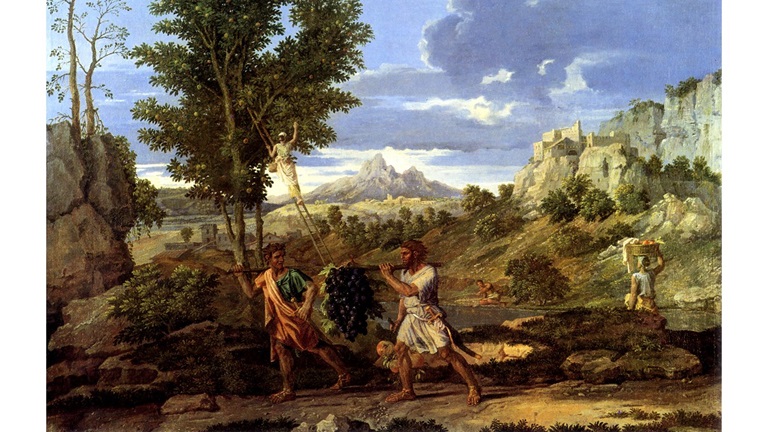
Caleb in Canaan
Green fields, walled towns, strong foes, but we are fit
To overcome. Forward, I say. It’s ours.
These forty days of foraging have fed
Twelve spies good fare and knowledge requisite.
Let no one claim this promised land devours
Its dwellers. Milk and honey flow. Widespread
We find pomegranates, figs, and grapes so great
Two men must bear a single cluster’s weight.
Our tribes? The self-cursed cowards wish they’d died
In meaty Egypt or dry wilderness,
Forever murmuring against the leaders
God appointed. Rebelliously they tried
To stone us, but His blazing holiness
Allowed them life when Moses interceded.
They’ll wander quarrelsome and never see
Canaan reserved for Joshua and me.
We’ll guide their children here—in forty years.
The young need training in war’s discipline,
And I seek patience to fulfill God’s plan
Outside the scope of my desired frontiers.
My strength will wither, and my spirits thin.
Why vanquish all my vigor as a man
In desert errantry traversing waste—
Sustained by manna’s paradise-like taste?
The Lord our God, the Lord is one. I saw
Him challenging sin’s pleasures with ten plagues.
The Exodus was our audacious charge!
He split the sea, and thundered forth the Law,
Inspired the march of these undaunted legs
Past demon-haunted territories large,
And I was chosen prince of Judah’s line,
The clan that boasts a lion as our sign.
Through nations sunk insensibly in error,
We’ll battle for a chastened space of time
Unparalleled in opportunity.
From us may rise a sovereign star that’s fairer
Than any ever seen, and more sublime,
Directing purposeful ferocity.
We may deserve to fight beneath the sun
Unset. The Lord our God, the Lord is one.
.
.
Margaret Coats lives in California. She holds a Ph.D. in English and American Literature and Language from Harvard University. She has retired from a career of teaching literature, languages, and writing that included considerable wrk in homeschooling for her own family and others.
















A not over-celebrated hero of the OT, so good to see him here. The last line – coming almost as a refrain from the fourth stanza – is particularly fine in this context, and the rhyme clinches it. Well done, very fine.
Caleb is always in the shadow of Joshua, but he has his own place among the “great and famous men” of Ecclesiasticus 46. That “refrain” solidifying the two final stanzas is a profession of faith in response to the dismay and self-doubt of the central stanza, where Caleb must make sense of knowing that he will have 40 years of wandering before entering the promised land. Thanks, James, for recognizing the motivational map of this young leader!
Margaret, you have chosen one of my favorite Old Testament stories and with sublime poetry provided a passionate portrayal of what was at stake for the Israelites and pointed the way toward the coming of the Lord. Caleb and Phineas, the two spies sent by Joshua to Jericho were sheltered and protected by the prostitute, Rahab, who placed them on her roof and covered them with flax. Rahab turned the authorities searching for them away in exchange for being saved when they invaded the land, for she had heard about their feats in their escape from Egypt. They told her to display a red cloth from her window which was on the wall. I still remember the picture in my children’s book of her covering the spies. Adding pomegranates and figs as you so beautifully put it, the spies reported back with that the land “flowed with milk and honey.” You have greatly enhanced my imagery with wonderful words and vivid portrayals. Bless you for this outstanding poem.
Roy, I had to think of you as an intelligence gatherer when writing this poem. I’m not surprised it’s one of your favorite stories. You outline a later appearance of spies in the incident involving Rahab. Almost 40 years later, in fact, as it occurred after the Israelites had done their wandering. The older generation had died off, except for Joshua and Caleb, and the younger was finally about to enter the promised land. As you say, two spies had been sent to Jericho before its amazing fall. The former prostitute Rahab and her family joined the Israelites, as they had come to believe in the only true God, and helped His people. I wonder if you have a study Bible giving the names of those two spies, as they are not named in the text as far as I can see. I would be surprised if the same Caleb were one of them, as he would be in his 60s by that time. He was right, certainly, that the 40 intervening years had been a time “unparalleled in opportunity” to prepare a faithful and obedient people cooperating with Joshua as their new commander. I had some thoughts of our new national administration as I was writing this. There is so much to accomplish in the country that it may take longer than we might hope. Thanks for your appreciation of this poem about the comparable situation of Israel arriving in Canaan.
Margaret, thanks for this well-crafted poem. I like the way you incorporate the phrase “The Lord our God, the Lord is one” into this piece: it being, of course, the focal point of the most sacred prayer in Judaism, the Sh’ma.
.”
Thank you, David! Thinking of Caleb as a young man who had recently experienced the giving of the Sh’ma and the divine command to repeat it, I could do no better than repeat it in the poem to show a spirit of determined obedience. Overall, the man is a forthright example of intelligent, muscular Judaism.
Agreed.
Thanks so much for this, Margaret. Between the Advent/Christmas scriptures and personal reading (“Reading Genesis” by Marilynne Robinson), I’ve been happily steeped in the Old Testament, and particularly love this story–especially their report of “giants” when they’re being debriefed by Moses. Like Mr. Whippman, I loved your incorporation of the Sh’ma into the poem. It’s particularly effective in a piece of so many well-considered and lavish details to suddenly slam into the idea of “One”. Only “One”. Marvelous. A very blessed New Year to you and I’ll look forward to reading more of–and learning more from–your work in the coming year. God bless. Jeffrey
And I look forward to yours, Jeffrey, in this year of blessings to come. Those other ten spies had seen the same things as Caleb and Joshua, but without a spirit of faith and right practice, they interpreted “strong foes” whom God could help them to overcome, as terrifying giants they feared to meet. Thus they lost all sight of the land’s beauty and goodness, and indeed lost the very land that had belonged to ancestors and was promised to them. The One is the one thing necessary.
Incredible poem on an important topic. I’ve often wondered if I would have sided with Joshua and Caleb or the other ten had I been sent on this mission. These were supposed to be the best-of-the-best from each tribe. They had just witnessed amazing miracles. Despite that, only two of them got it right since it is very difficult to believe God can/will do what doesn’t make sense through human eyes. That’s a lesson you have very capably reminded me of.
Thanks so much for your comment, Warren! I’ve been traveling happily, but regret not being able to acknowledge your kindness and your perception sooner. You’ve seen the lesson of Bible history. Scripture has something to say on most topics, and for this narrative, it seems to me “unparalleled opportunity” when men are willing to let God lead. This was particularly difficult for the right-thinking Caleb when most of his people refused to do so. But he went ahead and made the best of an opportunity that might have been greater had others displayed his fortitude.
I really like how the abcabcdd rhyme scheme works in this poem, especially given the weighty topic. The rhymes are far enough removed that I thought I was reading blank verse for the first stanza, but there was an underlying musicality that suddenly bubbled to the surface. I think a more standard abab would have been too boyish. Delaying the rhyme also delays the reader’s sense of closure, so Caleb’s thoughts come across as being mature and well-considered rather than swashbuckling and pulpit-thumping.
Also, I love the final line. “Sun / unset” gives extra emphasis to “unset” and changes how the reader views the final repetition of the shema.
Thanks, Rachel, for your thoughtful response. Sorry my present travel and other concerns have so much delayed my reply in return. I am glad the chosen form helps formulate the psyche of the speaker. He needs to be contemplative in order to support the visions of the future he has in the final stanza. The “sun/Unset” refers to the battle (forty years hence!) when Joshua successfully begs God to stop the sun in its course (as seen on earth) so that Israel may thoroughly defeat its enemies. This causes the longest day ever known, which is, however, less significant than the rising of the “star from Jacob” [Israel] also foreseen by Caleb. That prophecy by Balaam was made in the book of Numbers, and thus both events were part of Caleb’s own earthly future, from the point of view taken in the poem. He is capable of seeing 40 years wandering in the desert as a time of “unparalleled opportunity.” Very rare indeed for a human being! It requires complete faith in the one Lord who is our God. You rightly link it to the repetition of the shema. Thanks for your attention!
Margaret, this is a fascinating dramatic monologue in the voice of a biblical figure who generally yields the spotlight to Joshua but whose lineage is exceedingly important to subsequent history. I like the structure of your poem – a rhyme scheme which is suited to a narrative, essentially iambic though with variations (e.g., line 7 begins with an anapest.)
You present Caleb at a point in time and geography where the Children of Israel are on the cusp of claiming God’s Promised Land only to back away when fear and cynicism overwhelm their faith. Your poem gives Caleb some prophetic gifts and insights which might well see him past the natural frustration he might feel and help sustain him through another forty years of wandering in the desert. In fact, he is rather optimistically capable of looking on the bright side. He is a man of faith who takes seriously those words so sacred to Judaism: “Hear O Israel, the Lord our God, the Lord is One.” These are words countless Jews have died for rather than repudiate and they represent the very essence of the Jewish faith. Although they have been recited as the final words of Jewish martyrs (Rabbi Akiva in A.D. 135 is a famous example) it is a good thing to also remember that the words of the Shema are words of life, joy and promise. Your poem does a lovely thing by repeating this phrase both when looking back at what God has done and, in the next stanza, looking forward to what God will do.
When we get to that last stanza, your poem is particularly adept in the way it discusses “a sovereign star” for you do so in a way which may be considered pleasing to both Jews and Christians. Christians, of course, will read Christ into that mention of the star. But any knowledgeable Jewish reader would recognize Isaiah’s prophecy in Isaiah 40 of a sovereign who created the stars, who will rule like a shepherd.
There is real hope here even if this biblical plot-twist forces Israel into a detour. Well done, Margaret.
Thank you, Brian, and my apologies for such late response to this comment on which you spent attention and effort. Caleb is an historical figure of great significance, as one of only two adults (at the moment of the poem) who eventually enter the Promised Land. Even Moses will only see it from afar. Caleb can only show great faith and positive perseverance. Here I’ve added his moment of what you correctly say is natural frustration–that he will necessarily wander with the timid populace of weak faith and little confidence in God. To spur him on, I’ve added as well a practical recognition that the wandering can be useful–and some visionary gifts about his own lifetime (see the explanation to Rachel Lott above). I didn’t intend a reference to Isaiah farther in the future, but that is a legitimate view of readers such as yourself and Jews reflecting (as probably Isaiah does) on the Balaam prophecy.
I do hope that we can recognize ourselves, too, in the history here represented. We approach a time to claim good fruits of a recent victory, or triumphant exodus, from a misdirected past. Yet the way ahead is very, very far from easy. Practical perseverance and continued confidence in God are necessary. Only so will we too avoid an unwelcome lengthy detour. Thanks for your comprehension.
Engrossing reading, Margaret. I too admire the rhyme scheme: the use of a rhymed couplet to tie of each stanza is very effective. To me the most striking line is “Directing purposeful ferocity.” I’ve always thought of the Divine Mercy as also the toughest in the great line of Jewish prophets.
Thanks, Julian. When we consider that life on earth is warfare (according to Job) and heed Saint Paul’s allegory of the different kinds of spiritual armor, it’s clear that ferocity of a purposeful kind is required. I had not thought of it, but very much appreciate your recognizing the Divine Mercy as the toughest of prophecies (the foregoing prophets themselves exercising exemplary courage and fortitude). Caleb seems to be a prophet in deeds rather than words, as he overcomes immediate disappointment to brave out the long delay in his hopes. I’ve tried to present him not as waiting, but rather intent on doing, as lives out God’s way for himself and others.
Margaret, I appreciated this poem as I was not as familiar with this part of the Old Testament as I should have been. It piqued my interest and drew me in to want to read more of it. Your choice of topics is always so fascinating.
Thank you, Laura! I appreciate your commenting right away, although you know I’m necessarily delayed in acknowledging you. I do try to choose topics of unexpected interest, and to make sure I ponder them enough to make my words worthwhile to my readers. You and the others are truly valued.
Margaret. what a handsome poem this is, a powerful monologue with a real masculine thrust, underscoring the bravery of Joshua and Caleb in their dangerous travels. Such clear and striking images!
A perfect match of language and subject matter. This poem should move and excite anyone fortunate enough to read it.
Thank you so much, Tom. I’m glad to have your well-practiced reading assure me of the clarity and power here. I hope the choice of subject for this period of time, in which we begin national life on a new path, will serve as a warning that all is neither as easy nor as hard as some try to make it. Bravery and a masculine thrust are needed to overcome difficulties and claim promises, with faith in the Lord ever undergirding the process.