


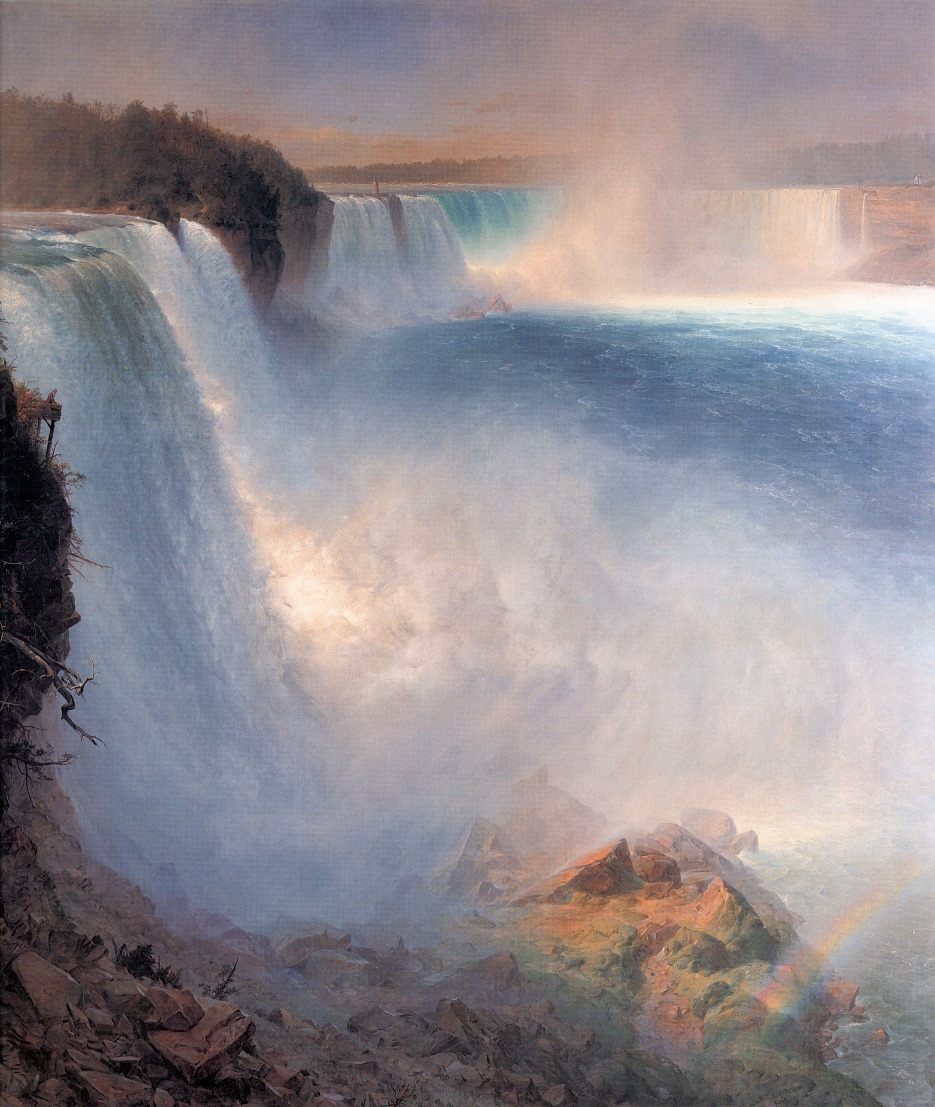
In Niagara by Frederick Edwin Church,
immediately one’s taken in to the great
falls. From a remarkably precarious perch,
one’s seized by the enormity of the landscape.
One sees at once the powerful and driving force
of the water rushing forth to accelerate
downward and over the inevitable course
one anticipates. The green and white waters splash
beneath a blue sky with pink clouds. The water pours.
One knows it roars. One can see it all in a flash
as it hurtles headlong, the vastness of its urge
and its necessary and crescendoing verge.
Bruce Dale Wise is a poet living in Washington State
Featured Image: “Niagara” by Frederick Edwin Church
















At this present time, 2026, I’m not really sure how to catalog this poem. Frederick Church (1826-1900) was the American Realist painter whose work I was absorbing. It seemed a challenge to put into words such a dramatic painting. In the first quarter of the 21st century I went through an ekphrastic period, and this is just one of perhaps countless examples. I am surprised at the firm melding of anglo-saxon and latinate diction in this small piece.
First off, it is twelve lines, anchored by the word “one/one’s”; but it is not secure. I’m not sure if I was in the syllabic or metric realm at the time. The movement is downward—enormously and inevitably. S1 (Sentence 1) ends in falls. S2 ends at the quatrain. S3 rolls on to L8, S4 to L9, and S5 ends L9. There is an internal rhyme @L5 & L6, “The water pours”/“One knows it roars.”. S7 ends the poem with a rhymed couplet, echoing the opening focused rhyme. The rhyme scheme seems strange to me: abacdbedeaa.
L1 identifies the topic: the painting and the painter. It moved me and I went along with it. The reason I enjoy this combination of language is because it is so well integrated, and nothing seems extraneous or foreign.