• Submit Poetry
  • Support SCP
  • About Us
  • Members
  • Join
Friday, May 15, 2026
Society of Classical Poets
  • Poems
    • Beauty
    • Culture
    • Satire
    • Humor
    • Children’s
    • Art
    • Ekphrastic
    • Epic
    • Epigrams and Proverbs
    • Human Rights in China
    • Music
    • Performing Arts
    • Riddles
    • Science
    • Song Lyrics
    • The Environment
    • The Raven
    • Found Poems
    • High School Poets
    • Terrorism
    • Covid-19
  • Poetry Forms
    • Sonnet
    • Haiku
    • Limerick
    • Villanelle
    • Rondeau
    • Pantoum
    • Sestina
    • Triolet
    • Acrostic
    • Alexandroid
    • Alliterative
    • Blank Verse
    • Chant Royal
    • Clerihew
    • Rhupunt
    • Rondeau Redoublé
    • Rondel
    • Rubaiyat
    • Sapphic Verse
    • Shape Poems
    • Terza Rima
  • Great Poets
    • Geoffrey Chaucer
    • Emily Dickinson
    • Homer
    • Henry Wadsworth Longfellow
    • Dante Alighieri
    • John Keats
    • John Milton
    • Edgar Allan Poe
    • William Shakespeare
    • William Wordsworth
    • William Blake
    • Robert Frost
  • Love Poems
  • Contests
  • SCP Academy
    • Educational
    • Teaching Classical Poetry—A Guide for Educators
    • Poetry Forms
    • The SCP Journal
    • Books
No Result
View All Result
Society of Classical Poets
  • Poems
    • Beauty
    • Culture
    • Satire
    • Humor
    • Children’s
    • Art
    • Ekphrastic
    • Epic
    • Epigrams and Proverbs
    • Human Rights in China
    • Music
    • Performing Arts
    • Riddles
    • Science
    • Song Lyrics
    • The Environment
    • The Raven
    • Found Poems
    • High School Poets
    • Terrorism
    • Covid-19
  • Poetry Forms
    • Sonnet
    • Haiku
    • Limerick
    • Villanelle
    • Rondeau
    • Pantoum
    • Sestina
    • Triolet
    • Acrostic
    • Alexandroid
    • Alliterative
    • Blank Verse
    • Chant Royal
    • Clerihew
    • Rhupunt
    • Rondeau Redoublé
    • Rondel
    • Rubaiyat
    • Sapphic Verse
    • Shape Poems
    • Terza Rima
  • Great Poets
    • Geoffrey Chaucer
    • Emily Dickinson
    • Homer
    • Henry Wadsworth Longfellow
    • Dante Alighieri
    • John Keats
    • John Milton
    • Edgar Allan Poe
    • William Shakespeare
    • William Wordsworth
    • William Blake
    • Robert Frost
  • Love Poems
  • Contests
  • SCP Academy
    • Educational
    • Teaching Classical Poetry—A Guide for Educators
    • Poetry Forms
    • The SCP Journal
    • Books
No Result
View All Result
Society of Classical Poets
No Result
View All Result
Home Poetry

‘Diocletian’s Horse’ and Other Poetry by Duane Caylor

November 21, 2025
in Poetry, Beauty, Culture
A A
10
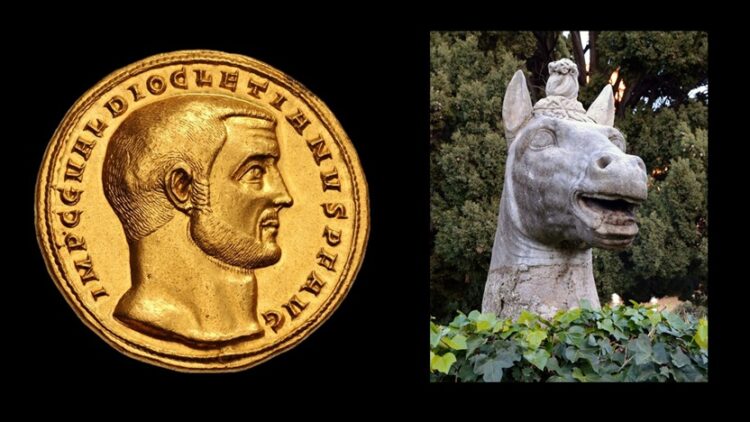
ancient coin of Emperor Diocletian, horse head in Baths of Diocletian (public domain)

ancient coin of Emperor Diocletian, horse head in Baths of Diocletian (public domain)

Diocletian’s Horse

“Save it for your horse.”
—Oedipus Tex, P.D.Q. Bach (Peter Schickele)

While Diocletian owned the home
Octavian built (although he ruled
from Asia Minor, don’t be fooled,
He was the emperor of Rome),

ambition and a lack of sense
brought some in Egypt to rebel
against his title. To compel
obedience through recompense,

the purple soldier took the field,
trapping insurgents in their nest
at Alexandria. Then, lest
the city fail to promptly yield

the new Augustus made decree
that all within its walls would pay
for obstinate lèse-majesté
until blood reached his horse’s knee.

But when he finally took the city,
the emperor’s stallion slipped in gore
and took a knee like to implore
the heavens for a drop of pity.

After the steed regained its feet,
the dominus dismounted and
discovered that a crimson band
acquired from the bloody street

had stained the carpals of his horse.
Though Diocletian was no sage,
this was an omen to assuage
and turn his anger to remorse.

The Alexandrian account
by grace was cleared of all arrears,
and avenues were filled with tears
enough to wash the tetrarch’s mount.

The emperor was prayed divine
By fathers and by hoi polloi,
but knowing their true source of joy,
They raised a bronze to his equine.


Memorial Service

The narrow windows squeeze December light
so tightly that it faints onto the floor
and soaks into the carpet’s velvet night
that stretches darkly out the room’s lone door.

The interest on her principal has grown
to be three generations now. They come
with other relatives and friends to own
life’s debt through funerary symbolum.

After the crowd and cousins have been seated,
the undertaker leads the closest kin
into the room as if they were defeated
Goths in a Roman triumph to begin

her last solemnity. The hymns, the prayer,
the homily assert the ancient creed
that Christ has vanquished death, yet where the air
is stale with mums, flesh wishes to proceed

from hope to sight, faith’s final resolution,
in finding sacrament to signify
that life will triumph over sin’s pollution
and bodies live again, although they die.

We ponder what we seem to be without.
Then in the back, a grandchild starts to sing
a nursery song that so dispels our doubt
we know that winter will concede to spring.


Duane Caylor is a physician in Dubuque, IA.  His poetry has appeared in a number of journals, including First Things, Measure, Slant, and Blue Unicorn.

ShareTweetPin
The Society of Classical Poets does not endorse any views expressed in individual poems or commentary.
Read Our Comments Policy Here

RandomPoems

Metrical Clerihew Poetry Challenge
Culture

‘Circling In’: A Poem in Terza Rima by Jeffrey Essmann

September 2, 2024

. Circling In It’s time (I tell myself) we circled in;Gave up at last the overwrought concernThat pulls us this-way-that...

Interview with Unofficial Trump Inaugural Poet Joseph Charles MacKenzie
Deconstructing Communism

Interview with Unofficial Trump Inaugural Poet Joseph Charles MacKenzie

March 5, 2017

By Evan Mantyk One week in mid-January this year, in the relatively obscure world of poetry, Joseph Charles MacKenzie’s “Pibroch for...

Next Post
poem/annunciation/Christmas

'Just Do It." and Other Poetry by Peter Venable

‘The Last Caesar’: A Poem by Mary Jane Myers

'The Last Caesar': A Poem by Mary Jane Myers

‘The Bamboozlers of Belém’: A Poem on COP30, by Susan Jarvis Bryant

'The Bamboozlers of Belém': A Poem on COP30, by Susan Jarvis Bryant

Comments 10

  1. Roy Eugene Peterson says:
    6 months ago

    Duane, these are two excellently written poems that compel the reader from the very beginning to move from verse to verse. Both poems gave me a feeling as though I were there. The second one has such a wonderfully enchanting conclusion.

    Reply
    • Duane Caylor says:
      2 months ago

      Thank you for your encouragement. I really appreciate it.

      Reply
    • Duane Caylor says:
      2 months ago

      Thank you for your positive review. I’m gratified that you liked the poems.

      Reply
  2. jd says:
    6 months ago

    Enjoyed both poems very much. I especially love the first two lines
    of “Memorial Service” but both poems leave much to admire. We are
    blessed that as a Physician you still find time to write poetry.

    Reply
  3. Adam Sedia says:
    6 months ago

    Both of these are excellent. I was excited to read “Diocletian’s Horse,” it is a tale I’ve heard and one I think is meant for verse. You’ve done a masterful job with it: your meter flows, your rhyme is fresh (e.g. pay – majesté), and you make the story flow without growing long-winded (a real risk in narrative poetry). You do the story justice. Bravo!

    “Memorial Service” is quite different. Here you paint a scene (with some wonderful turns of phrase in the first stanza), and spring the theme of the poem on us in the very end with the subtle, almost incidental mention of the child’s song — exactly as the realization would occur to an observer. You place the reader both in the scene and in the realization the poem reaches.

    Reply
  4. Joseph S. Salemi says:
    6 months ago

    These are two interesting and unusual poems.

    The Diocletian piece (tetrameter ABBA quatrains) retells the story of the emperor’s horse at Alexandria. The tale itself might be apocryphal, but it makes for a nice exemplum of imperial mercy to the enemy, even if prompted only by an accidental slip of a horse’s leg. In the photo of the Roman aureus that accompanies this poem, the last part of the coin’s inscription is PFAUG, standing for PIUS FELIX AUGUSTUS (“devoted, fortunate, and deeply honored”). This was s standard description of every emperor, but here within the context of the poem I feel that it suits Diocletian. He certainly could be extremely cruel and murderous, but in this particular case he was “PIUS” — aware of and devoted to his responsibilities, and of his duty as a Roman to be merciful to the conquered.

    “Memorial Service” is a poem of personal experience, describing the speaker’s feelings and perceptions at a service for a dead relative. In the first three quatrains there is a very careful painting of the scene and surroundings, and the gathering of family members. But in the last three quatrains we are hit with doubts, questions, and a final answer. Those present are showing their respect with solemnity and prayers, and they hear the Christian promise of resurrection. Yet they are hesitant and uncertain, until they hear the voice of a singing grandchild. The poem thus ends with a conflation of the doctrine of resurrection with the audible evidence of a new generation.

    Reply
    • Duane Caylor says:
      2 months ago

      Thank you for your thoughtful comments. My assumption is that the story of Diocletian’s horse is legendary, though I do not know for certain. I no longer remember where I read it.

      Reply
  5. Margaret Coats says:
    6 months ago

    The colloquial language of “Diocletian’s Horse” gives the poem a comic touch. That reflects the humor in the incident as told–and the relief of bystanders who witnessed it. You write as if one among them. The poem memorializes the tale and the equine not in bronze but as an easy-to-read truism on not taking matters too seriously.

    The necessary formalities of “Memorial Service,” including the full and open reminders of Christian belief and practice concerning death, combine with the disorientation of those attending, to show, very simply, the reality of human grief. Doing everything one is supposed to do, and acknowledging everything one believes, cannot do away with grief. The grandchild’s song breaks in, I would say, as a welcome distraction, as well as a reminder that life goes on, and a vivid confirmation of serious thoughts the adults present have just passed through. More profound than it may look, Duane. Well done.

    Reply
    • Duane Caylor says:
      2 months ago

      Thank you for your very kind words.

      Reply
  6. Duane Caylor says:
    2 months ago

    Thank you for taking the time to comment on my work. I appreciate the positive feedback.

    Reply

Leave a Reply Cancel reply

Your email address will not be published. Required fields are marked *

  1. Paul Freeman on ‘To May, the Prince of Months’ by Eustache Deschamps, Translated by Margaret CoatsMay 14, 2026

    I particularly enjoyed the references to the old and sick being rejuvenated/resuscitated by May after the rigours of winter. To…

  2. Maria on ‘To May, the Prince of Months’ by Eustache Deschamps, Translated by Margaret CoatsMay 14, 2026

    Dear Margaret this is a beautiful poem that captures the essence of the month of May. In is such a…

  3. Cynthia L Erlandson on ‘To May, the Prince of Months’ by Eustache Deschamps, Translated by Margaret CoatsMay 14, 2026

    So beautiful! I was enjoying all of your wonderful slant rhymes for “nature”, and then saw that those in the…

  4. Joseph S. Salemi on ‘To May, the Prince of Months’ by Eustache Deschamps, Translated by Margaret CoatsMay 14, 2026

    A very nice rendering of Eustache, and one that must have taken a great deal of work to maintain the…

  5. Roy Eugene Peterson on ‘To May, the Prince of Months’ by Eustache Deschamps, Translated by Margaret CoatsMay 14, 2026

    Margaret, your translation talents are amazing. Your manipulation of each line is masterful to achieve such effective rhymes in English…

Subscribe to Daily Poems

Enter your email address to subscribe to this blog and receive notifications of new posts by email.

Join 1,593 other subscribers

Recent Poems

  • ‘To May, the Prince of Months’ by Eustache Deschamps, Translated by Margaret Coats
  • Winners of Friends of Falun Gong 2026 Poetry Competition Announced
  • A Poem on Coach “Black Mike” Castronis from Athens Y Camp, by Alec Ream
  • A Poem on the Zambian National Park Mosi-oa-Tunya, by Paul A. Freeman
  • ‘Creation of Mom’: A Mother’s Day Poem by Roy E. Peterson
  • ‘Spontaneous Conjugal Combustion’ and Other Poems by Susan Jarvis Bryant
  • ‘The Man in the Moon Was a Very Round Man’: A Poem by Lauren V. Leon
  • ‘Fibromytrauma’: A Poem by Golan Shahar
  • ‘A Lonely Sliver’: A Poem by Katie Tencza
  • ‘Higher Gas Prices Are a Small Price to Pay’: An Iran War Poem by Mark F. Stone
  • ‘Always Ahead’: A Poem by Scharlie Meeuws
  • ‘Hamlet’s Lawyer’ and Other Poetry by Brian Yapko
  • ‘On An Old Photograph’: A Poem by Joseph S. Salemi
  • ‘Faust Foresees His End’: A Poem by Martin Briggs
  • ‘À la Carte’ and Other Poetry by C.B. Anderson
  • ‘Where the Sweet Bluebonnets Bloom’: A Poem by Roy E. Peterson
  • ‘The Waters’: A Poem by Margaret Brinton
  • ‘The Pinnacle of Poetry’ and Other Poems by Russel Winick
  • The First American Sonnets: An Essay on David Humphreys, by Margaret Coats
  • ‘The Holy Rollers on Poetry’: A Poem by Joseph S. Salemi
  • Sappho’s ‘Poem 1’ Translated by Bruce Phenix
  • ‘The Cautionary Tale of Phone Addicted Mimi’: A Poem by Paul A. Freeman
  • ‘Look Away’: A Poem for America’s 250th Anniversary, by Roger Crane
  • ‘Sunday Morning in Canada’: A Poem by Jeffrey Essmann
  • ‘Bean’: A Poem by Jan Mennite
  • ‘The Swan’s Song ’: A Poem for Shakespeare’s Birthday, by Susan Jarvis Bryant
  • ‘The Gravedigger’: A Poem by Marie Burdett
  • ‘Waiting for the Perfect Man’: A Poem by Janice Canerdy
  • ‘The George-A-Saurus’ and Other Poetry by Brian Yapko
  • ‘When Asked: What’s Your Favorite Season?’: A Poem by Paul Millan  

Categories

  • Acrostic
  • Alexandroid
  • Alliterative
  • Art
  • Best Poems
  • Blank Verse
  • Chant Royal
  • Classical Poets Live
  • Clerihew
  • Covid-19
  • Deconstructing Communism
  • Educational
  • Epic
  • Epigrams and Proverbs
  • Essays
    • Interviews with Poets
    • Poetry Reviews
  • Featured
  • From the Society
  • Great Poets
    • Dante Alighieri
    • Edgar Allan Poe
    • Emily Dickinson
    • Geoffrey Chaucer
    • Henry Wadsworth Longfellow
    • Homer
    • John Keats
    • John Milton
    • Robert Frost
    • William Blake
    • William Shakespeare
    • William Wordsworth
  • Human Rights in China
  • Limerick
  • Love Poems
  • Music
  • Pantoum
  • Performing Arts
  • Poetry
    • Beauty
    • Children's Poems
    • Culture
    • Ekphrastic
    • Found Poems
    • High School Poets
    • Humor
    • Riddles
  • Poetry Challenge
  • Poetry Contests
  • Poetry Forms
    • Curtal Sonnet
    • Haiku
  • Poetry Readings
  • Rhupunt
  • Rondeau
  • Rondeau Redoublé
  • Rondel
  • Rubaiyat
  • Sapphic Verse
  • Satire
  • Science
  • Sestina
  • Shape Poems
  • Short Stories
  • Song Lyrics
  • Sonnet
  • Symposium
  • Terrorism
  • Terza Rima
  • The Environment
  • Translation
  • Triolet
  • Video
  • Villanelle

Quick Links

  • About Us
  • Submit Poetry
  • Become a Member
  • Members List
  • Support the Society
  • Advertisement Placement
  • Comments Policy
  • Terms of Use

Welcome Back!

Login to your account below

Forgotten Password?

Retrieve your password

Please enter your username or email address to reset your password.

Log In
No Result
View All Result
  • Poems
    • Beauty
    • Culture
    • Satire
    • Humor
    • Children’s
    • Art
    • Ekphrastic
    • Epic
    • Epigrams and Proverbs
    • Human Rights in China
    • Music
    • Performing Arts
    • Riddles
    • Science
    • Song Lyrics
    • The Environment
    • The Raven
    • Found Poems
    • High School Poets
    • Terrorism
    • Covid-19
  • Poetry Forms
    • Sonnet
    • Haiku
    • Limerick
    • Villanelle
    • Rondeau
    • Pantoum
    • Sestina
    • Triolet
    • Acrostic
    • Alexandroid
    • Alliterative
    • Blank Verse
    • Chant Royal
    • Clerihew
    • Rhupunt
    • Rondeau Redoublé
    • Rondel
    • Rubaiyat
    • Sapphic Verse
    • Shape Poems
    • Terza Rima
  • Great Poets
    • Geoffrey Chaucer
    • Emily Dickinson
    • Homer
    • Henry Wadsworth Longfellow
    • Dante Alighieri
    • John Keats
    • John Milton
    • Edgar Allan Poe
    • William Shakespeare
    • William Wordsworth
    • William Blake
    • Robert Frost
  • Love Poems
  • Contests
  • SCP Academy
    • Educational
    • Teaching Classical Poetry—A Guide for Educators
    • Poetry Forms
    • The SCP Journal
    • Books

© 2025 SCP. WebDesign by CODEC Prime.