• Submit Poetry
  • Support SCP
  • About Us
  • Members
  • Join
Saturday, July 18, 2026
Society of Classical Poets
  • Poems
    • Beauty
    • Culture
    • Satire
    • Humor
    • Children’s
    • Art
    • Ekphrastic
    • Epic
    • Epigrams and Proverbs
    • Human Rights in China
    • Music
    • Performing Arts
    • Riddles
    • Science
    • Song Lyrics
    • The Environment
    • The Raven
    • Found Poems
    • High School Poets
    • Terrorism
    • Covid-19
  • Poetry Forms
    • Sonnet
    • Haiku
    • Limerick
    • Villanelle
    • Rondeau
    • Pantoum
    • Sestina
    • Triolet
    • Acrostic
    • Alexandroid
    • Alliterative
    • Blank Verse
    • Chant Royal
    • Clerihew
    • Rhupunt
    • Rondeau Redoublé
    • Rondel
    • Rubaiyat
    • Sapphic Verse
    • Shape Poems
    • Terza Rima
  • Great Poets
    • Geoffrey Chaucer
    • Emily Dickinson
    • Homer
    • Henry Wadsworth Longfellow
    • Dante Alighieri
    • John Keats
    • John Milton
    • Edgar Allan Poe
    • William Shakespeare
    • William Wordsworth
    • William Blake
    • Robert Frost
  • Love Poems
  • Contests
  • SCP Academy
    • Educational
    • Teaching Classical Poetry—A Guide for Educators
    • Poetry Forms
    • The SCP Journal
    • Books
No Result
View All Result
Society of Classical Poets
  • Poems
    • Beauty
    • Culture
    • Satire
    • Humor
    • Children’s
    • Art
    • Ekphrastic
    • Epic
    • Epigrams and Proverbs
    • Human Rights in China
    • Music
    • Performing Arts
    • Riddles
    • Science
    • Song Lyrics
    • The Environment
    • The Raven
    • Found Poems
    • High School Poets
    • Terrorism
    • Covid-19
  • Poetry Forms
    • Sonnet
    • Haiku
    • Limerick
    • Villanelle
    • Rondeau
    • Pantoum
    • Sestina
    • Triolet
    • Acrostic
    • Alexandroid
    • Alliterative
    • Blank Verse
    • Chant Royal
    • Clerihew
    • Rhupunt
    • Rondeau Redoublé
    • Rondel
    • Rubaiyat
    • Sapphic Verse
    • Shape Poems
    • Terza Rima
  • Great Poets
    • Geoffrey Chaucer
    • Emily Dickinson
    • Homer
    • Henry Wadsworth Longfellow
    • Dante Alighieri
    • John Keats
    • John Milton
    • Edgar Allan Poe
    • William Shakespeare
    • William Wordsworth
    • William Blake
    • Robert Frost
  • Love Poems
  • Contests
  • SCP Academy
    • Educational
    • Teaching Classical Poetry—A Guide for Educators
    • Poetry Forms
    • The SCP Journal
    • Books
No Result
View All Result
Society of Classical Poets
No Result
View All Result
Home Poetry Culture

Don Quixote Text with PDF: Adapted for Students

March 24, 2023
in Culture, Educational, Humor, Poetry
A A
3
poetry/mantyk/don quixote

.

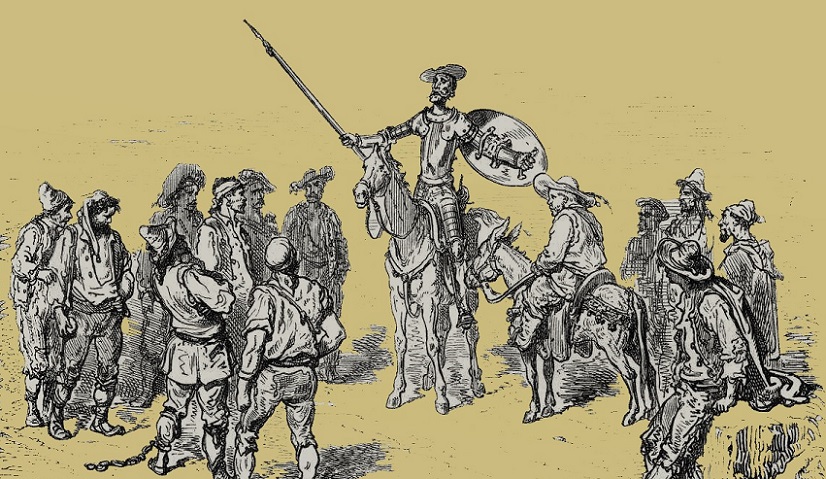
The following is an excerpt of Don Quixote by Miguel Cervantes, encompassing most of Chapters 1 through 8, including Don Quixote getting his start, acquiring his squire Sancho Panza, and going on the infamous adventure against the windmills. It is based on the 1880 translation by John Ormsby, has been updated and adapted for students today by Evan Mantyk, and features splendid illustrations by Gustave Dore.

Note that there is a brief biography of Miguel Cervantes at the end of the PDF below.

The entire PDF of the below can be downloaded here.

The Ormsby translation of the entire two volumes of Don Quixote unadapted can be found here.

If you find this resource useful for your classroom or homeschool, please consider making a donation to the Society of Classical Poets here.

.

A Brief Introduction

To be frank, my first impulsive reaction to Don Quixote is one of mild disgust. The traditional morality, or chivalry, that Cervantes parodies is what is precisely missing from our youth and unfortunately many adults today. Cervantes’ sarcasm and cynicism are instead found in over-abundance to the detriment of many. Therefore, I believe it is incumbent upon educators and homeschoolers to provide a clear understanding of the great inherent value of chivalry before exposing their students to a parody of chivalry in Don Quixote.

“How do you instill an appreciation of chivalry?” “What the heck is chivalry anyway?” are perhaps some questions people have.  I suggest a two-fold solution. First, have students read the 14th century classic Sir Gawain and the Green Knight. A complete adapted version for students is available here. Sir Gawain clearly defines and illuminates through actions the components of chivalry, particularly the five virtues that correlate to the five points of Sir Gawain’s pentangle symbol: generosity, fellowship, courtesy, chastity, and piety. To further enrich this understanding, have students also read an excerpt of the 14th century Chinese classic, Romance of the Three Kingdoms, which is about ancient warriors who demonstrate the five Confucian virtues—kindness, righteousness, courtesy, wisdom, and faith. These virtues and their expression are very similar to the five virtues found in Sir Gawain. A specially selected excerpt from Romance of the Three Kingdoms for just such a comparison can be found here.

Second, go to the bottom of the below excerpt and first read the biography of Miguel Cervantes, which shows how he was in fact a true gentleman of chivalry in his life. Once the proper context is given (implying that chivalry is essentially awesome, but of course you can’t take anything to an extreme either) then I believe that a “Let the hilarity begin!” is in order and Don Quixote can properly ride forth on a path of ridiculous madcap adventures. Enjoy!

.
Download the PDF here.

Don Quixote excerpt adapted
ShareTweetPin
The Society of Classical Poets does not endorse any views expressed in individual poems or commentary.
Read Our Comments Policy Here

RandomPoems

Three Poems for Mother’s Day
Beauty

Three Poems for Mother’s Day

May 12, 2019

Bunny by Sally Cook Indebted to a simple spark of life, You missed your chance at Europe’s wondrous door. A...

‘Dr. Quack’ and Other Poetry by Norma Pain
Culture

‘Dr. Quack’ and Other Poetry by Norma Pain

October 14, 2022

. Dr. Quack My name is Dr. Henry Quack and in my little room out back, Are lots of pills...

Next Post
poem/tweedie/knife

Pastoral Calls—Part 3 of 3: Poetry by Retired Pastor James A. Tweedie

poem/duncan/beauty

'The Glass Delusion of King Charles VI of France' by Shaun C. Duncan

poem/tryon/sping

'Promise': A Spring Poem by William Tryon

Comments 3

  1. Damian Robin says:
    3 years ago

    Thank you for the thoughtful consideration of pupils and teachers.

    Reply
  2. C.B Anderson says:
    3 years ago

    I read the book when I was in high school, and I loved it. But it’s terrible how the British mangle foreign words. Here, we would end up with something like “quick oats.”

    Reply
  3. Jettie H. van den Boom says:
    3 years ago

    1) “Don Quixote by Miguel Cervantes,” you still write, but don’t you know that
    “The original “Don Quixote” is an English book. The Spanish translations appeared in 1605 and 1615, much earlier than the original English publications in 1612 and 1620. Between these two periods, in 1614, a “false” Don Quixote was published under the name Avellaneda. The original English text was never released.

    Francis Bacon was the brain behind the three books of Don Quixote; he wrote the part of the hero.
    Ben Jonson took on the role of Sancho Panza, John Donne wrote the poems, “the two friends” Francis Beaumont and John Fletcher were assigned the task of writing loose stories. These authors made use of the library owned by Robert Cotton.
    The printer, William Stansby, inserted concealed clues into the text, in order for the reader to be able to draw conclusions…

    The Spanish translations were carried out by Thomas Shelton (DQI + DQII) and James Mabbe (the “bogus” DQ).
    Miguel de Cervantes was just a poor Spanish writer who had sold his name to survive. He had told his life-story to the English, so that it could be processed into the DQ.
    Ten people, sworn to secrecy about their collaboration in the writing of Don Quixote. Now in this book, after four hundred years, clarity is given as to the “who”, “what” and “why” of all this secrecy.”
    This you can read at the back of my in 2022 translated book ( from 2015) “the deciphering of the Don Quixote & the unmasking of Avellaneda”
    2) “It is based on the 1880 translation by John Ormsby,” you say.. but why read a translation of a translation?! English.. translated into Spanish.. and then made a translation from Spanish into English.. weird!
    3) “Note that there is a brief biography of Miguel Cervantes at the end of the PDF below.” I can join this: where did Cervantes stay between 1600 and May 1604? Answer : Het was in the Netherlands where Thomas Shelton dictated him the translation of ” The history of the valorous and wittie Knight-Errant Don-Quixote of the Mancha.”.. Rodrigo de Cervantes, his brother had died in The Battle of Nieuwpoort, 2 July 1600. That’s why he was asked to come to Brussels to take care of his brother’s affairs.

    Reply

Leave a Reply Cancel reply

Your email address will not be published. Required fields are marked *

  1. Joseph S. Salemi on National Poetry Month Limerick ChallengeJuly 18, 2026

    The music got cranked up, da capo— The audience cried “Oh please, stop, Oh! The prize-winning song Is just half-assed…

  2. Joseph S. Salemi on National Poetry Month Limerick ChallengeJuly 18, 2026

    Susan, that is very timely. He that hath ears to hear, let him hear.

  3. Susan Jarvis Bryant on ‘My Pyjamas!’ and Other Poems by Susan Jarvis BryantJuly 18, 2026

    Jan, thank you very much for your encouraging comment. I'm so glad you enjoyed the poems and especially glad they…

  4. James Sale on ‘The 51st State’: A Poem by James SaleJuly 18, 2026

    Not quite a win, Theresa, but thank you for the thought, and congratulations yourself on your "Finalist' status for your…

  5. Susan Jarvis Bryant on National Poetry Month Limerick ChallengeJuly 18, 2026

    A Slippery Victory There once was a prize for the best, Though merit was hardly the test. The winner was…

Subscribe to Daily Poems

Enter your email address to subscribe to this blog and receive notifications of new posts by email.

Join 1,594 other subscribers

Recent Poems

  • Winners and Rankings of The Great American Poetry Competition
  • ‘The Gold Star Mother’: A Poem by Gerard Maritato
  • ‘An American Dash’: A Poem by Linda Ellis
  • ‘The Anonymous Soldier’: A Poem by Lucy Lind
  • ‘For Those We Never Meet’: A Poem by Aneesh Agarwal
  • ‘Ben Franklin’s Copper Fugio Cent’: A Poem by Geoffrey Smagacz
  • Three Brief Poems by Luxorius, Translated by Joseph S. Salemi
  • ‘The American Spirit’: A Poem by Dusty Grein
  • ‘The Ballad of Zebulon Pike’: A Poem by M.D. Skeen
  • ‘We Are the Ones’ and Other Poetry by Cheryl Corey
  • ‘My Pyjamas!’ and Other Poems by Susan Jarvis Bryant
  • ‘A Snowy Egret’: A Poem by Bruce Dale Wise
  • ‘The Swearing-in of Calvin Coolidge’: A Sonnet by Robert W. Crawford
  • ‘Ballad of the Sequoia’: A Poem by Lauren V. Leon
  • ‘The 51st State’: A Poem by James Sale
  • ‘La Uva’ (The Grape): A Poem by Michael Pietrack
  • ‘There’s Blood that Flows Within the Stripes’: A Poem by Lauren V. Leon
  • ‘Birdsong’: A Poem by Jeffrey Essmann
  • ‘The Melody That Lingers On’ and Other Poetry by John McPherson
  • ‘American Dreams’: A Poem by Adam Sedia
  • ‘An American Fabius’: A Poem by John Hernandez
  • ‘Vernal Clinic’ and Other Poetry by C.B. Anderson
  • ‘Omaha Beach’ and Other Poetry by Bradford Skow
  • ‘Music to Part the Veil’: A Poem by T.M. Moore
  • ‘A Gentleman’s Guide to Losing a War’ and Other Poetry by Arnon Peterson
  • ‘Black Shuck’: A Poem by Martin Briggs
  • ‘When the Last World War II Veteran Passes Away’: A Poem by N.S. Boone
  • ‘A Fallow Year at Worthy Farm’: A Poem by Paul A. Freeman
  • ‘Outstanding in Afghanistan’: A Poem by Jared S. Chang
  • ‘250 More’: A Poem by Miguel Moreno

Categories

  • Acrostic
  • Alexandroid
  • Alliterative
  • Art
  • Best Poems
  • Blank Verse
  • Chant Royal
  • Classical Poets Live
  • Clerihew
  • Covid-19
  • Deconstructing Communism
  • Educational
  • Epic
  • Epigrams and Proverbs
  • Essays
    • Interviews with Poets
    • Poetry Reviews
  • Featured
  • From the Society
  • Great Poets
    • Dante Alighieri
    • Edgar Allan Poe
    • Emily Dickinson
    • Geoffrey Chaucer
    • Henry Wadsworth Longfellow
    • Homer
    • John Keats
    • John Milton
    • Robert Frost
    • William Blake
    • William Shakespeare
    • William Wordsworth
  • Human Rights in China
  • Limerick
  • Love Poems
  • Music
  • Pantoum
  • Performing Arts
  • Poetry
    • Beauty
    • Children's Poems
    • Culture
    • Ekphrastic
    • Found Poems
    • High School Poets
    • Humor
    • Riddles
  • Poetry Challenge
  • Poetry Contests
  • Poetry Forms
    • Curtal Sonnet
    • Haiku
  • Poetry Readings
  • Rhupunt
  • Rondeau
  • Rondeau Redoublé
  • Rondel
  • Rubaiyat
  • Sapphic Verse
  • Satire
  • Science
  • Sestina
  • Shape Poems
  • Short Stories
  • Song Lyrics
  • Sonnet
  • Symposium
  • Terrorism
  • Terza Rima
  • The Environment
  • Translation
  • Triolet
  • Video
  • Villanelle

Quick Links

  • About Us
  • Submit Poetry
  • Become a Member
  • Members List
  • Support the Society
  • Advertisement Placement
  • Comments Policy
  • Terms of Use

Welcome Back!

Login to your account below

Forgotten Password?

Retrieve your password

Please enter your username or email address to reset your password.

Log In
No Result
View All Result
  • Poems
    • Beauty
    • Culture
    • Satire
    • Humor
    • Children’s
    • Art
    • Ekphrastic
    • Epic
    • Epigrams and Proverbs
    • Human Rights in China
    • Music
    • Performing Arts
    • Riddles
    • Science
    • Song Lyrics
    • The Environment
    • The Raven
    • Found Poems
    • High School Poets
    • Terrorism
    • Covid-19
  • Poetry Forms
    • Sonnet
    • Haiku
    • Limerick
    • Villanelle
    • Rondeau
    • Pantoum
    • Sestina
    • Triolet
    • Acrostic
    • Alexandroid
    • Alliterative
    • Blank Verse
    • Chant Royal
    • Clerihew
    • Rhupunt
    • Rondeau Redoublé
    • Rondel
    • Rubaiyat
    • Sapphic Verse
    • Shape Poems
    • Terza Rima
  • Great Poets
    • Geoffrey Chaucer
    • Emily Dickinson
    • Homer
    • Henry Wadsworth Longfellow
    • Dante Alighieri
    • John Keats
    • John Milton
    • Edgar Allan Poe
    • William Shakespeare
    • William Wordsworth
    • William Blake
    • Robert Frost
  • Love Poems
  • Contests
  • SCP Academy
    • Educational
    • Teaching Classical Poetry—A Guide for Educators
    • Poetry Forms
    • The SCP Journal
    • Books

© 2025 SCP. WebDesign by CODEC Prime.