


A Strange Sun
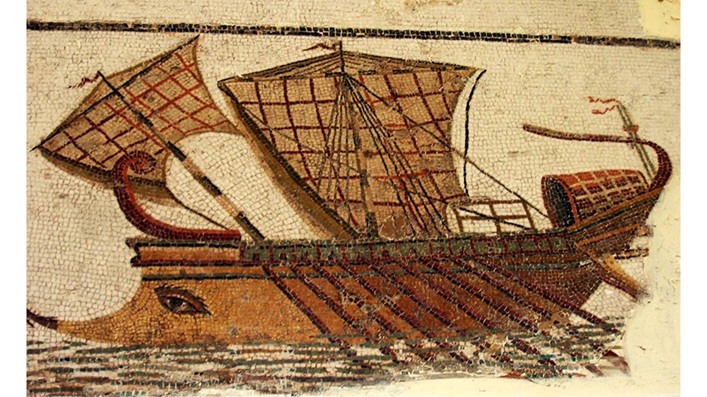
The ships sailed up the river’s mouth,
Against a steely, clear-eyed gale,
Far from the vineyard of the south,
The olive grove and terraced vale.
So different from their native lands
Appeared, unto each legionnaire,
The green hills wrapped in silver bands.
And somehow, so much colder there
The wind felt on each sun-tanned face,
Though there was but a narrow sea
Between them and their launching place,
Somehow, the sun shone differently.
Above the steady naval din—
The creaking boards, the splashing oars—
A silence slowly settled in,
Above the shouts and groans and roars,
As all along the misty banks
A tangled rabble watched them pass—
The wizened willows in their ranks,
The water-flags, the reedy grass,
The broad-leaved poplars, slim and high,
The loosestrife’s vivid, bloodstained rods,
The oaks with arms raised to the sky—
Through eyes of strange and hostile gods.
Patricia Rogers Crozier has been published in The Washington Post. She holds a B.S. in Physics from Mississippi College. She resides in Gulf Breeze, Florida and works at Publix. She is the winner of the 2024 SCP International Poetry Competition.














Well done, Patricia! This certainly reads like classic verse! Love how you put us in the scene, and your use of that trochaic inversion in your third line to emphasize “far.”
Your poems never fail to take me to a strange and unsettling place. So much evocative language here, I hear the creaking boards and feel the chill wind blowing off foreign shores peopled with botanical guardians. Good job as usual.
Patricia, you took me on a river voyage of mystery and wonder that inspires the imagination. I am amazed at how you thought to write about such an intriguing event. As M.D. mentioned, your evocative imagery took me there for the trip.
Thank you, Patricia, for this lovely poem – evocative, mysterious and so well expressed, as the previous commentators have said. Are we to think of the Romans entering the Thames Estuary? Best wishes, Bruce
This excellent poem could be purely imaginative/fictive, or it could be historically based. Perhaps it was the Roman mosaic that Evan picked for an illustration, but to my mind the poem described a small group of Roman naval forces sailing from conquered Gaul over the channel, and navigating up the mouth of a British river To the Roman sailors, their homeland’s vineyards and olive groves and terraces are far to the south, and they had only crossed a “narrow sea” (the channel) to come to Britain. And the sun and the breeze and the temperature are noticeably different from those of Italy. And the crowds of native Britons on the shores are potential or real enemies, with strange and hostile gods. I suppose what prompted these imaginings was the word “legionnaire,” a soldier in a Roman legion.
Anyway, it’s just my speculation. But that’s what came to my mind as a picture from the perfect words and oil-smooth meter.
I interpret the “tangled rabble” as the plants on the shore, foreboding and eerie to the eyes of the Romans..
Sure, that’s also a possible interpretation.
Patricia “A Strange Sun” …. nothing short of cinematic! Your imagery takes us on a voyage into the eyes of history! An illuminating read!
What I find most striking is the drama you create without a word of dialogue and indeed minimal action — just vivid, description, probing the amazement and unease of a southern expedition to a far-off northern land. That intentional vagueness adds to the mystery. Like Dr. Salemi, I think of Romans when I hear “legionnaire,” but it could just as easily be Phoenicians or Greeks (who traded with Britain for tin). Your selection of tetrameter is just right: short enough to emphasize movement, but not too much.
The poem seems above all emblematic, representing a nautical river voyage into an area so unfamiliar that legionary sailors find not only the sun strange, but the local gods of utterly unknown character. If the river represents a real one, I imagine it as the Rhone. Upstream to Lyon (after sailing a short way from Italy on the Mediterranean) could take the voyagers within sight of snowcapped alpine “green hills wrapped in silver bands.” It would be colder there. The “steely, clear-eyed gale” could be mistral winds characteristic of the area. Nautical and vegetal and meteorological images are well combined in this active and eerie descriptive piece, Patricia. It achieves a distinct emotional quality, too. Unsettling mystery is a forte of yours!