


.
Married to the Mob
He’s going out again today. What for?
His hundredth chance to settle some old score?
“Damn this! Screw that! Free cash! Free hash! More war!”
It seems some things just never change, Maxine.
He grabs a spear or full-armed magazine
And boasts his protests cure like a vaccine.
Peking one decade, Leningrad another,
As he hunts down opposing views to smother.
It all began with envy of his brother.
He thrives on conflict; hungers for blood spillage;
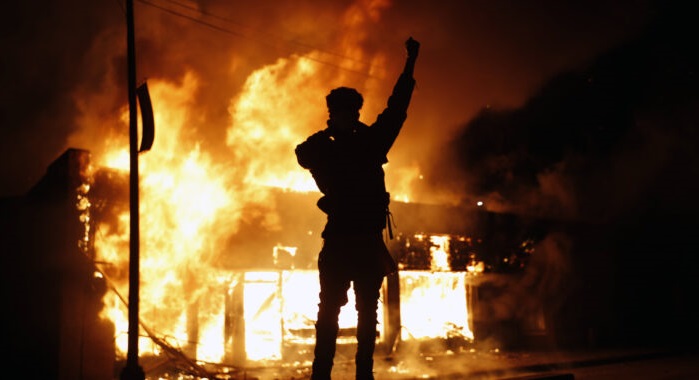
A night of arson, murder, rape and pillage.
Another synagogue; another village.
He hates the wealthy and the upper class
(Though if they give him cash they get a pass.)
And sometimes he just wants to kick some ass.
A pitchfork Friday; Tuesday he’ll use guns;
In May he’ll join the Vandals; June, the Huns.
Last week he torched a rabbi and three nuns.
He led that Maoist anti-Western fling;
The Civil War draft riots; Rodney King.
It seems, Maxine, this is the only thing
That gives him satisfaction besides whoring:
This agitating, stabbing, burning, goring
Accompanied by hoots and screams and roaring.
Maxine, our life together is surreal:
He loves jihad, he loves to stab and steal
And only lives to restorm the Bastille.
He takes words wrong. Some insult by the pope’ll
Ignite new plans for war. Theft of an opal
Could spark the plunder of Constantinople.
He’s stoked that universities don’t fail
To host barbaric brawls beyond the pale:
Columbia, North Carolina, Yale…
Tomorrow Brown and then U.C.L.A.
Where Gazans who play victim make him bray
As he turns terror into pure cosplay.
He won’t invite me with him anymore;
He knows that I won’t loot another store
Or leave a pile of bodies on the floor.
I wish that he were gainfully employed.
These torch and pitchfork gigs leave me annoyed.
I’m done—so done—with Hitler and George Floyd.
Maxine, it’s puerile, adolescent warring!
I say, “Cain, make it stop.” He just starts snoring.
Five thousand years of this. God, it’s so boring.
.
.
Barrabas
a sonnet
The shouts of “Crucify him!’ filled the square.
As if this man had done them any harm!
Were any in the throng remotely fair
When there was such scant basis for alarm?
The mob was roused and fickle. It compelled
Esteem one minute, hatred in the next.
How many even knew why he was held?
This puzzlement still leaves me sorely vexed.
The crowd condemned him yet was uninformed—
Weak-minded, wide-eyed, easily deceived.
Their sense of justice readily deformed,
They hungered to betray all they believed.
What mania, what devilment enticed
This mob to free Barrabas over Christ?
.
.
Brian Yapko is a retired lawyer whose poetry has appeared in over fifty journals. He is the winner of the 2023 SCP International Poetry Competition. Brian is also the author of several short stories, the science fiction novel El Nuevo Mundo and the gothic archaeological novel Bleeding Stone. He lives in Wimauma, Florida.


















Although I enjoyed the poem and have long thought that the Bible’s first sibling story needs far more attention, I also wonder why the current political allusions all seem aimed (subtly) at liberal politics rather than any leading conservatives who seem to revel in divisive and often racist language. I have been waiting to see a poem in SCP about the remarkable affection between Gus and Tim Walz (although one just popped up on another site). My understanding of classicism is that it encourages us to embrace the best traditions of the past , whatever their source. I suspect that Jesus was alluding to Cain and Abel whenever he spoke of brothers and when he encouraged us to turn the other cheek. I hope SCP can embrace as wide a range of classical interpretations as possible.
Margaret, right wing mobs these days are difficult to find. I only can think of the January 6th violence that never should have happened. Each of the examples in the poems are among the primary historical examples along with the recent relatively minor, but violent ones related to Floyd and Antifa.
Mr. O’Sullivan, I’m not sure why you are surprised to go onto a conservative poetry site and then express shock at finding a conservative viewpoint. I doubt you would have any such reaction if you want on one of the literally hundreds of left-leaning poetry sites that treat viewpoints such as mine as anathema. If that’s what you’re looking for, you don’t need to go far to find it.
But this is MY poem and I’m entitled to MY point of view. Let me quote you a meme I saw shortly after the assassination attempt of Donald Trump: “Not one building burned or store looted in the aftermath of the Trump assassination attempt. MAGA. Because we are not animals.” That speaks for me.
Let me also mention that I went to U.C.L.A. and I’m of Jewish heritage. The pro-terrorist demonstrations by leftist idiot students who didn’t even know what they were chanting disgusted me. That was the impetus for this poem. And I know what terrorizing of Jews took place by woke Hamasholes struck in their antisemitic rampages not only on the campus of my alma mater but on dozens of others. And I saw Biden and Harris and Democrat leaders do NOTHING to protect Jewish students. Or anyone with an opposing viewpoint. Sir, I was a Democrat for 45 years and I know why you’re defensive about left versus right. But I make no apologies for blaming the immature and narcissistic left for 90% of our civil unrest, I make no apologies for identifying current virulent antisemitism as being a leftist phenomenon, and I make no apologies for refusing to be gaslighted anymore by the Democrats. I’ve been a Republican for a total of 8 months out of my life and I only regret I didn’t see reality earlier. And that’s spoken as a gay man who practiced civil rights law for most of my 35 year career!
As for writing poetry with a different point of view — be my guest. It’s a free country. For now.
If a poem submitted here, Maurice, is of good quality, it will probably be published even if goes against what you view as the prevailing grain here on this site. So shut up and get to work if you think you can write something worth reading.
Brian, the actions of all such mobs are perfectly manifested in the pairing of these two poems that resonate across the centuries. Your adept use of words and rhyme are, as always, masterful.
Thank you very much, Roy. I wanted to show the problem poetically in “Married to the Mob.” Then I wanted to go from cause to effect by describing the tragedy of the mob choosing Barrabas over Jesus. Mobs rarely make good decisions.
I’ve read the Barrabas sonnet twice. It really should be more widely read. I get the feeling peer pressure and wanting to belong, as well as mass hysteria (which I’ve seen in operation in Africa) probably has a lot to do with the switch of opinion and the change from curious crowd to baying mob.
It’s something your poem would really be useful to discuss and analyse in this day and age.
Thanks for the reads.
Thank you very much, Paul. I’m glad this poem spoke to you and to your personal observations.
Brian, “Married to the Mob” is an amazing dramatic monologue. And writing it in monorhyme tercets was very effective, since it allows clear and specific focus on each new example or image. You’ve painted a perfect portrait of the typical brainless left-wing radical, and you’ve touched on a series of idiocies and flashpoints (some historical, some current) wherein this radical operates.
Making him “Cain” was a solid choice. It grounds the described character in scriptural history, and links him with resentment and envy. The silent interlocutor in this poem (“Maxine”) interests me — is she a wife, a girlfriend, an acquaintance, a sibling? Is she “married” to Cain himself, or to the speaker? Or perhaps the speaker is a female friend of Maxine. It could be any of these, and my suspicion is that her name was chosen to make the excellent rhymes in the second tercet.
The sixth tercet made me laugh out loud. And the entire poem works with the precision of s Swiss watch. Great work!
Thank you very much, Joe! Your reconstruction of how I got to “Maxine” particularly delights me. You have engaged in an insightful reconstruction of my thought process in writing the piece. I don’t need to tell you, but readers interested in literary criticism might appreciate knowing that this type of detective work and deductive reasoning in the deconstruction of a piece to get at poetic intent is a hugely important skill. Lawyers use it all the time when analyzing the drafting of statutes or constitutions in an attempt to ascertain legislative intent. But it’s a cross-over skill which will serve the literary critic well.
As you deduced, I started this poem with a bunch of female names in mind but once I decided on using the word “vaccine” the name “Maxine” suddenly became the obvious choice. It got extra points for me being Latin-derived as I figured that would give the surreal timeframe a vaguely Roman anchor to build on in addition to the Biblical one. My point, of course, is that Cain’s influence has always been with us, irrespective of clime or culture.
Who is Maxine? I’ve never identified her as other than a female confidante of Mrs. Cain, the speaker. I don’t really have a setting either, but if pressed I could see them at Starbucks or over lunch somewhere swapping husband-complaint stories.
Jeez, Brian. I thought it was Maxine Waters.
I can’t imagine putting Maxine Waters in a poem, C.B. I don’t have the mental resilience.
Brian, these are great, especially the rhymes! I’m guessing “Married to the Mob” is based on what happened to the hostages in Gaza… if not, then the timing is perfect!
As for “Barabbas,” it reminds me: I once saw a meme showing a painting of the crowd choosing Barabbas, with the caption: “Democracy: The system that chose Barabbas over Jesus.” I believe that summarizes and explains modernity’s political quagmires quite well.
Thank you very much, Josh! I actually wrote “Married to the Mob” in May or so when there were the pro-terrorist encampments at UCLA, Columbia, et al. That it got published on the same day as the unconscionable slaughter of the six innocent Israeli hostages by Hamas animals in Gaza was coincidental but timely.
I love your observations about “Barabbas” and the meme you describe. You are so right. Mobs cannot be trusted to get it right. Quite the contrary.
This is a great pair of poems Brian! As soon as I read the third line in the third stanza I thought of Cain, and it was satisfying to see him named in the last stanza, as the embodiment of the man of sin. Jesus told Phillip “he that hath seen me hath seen the Father”. I suppose the same goes for Cain, whose father was “a murderer from the beginning, and abode not in the truth, because there is no truth in him”. Which brings us to Bar-abbas, son-of-the-father, who was literally and physically saved from having to die for his own sins by Jesus’ crucifixion in his stead. The Bible doesn’t disclose if Barabbas, a murderer and a robber, repented of his sins and was saved from the second death, it only shows that he was provided with the free offer, like all the rest of us since that day on Calvary: “If we confess our sins, he is faithful and just to forgive us our sins, and to cleanse us from all unrighteousness.” 1 John 1:9
I would also like to know who Maxine is.
Thank you so much, Yael, for reading and commenting. Your insights on Cain (via John) and his connection to Satan are profound as are your thoughts on Barabbas. Thank you for the reminder of the meaning of his name (“abba”means father in Hebrew) and the questions of what he did with his life once Christ took his place on the Cross. That would make a fascinating poem. I do know that one fictionalization of the life of Barrabas was made into a movie (eponymous title) starring Anthony Quinn. I don’t remember Barabbas being particularly meaningful and I think his misdeeds do finally catch up with him during the reign of Nero. But I won’t spoil the ending. Nonetheless, maybe a poem with more depth along the lines you mention would be a creative project to think about…
Cain’s wife is the speaker–along with his daughters-in-law throughout these five thousand years. Brian, if she didn’t know about his ways before the wedding day, she can get an annulment, even from the Church. And if she did know, I can only think of the Godfather’s second wife, who accepted the proposal out of love with full knowledge, and armed bodyguards accompanying the couple at a discreet distance. When she hears about the first horrible violence he does after they’re married, she gets out her rosary as her part of the job.
Thank you so much for this fun comment, Margaret! I envision Cain and his fictionalized wife as a couple who have existed together all through history, permanently yoked and rather divorced from the Biblical narrative by my flight of fantasy. Because they are fantasy characters “suggested by” the Bible rather than literal Biblical renderings, I never considered Cain’s children. Your mention of The Godfather threw me for a second until I realized you are joining in the anachronistic fun of the piece, and actually shoehorning in a reference to the “other” Mob! Mob as mafia is, of course, where I borrowed my title from in the first place. So kudos for making that connection explicit!
Such beautiful poetry, Brian. Honestly, I too have often mulled over the event circling your sonnet Barrabas. To quote you, the line, “What mania, what devilment enticed this mob to free Barrabas over Christ?” is indeed as puzzling as it is vexing. But I believe everything was His plan, from the minutest to the grandest. Rest; He knows better. Thanks for these. Take care.
Thank you so much, Shamik, for your appreciation of the sonnet. I often despair over how easy it is for groups of people to degenerate into mobs and how any goodness and hope they think they are supporting actually devolves into the horrific vaunting of hate. As I searched for a historic corollary to the evils that I have watched perpetrated on our college campuses in the U.S. (elsewhere, too) I kept drifting back to the biblical corollary of the mob screaming for Christ to be crucified – a mob that surely did not have any true awareness of what was at stake, but they acted recklessly and destructively anyway. Because that’s what mobs do.
Your words of solace are very meaningful and comforting to me, Shamik. You are so right. Nothing happens that is not within God’s plan and He does indeed know better. Your comment made my day.
It was part of Jesus’ mission to take our place. The mob, like Judas, only facilitated the necessary outcome.
Thank you for this reminder, C.B., of the fact that Jesus undertook this mission for an incredibly important reason and that His sacrifice for us was divinely ordained. It simply had to be, painful though it was (and is). Awe of His sacrifice and the sting of that pain echoes through the centuries.
Brian, what an excellent and enviable imagination you have! “Married to the Mob” is superb! It captures the pure evil of the mob mindset with wit and wonder and I just love the way you highlight historical and modern-day events. You make a deadly serious point in a highly entertaining manner. This really is satire at its finest, and I thank you for it. I believe your admirably wrought stanzas get a point across far more effectively than any history lesson could… especially the skewed ones rewritten by dons who don’t want to reveal they’re part of the current crime syndicate.
The pairing with “Barrabas” is spot on. This excellent sonnet sings of the pitfalls of mob rule clearly and disturbingly. These lines say it all for me: “The crowd condemned him yet was uninformed— / Weak-minded, wide-eyed, easily deceived.” A grave warning, indeed.
Brian, thank you!!
Susan, I’m so very pleased that you enjoyed these poems! Mob was inappropriately fun to write but, as you know from your own Screwtape-inspired work, that sometimes putting on the mantle of sick ideology can make for the most inspired satire.
I’m also glad that you understood perfectly the pairing of poems. Cause and effect. The disease followed by the damage — damage which can wound the most innocent of souls. In fact, the bullies in the mob count on it.