


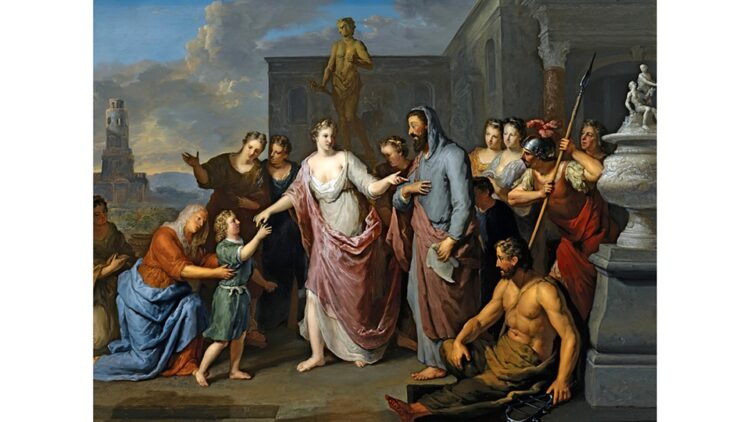
Meeting Alexander
You were the wonder of another age.
Enemies and friends alike: they learned
To love your laughter and to fear your rage.
It was your therapy when cities burned,
But if I somehow met you face to face
Such probing questions I would like to ask.
Yet I’m not Greek; it would not be my place
To see the man behind the golden mask.
Couches, back then, were just for relaxation:
You would allow nobody in your head.
You don’t owe me the slightest explanation
For those you left bereaved, enslaved, or dead.
But still I’d search for guilt, and an admission:
Olympias, your mother—she inspired
You, spurred you on, fed your ambition…
Was she the only woman you desired?
Psychoanalysis did not exist
When you brought empires down. Isn’t it strange:
For all your victories—it’s quite a list—
Yourself, you could not conquer, could not change.
David Whippman is a British poet, now retired after a career in healthcare. Over the years he’s had quite a few poems, articles and short stories published in various magazines.



















My initial introduction to Alexander came from the movie Die Hard when Hans Gruber said that Alexander wept for there were no more worlds to conquer. Unlike Gruber, I did not have the benefit of a classical education. Since then, I’ve learned more about him and agree completely that there was something seriously wrong with him. Great poem!
Thanks for your feedback, Warren. I think the flaws in some people are what drives them on. Certainly Alexander was capable of behaving with great courtesy and restraint (as when he captured the Persian royal family) but also great savagery. Psychoanalysis of someone dead for 2,300 years has one advantage – you can never be proved wrong!
Meeting, but not understanding. Or rather, understanding that Alexander the Great’s great problem must have been one shared by many throughout history: self-mastery. What needed to be changed? Impossible to say–this meeting leaves the unconquerable conqueror inscrutable. The speaker cannot speak Greek. The tools of psychoanalysis cannot be applied. David, you have many psychology expressions here: therapy, probing questions, in your head, guilt, admission, ambition, desire. And you suggest a diagnosis of early maternal dominance. That could have accounted for what a psychoanalyst might describe as Alexander’s unhealthy adult emotional life: no strong sense of self, leading to a compulsive desire to dominate others by any means. Still, it would seem that many men share the affliction without having Alexander’s military talents or achieving his political greatness. He or YOU (emphasized at the beginning of line 15) remains a mystery of personality and history. Excellent work bringing this forward in so few lines!
Thanks for such a detailed comment, Margaret. after 2,300 years, speculation about Alexander has endless possibilities. I wonder how our modern outlook, with the awareness of “microaggressions” and all the rest of the jargon, would view the folk of those times. The historical novelist Mary Renault suggested that Alexander had a low sex drive, compensated for by a desire to be admired and respected. I’m a retired psychi nurse, so I have an interest in this kind of thing.
Margaret, thanks for this detailed comment. I wrote a reply which seems to have disappeared into the ether! But anyway, the historical novelist Mary Renault suggested that Alexander compensated for a low sex drive by a craving for admiration and fame. As a retired psychi nurse, this kind of topic has always interested me. Thanks again.
An enjoyable and entertaining piece, David. Most of my knowledge of Alexander I gleaned from the film of the same name, though I did once visit (trek to) Siwa Oasis, in the middle of the Western / Sahara Desert, on the Egyptian / Libyan border, where Alexander consulted an oracle. It was a mystical place, in a state of great disrepair, without an oracle in sight.
Thanks for the read.
Glad you liked the poem, Paul. Thanks.
This poem flows smoothly and delivers your thoughts and points precisely. It makes me wonder, as you did when writing this, whether or not Alexander’s achievements were only sought in place of overcoming something deep within himself on a psychological level. I can’t believe that he waged war and conquered solely for remembrance or for the love of destruction; he was a human being much like us.
Thanks Scott. It’s fascinating to speculate at the motivations of those in the distant past. The pitfall is that we tend to assume they had our outlook on the world.
This is a good poem with excellent rhymes and solid metrics. It is a rhetorical apostrophe to an absent person. The speaker talks candidly to Alexander, but is aware that no answer to his questioning thoughts will be forthcoming.
No historical poem is required to work with or adhere to the psychological assumptions of the poem’s time-frame, or the time-frame of its author or readers. Poetic license allows for some anachronism if it serves an aesthetic purpose. But it is a good idea not to stray too far from what was likely or probable in the mind of someone who lived many centuries ago.
The poem asks intriguing questions about Alexander’s mindset and motivations, and rightly points out that those things are irrecoverable for those who exist millennia after Alexander’s world has vanished.
But rather than thinking up modern psychological reasons why Alexander did what he did, it might be better to consider what an ancient Graeco-Macedonian warrior prince might have believed.
Alexander was in love with the Iliad, and carried with him on all his campaigns an annotated copy of that epic – a gift from his tutor Aristotle. His heroes were the great warriors of that text: Achilleus, Hektor, Ajax, Diomedes. And he would have held highest in his estimation the thing that many warrior-kings honored and sought after: κλέος ἄϕθιτον (“imperishable fame”).
The cities crushed or the persons killed or enslaved would count for little in the mind of a warrior whose purpose is to gain “imperishable fame.” And he would have been truly baffled by questions concerning his sex drive or his mother.
You’re right, Joseph, and thanks for your comment. I’m aware that a lot of modern questions would be meaningless to a man of his era. But we still can’t help speculating!
As I said in my reply to Margaret, the writer Mary Renault, in her biography of Alexander, has some interesting thoughts on what drove him.
David, I find this poem not only beautifully crafted but extremely intriguing. One of my very favorite subjects in poetry is the dialogue between the poet and either the historic or the literary character. I find, in the end, it’s much more about the poet’s state of mind than the titular subject. There’s a reason the poet was drawn to this particular character and, clearly, in this case the poet must have had some reason why he wanted to engage with Alexander and get him on the therapist’s couch.
What I read here is a fascination with an aspect of human nature represented by Alexander’s brute consciencelessness. Conquest. Murder. The enslavement of thousands. I rarely think of Alexander in these terms because I admire his achievements so much that I rarely think of the cost. It opens a can of worms concerning those who achieve great things but end up with results that some claim hurtful. This is a constant issue with Columbus and I refuse to engage with those who would cancel him. Or Cortez. Or the Pilgrims. But I notice this is a Western issue. I have never heard of people toppling statues of Genghis Khan or apologizing abjectly for Mohammed’s jihad.
All this being said, I, too, would like to get to the heart of what it is in human nature that so easily conquers and destroys and then loses no sleep over it. But that’s such a modern reading. Go back to Alexander’s Greece for a moment. Guilt? I doubt it. And as you say, Alexander owes us not the slightest explanation.
Did you know the city “Kandahar” in Afghanistan is linguistically derived from the name “Alexander?” It was originally named “Alexandria.” One of many. Testament to how important this young conqueror was to history.
Thanks Brian. You’re right, in the end this hypothetical questioning is more about the interrogator than the subject. I guess it has to be: the Greeks and Romans had such a different mindset from us. MacNeice said it succinctly in his Autumn Journal: “It was all so unimaginably different, and all so long ago.”
You also raise a telling point about he way that some cultures get a kind of free pass. I’ve never heard a Turk or Arab agonise about the horrors of the Ottoman Empire or of the caliphates of the middle east, for example.
Yes, you’re also right that a lot of place names in India and other countries – Secunderabad, for example – are actually corruptions of Alexander’s name.
This last point reminds me of something I read many years ago, in a numismatic journal. In India, in the 1940s, a silver tetradrachm coin of Alexander the Great turned up in change in a busy marketplace in Bombay. It was accepted without question in a small transaction, and only later saved by the recipient when he was told it was ancient, and might be valuable. The article pointed out that, for a very long time after Alexander’s death, his coinage circulated in India because of its solid value and beauty (it had a profile of Herakles in a lion-skin on its obverse). And copies of it were minted by local rulers because of the high reputation that the silver coin had. But can you imagine an actual coin of Alexander circulating for over 2000 years, as an acceptable legal tender?
The name “Alexandros” means “Protector of Men.” And in the light of all of those places that still carry versions of his name, I think we can say that he made quite a good impression wherever he went.