• Submit Poetry
  • Support SCP
  • About Us
  • Members
  • Join
Sunday, September 6, 2026
Society of Classical Poets
  • Poems
    • Beauty
    • Culture
    • Satire
    • Humor
    • Children’s
    • Art
    • Ekphrastic
    • Epic
    • Epigrams and Proverbs
    • Human Rights in China
    • Music
    • Performing Arts
    • Riddles
    • Science
    • Song Lyrics
    • The Environment
    • The Raven
    • Found Poems
    • High School Poets
    • Terrorism
    • Covid-19
  • Poetry Forms
    • Sonnet
    • Haiku
    • Limerick
    • Villanelle
    • Rondeau
    • Pantoum
    • Sestina
    • Triolet
    • Acrostic
    • Alexandroid
    • Alliterative
    • Blank Verse
    • Chant Royal
    • Clerihew
    • Rhupunt
    • Rondeau Redoublé
    • Rondel
    • Rubaiyat
    • Sapphic Verse
    • Shape Poems
    • Terza Rima
  • Great Poets
    • Geoffrey Chaucer
    • Emily Dickinson
    • Homer
    • Henry Wadsworth Longfellow
    • Dante Alighieri
    • John Keats
    • John Milton
    • Edgar Allan Poe
    • William Shakespeare
    • William Wordsworth
    • William Blake
    • Robert Frost
  • Love Poems
  • Contests
  • SCP Academy
    • Educational
    • Teaching Classical Poetry—A Guide for Educators
    • Poetry Forms
    • The SCP Journal
    • Books
No Result
View All Result
Society of Classical Poets
  • Poems
    • Beauty
    • Culture
    • Satire
    • Humor
    • Children’s
    • Art
    • Ekphrastic
    • Epic
    • Epigrams and Proverbs
    • Human Rights in China
    • Music
    • Performing Arts
    • Riddles
    • Science
    • Song Lyrics
    • The Environment
    • The Raven
    • Found Poems
    • High School Poets
    • Terrorism
    • Covid-19
  • Poetry Forms
    • Sonnet
    • Haiku
    • Limerick
    • Villanelle
    • Rondeau
    • Pantoum
    • Sestina
    • Triolet
    • Acrostic
    • Alexandroid
    • Alliterative
    • Blank Verse
    • Chant Royal
    • Clerihew
    • Rhupunt
    • Rondeau Redoublé
    • Rondel
    • Rubaiyat
    • Sapphic Verse
    • Shape Poems
    • Terza Rima
  • Great Poets
    • Geoffrey Chaucer
    • Emily Dickinson
    • Homer
    • Henry Wadsworth Longfellow
    • Dante Alighieri
    • John Keats
    • John Milton
    • Edgar Allan Poe
    • William Shakespeare
    • William Wordsworth
    • William Blake
    • Robert Frost
  • Love Poems
  • Contests
  • SCP Academy
    • Educational
    • Teaching Classical Poetry—A Guide for Educators
    • Poetry Forms
    • The SCP Journal
    • Books
No Result
View All Result
Society of Classical Poets
No Result
View All Result
Home Poetry Culture

‘Shroud-Eater’ by Joseph S. Salemi

October 30, 2022
in Culture, Poetry
A A
18
poems 'Shroud-Eater' by Joseph S. Salemi

.

Shroud-Eater

The undead Shroud-Eater, or mâcheur de suaire, is not
as well known as the vampire, but is just as horrifying.
He prowls cemeteries chewing on his shroud and his own
flesh, attacks persons, and brings plague or misfortune to
anything in the vicinity. He can be killed only by shoving
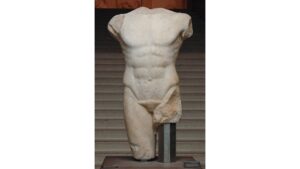
a brick or stone in his mouth, and reburying him. In 2005
the skull of a female one (mâcheuse) was unearthed at
the island of Lazzaretto Nuovo in Venice, buried in the
medieval plague pits.

He walks at any time—the day, the night—
Chewing his linen winding-sheet, and once
He gets down to his bare and rotting skin
Gnaws on that as well. His sightless eyes
Are redder than poppy petals, and gaze out
In that unfocused corpse-stare of the damned.

Along the paths of graveyards he takes steps
In a slow, half-hesitating gait
Like one asleep, or drunk, or in a trance
That drives him, as if cattle prods of Hell
Were at his back, compelling him to move.

There is one way to stop him. You must take
A brick or stone and shove it in his mouth
As far as it will go. His jaws, so locked,
Can never chew again, and he will die,
No longer trouble to the living world
Or to the quiet cemetery’s rows
Of sepulchers, sarcophagi, and urns.

.

.

Joseph S. Salemi has published five books of poetry, and his poems, translations and scholarly articles have appeared in over one hundred publications world-wide.  He is the editor of the literary magazine TRINACRIA and writes for Expansive Poetry On-line. He teaches in the Department of Humanities at New York University and in the Department of Classical Languages at Hunter College.

ShareTweetPin
The Society of Classical Poets does not endorse any views expressed in individual poems or commentary.
Read Our Comments Policy Here

RandomPoems

poem/coats/translation
Beauty

‘With a Smile of the Heart’ (Circa 1200), Translated by Margaret Coats

October 5, 2023

. Introduction This long lyric of short lines has pairs of stanzas linked in rhyme. It is a sequence honoring...

Three Love-Crossed Sonnets by James A. Tweedie
Beauty

‘The Hectic Life’ and Other Poetry by Thor Kangas

January 18, 2025

. The Hectic Life _Sometimes we get discouraged _With life and all its fuss, Its raucous moments speeding by _Like...

Next Post
‘A Fragmentary Introduction to the Geo-Political America of the Progressive Left’ and Other Poetry by James A. Tweedie

'Are You Prepared for All Hallows’ Eve?' by Kevin Hayes

‘Night Visitor’ and Other Ghost Poetry by Roy E. Peterson

'Night Visitor' and Other Ghost Poetry by Roy E. Peterson

‘It’s Halloween’ by Paul A. Freeman

'It’s Halloween' by Paul A. Freeman

Comments 18

  1. Dan Ward says:
    4 years ago

    They’ll be out in force on Nov 8 to vote. Don’t forget your voter ID and a brick!

    Reply
  2. Phil S. Rogers says:
    4 years ago

    Fascinating! I had to do research on this, as a shroud eater was not something with which I was familiar. Never too old to learn something new. Thank you

    Reply
  3. Michael Zahn says:
    4 years ago

    Nice!

    Reply
  4. Susan Jarvis Bryant says:
    4 years ago

    Joe, the blank verse really suits the subject matter of this eerie poem. Its matter-of-fact, no-fuss delivery, make those “sightless eyes… redder than poppy petals” shine even brighter, and that brick or stone to shove in his mouth an absolute necessity. I had never heard of a shroud-eater until I read this seriously scary poem – coupled with the ghoulish picture… I fear a nightmare may seek me out in the wee hours… the sign of a powerful poem I should never have read.

    Reply
  5. Norma Pain says:
    4 years ago

    The ‘Shroud-eater’ sounds like one horrible entity. I can think of a few people whose mouths would be better served by chewing on a brick!! Like people in power who keep telling lies. Thanks for the scare Joseph.

    Reply
  6. Paul Freeman says:
    4 years ago

    A very atmospheric, spooky piece of writing. The blank verse worked well for this poem.

    Thanks for the read.

    Reply
  7. Roy E. Peterson says:
    4 years ago

    Like others who made comments, the “Shroud-eater” is a new form of terror to me,” one which I never hope to encounter. More than that, is the erudite rendition and treatment of the subject that is compelling reading.

    Reply
  8. Brian Yapko says:
    4 years ago

    This is sublimely creepy poetry and some fascinating information about a zombie-like monster I’ve never heard of. Perfect for Halloween.

    Reply
  9. Sally Cook says:
    4 years ago

    Dear Joe —

    Awful ! Not the poetry certainly, which, for me, called up all my childhood nightmares; endless evenings under a sultry sky, being chased by something that had emerged from a black enameled closet door. I woke tired from running after every one of these awful evenings. Shades of C. S. Lewis !
    Of course, today, most ghouls are in government !
    Well, that’s what a good poem is, (among other things) words on a page that call up powerful emotions . Hope nothing comes out of my closet tonight !

    Reply
  10. Joseph S. Salemi says:
    4 years ago

    I also had never heard of the shroud-eater until a few weeks ago, when I came across the article about the discovery of the skull in Venice in 2005. The picture (which Evan reproduced above) that accompanied the article impelled me to write the poem. There are a few things about the shroud-eater on the internet, some in French, so the story has long been widespread in Europe, just like that of the vampire. The discovery of this skull only ups the ante.

    Reply
  11. C.B. Anderson says:
    4 years ago

    Possibly, Joseph, your most macabre poem ever. I’m sure it’s just a coincidence that you posted it at the end of October. All you’ve done is give us one more thing to worry about.

    Reply
  12. Shaun C. Duncan says:
    4 years ago

    This is a genuinely frightening poem, made all the more unsettling by the almost forensic use of language and lack of rhyme. It reminds me of the (prose) work of Thomas Ligotti, who I consider to be the finest horror writer since Lovecraft at least and maybe even Poe. Sadly, I paid far too much money a few years back for a volume of poetry he put out, expecting something of this quality. Instead it read like a 14 year-old goth imitating Rupi Kaur.

    It’s unfortunate that macabre poetry after Poe never seemed to blossom into a fully-fledged genre in its own right, and most of the examples I can think of (the works of Park Barnitz, Clark Ashton Smith and Lovecraft himself), though neglected, too often embraced the worst excesses of Poe and the decadents.

    Reply
    • Joseph S. Salemi says:
      4 years ago

      I agree — the Gothic horror style (of which Poe was the most prominent American representative) never seemed to catch on in this country. It lacked the kind of pious, goody-good, middle-class respectability that Americans prefer.

      Reply
  13. The Society says:
    4 years ago

    This is an important note to the poet Joseph S. Salemi and to all readers: Someone with the following information

    email address: [email protected]
    IP address: 192.76.8.69

    has posted some comments under Dr. Salemi’s name, including death threats. Those comments were deleted of course, but just in case you saw them, they came from some sinister internet troll trying to cause trouble.

    The Society of Classical Poets provides an open forum for discussing published poetry, and we hope to keep it open. Our comment policy can be found here https://classicalpoets.org/comments-policy/

    -Evan Mantyk
    SCP Editor

    Reply
    • Mike Bryant says:
      4 years ago

      As the moderator, I must say that Dr. Salemi has never issued a threat to anyone. It is particularly vile that this poor excuse for a human being, ostensibly PJackson, was trying to deflect his crime onto another. Also, why are the threats, of death and violence, all coming from those who claim virtue?
      Does “NO DEATH THREATS” really have to be stated on our comment policy?

      Reply
  14. David Whippman says:
    4 years ago

    The use of blank verse is effective here – a rhyming poem might have seemed a little trite. Well written and unsettling.

    Reply
  15. Margaret Coats says:
    4 years ago

    Joseph, there is very little information indeed on the shroud-eater in our linguistic area of the internet. Your poem is now the top result in a search (probably because it’s most recent), even when I speak to the computer in French. An informative French site claims that the phenomenon is especially German, and speaks of instances farther east in Europe. The most chilling part of what I found says that shroud-eaters are morts-vivants who were buried alive, seemingly the result of hasty dumps of plague victims. They chew on their shrouds and then on their flesh because they need food to remain alive. This is a notable symbolic difference from the usual thirst (not hunger) of the dead. The supposed thirst of the dead, in varied cultures, is interpreted as the desire to be fully dissolved and thus capable of reincarnation, or of departing to wherever the dead stay beyond the graveyard. Shroud-eaters, on the other hand, are living beings who wish to continue in life. As you say in your poem, they will die and cause no more trouble only when they can no longer chew on their available food. I did read of an additional way to achieve this, other than forcing a brick or stone into the mouth. A 17th-century local official used a sword to decapitate one, which solved the problem in his town cemetery. With the nutritive pathway from mouth to body cut, the effect would be the same as lockjaw with a brick. As you see, you’ve upped the ante of interest in this phenomenon with your poem.

    Reply
    • Joseph S. Salemi says:
      4 years ago

      Margaret, thanks for your informative comments. Yes, I did read that account of a 17th-century official decapitating one of them of with a sword, with the effect of killing the creature.

      The suggestion that these beings may have been prematurely thrown into the plague pits by frightened sextons or corpse-gatherers is truly upsetting, and the image of them hungrily eating their own shrouds and flesh in sheer desperation makes my skin crawl. This may be how the legend began. The avalanche of victims during the sporadic outbreaks of bubonic plague was so overwhelming that mistakes like this may well have occurred.

      The number of the dead was so great in cities like London that there simply wasn’t any conventional space for all the corpses. In my poem “London Charterhouse,” about the martyrdom of the Carthusian monks under Henry VIII, I mention that the Carthusian “Charterhouse” in that city was in fact built upon a huge cemetery of plague victims from 1349. I imagine a terrified priest rapidly saying prayers over a crammed pit of blackened bodies, and leaving as quickly as possible.

      Reply

Leave a Reply Cancel reply

Your email address will not be published. Required fields are marked *


  1. Roy Eugene Peterson on ‘Serenade’ and Other Poetry by Adam SediaSeptember 6, 2026

    Adam, there is so much to commend these two poems from the refreshing rhyme schemes to the depth of sensitivity…

  2. Theresa Werba on ‘Serenade’ and Other Poetry by Adam SediaSeptember 6, 2026

    Adam, your musicality really is shining forth in "Serenade"-- I really like this particular form, ABBCADDC-- that with the alternation…

  3. Theresa Werba on ‘China Made’: A Poem by Theresa WerbaSeptember 6, 2026

    Wow Adam, I am very gratified when I can "sear the reader's mind".... it's funny but I had written the…

  4. Russel Winick on ‘Advantages of Restaurants’ and Other Poems by Russel WinickSeptember 6, 2026

    Thanks Adam. I’m guessing it had something to do with a romantic relationship, because the immediate change from her steady…

  5. Theresa Werba on Poetry Book Review: Love Found, Yearned For, and Lost by James A. TweedieSeptember 6, 2026

    Thank you Adam! I am glad you'll be reading the entire collection-- as a whole artistic statement it is both…

Subscribe to Daily Poems

Enter your email address to subscribe to this blog and receive notifications of new posts by email.

Join 1,637 other subscribers

Recent Poems

  • ‘Serenade’ and Other Poetry by Adam Sedia
  • ‘Self-Exploration’ and Other Poems by Paul Millan
  • ‘Victory’: A Poem by Jonathan Graver
  • ‘The Cristero Centennial’: A Poem by Margaret Coats
  • ‘A Potpourri of Aphoristic Verses’ by C.B. Anderson
  • ‘The Estuary’: A Poem by Jeff Eardley
  • ‘A World Without the Wednesday Child’: A Poem by Kimberly Fore
  • The 2026 Society of Classical Poets International Poetry Competition
  • The 2026 SCP International High School Poetry Competition
  • ‘Realistic Reflections’ and Other Poetry by Anna J. Arredondo
  • ‘China Made’: A Poem by Theresa Werba
  • ‘The Savage Moon’ and Other Poetry by Brian Yapko
  • Poetry Book Review: Love Found, Yearned For, and Lost by James A. Tweedie
  • ‘When Opportunity Knocks’: A Poem by Roy E. Peterson
  • ‘Legend of the Griffin’: A Poem by Iryna Hall
  • ‘Government Issue’ and Other Poems by Joseph S. Salemi
  • ‘Chaucer Announces His Desire to Retire’: A Poem by Paul A. Freeman
  • ‘Advantages of Restaurants’ and Other Poems by Russel Winick
  • ‘Bone China’: A Poem by Mary Gardner
  • ‘On the Death of One Too Young to Die’: A Poem by Jeffrey Essmann
  • ‘This Too Shall Pass’ and Other Poetry by Justin Dasher
  • ‘Humdrum and Harum-Scarum’: A Lecture on Free Verse, by Robert Bridges (1922)
  • ‘Unrest On the Floodplain’: A Poem by Bhikkhu Nyanasobhano
  • ‘Latitude and Loss’: A Poem by Martin Briggs
  • ‘Act III’ and Other Poetry by C.B. Anderson
  • ‘God’s Funeral’: A Poem by James Sale
  • ‘Star Festival’: A Poem by Margaret Coats
  • ‘Song of the Frog Princess’: A Poem by Scharlie Meeuws
  • ‘The Odyssey: Nolan and Solot Compared’: An Essay by Michael Curtis
  • ‘Solitude’ and Other Poems by Mary Jane Myers

Categories

  • Acrostic
  • Alexandroid
  • Alliterative
  • Art
  • Best Poems
  • Blank Verse
  • Chant Royal
  • Classical Poets Live
  • Clerihew
  • Covid-19
  • Deconstructing Communism
  • Educational
  • Epic
  • Epigrams and Proverbs
  • Essays
    • Interviews with Poets
    • Poetry Reviews
  • Featured
  • From the Society
  • Great Poets
    • Dante Alighieri
    • Edgar Allan Poe
    • Emily Dickinson
    • Geoffrey Chaucer
    • Henry Wadsworth Longfellow
    • Homer
    • John Keats
    • John Milton
    • Robert Frost
    • William Blake
    • William Shakespeare
    • William Wordsworth
  • Human Rights in China
  • Limerick
  • Love Poems
  • Music
  • Pantoum
  • Performing Arts
  • Poetry
    • Beauty
    • Children's Poems
    • Culture
    • Ekphrastic
    • Found Poems
    • High School Poets
    • Humor
    • Riddles
  • Poetry Challenge
  • Poetry Contests
  • Poetry Forms
    • Curtal Sonnet
    • Haiku
  • Poetry Readings
  • Rhupunt
  • Rondeau
  • Rondeau Redoublé
  • Rondel
  • Rubaiyat
  • Sapphic Verse
  • Satire
  • Science
  • Sestina
  • Shape Poems
  • Short Stories
  • Song Lyrics
  • Sonnet
  • Symposium
  • Terrorism
  • Terza Rima
  • The Environment
  • Translation
  • Triolet
  • Video
  • Villanelle

Quick Links

  • About Us
  • Submit Poetry
  • Become a Member
  • Members List
  • Support the Society
  • Advertisement Placement
  • Comments Policy
  • Terms of Use

Welcome Back!

Login to your account below

Forgotten Password?

Retrieve your password

Please enter your username or email address to reset your password.

Log In
No Result
View All Result
  • Poems
    • Beauty
    • Culture
    • Satire
    • Humor
    • Children’s
    • Art
    • Ekphrastic
    • Epic
    • Epigrams and Proverbs
    • Human Rights in China
    • Music
    • Performing Arts
    • Riddles
    • Science
    • Song Lyrics
    • The Environment
    • The Raven
    • Found Poems
    • High School Poets
    • Terrorism
    • Covid-19
  • Poetry Forms
    • Sonnet
    • Haiku
    • Limerick
    • Villanelle
    • Rondeau
    • Pantoum
    • Sestina
    • Triolet
    • Acrostic
    • Alexandroid
    • Alliterative
    • Blank Verse
    • Chant Royal
    • Clerihew
    • Rhupunt
    • Rondeau Redoublé
    • Rondel
    • Rubaiyat
    • Sapphic Verse
    • Shape Poems
    • Terza Rima
  • Great Poets
    • Geoffrey Chaucer
    • Emily Dickinson
    • Homer
    • Henry Wadsworth Longfellow
    • Dante Alighieri
    • John Keats
    • John Milton
    • Edgar Allan Poe
    • William Shakespeare
    • William Wordsworth
    • William Blake
    • Robert Frost
  • Love Poems
  • Contests
  • SCP Academy
    • Educational
    • Teaching Classical Poetry—A Guide for Educators
    • Poetry Forms
    • The SCP Journal
    • Books

© 2025 SCP. WebDesign by CODEC Prime.