• Submit Poetry
  • Support SCP
  • About Us
  • Members
  • Join
Tuesday, May 12, 2026
Society of Classical Poets
  • Poems
    • Beauty
    • Culture
    • Satire
    • Humor
    • Children’s
    • Art
    • Ekphrastic
    • Epic
    • Epigrams and Proverbs
    • Human Rights in China
    • Music
    • Performing Arts
    • Riddles
    • Science
    • Song Lyrics
    • The Environment
    • The Raven
    • Found Poems
    • High School Poets
    • Terrorism
    • Covid-19
  • Poetry Forms
    • Sonnet
    • Haiku
    • Limerick
    • Villanelle
    • Rondeau
    • Pantoum
    • Sestina
    • Triolet
    • Acrostic
    • Alexandroid
    • Alliterative
    • Blank Verse
    • Chant Royal
    • Clerihew
    • Rhupunt
    • Rondeau Redoublé
    • Rondel
    • Rubaiyat
    • Sapphic Verse
    • Shape Poems
    • Terza Rima
  • Great Poets
    • Geoffrey Chaucer
    • Emily Dickinson
    • Homer
    • Henry Wadsworth Longfellow
    • Dante Alighieri
    • John Keats
    • John Milton
    • Edgar Allan Poe
    • William Shakespeare
    • William Wordsworth
    • William Blake
    • Robert Frost
  • Love Poems
  • Contests
  • SCP Academy
    • Educational
    • Teaching Classical Poetry—A Guide for Educators
    • Poetry Forms
    • The SCP Journal
    • Books
No Result
View All Result
Society of Classical Poets
  • Poems
    • Beauty
    • Culture
    • Satire
    • Humor
    • Children’s
    • Art
    • Ekphrastic
    • Epic
    • Epigrams and Proverbs
    • Human Rights in China
    • Music
    • Performing Arts
    • Riddles
    • Science
    • Song Lyrics
    • The Environment
    • The Raven
    • Found Poems
    • High School Poets
    • Terrorism
    • Covid-19
  • Poetry Forms
    • Sonnet
    • Haiku
    • Limerick
    • Villanelle
    • Rondeau
    • Pantoum
    • Sestina
    • Triolet
    • Acrostic
    • Alexandroid
    • Alliterative
    • Blank Verse
    • Chant Royal
    • Clerihew
    • Rhupunt
    • Rondeau Redoublé
    • Rondel
    • Rubaiyat
    • Sapphic Verse
    • Shape Poems
    • Terza Rima
  • Great Poets
    • Geoffrey Chaucer
    • Emily Dickinson
    • Homer
    • Henry Wadsworth Longfellow
    • Dante Alighieri
    • John Keats
    • John Milton
    • Edgar Allan Poe
    • William Shakespeare
    • William Wordsworth
    • William Blake
    • Robert Frost
  • Love Poems
  • Contests
  • SCP Academy
    • Educational
    • Teaching Classical Poetry—A Guide for Educators
    • Poetry Forms
    • The SCP Journal
    • Books
No Result
View All Result
Society of Classical Poets
No Result
View All Result
Home Poetry Culture

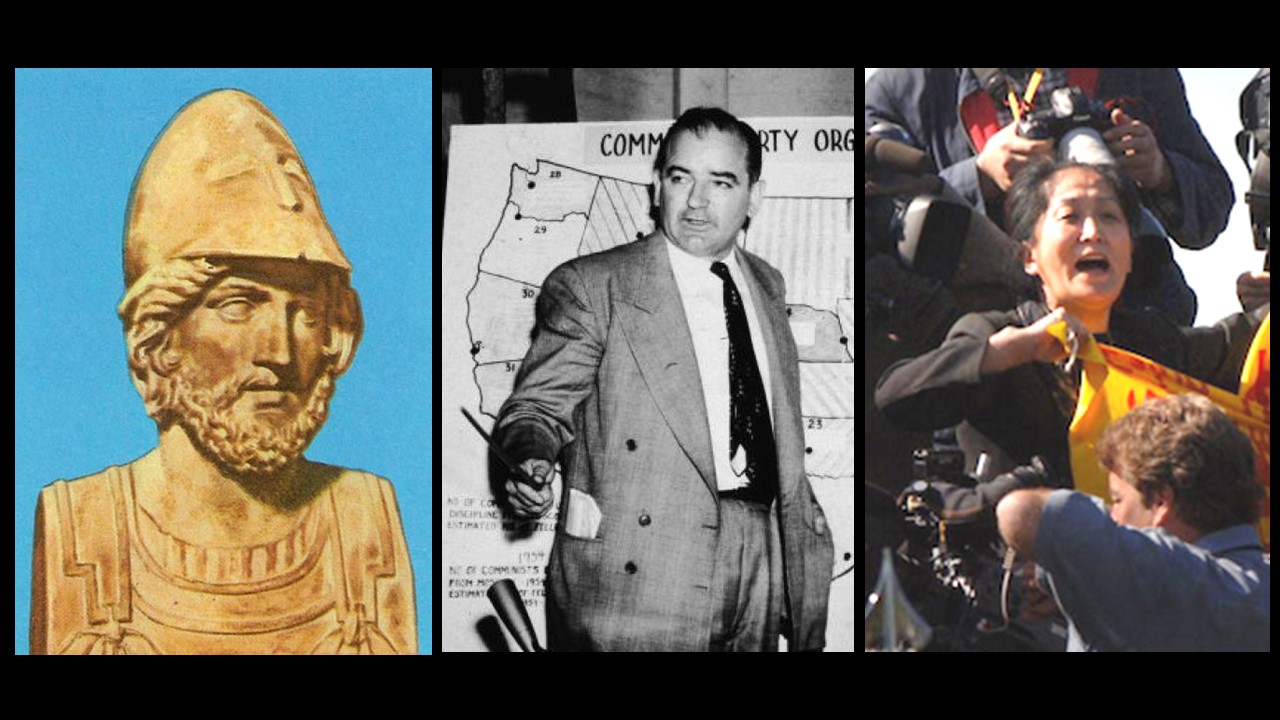
Sonnets on Themistocles, Sen. McCarthy, and Wenyi Wang, by Evan Mantyk

April 25, 2021
in Culture, Deconstructing Communism, Human Rights in China, Poetry
A A
28
poems Sonnets on Themistocles, Sen. McCarthy, and Wenyi Wang, by Evan Mantyk

.

Themistocles

Athens, Greece, 483 B.C.

“Barbarians loom upon the coast—dark clouds.
Athenians see them, but don’t think they’d pour
Their cataclysmic flooding on our shore.
They only hear the nearby shouts from crowds.
And so it goes. Let them do what they like…
But what if I raised up one of those shouts
That threatened emptily our trading routes,
Inducing thoughts of war at sea to spike?
Now then they’d build a hundred-trireme fleet
That may well be what saves them in the end.
Contrivances of dreams toward good thus bend
When minds are true enough and words are sweet,
For manmade arms are often what depose
Ideas men made and that the gods oppose.”

.

.

Senator Joseph McCarthy

Washington D.C., 1954

“‘Have you no sense of decency?’ you ask
Of me, but do not ask the communists
Whose iron inhumanity persists.
Why not take the Soviets, not me, to task?
Is decency a nation giving tears
And blood to raise its people up and then
These chicks turn ‘round to eat their mother hen?
Your ingrate words insult the soul that rears.
What’s decent when our China diplomat
Says communism is the best hope for
The largest nation in the world. What poor
Foresight would leave our Taiwan allies flat?
Your mock emotions have no roots in fact;
I pray the public can see through your act.”

.

.

Dr. Wenyi Wang

White House South Lawn, April 20, 2006

She shouts, “President Bush: Stop him from killing!”
Interrupting China’s leader Hu,
Who looks around unsure just what to do.
All stand there stunned at someone who is willing
To speak when questions from the press are blocked,
When voices from the labor camps are choked
And all the world is in complicity soaked.
As if some naked man stood there, they’re shocked
To see the Emperor who wears no clothes
And holds within his claws the butchered parts
Of people bound for sale at organ marts—
Then just like that she’s stopped, and quiet grows…
The horror that has flashed before the eyes
Dissolves for now into a scene of lies.

.

.

Evan Mantyk teaches literature and history in New York and is President of the Society of Classical Poets.

ShareTweetPin
The Society of Classical Poets does not endorse any views expressed in individual poems or commentary.
Read Our Comments Policy Here

RandomPoems

‘Hearts and Clouds’ by Roy E. Peterson
Beauty

‘Hearts and Clouds’ by Roy E. Peterson

January 14, 2021

  You can’t imagine what I saw,Some clouds that only God can drawWith pinks and reds and violet blue.He painted...

Write a Poem on One of These Hong Kong Protest Images
Culture

Write a Poem on One of These Hong Kong Protest Images

November 12, 2019

  The above images are from the pro-democracy protests going on right now in Hong Kong, as the populace peacefully...

Next Post
‘Spring Was Near, Now Spring’s Here’ by Carolyn Clark

'Spring Fling' by Cheryl Corey

On the Couple Who Accidentally Painted Over Modern Art, and Other Poetry by Julian Woodruff

On the Couple Who Accidentally Painted Over Modern Art, and Other Poetry by Julian Woodruff

‘In Praise of Formal Poetry’ by James A. Tweedie

'A Shout Out to Traditionalist Poets' by Paul A. Freeman

Comments 28

  1. Margaret Coats says:
    5 years ago

    The couplet to “Themistocles” is an outstanding epigram! Because these well-done sonnets are presented as a group of three on the same topic (of someone speaking out against socio-political danger), they seems to present a degeneration of the situation as history passes.

    I am intrigued that all four sonnets for today (these three and the one by Daniel Magdalen) use a rhyme scheme that is not Petrarchan or French or Shakespearean or Spenserian. Any special reason for choosing closed quatrains plus a couplet?

    Reply
    • Julian D. Woodruff says:
      5 years ago

      Margaret,
      Don’t you think Evan’s closed 4trains work particularly well in his 1st sonnet? If you have some specific observations on the coordination of form and content in the 4 sonnets I hope you’ll share them.

      Reply
      • Margaret Coats says:
        5 years ago

        I do think the first sonnet is especially fine. I’m still pondering how this sonnet form works for the reader. Evan’s ideas on the subject may be more informative, as he has written enough in the form to say how it works for the writer.

        Reply
    • James A. Tweedie says:
      5 years ago

      Margaret, I wrote in that sonnet form for over 40 years since that was the form I was taught in my 3rd year high school English class. This past year I have been increasingly being Shakespearean with forays into other classical forms. I find that if the words and rhythm of a sonnet are well constructed the poem works equally well in whatever form it is written.

      https://classicalpoets.org/2019/11/08/the-sound-of-sunset-by-james-a-tweedie/

      One example.

      Reply
    • Evan Mantyk says:
      5 years ago

      Dear Margaret,

      Thank you for exceedingly perceptive comment! You have picked up on and crystalized the overall theme of the three quite well.

      The ABBA, or closed, quatrain felt more fitting here because it is slightly more mysterious and less sweet to the ear than the more common ABAB. It gives the sense of something impending. Yet, if I had gone the way of the Petrarchan scheme, it would have been too demanding for the subject matter, which was intended to turn what are, probably to most readers, obscure bits of history into pieces that don’t need a separate reading on history. Even so, I may not have succeeded on this latter point and have added hyperlinks in the epigraphs for those who want to read the sources behind them.

      It just so happens that Mr. Magdalen submitted to me the other poem also in closed quatrains. It was originally four quatrains, but it quite naturally ended in a revision to a similar scheme.

      Reply
  2. Dave Whippman says:
    5 years ago

    All three pieces are skilfully written. The one on Themistocles intrigued me as I have studied that period of Greek history. I wonder if history would have been different if Themistocles not Aristides had been exiled?

    Reply
    • Evan Mantyk says:
      5 years ago

      Thank you, Dave. It is an intriguing period of history. More recently I’ve returned to it by reading some of Thucydides’ Peloponnesian War, which I thought would be a disappointment since the Greeks fight each other, but is still quite fascinating.

      Reply
  3. Cynthia Erlandson says:
    5 years ago

    Because you know history, you can see clearly what’s happening, and be prophetic, as you are in these insightful poems. I am glad you wrote them.

    Reply
    • Evan Mantyk says:
      5 years ago

      Thank you, Cynthia!

      Reply
  4. BRIAN YAPKO says:
    5 years ago

    Evan, thank you for these skilled poems which have actually educated me about events and conflicts I knew nothing about. You’ve inspired me to do some internet research on them and learn a bit more about the timelessness of political dysfunction and the unfair pass that communism keeps getting from those who claim to care about justice . The subjects may be unhappy ones, but I’m a big fan of historical poems and each one of these is a memorable read.

    Reply
    • Evan Mantyk says:
      5 years ago

      Thank you, Brian! I have added hyperlinks on the epigraphs too for some of the background sources. I should probably note too that Joseph McCarthy is a political pariah on both the Left and the Right today and I think this is undeserved. For more information on that, Diana West is an excellent source: https://www.theepochtimes.com/a-short-communist-history-of-mccarthyism_2676831.html

      Reply
  5. Jeff Eardley says:
    5 years ago

    Evan, your students are lucky to have a tutor who inspires further reading, as I did after reading these three informative works. Only one thing puzzled me. My Wikipedia says “Wang Wenyi.” Is this some name reversal thing? She was a bold lady to speak out and thank you for educating me.

    Reply
    • Evan Mantyk says:
      5 years ago

      Dear Jeff,

      Thank you for your comment. The Chinese norm is to put the family name first, in this case Wang. Most Chinese people, after moving West to study, work, and raise their families will adopt the Western tradition of putting the family name last. I personally know Wenyi and she indeed styles herself as Dr. Wenyi Wang. I’ve put a link in the epigraph above that is a better source than Wikipedia (https://www.theepochtimes.com/wenyi-wang-why-i-protested-hu-jintao-at-the-white-house_1503506.html).

      (Something to keep in mind: While sometimes useful, Wikipedia is unfortunately in the hands of people with ulterior motives. It has butchered the Society’s entry and banned me or anyone else from fixing it.)

      Reply
  6. James Sale says:
    5 years ago

    Very moving poems, Evan, and I especially like the last one, Dr. Wenyi Wang, as this is heart-rending in its truth. Strange, though the rhymes of the last couplet are all too familiar, yet in this context they come alive again.

    Reply
    • Evan Mantyk says:
      5 years ago

      Thank you, James! I know her personally. She is indeed a real Joan of Arc.

      Reply
  7. Daniel Magdalen says:
    5 years ago

    The three sonnets are carefully crafted, and demonstrate great precision and clarity of thought. Written in a direct, sincere manner, they convey the unity of the author’s perspective on the perceived meanings of these historical references, which, at first glance, would seem rather unrelated. The overall coherence of the vision, however, leads the reader to immediately identify how the three texts converge into a common and expressive attitude and manner of reasoning.

    Reply
  8. Cheryl Corey says:
    5 years ago

    It’s fascinating how you’ve linked the three sonnets to different periods of history. I’m curious to know – what was your initial inspiration? Did you plan to create such a sequence? Did you work on them in order, or was there one you wrote first and the others followed? And how long did they take? My own personal quirk is to note when I start and finish a poem. I think I read somewhere that Larkin did the same.

    Reply
    • Evan Mantyk says:
      5 years ago

      Dear Cheryl,
      Over the last few years, I have taken to writing sonnets on notable figures both present and past. These are three I had intended to write about for some time. I generally don’t have time to write much but had some time off work and took the opportunity to write them. The actual sonnet writing is pretty quick, maybe an hour, but then it usually undergoes revisions for the next couple days. That these are linked and portray a sort of ticking time bomb to the present was providential.

      Reply
  9. David Watt says:
    5 years ago

    Evan, your time bridging trio of sonnets bring to my mind the words “wake up”‘ : to existential threats, to lies, and the ideology of violence.
    Your concluding sonnet eloquently demonstrates the discomfort caused by a single dissenting voice. I can imagine the awkward shifting of backsides on seats.

    Reply
    • Evan Mantyk says:
      5 years ago

      Thank you, David. “Awkward shifting of backsides on seats”: well put!

      Reply
  10. Yael says:
    5 years ago

    The poems are enjoyable for their verbal compositions, as well as the subject matter. I like the juxtaposition of characters and points in history. Gives me something to think about, thank you.

    Reply
    • Evan Mantyk says:
      5 years ago

      You’re very welcome, Yael! Thank you for reading.

      Reply
  11. Sally Cook says:
    5 years ago

    Dear Evan –
    With your background and knowledge, you must be an incomparable teacher. I am curious on two points – the first, do you teach in a private or public school, and the second, when you offer so much do you receive an equal response from your students?
    Thank you for an excellent read.

    Reply
    • Evan Mantyk says:
      5 years ago

      Thank you, Sally! I teach at a private school. The students have been very receptive and I think they generally like my approach to history, which involves throwing out the textbook and focusing on those great figures who defined history and the divine culture passed down from Heaven.

      Reply
      • jame sale says:
        5 years ago

        Of all the things that Evan is doing, I think the most important that I detect is that he is enabling his students to ‘think’, to think for themselves, to see through the manipulations that words frequently represent – and this ‘thinking’ is a dying ability, for as we see now, so many currently can only trot out memes! Keep up the good work, Evan!

        Reply
  12. Sally Cook says:
    5 years ago

    Dear Evan —

    You respect truth; so few do. And you also know that words mean things. They are meant to illuminate never to obfuscate.
    Thanks for James Sale’s comments; we are blessed to have you here at SCP.

    Reply
  13. Sally Cook says:
    5 years ago

    Dear Evan —
    I thought you might be teaching in a private school where the “woke” folks are not yet established. You believe in truth, and know that words mean things and are meant to illuminate, not obfuscate. I am happy to hear that your students respond to your teaching. James Sale’s words resonate, as well.

    Reply
    • James Sale says:
      5 years ago

      Thanks Sally – yes, the failure to take control of the content of education in the 60s is one of the primary reasons we are in this state now. This is well documented in Allan Bloom’s brilliant and best-selling book of 1987, The Closing of the American Mind, and as he commented then: ‘But the community of scholars proved to be no community. There was no solidarity in defence of the pursuit of truth.’ It seems little was learnt in 1987 from his expose of what is happening, and so we now come to the brink, the abyss. Thus, Evan – in his small way – and all of us in our small ways – is doing important work and must be heard. Collectively, we must all be heard and resist this descent into anarchy, which will lead inexorably, as the French Revolution did, to blood, terror and long live the Emperor. The founding Fathers of America certainly did not want that – and I surely don’t!

      Reply

Leave a Reply Cancel reply

Your email address will not be published. Required fields are marked *

  1. Susan Jarvis Bryant on ‘Spontaneous Conjugal Combustion’ and Other Poems by Susan Jarvis BryantMay 12, 2026

    Awww, what a beautiful comment, Mark. It's lovely to hear of the joys of marital bliss after 53 years. Congratulations!…

  2. Susan Jarvis Bryant on ‘Spontaneous Conjugal Combustion’ and Other Poems by Susan Jarvis BryantMay 12, 2026

    C.B., it's always interesting to read your take on my poems, and I've got to say I agree with you…

  3. Roy Eugene Peterson on A Poem on Coach “Black Mike” Castronis from Athens Y Camp, by Alec ReamMay 12, 2026

    Alec, this is a touching tribute to a camp coach/counselor. I had my own at Camp Paisano near Alpine, Texas.…

  4. Roy Eugene Peterson on ‘Creation of Mom’: A Mother’s Day Poem by Roy E. PetersonMay 12, 2026

    Margaret, I was thinking about the vast variety of Moms when I wrote it. Thank you for pointing that out…

  5. Alec Ream on A Poem on Coach “Black Mike” Castronis from Athens Y Camp, by Alec ReamMay 12, 2026

    Margaret, thank you for the read and remarks. First Presbyterian is still there. As is Emmanuel Episcopal, which started at…

Subscribe to Daily Poems

Enter your email address to subscribe to this blog and receive notifications of new posts by email.

Join 1,593 other subscribers

Recent Poems

  • A Poem on Coach “Black Mike” Castronis from Athens Y Camp, by Alec Ream
  • A Poem on the Zambian National Park Mosi-oa-Tunya, by Paul A. Freeman
  • ‘Creation of Mom’: A Mother’s Day Poem by Roy E. Peterson
  • ‘Spontaneous Conjugal Combustion’ and Other Poems by Susan Jarvis Bryant
  • ‘The Man in the Moon Was a Very Round Man’: A Poem by Lauren V. Leon
  • ‘Fibromytrauma’: A Poem by Golan Shahar
  • ‘A Lonely Sliver’: A Poem by Katie Tencza
  • ‘Higher Gas Prices Are a Small Price to Pay’: An Iran War Poem by Mark F. Stone
  • ‘Always Ahead’: A Poem by Scharlie Meeuws
  • ‘Hamlet’s Lawyer’ and Other Poetry by Brian Yapko
  • ‘On An Old Photograph’: A Poem by Joseph S. Salemi
  • ‘Faust Foresees His End’: A Poem by Martin Briggs
  • ‘À la Carte’ and Other Poetry by C.B. Anderson
  • ‘Where the Sweet Bluebonnets Bloom’: A Poem by Roy E. Peterson
  • ‘The Waters’: A Poem by Margaret Brinton
  • ‘The Pinnacle of Poetry’ and Other Poems by Russel Winick
  • The First American Sonnets: An Essay on David Humphreys, by Margaret Coats
  • ‘The Holy Rollers on Poetry’: A Poem by Joseph S. Salemi
  • Sappho’s ‘Poem 1’ Translated by Bruce Phenix
  • ‘The Cautionary Tale of Phone Addicted Mimi’: A Poem by Paul A. Freeman
  • ‘Look Away’: A Poem for America’s 250th Anniversary, by Roger Crane
  • ‘Sunday Morning in Canada’: A Poem by Jeffrey Essmann
  • ‘Bean’: A Poem by Jan Mennite
  • ‘The Swan’s Song ’: A Poem for Shakespeare’s Birthday, by Susan Jarvis Bryant
  • ‘The Gravedigger’: A Poem by Marie Burdett
  • ‘Waiting for the Perfect Man’: A Poem by Janice Canerdy
  • ‘The George-A-Saurus’ and Other Poetry by Brian Yapko
  • ‘When Asked: What’s Your Favorite Season?’: A Poem by Paul Millan  
  • ‘The Last At-Bat of Lyndon Braun’: A Poem by Michael Pietrack
  • ‘The Perpetual Battle’ and Other Poetry by Adam Sedia

Categories

  • Acrostic
  • Alexandroid
  • Alliterative
  • Art
  • Best Poems
  • Blank Verse
  • Chant Royal
  • Classical Poets Live
  • Clerihew
  • Covid-19
  • Deconstructing Communism
  • Educational
  • Epic
  • Epigrams and Proverbs
  • Essays
    • Interviews with Poets
    • Poetry Reviews
  • Featured
  • From the Society
  • Great Poets
    • Dante Alighieri
    • Edgar Allan Poe
    • Emily Dickinson
    • Geoffrey Chaucer
    • Henry Wadsworth Longfellow
    • Homer
    • John Keats
    • John Milton
    • Robert Frost
    • William Blake
    • William Shakespeare
    • William Wordsworth
  • Human Rights in China
  • Limerick
  • Love Poems
  • Music
  • Pantoum
  • Performing Arts
  • Poetry
    • Beauty
    • Children's Poems
    • Culture
    • Ekphrastic
    • Found Poems
    • High School Poets
    • Humor
    • Riddles
  • Poetry Challenge
  • Poetry Contests
  • Poetry Forms
    • Curtal Sonnet
    • Haiku
  • Poetry Readings
  • Rhupunt
  • Rondeau
  • Rondeau Redoublé
  • Rondel
  • Rubaiyat
  • Sapphic Verse
  • Satire
  • Science
  • Sestina
  • Shape Poems
  • Short Stories
  • Song Lyrics
  • Sonnet
  • Symposium
  • Terrorism
  • Terza Rima
  • The Environment
  • Translation
  • Triolet
  • Video
  • Villanelle

Quick Links

  • About Us
  • Submit Poetry
  • Become a Member
  • Members List
  • Support the Society
  • Advertisement Placement
  • Comments Policy
  • Terms of Use

Welcome Back!

Login to your account below

Forgotten Password?

Retrieve your password

Please enter your username or email address to reset your password.

Log In
No Result
View All Result
  • Poems
    • Beauty
    • Culture
    • Satire
    • Humor
    • Children’s
    • Art
    • Ekphrastic
    • Epic
    • Epigrams and Proverbs
    • Human Rights in China
    • Music
    • Performing Arts
    • Riddles
    • Science
    • Song Lyrics
    • The Environment
    • The Raven
    • Found Poems
    • High School Poets
    • Terrorism
    • Covid-19
  • Poetry Forms
    • Sonnet
    • Haiku
    • Limerick
    • Villanelle
    • Rondeau
    • Pantoum
    • Sestina
    • Triolet
    • Acrostic
    • Alexandroid
    • Alliterative
    • Blank Verse
    • Chant Royal
    • Clerihew
    • Rhupunt
    • Rondeau Redoublé
    • Rondel
    • Rubaiyat
    • Sapphic Verse
    • Shape Poems
    • Terza Rima
  • Great Poets
    • Geoffrey Chaucer
    • Emily Dickinson
    • Homer
    • Henry Wadsworth Longfellow
    • Dante Alighieri
    • John Keats
    • John Milton
    • Edgar Allan Poe
    • William Shakespeare
    • William Wordsworth
    • William Blake
    • Robert Frost
  • Love Poems
  • Contests
  • SCP Academy
    • Educational
    • Teaching Classical Poetry—A Guide for Educators
    • Poetry Forms
    • The SCP Journal
    • Books

© 2025 SCP. WebDesign by CODEC Prime.