• Submit Poetry
  • Support SCP
  • About Us
  • Members
  • Join
Friday, September 4, 2026
Society of Classical Poets
  • Poems
    • Beauty
    • Culture
    • Satire
    • Humor
    • Children’s
    • Art
    • Ekphrastic
    • Epic
    • Epigrams and Proverbs
    • Human Rights in China
    • Music
    • Performing Arts
    • Riddles
    • Science
    • Song Lyrics
    • The Environment
    • The Raven
    • Found Poems
    • High School Poets
    • Terrorism
    • Covid-19
  • Poetry Forms
    • Sonnet
    • Haiku
    • Limerick
    • Villanelle
    • Rondeau
    • Pantoum
    • Sestina
    • Triolet
    • Acrostic
    • Alexandroid
    • Alliterative
    • Blank Verse
    • Chant Royal
    • Clerihew
    • Rhupunt
    • Rondeau Redoublé
    • Rondel
    • Rubaiyat
    • Sapphic Verse
    • Shape Poems
    • Terza Rima
  • Great Poets
    • Geoffrey Chaucer
    • Emily Dickinson
    • Homer
    • Henry Wadsworth Longfellow
    • Dante Alighieri
    • John Keats
    • John Milton
    • Edgar Allan Poe
    • William Shakespeare
    • William Wordsworth
    • William Blake
    • Robert Frost
  • Love Poems
  • Contests
  • SCP Academy
    • Educational
    • Teaching Classical Poetry—A Guide for Educators
    • Poetry Forms
    • The SCP Journal
    • Books
No Result
View All Result
Society of Classical Poets
  • Poems
    • Beauty
    • Culture
    • Satire
    • Humor
    • Children’s
    • Art
    • Ekphrastic
    • Epic
    • Epigrams and Proverbs
    • Human Rights in China
    • Music
    • Performing Arts
    • Riddles
    • Science
    • Song Lyrics
    • The Environment
    • The Raven
    • Found Poems
    • High School Poets
    • Terrorism
    • Covid-19
  • Poetry Forms
    • Sonnet
    • Haiku
    • Limerick
    • Villanelle
    • Rondeau
    • Pantoum
    • Sestina
    • Triolet
    • Acrostic
    • Alexandroid
    • Alliterative
    • Blank Verse
    • Chant Royal
    • Clerihew
    • Rhupunt
    • Rondeau Redoublé
    • Rondel
    • Rubaiyat
    • Sapphic Verse
    • Shape Poems
    • Terza Rima
  • Great Poets
    • Geoffrey Chaucer
    • Emily Dickinson
    • Homer
    • Henry Wadsworth Longfellow
    • Dante Alighieri
    • John Keats
    • John Milton
    • Edgar Allan Poe
    • William Shakespeare
    • William Wordsworth
    • William Blake
    • Robert Frost
  • Love Poems
  • Contests
  • SCP Academy
    • Educational
    • Teaching Classical Poetry—A Guide for Educators
    • Poetry Forms
    • The SCP Journal
    • Books
No Result
View All Result
Society of Classical Poets
No Result
View All Result
Home Poetry Beauty

‘Steel Masks’ by Joseph S. Salemi

May 6, 2017
in Beauty, Culture, Poetry
A A
12
??????????????????????????????????????????????????????????????????????????????????????????????

??????????????????????????????????????????????????????????????????????????????????????????????


Steel Masks

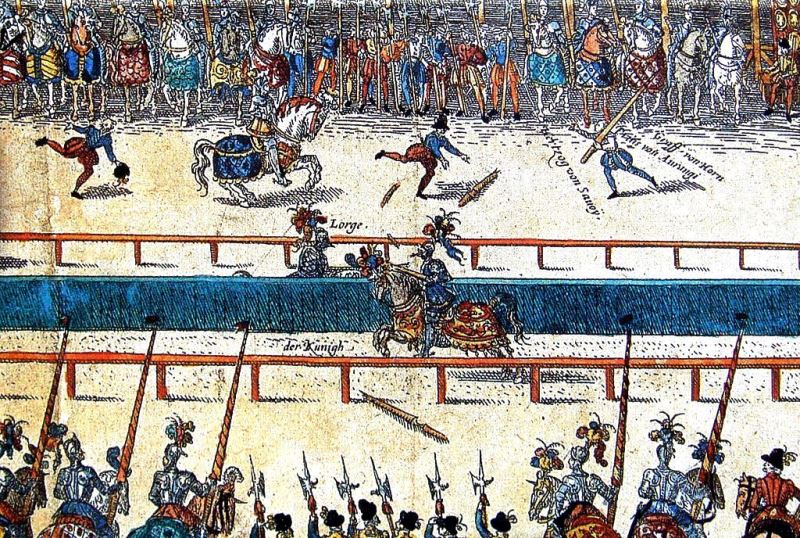
King Henri II of France was accidentally killed in 1559 during a festive tournament when he was lanced in the eye by Gabriel Montgomery, seigneur de Lorges, a member of his Garde Escossaise. A young Italian nobleman named Luigi Corbinelli witnessed the event, and was so profoundly moved by it that he renounced the world and joined the Jesuit order.

The swirling pomp of ceremony, gold
And ermine, banners blazoned in vermilion—
Heraldic pennants waving in the sun
Float high above the lists and the pavilions.

The wedding day of France’s royal daughter
Has packed Parisian streets with festive throngs,
While clanking weapons and the thrum of lutes
Contend with trumpets, bells, and brazen gongs.

The king is flushed, ebullient, in his prime—
A monarch at the pinnacle of pride.
His every gesture summons from the crowd
A roar of hoarse approval. Then there rides

Montgomery to the joust. His face is masked
In gleaming steel; he holds his ribboned lance
Level and ready for the playful tilt.
The lords and commons cheer as horses prance.

The Scotsman’s lance-tip glances off the shield
King Henri holds at some ill-fated angle
And drives right through his visor. In one pass
The king is dead, his brains a bloody tangle.

A shock runs through the city, and then France,
Where death has entered like a silent thief.
A young Italian noble who had come
To take part in this wedding-turned-to-grief

Is stricken to the core. He cannot sleep.
All food is tasteless, every pleasure nil.
He thinks of Henri, vigorous and fit,
Dead for a silly, momentary thrill.

Returning home to Florence, he then deeds
All rights in his estate to a relation,
Presents himself to the Ignatian Order.
When asked, he gives this simple explanation:

“I saw King Henri speared straight through his mask
Of iron, by another masked in steel.
And at that moment I saw through the sham
Of life, and how it hides us from the Real.

We think our vizards tempered, well-wrought, proof—
But they are brittle masks that cannot blunt
The thrust that sends us down to that cold realm
For which life is a flimsy, pasteboard front.”

From Steel Masks (White Violet Press, 2012)


Joseph S. Salemi has published five books of poetry, and his poems, translations and scholarly articles have appeared in over one hundred publications world-wide.  He is the editor of the literary magazine Trinacria. He teaches in the Department of Humanities at New York University and in the Department of Classical Languages at Hunter College.

ShareTweetPin
The Society of Classical Poets does not endorse any views expressed in individual poems or commentary.
Read Our Comments Policy Here

RandomPoems

‘The Swallows of La Cienega’ by Joseph Charles MacKenzie (with Audio)
Beauty

‘The Swallows of La Cienega’ by Joseph Charles MacKenzie (with Audio)

October 12, 2018

  For Elizabeth La Cienega slept on a muted afternoon At old Las Golodrinas, when I spied a nest Of...

‘The Scapegoat’: A Poem by Eric v.d. Luft
Culture

‘The Scapegoat’: A Poem by Eric v.d. Luft

January 17, 2026

  The Scapegoat Their memories select the bad, forget The good. Their hypersensitivity And need for higher maintenance won't let...

Next Post
‘The Course of Empire’ Observations by Reid McGrath

'Tribal Lament' by Lorna Davis

‘A Spirit of Creativity’: Interview with Sally Cook

'A Spirit of Creativity': Interview with Sally Cook

‘Looking Down on Mt. Rushmore’ by John W.L. Toivonen

'Looking Down on Mt. Rushmore' by John W.L. Toivonen

Comments 12

  1. Sally Cook says:
    9 years ago

    As always, Dr. Salemi has struck well below the surface of the meaning of a poem.

    Reply
  2. Yolanda says:
    9 years ago

    Loved every word. reaching, teaching, learning

    Reply
  3. Joseph Charles MacKenzie says:
    9 years ago

    This is precisely it. Anyone can understand the final moral of this poem—who is not a vegetable—without study. And yet, I can say that, even at my current level of scholarship, I enjoy this poem as much for its perfections as for that wonderful invitation it contains, the invitation to look further into history. (I am aware of all things Valois/Poitiers/Medici but not Fr. Lewis Corbinelli—who, I find, appears in a biography on my shelf of St. Alyosis Gonzaga as a friend of this latter.) Salemi I appreciate because he always makes me aware of my scholarly limitations while teaching a great lesson at the same time. Historia magistra vitae. But also, history is everything.

    Truly there is even more here. There is also the ultimate triumph of lyricism in this poem, and that triumph takes place within the reader. Just as Salemi draws us into the pageant and pomp of a very real story, making it all the more real by his versification, he helps us, in our mindless, carnal age, to receive the “shock” that men of a more spiritual time would have experienced.

    But the lyricism is undeniable with the final expression of life’s passing nature, it’s vanity, and the sin of pride that clings to it. Here, we are truly in the realm of classic verse, a continuation of a grand tradition, all very fresh and, as I say—inviting!

    I think Mr. Salemi’s masterpiece a fit subject for meditation, and a haunting one. I might have added the adulterous love interest concerning Diane de Poitiers who is also associated with the all-important lance ribbon. So many stories. Thank you, Mr. Salemi, for opening the treasure chest of history, and with it our minds, in your marvelous works.

    Reply
  4. Kathy F. says:
    9 years ago

    Great poem! I really enjoyed reading it!

    Reply
  5. Hibah Shabkhez says:
    9 years ago

    Wow. Brilliantly written, and very relatable, especially as the incident in question had a rather profound effect on me too when I first read it.

    Reply
  6. James Sale says:
    9 years ago

    Truly, a wonderful poem – the language is economical, evocative and finally conclusive. Poetry revealing the horror of life, and yet with beauty. This kind of poetry should be taught in our schools and colleges.

    Reply
    • Joseph Charles MacKenzie says:
      9 years ago

      Mr. Salemi’s poem can never be taught in our American schools or colleges. By its allusion to Western European culture, it directly conflicts with American public education’s gay, transgender, secularist-communist agenda. As Mao’s “cultural revolution” is the official template of American public education, school and college administrators would automatically condemn Mr. Salemi as a “feudalist” and punish anyone who teaches his poems with termination, defamation, and, eventually, physical attack by an Antifa member “when least expected.”

      Reply
  7. Joseph S. Salemi says:
    9 years ago

    I’m deeply grateful for all of the many comments made on my poem. Thank you all.

    Let me add one thing: J.C. MacKenzie is absolutely right about the vicious left-wing control that obtains in most American colleges and in public education in general. There is a palpable and deeply oppressive hostility towards Christianity, Western culture, white males, heterosexual relations, and anything that is perceived as conservative or traditional. Quite naturally, this carries over into curriculum decisions, pedagogical policy, and even campus atmosphere.

    Academic freedom? There is none. Say anything that someone in a protected c;lass of pampered minorities objects to, and you will be called on the carpet by some “Diversity Committee” composed of vicious inquisitors. This happened just recently to Professor Michael Rectenwald at New York University, and I could mention several other cases from all over the nation.

    The most intolerant persons on the planet are academic left-liberals.

    Reply
    • Joseph Charles MacKenzie says:
      9 years ago

      When I returned from Paris, triumphant, with the finest 30-page biography ever assembled on my then contemporary poet subject, to my department at the University of New Mexico, I found my dissertation director, a grand and important lady of the old Sorbonne, exiled from her own department and replaced by a junta of modernists including a Harvard feminist. I was suddenly alone.

      That year, French was no longer spoken in our French classes and French literature was scarcely read at all at the graduate level with most readings replaced by Russian structuralists, deconstructionists, and African American post-colonialists. The stench of Marx poisoned the air.

      A girl doctoral candidate wrote her dissertation, so she boasted, in two weekends. The subject was how St. Theresa of Avila, in her moments of ecstasy, was being literally and figuratively “raped by God.” At the very same time, my exhaustive dissertation was rejected because I used the name of Christ only once, which automatically made it “a work of theology outside the competence of the committee”—although it was sensu stricto nothing more than straight literary history in the old traditional manner my former director had taught me, and it was in French.

      When I protested, the committee agreed to move forward with the dissertation on two conditions: that I “remove the name of Christ” and “any Christian god” from the body of my text, and that I expunge from my bibliography all references to Catholic Déportés and Résistants, many of whom I painstakingly interviewed in Paris.

      Sitting in a chair before my assembled committee, I told them quite politely to go to hell and walked out of the room. Eight years of hard, expensive work, gone in an instant. And a the girl who boasted that she wrote her dissertation—in English—in only two weekends, was recommended to teach at Harvard as her reward.

      Like Fr. Corinelli, I renounced the world, placed all my papers and effects in a dumpster, and entered the religious life, studying in France, Switzerland, Italy, and back in the States as a cleric in Minor Orders. As it happened, my true vocation was poetry, all along.

      Far more important: Let us pray for Henri de Valois. Does anyone ever think to assist this poor soul? Death had entered his roving eye long before Montgomery’s lance, in his beholding Diane de Poitiers with an adulterous intentions. For, the French are not exempt from original sin as so many of their princes have pretended. In the spirit of Mr. Salemi’s poem, let us always hold our guards aright against the false temptations of this world.

      All tournaments are won by the deflecting angle angle of our shields.

      Reply
      • James Sale says:
        9 years ago

        Thank you for your ripostes to what I thought was a simple assertion: that we should be teaching this kind of poetry in schools and colleges! But I agree that something has gone profoundly wrong with our education system and its values. I am reminded of St Paul’s statement to the Ephesians: “For our struggle is not against flesh and blood, but against the rulers, against the powers, against the world forces of this darkness, against the spiritual forces of wickedness in the heavenly places”. There is a ‘spirit’ in modernism/post-modernism way in excess of the original rationale for its existence (as a protest against excess conservatism); and this spirit is atheistical, implacable, hostile to all forms of goodness, beauty and truth, and especially loves Pilates’ question – ‘What is truth?’ but of course like ‘skipping’ Pilate, never stays for an answer.

        Reply
  8. Luc Ebrewe Dias says:
    9 years ago

    Mr. Salemi, the pacing, phrasing, sentence balance, and diction of your composition are accomplished with skill. Also, thank you for keeping us informed, as in the case of New York University’s treatment of Michael Rectenwald. Your stand is a blessing to American literature.

    Thank you, Mr. MacKenzie, for keeping us informed about intolerance at the University of New Mexico. Such a bizarre reaction to the name of Christ is appalling, their understanding of “any Christian god” an unsurprising demonstration of ignorance, and your reaction, inspiring.

    The attack upon truth, compassion, and forbearance is real, and it is definitely not limited to China.

    Reply
  9. David Hollywood says:
    9 years ago

    Marvelous pace and rhythm and interest.

    Reply

Leave a Reply Cancel reply

Your email address will not be published. Required fields are marked *


  1. Theresa Villarreal on The Society of Classical Poets 2026 Haiku CompetitionSeptember 4, 2026

    1.)A Lonely Café by Theresa Maria Villarreal A busy café Lonely woman, coffee cup Birthday card alone 2.) The Woods…

  2. C.B. Anderson on ‘A Potpourri of Aphoristic Verses’ by C.B. AndersonSeptember 4, 2026

    When you go to McDonald's, Paul, don't order the nuggets. And always keep dog treats in your pocket -- most…

  3. C.B. Anderson on ‘A Potpourri of Aphoristic Verses’ by C.B. AndersonSeptember 4, 2026

    Sometimes, Norma, blinkers are called blinders, and rightly so. But no one should take my advice at face value. Test…

  4. C.B. Anderson on ‘A Potpourri of Aphoristic Verses’ by C.B. AndersonSeptember 4, 2026

    You have my express permission, Yael, to republish these couplets in any form and for any purpose you choose. I'm…

  5. C.B. Anderson on ‘A Potpourri of Aphoristic Verses’ by C.B. AndersonSeptember 4, 2026

    And that is why, Cynthia, sweaters are not always made of wool; sometimes they make them out of cotton, but…

Subscribe to Daily Poems

Enter your email address to subscribe to this blog and receive notifications of new posts by email.

Join 1,635 other subscribers

Recent Poems

  • ‘The Cristero Centennial’: A Poem by Margaret Coats
  • ‘A Potpourri of Aphoristic Verses’ by C.B. Anderson
  • ‘The Estuary’: A Poem by Jeff Eardley
  • ‘A World Without the Wednesday Child’: A Poem by Kimberly Fore
  • The 2026 Society of Classical Poets International Poetry Competition
  • The 2026 SCP International High School Poetry Competition
  • ‘Realistic Reflections’ and Other Poetry by Anna J. Arredondo
  • ‘China Made’: A Poem by Theresa Werba
  • ‘The Savage Moon’ and Other Poetry by Brian Yapko
  • Poetry Book Review: Love Found, Yearned For, and Lost by James A. Tweedie
  • ‘When Opportunity Knocks’: A Poem by Roy E. Peterson
  • ‘Legend of the Griffin’: A Poem by Iryna Hall
  • ‘Government Issue’ and Other Poems by Joseph S. Salemi
  • ‘Chaucer Announces His Desire to Retire’: A Poem by Paul A. Freeman
  • ‘Advantages of Restaurants’ and Other Poems by Russel Winick
  • ‘Bone China’: A Poem by Mary Gardner
  • ‘On the Death of One Too Young to Die’: A Poem by Jeffrey Essmann
  • ‘This Too Shall Pass’ and Other Poetry by Justin Dasher
  • ‘Humdrum and Harum-Scarum’: A Lecture on Free Verse, by Robert Bridges (1922)
  • ‘Unrest On the Floodplain’: A Poem by Bhikkhu Nyanasobhano
  • ‘Latitude and Loss’: A Poem by Martin Briggs
  • ‘Act III’ and Other Poetry by C.B. Anderson
  • ‘God’s Funeral’: A Poem by James Sale
  • ‘Star Festival’: A Poem by Margaret Coats
  • ‘Song of the Frog Princess’: A Poem by Scharlie Meeuws
  • ‘The Odyssey: Nolan and Solot Compared’: An Essay by Michael Curtis
  • ‘Solitude’ and Other Poems by Mary Jane Myers
  • ‘The River Not Taken’ and Other Poetry by Brian Yapko
  • ‘Totentanz’: A Poem by James A. Tweedie
  • ‘In God Is Our Trust’: A Poem by Roy E. Peterson

Categories

  • Acrostic
  • Alexandroid
  • Alliterative
  • Art
  • Best Poems
  • Blank Verse
  • Chant Royal
  • Classical Poets Live
  • Clerihew
  • Covid-19
  • Deconstructing Communism
  • Educational
  • Epic
  • Epigrams and Proverbs
  • Essays
    • Interviews with Poets
    • Poetry Reviews
  • Featured
  • From the Society
  • Great Poets
    • Dante Alighieri
    • Edgar Allan Poe
    • Emily Dickinson
    • Geoffrey Chaucer
    • Henry Wadsworth Longfellow
    • Homer
    • John Keats
    • John Milton
    • Robert Frost
    • William Blake
    • William Shakespeare
    • William Wordsworth
  • Human Rights in China
  • Limerick
  • Love Poems
  • Music
  • Pantoum
  • Performing Arts
  • Poetry
    • Beauty
    • Children's Poems
    • Culture
    • Ekphrastic
    • Found Poems
    • High School Poets
    • Humor
    • Riddles
  • Poetry Challenge
  • Poetry Contests
  • Poetry Forms
    • Curtal Sonnet
    • Haiku
  • Poetry Readings
  • Rhupunt
  • Rondeau
  • Rondeau Redoublé
  • Rondel
  • Rubaiyat
  • Sapphic Verse
  • Satire
  • Science
  • Sestina
  • Shape Poems
  • Short Stories
  • Song Lyrics
  • Sonnet
  • Symposium
  • Terrorism
  • Terza Rima
  • The Environment
  • Translation
  • Triolet
  • Video
  • Villanelle

Quick Links

  • About Us
  • Submit Poetry
  • Become a Member
  • Members List
  • Support the Society
  • Advertisement Placement
  • Comments Policy
  • Terms of Use

Welcome Back!

Login to your account below

Forgotten Password?

Retrieve your password

Please enter your username or email address to reset your password.

Log In
No Result
View All Result
  • Poems
    • Beauty
    • Culture
    • Satire
    • Humor
    • Children’s
    • Art
    • Ekphrastic
    • Epic
    • Epigrams and Proverbs
    • Human Rights in China
    • Music
    • Performing Arts
    • Riddles
    • Science
    • Song Lyrics
    • The Environment
    • The Raven
    • Found Poems
    • High School Poets
    • Terrorism
    • Covid-19
  • Poetry Forms
    • Sonnet
    • Haiku
    • Limerick
    • Villanelle
    • Rondeau
    • Pantoum
    • Sestina
    • Triolet
    • Acrostic
    • Alexandroid
    • Alliterative
    • Blank Verse
    • Chant Royal
    • Clerihew
    • Rhupunt
    • Rondeau Redoublé
    • Rondel
    • Rubaiyat
    • Sapphic Verse
    • Shape Poems
    • Terza Rima
  • Great Poets
    • Geoffrey Chaucer
    • Emily Dickinson
    • Homer
    • Henry Wadsworth Longfellow
    • Dante Alighieri
    • John Keats
    • John Milton
    • Edgar Allan Poe
    • William Shakespeare
    • William Wordsworth
    • William Blake
    • Robert Frost
  • Love Poems
  • Contests
  • SCP Academy
    • Educational
    • Teaching Classical Poetry—A Guide for Educators
    • Poetry Forms
    • The SCP Journal
    • Books

© 2025 SCP. WebDesign by CODEC Prime.