


• Submit Poetry
  • Support SCP
  • About Us
  • Members
  • Join
Saturday, July 18, 2026
Society of Classical Poets
  • Poems
    • Beauty
    • Culture
    • Satire
    • Humor
    • Children’s
    • Art
    • Ekphrastic
    • Epic
    • Epigrams and Proverbs
    • Human Rights in China
    • Music
    • Performing Arts
    • Riddles
    • Science
    • Song Lyrics
    • The Environment
    • The Raven
    • Found Poems
    • High School Poets
    • Terrorism
    • Covid-19
  • Poetry Forms
    • Sonnet
    • Haiku
    • Limerick
    • Villanelle
    • Rondeau
    • Pantoum
    • Sestina
    • Triolet
    • Acrostic
    • Alexandroid
    • Alliterative
    • Blank Verse
    • Chant Royal
    • Clerihew
    • Rhupunt
    • Rondeau Redoublé
    • Rondel
    • Rubaiyat
    • Sapphic Verse
    • Shape Poems
    • Terza Rima
  • Great Poets
    • Geoffrey Chaucer
    • Emily Dickinson
    • Homer
    • Henry Wadsworth Longfellow
    • Dante Alighieri
    • John Keats
    • John Milton
    • Edgar Allan Poe
    • William Shakespeare
    • William Wordsworth
    • William Blake
    • Robert Frost
  • Love Poems
  • Contests
  • SCP Academy
    • Educational
    • Teaching Classical Poetry—A Guide for Educators
    • Poetry Forms
    • The SCP Journal
    • Books
No Result
View All Result
Society of Classical Poets
  • Poems
    • Beauty
    • Culture
    • Satire
    • Humor
    • Children’s
    • Art
    • Ekphrastic
    • Epic
    • Epigrams and Proverbs
    • Human Rights in China
    • Music
    • Performing Arts
    • Riddles
    • Science
    • Song Lyrics
    • The Environment
    • The Raven
    • Found Poems
    • High School Poets
    • Terrorism
    • Covid-19
  • Poetry Forms
    • Sonnet
    • Haiku
    • Limerick
    • Villanelle
    • Rondeau
    • Pantoum
    • Sestina
    • Triolet
    • Acrostic
    • Alexandroid
    • Alliterative
    • Blank Verse
    • Chant Royal
    • Clerihew
    • Rhupunt
    • Rondeau Redoublé
    • Rondel
    • Rubaiyat
    • Sapphic Verse
    • Shape Poems
    • Terza Rima
  • Great Poets
    • Geoffrey Chaucer
    • Emily Dickinson
    • Homer
    • Henry Wadsworth Longfellow
    • Dante Alighieri
    • John Keats
    • John Milton
    • Edgar Allan Poe
    • William Shakespeare
    • William Wordsworth
    • William Blake
    • Robert Frost
  • Love Poems
  • Contests
  • SCP Academy
    • Educational
    • Teaching Classical Poetry—A Guide for Educators
    • Poetry Forms
    • The SCP Journal
    • Books
No Result
View All Result
Society of Classical Poets
No Result
View All Result
Home Poetry Beauty

‘The Beginning of Wisdom’ by T.M.A. Day

September 12, 2022
in Beauty, Culture, Poetry
A A
10
poems 'The Beginning of Wisdom' by T.M.A. Day

.

The Beginning of Wisdom

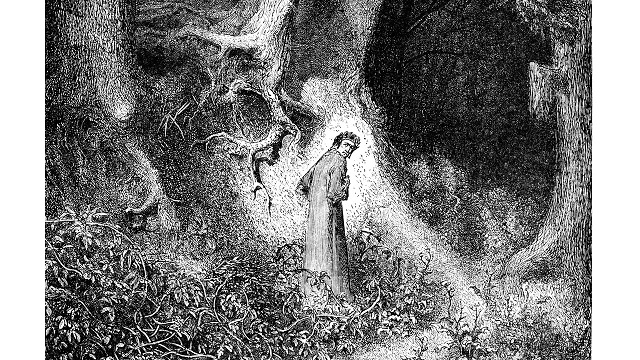
Within the passing noon of our own life,
I saw through woodlands dark and traces grim,
Those words upon the graven arches rim,
Whose clarity compounds immortal strife.
They claimed their maker was that power divine,
The highest wisdom and the primal love,
Who makes and moves the sun and stars above,
And set this portal deep below the brine.
Great gates of steel lay broken to the side,
Their hinges warped and bent as at a blow.
Rude barricades scarce filled a gap so wide,
That any soul who pleased might come or go.
And the remains of men who have just died,
Were urged by frantic whispers not to slow.

.

.

T.M.A. Day is in formation for the Catholic priesthood in the Archdiocese of Indianapolis, Indiana.
ShareTweetPin
The Society of Classical Poets does not endorse any views expressed in individual poems or commentary.
Read Our Comments Policy Here

RandomPoems

‘Barabbas’: An Easter Poem by Susan Jarvis Bryant
Poetry

‘Barabbas’: An Easter Poem by Susan Jarvis Bryant

April 5, 2026

  Barabbas They named their chosen one and set him free. They picked a thug who reeked of others’ blood....

On Alma Tadema’s Coign of Vantage and Other Poetry by Mary Jane Myers
Art

On Alma Tadema’s Coign of Vantage and Other Poetry by Mary Jane Myers

January 24, 2023

. . On Alma Tadema’s Coign of Vantage Flora peeks over the marble parapet, a dizzying perch above the azure...

Next Post
A Poem on Drug Abuse: ‘An American Tragedy’ by Phil S. Rogers

A Poem on Drug Abuse: 'An American Tragedy' by Phil S. Rogers

‘Obedience’ by Giuseppe Gioachino Belli, Translated by Joseph S. Salemi (with a Long Note)

'Obedience' by Giuseppe Gioachino Belli, Translated by Joseph S. Salemi (with a Long Note)

‘The Salt Spring Island Trolls’ by Norma Pain

'The Salt Spring Island Trolls' by Norma Pain

Comments 10

  1. Richard Craven says:
    4 years ago

    A devotional Petrarchan sonnet. Very polished and technically adept, and an accomplishment to be proud of (at least if you hadn’t taken holy orders!). One minor point: is there a particular reason why you’ve written “have” rather than “had” in the penultimate line?

    Reply
    • T.M.A. Day says:
      4 years ago

      Thank you! A good point on have v.s. had – I thought that it would convey a greater sense of immediacy as the poem progressed, but now I am second guessing it.

      Reply
  2. Roy E. Peterson says:
    4 years ago

    The image that came to my mind was of a decrepit cemetery with the concept that earthly interment is for the mortal body, but the tombstones herald the beginning of wisdom.

    Reply
  3. Paul Freeman says:
    4 years ago

    An intriguing piece with a number of interpretations which I’ll be sifting through.

    Thanks for the read.

    Reply
  4. T.M.A. Day says:
    4 years ago

    N.B. – It might be helpful to open up to Inferno, Canto III, in whatever version of Dante you have around.

    Reply
  5. Cynthia Erlandson says:
    4 years ago

    I think this is both a marvelous poem in its own right, and also such a good echo of Dante that it could be mistaken for his writing.

    Reply
  6. Geoffrey S. says:
    4 years ago

    Why is it “the passing noon of our own life” instead of “the passing noon of my own life” given that in the next line you refer to “I”? The Petrarchan sonnet is a good choice for a poem reflecting Dante, but it doesn’t strictly adhere to the abbaabba rhyme scheme in the octet. Is there a reason for the variation?

    Reply
    • T.M.A. Day says:
      4 years ago

      The plural in the first line is a reference to the first line of the Comedy, which is normally translated to the effect of: “Mid-way through the journey of our life,” before switching to the singular.

      As for the variation, it was more the fact that I wanted the second quartet to mirror as strongly as possible a line and a half from Canto III while referencing the last line of the whole Comedy, “the Love which moves the sun and other stars.”

      Reply
  7. Satyananda Sarangi says:
    4 years ago

    Greetings!

    This is ethereal! The cadence was adept – each word had its importance. Awe inspiring stuff.

    Thank you for this poem.

    Reply
  8. Margaret Coats says:
    4 years ago

    For this to be a sonnet in its own right, it can’t depend so much on Dante that the poem makes no statement of its own about the beginning of wisdom. “Any soul who pleased might come or go” seems to be that statement. Sin and hell are not inevitable. However, I find the idea obscured both by the Dantesque atmosphere, and by common-sense Christian faith applied to the sonnet situation. By the atmosphere, I mean the sonnet ending with frantic whispers, seeming to emerge from hell, and urging souls to hurry up and enter. That makes sense insofar as it contributes to the terror of Dante, a temporary visitor who will see hell and report on its horrors. Common sense, though, says that the souls of the deceased enter hell by choices made during life. They have no choice after death, and cannot go out again if they please. The sonnet’s pronouncement about the beginning of wisdom is addressed only to the living with choices still to make. Hell does its best to make that unclear. Having come back to read this poem a number of times, I take it the hellish lack of clarity is intentional, but I find that the darkness achieved leaves the reader looking for the wisdom.

    The “portal deep below the brine” could also be a confusing detail. Of course, you mean Dante puts hell beneath the surface of the earth, but an underwater scene comes to mind. Looking at Canto III, I see that Dante wisely refers to air.

    Reply

Leave a Reply Cancel reply

Your email address will not be published. Required fields are marked *

  1. Marguerite on ‘When the Phone Rings’ and Other Short Poems by Russel WinickJuly 18, 2026

    Amen on "Apologies!"

  2. Susan Jarvis Bryant on ‘My Pyjamas!’ and Other Poems by Susan Jarvis BryantJuly 18, 2026

    Jan, thank you very much for your encouraging comment. I'm so glad you enjoyed the poems and especially glad they…

  3. James Sale on ‘The 51st State’: A Poem by James SaleJuly 18, 2026

    Not quite a win, Theresa, but thank you for the thought, and congratulations yourself on your "Finalist' status for your…

  4. Susan Jarvis Bryant on National Poetry Month Limerick ChallengeJuly 18, 2026

    Beautifully written and hilarious, Jan! You have inspired me to have a go. Thank you!

  5. Jan Mennite on ‘My Pyjamas!’ and Other Poems by Susan Jarvis BryantJuly 18, 2026

    Susan, I always feel that my poetic intelligence increases while I read your work. I laughed and learned and felt…

Subscribe to Daily Poems

Enter your email address to subscribe to this blog and receive notifications of new posts by email.

Join 1,594 other subscribers

Recent Poems

  • Winners and Rankings of The Great American Poetry Competition
  • ‘The Gold Star Mother’: A Poem by Gerard Maritato
  • ‘An American Dash’: A Poem by Linda Ellis
  • ‘The Anonymous Soldier’: A Poem by Lucy Lind
  • ‘For Those We Never Meet’: A Poem by Aneesh Agarwal
  • ‘Ben Franklin’s Copper Fugio Cent’: A Poem by Geoffrey Smagacz
  • Three Brief Poems by Luxorius, Translated by Joseph S. Salemi
  • ‘The American Spirit’: A Poem by Dusty Grein
  • ‘The Ballad of Zebulon Pike’: A Poem by M.D. Skeen
  • ‘We Are the Ones’ and Other Poetry by Cheryl Corey
  • ‘My Pyjamas!’ and Other Poems by Susan Jarvis Bryant
  • ‘A Snowy Egret’: A Poem by Bruce Dale Wise
  • ‘The Swearing-in of Calvin Coolidge’: A Sonnet by Robert W. Crawford
  • ‘Ballad of the Sequoia’: A Poem by Lauren V. Leon
  • ‘The 51st State’: A Poem by James Sale
  • ‘La Uva’ (The Grape): A Poem by Michael Pietrack
  • ‘There’s Blood that Flows Within the Stripes’: A Poem by Lauren V. Leon
  • ‘Birdsong’: A Poem by Jeffrey Essmann
  • ‘The Melody That Lingers On’ and Other Poetry by John McPherson
  • ‘American Dreams’: A Poem by Adam Sedia
  • ‘An American Fabius’: A Poem by John Hernandez
  • ‘Vernal Clinic’ and Other Poetry by C.B. Anderson
  • ‘Omaha Beach’ and Other Poetry by Bradford Skow
  • ‘Music to Part the Veil’: A Poem by T.M. Moore
  • ‘A Gentleman’s Guide to Losing a War’ and Other Poetry by Arnon Peterson
  • ‘Black Shuck’: A Poem by Martin Briggs
  • ‘When the Last World War II Veteran Passes Away’: A Poem by N.S. Boone
  • ‘A Fallow Year at Worthy Farm’: A Poem by Paul A. Freeman
  • ‘Outstanding in Afghanistan’: A Poem by Jared S. Chang
  • ‘250 More’: A Poem by Miguel Moreno

Categories

  • Acrostic
  • Alexandroid
  • Alliterative
  • Art
  • Best Poems
  • Blank Verse
  • Chant Royal
  • Classical Poets Live
  • Clerihew
  • Covid-19
  • Deconstructing Communism
  • Educational
  • Epic
  • Epigrams and Proverbs
  • Essays
    • Interviews with Poets
    • Poetry Reviews
  • Featured
  • From the Society
  • Great Poets
    • Dante Alighieri
    • Edgar Allan Poe
    • Emily Dickinson
    • Geoffrey Chaucer
    • Henry Wadsworth Longfellow
    • Homer
    • John Keats
    • John Milton
    • Robert Frost
    • William Blake
    • William Shakespeare
    • William Wordsworth
  • Human Rights in China
  • Limerick
  • Love Poems
  • Music
  • Pantoum
  • Performing Arts
  • Poetry
    • Beauty
    • Children's Poems
    • Culture
    • Ekphrastic
    • Found Poems
    • High School Poets
    • Humor
    • Riddles
  • Poetry Challenge
  • Poetry Contests
  • Poetry Forms
    • Curtal Sonnet
    • Haiku
  • Poetry Readings
  • Rhupunt
  • Rondeau
  • Rondeau Redoublé
  • Rondel
  • Rubaiyat
  • Sapphic Verse
  • Satire
  • Science
  • Sestina
  • Shape Poems
  • Short Stories
  • Song Lyrics
  • Sonnet
  • Symposium
  • Terrorism
  • Terza Rima
  • The Environment
  • Translation
  • Triolet
  • Video
  • Villanelle

Quick Links

  • About Us
  • Submit Poetry
  • Become a Member
  • Members List
  • Support the Society
  • Advertisement Placement
  • Comments Policy
  • Terms of Use

Welcome Back!

Login to your account below

Forgotten Password?

Retrieve your password

Please enter your username or email address to reset your password.

Log In
No Result
View All Result
  • Poems
    • Beauty
    • Culture
    • Satire
    • Humor
    • Children’s
    • Art
    • Ekphrastic
    • Epic
    • Epigrams and Proverbs
    • Human Rights in China
    • Music
    • Performing Arts
    • Riddles
    • Science
    • Song Lyrics
    • The Environment
    • The Raven
    • Found Poems
    • High School Poets
    • Terrorism
    • Covid-19
  • Poetry Forms
    • Sonnet
    • Haiku
    • Limerick
    • Villanelle
    • Rondeau
    • Pantoum
    • Sestina
    • Triolet
    • Acrostic
    • Alexandroid
    • Alliterative
    • Blank Verse
    • Chant Royal
    • Clerihew
    • Rhupunt
    • Rondeau Redoublé
    • Rondel
    • Rubaiyat
    • Sapphic Verse
    • Shape Poems
    • Terza Rima
  • Great Poets
    • Geoffrey Chaucer
    • Emily Dickinson
    • Homer
    • Henry Wadsworth Longfellow
    • Dante Alighieri
    • John Keats
    • John Milton
    • Edgar Allan Poe
    • William Shakespeare
    • William Wordsworth
    • William Blake
    • Robert Frost
  • Love Poems
  • Contests
  • SCP Academy
    • Educational
    • Teaching Classical Poetry—A Guide for Educators
    • Poetry Forms
    • The SCP Journal
    • Books

© 2025 SCP. WebDesign by CODEC Prime.








