


The Sparrow
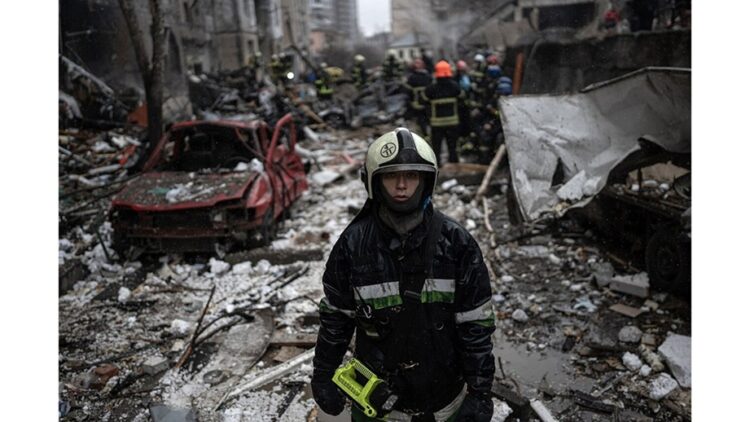
It started in the dark and early hours.
Kyiv—asleep, enjoying blissful dreams.
Then missiles streaked. Explosions. Debris showers.
Smashing walls and windows. Sirens. Screams.
Ivan recalled this, walking Podil’s streets.
No patrons enjoying coffee and cigarettes.
Abandoned stores were still. Some rubble heaps.
He wept to see the dusty sign of Horobets.
His chocolate shop, untouched, was somehow spared
and just as he had left it weeks before.
He slowly climbed the three familiar stairs,
welcomed by the bells upon the door.
The smells of char and plaster were replaced
by toasted chocolate—now more bittersweet,
and for a moment, the war had been erased,
until he turned and looked out at the street.
Atop a mound of broken cinder blocks,
a sparrow found a twisted rebar branch
and perched as if the world had never stopped,
as though tomorrow still possessed a chance.
Ivan turned back and faced his little shop.
He tied his apron, ignoring roaring rockets.
Despite the sirens and machine gun pops,
he said, “Still someone has to make the chocolate.”
Michael Pietrack is a poet based in Grand Junction, Colorado. He is known for his narrative poetry and novels written in verse, including Legacy: The Saga Begins (2023) and Boone (2026). He has placed three times in the Society of Classical Poets International Competition with “Ballerina,” “The Loons of Colby Lake,” and “Grindstone.”
















Your poetry is getting better and better Michael – this is very powerful, and I love the final ‘dissonant’ rhyme of ‘rockets/chocolate’ – deeply excellent work.
Thank you, James. Thanks for noticing the growth—it’s because of mentors like you!
A realistic and convincing sketch, Michael. I particularly like the way the sparrow of the title only makes an appearance in the penultimate stanza, as a harbinger of hope. Very clever.
Thank you for the note of appreciation for the poem.
And yes, sometimes the smallest thing, like a sparrow, can fill us with hope and move us into action.
Lovely poem and well-read.
Thank you! I think if classical poetry is going to survive, it needs to come off the page and be heard and animated to meet people where they are today.
I liked the poem very much and I strongly agree with what you just wrote on classical poetry. In health and medicine, education, nature, war and peace, etc: Where people are today.
I liked your most recent poems too. Chemo refusal especially would make an incredible video. I’d be happy to help you with it.
Thanks! This is super generous of you. Please email me at [email protected]
I remember when Kyiv was Kiev under the Soviets and strolling the streets in more peaceful times. You have caught the images of what it is like today with a sparrow on the rebar and life still going on despite Russian belligerence. Well thought out message interspersed with Ukrainian imagery.
Thank you. I was at a work conferences, where I was meeting with delegates from some 30 countries. And the Ukrainian rep brought chocolate. I asked her where they were from, and she looked at me puzzled. She said, “Ukraine, of course.” I replied, “Someone is still making chocolate?” She had a far off look and said, “Someone has to.” And the poem was born…
Sparrows and chocolate. Such delicate links to the survival of the human spirit. It adds another hopeful note to man’s search for meaning. For me, a very meaningful poem Michael. Thank you
It makes me more than happy to know that it was meaningful to you. Isn’t that what poetry is all about?
I just opened a tin if chocolate-covered sparrows, and they were excellent. The ones inhabiting my backyard prefer unadorned seeds. One thing is sure: Weeds prosper as well in times of war just as well as they do in times of peace, and birds don’t much care whether they perch on tree branches or ribbed steel.
True. Life carries on. And so must we.
An extraordinary story, Michael. The sparrow as emblem for Ivan is just too good. Ordinary man, ordinary bird in the same situation, with the soul-shaking distinction of human knowledge and decision-making capacity. Still, Ivan, capable of judgment–and having the immense good fortune of finding his old perch available–in effect decides to be the sparrow and carry on. Each of the three times “chocolate” is spoken, your poem takes on a happy touch, confirming Ivan’s forward-looking resolve after coming through tears of stunned shock. Chocolate outdoes the lost coffee and cigarettes. As final word, it’s the material victory over rockets.
It’s such a joy to be so well understood. Thank you for the note and perfect explanation of the message.
Lovely poem, Michael. I’m always drawn toward poems that show the stark, poignant contrasts of beauty, like your sparrow, with the ugliness and misery in the world.
We humans sure have made a mess of things.
Thanks for the note. I appreciate your poetry too and look forward to your next one.
Michael–
What a wonderful poem.
You have written six stanzas of masterful cross-rhymed iambic pentameter. The narrator employs precise descriptive details to give the reader a gut-wrenching glimpse of war’s devastation. Yet, in a tribute to the life-force of living creatures (both birds and men) the narrator ends on a positive note.
The scene is set: a chocolate-maker returns to his Kyev neighborhood several weeks after it has been bombed. He discovers that the area has suffered significant damage, but that his shop has been spared. He notices that ‘a sparrow found a twisted rebar branch and perched as if the world had never stopped…’ This little creature renews the man’s spirit, and ‘he tied his apron… said, “Still someone has to make the chocolate.”’ So very moving, and so inspirational to a reader.
Note: I researched the name “Horobets”—its etymology is “sparrow”—what lovely subtlety.
Note: (Personal experience in 2022): On the Etsy website, I bought excellent leather goods from a skilled Ukrainian craftsman. His shop (attached to his family’s living quarters) in Kyev was destroyed. He e-mailed all his worldwide clients, and we grieved with him. The war suddenly was so very personal. I wonder: has he been able to rebuild his life?
Most sincerely
Mary Jane (Myers)
Mary Jane, you’re the first person to get the connection of Horobets. That connection is what make the sparrow on top of the rebar all the more powerful. I’m so glad you caught it and enjoyed the poem.
Michael,
I greatly enjoyed reading your poem. The visual imagery of the bird on the rebar branch was a great touch. I love the ending and it’s fascinating that your work encounter spurred the creation of this poem; a reminder for all of us to be open to the muse. Thanks for sharing.
Paul, yes, a poet sees the poem in the everyday thing, even a brief encounter. BTW–the chocolate was awesome!