• Submit Poetry
  • Support SCP
  • About Us
  • Members
  • Join
Friday, September 4, 2026
Society of Classical Poets
  • Poems
    • Beauty
    • Culture
    • Satire
    • Humor
    • Children’s
    • Art
    • Ekphrastic
    • Epic
    • Epigrams and Proverbs
    • Human Rights in China
    • Music
    • Performing Arts
    • Riddles
    • Science
    • Song Lyrics
    • The Environment
    • The Raven
    • Found Poems
    • High School Poets
    • Terrorism
    • Covid-19
  • Poetry Forms
    • Sonnet
    • Haiku
    • Limerick
    • Villanelle
    • Rondeau
    • Pantoum
    • Sestina
    • Triolet
    • Acrostic
    • Alexandroid
    • Alliterative
    • Blank Verse
    • Chant Royal
    • Clerihew
    • Rhupunt
    • Rondeau Redoublé
    • Rondel
    • Rubaiyat
    • Sapphic Verse
    • Shape Poems
    • Terza Rima
  • Great Poets
    • Geoffrey Chaucer
    • Emily Dickinson
    • Homer
    • Henry Wadsworth Longfellow
    • Dante Alighieri
    • John Keats
    • John Milton
    • Edgar Allan Poe
    • William Shakespeare
    • William Wordsworth
    • William Blake
    • Robert Frost
  • Love Poems
  • Contests
  • SCP Academy
    • Educational
    • Teaching Classical Poetry—A Guide for Educators
    • Poetry Forms
    • The SCP Journal
    • Books
No Result
View All Result
Society of Classical Poets
  • Poems
    • Beauty
    • Culture
    • Satire
    • Humor
    • Children’s
    • Art
    • Ekphrastic
    • Epic
    • Epigrams and Proverbs
    • Human Rights in China
    • Music
    • Performing Arts
    • Riddles
    • Science
    • Song Lyrics
    • The Environment
    • The Raven
    • Found Poems
    • High School Poets
    • Terrorism
    • Covid-19
  • Poetry Forms
    • Sonnet
    • Haiku
    • Limerick
    • Villanelle
    • Rondeau
    • Pantoum
    • Sestina
    • Triolet
    • Acrostic
    • Alexandroid
    • Alliterative
    • Blank Verse
    • Chant Royal
    • Clerihew
    • Rhupunt
    • Rondeau Redoublé
    • Rondel
    • Rubaiyat
    • Sapphic Verse
    • Shape Poems
    • Terza Rima
  • Great Poets
    • Geoffrey Chaucer
    • Emily Dickinson
    • Homer
    • Henry Wadsworth Longfellow
    • Dante Alighieri
    • John Keats
    • John Milton
    • Edgar Allan Poe
    • William Shakespeare
    • William Wordsworth
    • William Blake
    • Robert Frost
  • Love Poems
  • Contests
  • SCP Academy
    • Educational
    • Teaching Classical Poetry—A Guide for Educators
    • Poetry Forms
    • The SCP Journal
    • Books
No Result
View All Result
Society of Classical Poets
No Result
View All Result
Home Poetry Beauty

‘Transhumanism’ and Other Poetry by Joe Spring

January 24, 2019
in Beauty, Culture, Humor, Poetry, Science
A A
10
poems 'Transhumanism' and Other Poetry by Joe Spring

Transhumanism

Somewhere about there’s a slithering sound of man’s enmity,
causing excitement and casting the seeds of calamity,
claiming enlightened revision of old postmodernity.
Oh! But the thought is as novel as man in eternity.

Lewis and Ransom have shown us to view the transhumanists
in the same light as Mark Studdock and Feverstone’s futurists:
some are as wholly committed as Babylon’s atheists;
others are following blindly the lure of these dataists.

Tempted to self-exultation, they’re striving for deity;
how can this hideous fate be the talk of society?
Dreams that dilute all the values and truth of humanity,
genuine glory exchanged for a dead singularity.


Forgive Me, Dactyl

(see Pentadactyl)

Thinking again about dactyls and how they don’t tolerate
stress out of place or the sneaky insertion of syllables,
gladly and humbly I wonder, perhaps I should moderate
poetry calling them dinosaurs, bigots and imbeciles.

P’raps we should think of a dactyl as champion of chastity,
raising the banner of vehement structural sanctity,
hating the sin of iambic compulsion of poetry,
leading the poet in pathways of diligent purity.


Joe Spring lives and works in Johannesburg, South Africa. For more information please visit www.joespringwrites.com.

ShareTweetPin
The Society of Classical Poets does not endorse any views expressed in individual poems or commentary.
Read Our Comments Policy Here

RandomPoems

‘The Senior Covid Blues’ by Lee Goldberg
Covid-19

‘The Senior Covid Blues’ by Lee Goldberg

February 3, 2021

. The Senior Covid Blues I have read many articles about the virus particles that swirl about and sneak into...

‘Returning Soldiers’: An Armistice Day Poem by Paul A. Freeman
Beauty

‘Returning Soldiers’: An Armistice Day Poem by Paul A. Freeman

November 10, 2023

. Returning Soldiers With hedgerows, fields and trees the soldiers of a forward trench have rested with unease, reduced beyond...

Next Post
‘Common Language’ and Other Poetry by Mike Ruskovich

'Common Language' and Other Poetry by Mike Ruskovich

‘Tiger Fire’ by Sally Sandler

'Tiger Fire' by Sally Sandler

‘Going Along to Get Along’ by Joseph S. Salemi

'Going Along to Get Along' by Joseph S. Salemi

Comments 10

  1. Joe Tessitore says:
    8 years ago

    What a pair – of poems, that is!

    “dinosaurs, bigots and imbeciles” is spectacular, and a great way to start the day!

    Reply
    • Joe Spring says:
      8 years ago

      Thanks, Joe!

      Reply
  2. Michael Dashiell says:
    8 years ago

    I read a little about Transhumanism. It began with Decartes it seems but has now extended to a computer view of the world, that we’re all programs created by cosmic overlords. It hopes we’ll be rendered an afterlife, yet it too a program. I think it’s original yet far fetched, and has no more credibility that established religion. I sounds more like a side effect of our dependency on and wide and personal relationship with computers.

    Reply
    • Joe Spring says:
      8 years ago

      Yes, it’s taken a few forms, and is certainly nothing new. Transhumanism is not synonymous with the Singularity concept, but they’re quite closely paired in this latest manifestation. As I listened to some explanations and arguments around the topic, it made me think of CS Lewis’s “That Hideous Strength”, a modern Babylonian problem. Will it happen? No. Does that make it a harmless philosophy? No.

      Reply
  3. C.B. Anderson says:
    8 years ago

    I thought the rhymes in both poems were rather sketchy I won’t go into detail, because I have commented on similar infelicities in the past. Either you see it, or you don’t.

    Reply
    • Joe Spring says:
      8 years ago

      Hi CB.

      Thanks for your feedback. I don’t think you need to be as dismissive as “either you see it, or you don’t.” Please don’t tire of constructive criticism. There’s more hope than that, as we edify each other.

      Where near-rhymes pop up in our society’s poetry, perhaps we can consider which ones are intentional, which ones are tolerable, and which ones are erroneous (which should be tested by asking the poet, “did you think this rhymed perfectly?”). Would you draw the line of classical poetry at strict, perfect rhyme? I’m concerned that if we only accept perfect rhymes, we might never touch topics like “enmity”, and we’d be stuck on old topics of loves and doves.

      As it is, I feel that there is sufficient phonetic beauty in the line-endings to keep the listener engaged in what’s being said – and is this the primary purpose of our art?

      Reply
      • Joe Spring says:
        8 years ago

        *and is this not the primary purpose of our art?

        Reply
      • Joe Tessitore says:
        8 years ago

        I appreciate your response.
        I, who write like a precision instrument, truly appreciate others who don’t.
        I often wish that I could follow my own advice:

        Be like the Dervish
        in his trance;
        Set free your words
        and watch them dance.

        Reply
      • C.B. Anderson says:
        8 years ago

        All right, then.

        1.
        enmity/calamity: what’s being rhymed here is -ty/-ty, which is, I’m sure you will admit, a rather trivial rhyme. -mity/-mity does not really obtain because “-mi-” is an unstressed syllable and, as such, cannot really carry a rhyme. calamity/amity is better because the stressed lam/am would carry the load, with
        -ity simply being the extension of each word.

        modernity/eternity works well enough.

        In the second stanza ists/ists/ists/ists is again trivial. It’s probably a bad idea in general to use standard suffixes as a rhyming element. I’m not speaking to slant rhyme here, but just to the mechanics of creating strong rhymes.

        And then we have -y/-y/-y/-y, with the same objections as noted above. Good rhymes for the end words you have chose might be deity(if pronounced with a long “a”)/laity, society/piety, humanity/urbanity, singularity/charity.

        To touch on slant rhymes, how about tragedy/strategy? You could look at as a rhyme of -dy/-gy, but also note that every syllable assonates with its counterpart, with the consonants interchanged.

        2.
        I find the rhymes in the first stanza charming in a slant way. The consonants don’t match up, but the vowels show nice assonance.

        -ty/-ty/-ry/-ty in the second stanza. I think I’ve covered this.

        Another problem, according to some authorities, is the overuse of abtract nouns as end-rhymed words. I personally don’t have a big problem with this, but you will tend to have a lot of words ending in -ism, -tion, -ness and so forth.

        Have you got something against loves and doves? One may write about enmity without using it as an end rhyme. How about good old simple hate?

        Reply
  4. Joe Spring says:
    8 years ago

    Thanks CB. Good point on the word endings ist/ism/ness/y, etc. I found a good pair of deity/aseity in another of my poems, and didn’t want to repeat its usage in this one. (Ode to the Spirit of Aseity, on my website). As for calamity/amity pattern, dactyls provide quite a challenge there and I’m satisfied to rhyme on the unstressed parts.

    I hadn’t heard of slant rhymes but the description makes sense. A useful tool in a rhyme-poor language. I don’t like being limited to words with obvious rhymes (hate is much less of a story than emnity, and love/dove is indeed beautiful, nothing against them individually, but many in our community would lynch such easy pairing. How tedious those songs we hear on the radio.)

    Reply

Leave a Reply Cancel reply

Your email address will not be published. Required fields are marked *


  1. Yael on ‘The Cristero Centennial’: A Poem by Margaret CoatsSeptember 4, 2026

    Great history lesson poem Margaret, thank you. Christ is King indeed and the gates of hell cannot prevail against Him.

  2. Margaret Coats on ‘The Cristero Centennial’: A Poem by Margaret CoatsSeptember 4, 2026

    Thank you for appreciating my poem, jd. The Cristero history, relatively close to us in time and just across our…

  3. Margaret Coats on ‘The Cristero Centennial’: A Poem by Margaret CoatsSeptember 4, 2026

    Thanks for your comment, Roy. From your history studies, you would realize that the United States started out on the…

  4. Theresa Villarreal on The Society of Classical Poets 2026 Haiku CompetitionSeptember 4, 2026

    1.)A Lonely Café by Theresa Maria Villarreal A busy café Lonely woman, coffee cup Birthday card alone 2.) The Woods…

  5. C.B. Anderson on ‘A Potpourri of Aphoristic Verses’ by C.B. AndersonSeptember 4, 2026

    When you go to McDonald's, Paul, don't order the nuggets. And always keep dog treats in your pocket -- most…

Subscribe to Daily Poems

Enter your email address to subscribe to this blog and receive notifications of new posts by email.

Join 1,635 other subscribers

Recent Poems

  • ‘The Cristero Centennial’: A Poem by Margaret Coats
  • ‘A Potpourri of Aphoristic Verses’ by C.B. Anderson
  • ‘The Estuary’: A Poem by Jeff Eardley
  • ‘A World Without the Wednesday Child’: A Poem by Kimberly Fore
  • The 2026 Society of Classical Poets International Poetry Competition
  • The 2026 SCP International High School Poetry Competition
  • ‘Realistic Reflections’ and Other Poetry by Anna J. Arredondo
  • ‘China Made’: A Poem by Theresa Werba
  • ‘The Savage Moon’ and Other Poetry by Brian Yapko
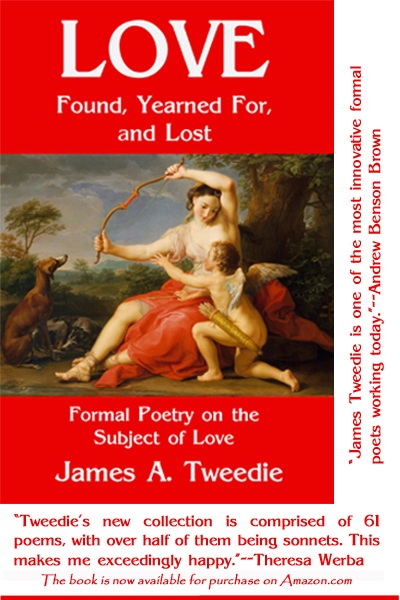
  • Poetry Book Review: Love Found, Yearned For, and Lost by James A. Tweedie
  • ‘When Opportunity Knocks’: A Poem by Roy E. Peterson
  • ‘Legend of the Griffin’: A Poem by Iryna Hall
  • ‘Government Issue’ and Other Poems by Joseph S. Salemi
  • ‘Chaucer Announces His Desire to Retire’: A Poem by Paul A. Freeman
  • ‘Advantages of Restaurants’ and Other Poems by Russel Winick
  • ‘Bone China’: A Poem by Mary Gardner
  • ‘On the Death of One Too Young to Die’: A Poem by Jeffrey Essmann
  • ‘This Too Shall Pass’ and Other Poetry by Justin Dasher
  • ‘Humdrum and Harum-Scarum’: A Lecture on Free Verse, by Robert Bridges (1922)
  • ‘Unrest On the Floodplain’: A Poem by Bhikkhu Nyanasobhano
  • ‘Latitude and Loss’: A Poem by Martin Briggs
  • ‘Act III’ and Other Poetry by C.B. Anderson
  • ‘God’s Funeral’: A Poem by James Sale
  • ‘Star Festival’: A Poem by Margaret Coats
  • ‘Song of the Frog Princess’: A Poem by Scharlie Meeuws
  • ‘The Odyssey: Nolan and Solot Compared’: An Essay by Michael Curtis
  • ‘Solitude’ and Other Poems by Mary Jane Myers
  • ‘The River Not Taken’ and Other Poetry by Brian Yapko
  • ‘Totentanz’: A Poem by James A. Tweedie
  • ‘In God Is Our Trust’: A Poem by Roy E. Peterson

Categories

  • Acrostic
  • Alexandroid
  • Alliterative
  • Art
  • Best Poems
  • Blank Verse
  • Chant Royal
  • Classical Poets Live
  • Clerihew
  • Covid-19
  • Deconstructing Communism
  • Educational
  • Epic
  • Epigrams and Proverbs
  • Essays
    • Interviews with Poets
    • Poetry Reviews
  • Featured
  • From the Society
  • Great Poets
    • Dante Alighieri
    • Edgar Allan Poe
    • Emily Dickinson
    • Geoffrey Chaucer
    • Henry Wadsworth Longfellow
    • Homer
    • John Keats
    • John Milton
    • Robert Frost
    • William Blake
    • William Shakespeare
    • William Wordsworth
  • Human Rights in China
  • Limerick
  • Love Poems
  • Music
  • Pantoum
  • Performing Arts
  • Poetry
    • Beauty
    • Children's Poems
    • Culture
    • Ekphrastic
    • Found Poems
    • High School Poets
    • Humor
    • Riddles
  • Poetry Challenge
  • Poetry Contests
  • Poetry Forms
    • Curtal Sonnet
    • Haiku
  • Poetry Readings
  • Rhupunt
  • Rondeau
  • Rondeau Redoublé
  • Rondel
  • Rubaiyat
  • Sapphic Verse
  • Satire
  • Science
  • Sestina
  • Shape Poems
  • Short Stories
  • Song Lyrics
  • Sonnet
  • Symposium
  • Terrorism
  • Terza Rima
  • The Environment
  • Translation
  • Triolet
  • Video
  • Villanelle

Quick Links

  • About Us
  • Submit Poetry
  • Become a Member
  • Members List
  • Support the Society
  • Advertisement Placement
  • Comments Policy
  • Terms of Use

Welcome Back!

Login to your account below

Forgotten Password?

Retrieve your password

Please enter your username or email address to reset your password.

Log In
No Result
View All Result
  • Poems
    • Beauty
    • Culture
    • Satire
    • Humor
    • Children’s
    • Art
    • Ekphrastic
    • Epic
    • Epigrams and Proverbs
    • Human Rights in China
    • Music
    • Performing Arts
    • Riddles
    • Science
    • Song Lyrics
    • The Environment
    • The Raven
    • Found Poems
    • High School Poets
    • Terrorism
    • Covid-19
  • Poetry Forms
    • Sonnet
    • Haiku
    • Limerick
    • Villanelle
    • Rondeau
    • Pantoum
    • Sestina
    • Triolet
    • Acrostic
    • Alexandroid
    • Alliterative
    • Blank Verse
    • Chant Royal
    • Clerihew
    • Rhupunt
    • Rondeau Redoublé
    • Rondel
    • Rubaiyat
    • Sapphic Verse
    • Shape Poems
    • Terza Rima
  • Great Poets
    • Geoffrey Chaucer
    • Emily Dickinson
    • Homer
    • Henry Wadsworth Longfellow
    • Dante Alighieri
    • John Keats
    • John Milton
    • Edgar Allan Poe
    • William Shakespeare
    • William Wordsworth
    • William Blake
    • Robert Frost
  • Love Poems
  • Contests
  • SCP Academy
    • Educational
    • Teaching Classical Poetry—A Guide for Educators
    • Poetry Forms
    • The SCP Journal
    • Books

© 2025 SCP. WebDesign by CODEC Prime.