• Submit Poetry
  • Support SCP
  • About Us
  • Members
  • Join
Saturday, September 5, 2026
Society of Classical Poets
  • Poems
    • Beauty
    • Culture
    • Satire
    • Humor
    • Children’s
    • Art
    • Ekphrastic
    • Epic
    • Epigrams and Proverbs
    • Human Rights in China
    • Music
    • Performing Arts
    • Riddles
    • Science
    • Song Lyrics
    • The Environment
    • The Raven
    • Found Poems
    • High School Poets
    • Terrorism
    • Covid-19
  • Poetry Forms
    • Sonnet
    • Haiku
    • Limerick
    • Villanelle
    • Rondeau
    • Pantoum
    • Sestina
    • Triolet
    • Acrostic
    • Alexandroid
    • Alliterative
    • Blank Verse
    • Chant Royal
    • Clerihew
    • Rhupunt
    • Rondeau Redoublé
    • Rondel
    • Rubaiyat
    • Sapphic Verse
    • Shape Poems
    • Terza Rima
  • Great Poets
    • Geoffrey Chaucer
    • Emily Dickinson
    • Homer
    • Henry Wadsworth Longfellow
    • Dante Alighieri
    • John Keats
    • John Milton
    • Edgar Allan Poe
    • William Shakespeare
    • William Wordsworth
    • William Blake
    • Robert Frost
  • Love Poems
  • Contests
  • SCP Academy
    • Educational
    • Teaching Classical Poetry—A Guide for Educators
    • Poetry Forms
    • The SCP Journal
    • Books
No Result
View All Result
Society of Classical Poets
  • Poems
    • Beauty
    • Culture
    • Satire
    • Humor
    • Children’s
    • Art
    • Ekphrastic
    • Epic
    • Epigrams and Proverbs
    • Human Rights in China
    • Music
    • Performing Arts
    • Riddles
    • Science
    • Song Lyrics
    • The Environment
    • The Raven
    • Found Poems
    • High School Poets
    • Terrorism
    • Covid-19
  • Poetry Forms
    • Sonnet
    • Haiku
    • Limerick
    • Villanelle
    • Rondeau
    • Pantoum
    • Sestina
    • Triolet
    • Acrostic
    • Alexandroid
    • Alliterative
    • Blank Verse
    • Chant Royal
    • Clerihew
    • Rhupunt
    • Rondeau Redoublé
    • Rondel
    • Rubaiyat
    • Sapphic Verse
    • Shape Poems
    • Terza Rima
  • Great Poets
    • Geoffrey Chaucer
    • Emily Dickinson
    • Homer
    • Henry Wadsworth Longfellow
    • Dante Alighieri
    • John Keats
    • John Milton
    • Edgar Allan Poe
    • William Shakespeare
    • William Wordsworth
    • William Blake
    • Robert Frost
  • Love Poems
  • Contests
  • SCP Academy
    • Educational
    • Teaching Classical Poetry—A Guide for Educators
    • Poetry Forms
    • The SCP Journal
    • Books
No Result
View All Result
Society of Classical Poets
No Result
View All Result
Home Poetry Beauty

Two Mythological Poems by Joseph S. Salemi

July 19, 2021
in Beauty, Blank Verse, Culture, Humor, Poetry
A A
13
poems Two Mythological Poems by Joseph S. Salemi

.

Heliotrope

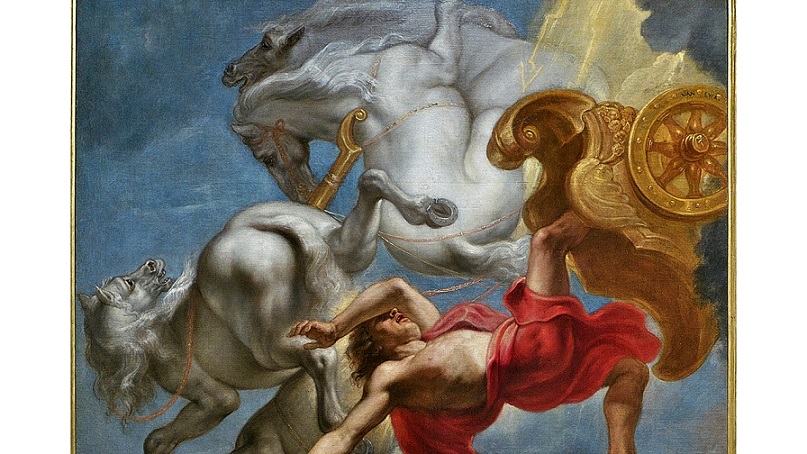
Phaeton, son of the god Helios, attempted to drive his father’s
celestial chariot. His inexperience caused him to burn up part
of the earth and the heavens, so he was killed by a thunderbolt
from Zeus.

The frightened gods all breathed in deep relief
(Thunderer, thanks! You’ve saved both earth and sky!)
When Phaeton, son of Helios, fell down
Plummeting in flames to his destruction.
The Scorpion and the Serpent writhed no more
In dazzling malice, while ethereal heats
Baked even the most distant spheres to frenzy.

They cleared the scorched and broken clutter, took
An inventory of what had been lost.
As for Phaeton’s burnt and mangled limbs,
Nymphs gathered them for piteous interment—
Keening, they wrote in cold funereal marble
The epitaph of one youth’s foolish daring;
And soon, the rolling tropics of the sky
Moved in their old and well-accustomed circles,
Unperturbed, unconscious, and at ease.

But on earth, gold faces turned and twisted
In disorder and vague reminiscence.
And they still to this day scan the sky,
Though now attuned to orthodoxy’s rhythm
And tutored in celestial restraint.

.

.

The Comic Birth of Venus

Venus was born from the severed genitals of Uranos. They were cut
off by his sons while Uranos was in the act of intercourse with his wife
Gaia, and then thrown into the sea where they mixed with oceanic foam.
From this conjunction of flesh, blood, and water the goddess of sexuality
emerged.

The wind moved over waters, whispering—
It swirled the waters, curled them into waves
That were siphoned into twisting shells.
Trapped air spun in bubbles, churned to froth;
The caught entangled spirit raged in vain
And from this turmoil rose a gauzy veil
That spiraled upwards, like a cyclone’s gyre.

Still the wind moved, turned the silver veil
Into a rosy, shimmering fine mist,
And unresisting, this became a pearl
Congealing to epiphany in nacre.

And now, the shell-borne child of foamy spume
Stands spectral on the glassy, unplumbed deep
While all around, the brood of earth and sea
Gape in wonder. Then the trickster gull
Swoops by like an albatross to squawk:

What else is new? We’re born ’twixt wind and water!

.

.

Joseph S. Salemi has published five books of poetry, and his poems, translations and scholarly articles have appeared in over one hundred publications world-wide.  He is the editor of the literary magazine Trinacria and writes for Expansive Poetry On-line. He teaches in the Department of Humanities at New York University and in the Department of Classical Languages at Hunter College.

ShareTweetPin
The Society of Classical Poets does not endorse any views expressed in individual poems or commentary.
Read Our Comments Policy Here

RandomPoems

‘If Milton Were Alive Today’ by Andrew Benson Brown
Culture

‘If Milton Were Alive Today’ by Andrew Benson Brown

March 14, 2020

  The blind poet awakes and feels his way Into the living room, where light of day Will find his...

‘Evensong’: A Poem by Peter Venable
Beauty

‘Evensong’: A Poem by Peter Venable

February 11, 2025

. Evensong The embers dimmed on the Pacific; _The sky a scarlet hue. One might conclude the fire seraphic--- _A...

Next Post
‘CCP Members in World Organizations’ by Damian Robin

'CCP Members in World Organizations' by Damian Robin

‘Making All Things Orderly’ and Other Poetry by Sally Cook

'Making All Things Orderly' and Other Poetry by Sally Cook

‘Kilkenny Castle’ and Other Poetry by Lucia Haase

'Kilkenny Castle' and Other Poetry by Lucia Haase

Comments 13

  1. Margaret Coats says:
    5 years ago

    Edith Hamilton says, Of course the Greeks too had their roots in the primeval slime. Of course they too once lived a savage life, ugly and brutal. But what the myths show us is how high they had risen above the ancient filth and fierceness. Only a few traces of that time are to be found in the stories, O poet with imagination vividly alive and unchecked by reason!

    Reply
  2. Paul Freeman says:
    5 years ago

    Most of the literature we were furnished with at school on Greek and Roman gods and goddesses was as dull as dishwater. I’ve read several engaging pieces on the SCP site on these very topics and rue that they were not available back in the day.

    I particularly enjoyed Heliotrope, Joe (maybe because I get queasy about the idea of genitals being cut off). Once again, you’ve made the myths of yore accessible in a way they should always have been in the English language.

    Thanks for the reads.

    Reply
  3. Sally Cook says:
    5 years ago

    There’s something grand about the Greek and Roman gods and goddesses – I always think of them 8-10 feet tall, all knowing, and with a savage and direct morality. One can learn a lot from them, even when their ways seem alien.
    Loved what you had to say about Venue !
    Some of it is comic, and yet the two lines I consider most beautiful occur in this poem. They are:

    “Still the wind moved, turned the silver veil
    Into a rosy, shimmering fine mist,…”

    Thanks, Joe, for sharing your exceptional knowledge.

    Reply
  4. Susan Jarvis Bryant says:
    5 years ago

    If there was any doubt that beauty lies in the realms of humour, here is the proof.

    Reply
  5. Joseph S. Salemi says:
    5 years ago

    I have several other poems on mythological themes published at the website Expansive Poetry Online, if anyone is interested.

    That website also has excellent poems by some of our regulars; Susan Bryant, Sally Cook, and Michael Curtis.

    Reply
  6. Julian D. Woodruff says:
    5 years ago

    These both have a very satisfying, story-telling manner that could be sustained to epic length. I admit that a few details have me scratching my head. What is it about the tropics that they are singled out? The last lines of Heliotrope are alluding to … the (renewed) cold war, deterrence and defense systems? Or? And the albatross: how did you hit on that weighty bird, Joe? (I hope these questions don’t come off as similar to Bruckner’s asking Wagner, while they were at a performance of Die Walkuere, “Why are they burning Bruenhilde?”)

    Reply
  7. Joseph S. Salemi says:
    5 years ago

    “Tropics” just refers to the circling sections of the sky (the “tropic” of Cancer, the “tropic” of Capricorn) where various constellations move in fixed patterns.

    The last lines of the poem allude to heliotropic flowers that turn their faces towards the moving sun (sunflowers, marigolds, and the like). The more specific mythological reference is to the story of how the girl Clytie was transformed to a sunflower when the sun god Helios (father of Phaeton) punished her for ruining his relationship with the girl Leucothoe. The transformed Clytie (as a sunflower) still “scans the sky,” looking for the god Helios, who ignores her.

    As for the albatross — well, it has a bad rep as a bird of misfortune after Coleridge’s poem. The main point (which makes this poem “comic,” I hope) is the squawking gull and his comment on how we are all born between “wind and water.” Birth takes place between a mother’s genitals and anus, and I was thinking of the famous line from Yeats: “Love has pitched his mansion in the seat of excrement.” The “wind and water” that create Venus are paralleled with the “wind” (bowel gas) and “water” (urine) of the human body.

    So, the gull-albatross and his comment are a way to puncture the deliberately high-flown rhetoric of the poem with a deflationary statement of carnality and earthiness.

    Reply
    • C.B. Anderson says:
      5 years ago

      There is a flower, Joseph, called Heliotrope (Heliotropium that is not at all related to the sunflower (except by virtue of their both being plants). There is a rather unprepossessing shrub called Leucothoe. I don’t know why it was named after the girl in the myth. The density of meaning in these poems is extraordinary, which is true of all great art.

      Reply
      • Joseph S. Salemi says:
        5 years ago

        Many thanks Kip. I wrote the poems 43 years ago, but they have never been published.

        Reply
      • C.B. Anderson says:
        5 years ago

        Until now. It’s funny how some of our early stuff rings truer than what we wrote after we became more sophisticated.

        Reply
  8. David Whippman says:
    5 years ago

    Any poem connected with Greek history or myth is off to a flying start with me, it’s fascinated me since childhood. I don’t know if you planned it, but for me these pieces actually somehow had the flavour of something translated from the Greek. Good stuff.

    On an unrelated note, many thanks for the copies of Trinacria!

    Reply
    • Joseph S. Salemi says:
      5 years ago

      David, be sure to submit material for Issue # 19 of TRINACRIA, which is now in preparation.

      Reply
  9. David Whippman says:
    5 years ago

    Thanks again, I will.

    Reply

Leave a Reply Cancel reply

Your email address will not be published. Required fields are marked *


  1. Laura Deagon on ‘The Cristero Centennial’: A Poem by Margaret CoatsSeptember 4, 2026

    It's hard to believe that something like this has been suppressed from the history presented to us in academia. I…

  2. Alice V. Brock on The Society of Classical Poets 2026 Haiku CompetitionSeptember 4, 2026

    1. Sunset The sun slides away Finish here, begin elsewhere Gifting crimson streams 2. Fly Away Hard sticks, soft feathers…

  3. Yael on ‘The Cristero Centennial’: A Poem by Margaret CoatsSeptember 4, 2026

    Great history lesson poem Margaret, thank you. Christ is King indeed and the gates of hell cannot prevail against Him.

  4. Margaret Coats on ‘The Cristero Centennial’: A Poem by Margaret CoatsSeptember 4, 2026

    Thank you for appreciating my poem, jd. The Cristero history, relatively close to us in time and just across our…

  5. Margaret Coats on ‘The Cristero Centennial’: A Poem by Margaret CoatsSeptember 4, 2026

    Thanks for your comment, Roy. From your history studies, you would realize that the United States started out on the…

Subscribe to Daily Poems

Enter your email address to subscribe to this blog and receive notifications of new posts by email.

Join 1,636 other subscribers

Recent Poems

  • ‘The Cristero Centennial’: A Poem by Margaret Coats
  • ‘A Potpourri of Aphoristic Verses’ by C.B. Anderson
  • ‘The Estuary’: A Poem by Jeff Eardley
  • ‘A World Without the Wednesday Child’: A Poem by Kimberly Fore
  • The 2026 Society of Classical Poets International Poetry Competition
  • The 2026 SCP International High School Poetry Competition
  • ‘Realistic Reflections’ and Other Poetry by Anna J. Arredondo
  • ‘China Made’: A Poem by Theresa Werba
  • ‘The Savage Moon’ and Other Poetry by Brian Yapko
  • Poetry Book Review: Love Found, Yearned For, and Lost by James A. Tweedie
  • ‘When Opportunity Knocks’: A Poem by Roy E. Peterson
  • ‘Legend of the Griffin’: A Poem by Iryna Hall
  • ‘Government Issue’ and Other Poems by Joseph S. Salemi
  • ‘Chaucer Announces His Desire to Retire’: A Poem by Paul A. Freeman
  • ‘Advantages of Restaurants’ and Other Poems by Russel Winick
  • ‘Bone China’: A Poem by Mary Gardner
  • ‘On the Death of One Too Young to Die’: A Poem by Jeffrey Essmann
  • ‘This Too Shall Pass’ and Other Poetry by Justin Dasher
  • ‘Humdrum and Harum-Scarum’: A Lecture on Free Verse, by Robert Bridges (1922)
  • ‘Unrest On the Floodplain’: A Poem by Bhikkhu Nyanasobhano
  • ‘Latitude and Loss’: A Poem by Martin Briggs
  • ‘Act III’ and Other Poetry by C.B. Anderson
  • ‘God’s Funeral’: A Poem by James Sale
  • ‘Star Festival’: A Poem by Margaret Coats
  • ‘Song of the Frog Princess’: A Poem by Scharlie Meeuws
  • ‘The Odyssey: Nolan and Solot Compared’: An Essay by Michael Curtis
  • ‘Solitude’ and Other Poems by Mary Jane Myers
  • ‘The River Not Taken’ and Other Poetry by Brian Yapko
  • ‘Totentanz’: A Poem by James A. Tweedie
  • ‘In God Is Our Trust’: A Poem by Roy E. Peterson

Categories

  • Acrostic
  • Alexandroid
  • Alliterative
  • Art
  • Best Poems
  • Blank Verse
  • Chant Royal
  • Classical Poets Live
  • Clerihew
  • Covid-19
  • Deconstructing Communism
  • Educational
  • Epic
  • Epigrams and Proverbs
  • Essays
    • Interviews with Poets
    • Poetry Reviews
  • Featured
  • From the Society
  • Great Poets
    • Dante Alighieri
    • Edgar Allan Poe
    • Emily Dickinson
    • Geoffrey Chaucer
    • Henry Wadsworth Longfellow
    • Homer
    • John Keats
    • John Milton
    • Robert Frost
    • William Blake
    • William Shakespeare
    • William Wordsworth
  • Human Rights in China
  • Limerick
  • Love Poems
  • Music
  • Pantoum
  • Performing Arts
  • Poetry
    • Beauty
    • Children's Poems
    • Culture
    • Ekphrastic
    • Found Poems
    • High School Poets
    • Humor
    • Riddles
  • Poetry Challenge
  • Poetry Contests
  • Poetry Forms
    • Curtal Sonnet
    • Haiku
  • Poetry Readings
  • Rhupunt
  • Rondeau
  • Rondeau Redoublé
  • Rondel
  • Rubaiyat
  • Sapphic Verse
  • Satire
  • Science
  • Sestina
  • Shape Poems
  • Short Stories
  • Song Lyrics
  • Sonnet
  • Symposium
  • Terrorism
  • Terza Rima
  • The Environment
  • Translation
  • Triolet
  • Video
  • Villanelle

Quick Links

  • About Us
  • Submit Poetry
  • Become a Member
  • Members List
  • Support the Society
  • Advertisement Placement
  • Comments Policy
  • Terms of Use

Welcome Back!

Login to your account below

Forgotten Password?

Retrieve your password

Please enter your username or email address to reset your password.

Log In
No Result
View All Result
  • Poems
    • Beauty
    • Culture
    • Satire
    • Humor
    • Children’s
    • Art
    • Ekphrastic
    • Epic
    • Epigrams and Proverbs
    • Human Rights in China
    • Music
    • Performing Arts
    • Riddles
    • Science
    • Song Lyrics
    • The Environment
    • The Raven
    • Found Poems
    • High School Poets
    • Terrorism
    • Covid-19
  • Poetry Forms
    • Sonnet
    • Haiku
    • Limerick
    • Villanelle
    • Rondeau
    • Pantoum
    • Sestina
    • Triolet
    • Acrostic
    • Alexandroid
    • Alliterative
    • Blank Verse
    • Chant Royal
    • Clerihew
    • Rhupunt
    • Rondeau Redoublé
    • Rondel
    • Rubaiyat
    • Sapphic Verse
    • Shape Poems
    • Terza Rima
  • Great Poets
    • Geoffrey Chaucer
    • Emily Dickinson
    • Homer
    • Henry Wadsworth Longfellow
    • Dante Alighieri
    • John Keats
    • John Milton
    • Edgar Allan Poe
    • William Shakespeare
    • William Wordsworth
    • William Blake
    • Robert Frost
  • Love Poems
  • Contests
  • SCP Academy
    • Educational
    • Teaching Classical Poetry—A Guide for Educators
    • Poetry Forms
    • The SCP Journal
    • Books

© 2025 SCP. WebDesign by CODEC Prime.