• Submit Poetry
  • Support SCP
  • About Us
  • Members
  • Join
Sunday, July 19, 2026
Society of Classical Poets
  • Poems
    • Beauty
    • Culture
    • Satire
    • Humor
    • Children’s
    • Art
    • Ekphrastic
    • Epic
    • Epigrams and Proverbs
    • Human Rights in China
    • Music
    • Performing Arts
    • Riddles
    • Science
    • Song Lyrics
    • The Environment
    • The Raven
    • Found Poems
    • High School Poets
    • Terrorism
    • Covid-19
  • Poetry Forms
    • Sonnet
    • Haiku
    • Limerick
    • Villanelle
    • Rondeau
    • Pantoum
    • Sestina
    • Triolet
    • Acrostic
    • Alexandroid
    • Alliterative
    • Blank Verse
    • Chant Royal
    • Clerihew
    • Rhupunt
    • Rondeau Redoublé
    • Rondel
    • Rubaiyat
    • Sapphic Verse
    • Shape Poems
    • Terza Rima
  • Great Poets
    • Geoffrey Chaucer
    • Emily Dickinson
    • Homer
    • Henry Wadsworth Longfellow
    • Dante Alighieri
    • John Keats
    • John Milton
    • Edgar Allan Poe
    • William Shakespeare
    • William Wordsworth
    • William Blake
    • Robert Frost
  • Love Poems
  • Contests
  • SCP Academy
    • Educational
    • Teaching Classical Poetry—A Guide for Educators
    • Poetry Forms
    • The SCP Journal
    • Books
No Result
View All Result
Society of Classical Poets
  • Poems
    • Beauty
    • Culture
    • Satire
    • Humor
    • Children’s
    • Art
    • Ekphrastic
    • Epic
    • Epigrams and Proverbs
    • Human Rights in China
    • Music
    • Performing Arts
    • Riddles
    • Science
    • Song Lyrics
    • The Environment
    • The Raven
    • Found Poems
    • High School Poets
    • Terrorism
    • Covid-19
  • Poetry Forms
    • Sonnet
    • Haiku
    • Limerick
    • Villanelle
    • Rondeau
    • Pantoum
    • Sestina
    • Triolet
    • Acrostic
    • Alexandroid
    • Alliterative
    • Blank Verse
    • Chant Royal
    • Clerihew
    • Rhupunt
    • Rondeau Redoublé
    • Rondel
    • Rubaiyat
    • Sapphic Verse
    • Shape Poems
    • Terza Rima
  • Great Poets
    • Geoffrey Chaucer
    • Emily Dickinson
    • Homer
    • Henry Wadsworth Longfellow
    • Dante Alighieri
    • John Keats
    • John Milton
    • Edgar Allan Poe
    • William Shakespeare
    • William Wordsworth
    • William Blake
    • Robert Frost
  • Love Poems
  • Contests
  • SCP Academy
    • Educational
    • Teaching Classical Poetry—A Guide for Educators
    • Poetry Forms
    • The SCP Journal
    • Books
No Result
View All Result
Society of Classical Poets
No Result
View All Result
Home Poetry Culture

On Their Uncanny Similarities: Hamlet and Journey to the West

January 30, 2017
in Culture, Educational, Essays, William Shakespeare
A A
5
poems On Their Uncanny Similarities: Hamlet and Journey to the West

by Evan Mantyk

WHAT DOES THE classic Chinese story Journey to the West have to do with William Shakespeare’s classic play Hamlet? A lot it turns out.

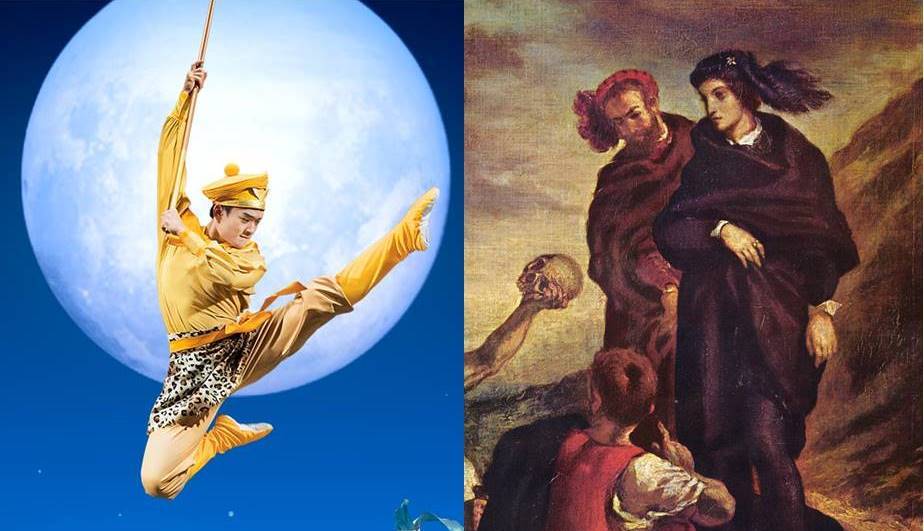
Both Hamlet and Journey to the West were written in the late 16th century, one in China and the other in England. Both rely heavily on poetry. Both also are favorites for stage production still today. Shen Yun Performing Arts even performs Journey to the West pieces throughout the English-speaking world, and Beijing Dance Theater has their own production of Hamlet in China.

Quite a coincidence, right? That’s only the beginning. A particular episode within Journey to the West, set in the Kingdom of Crow-cock, bears an uncanny similarity to the exact plot of Hamlet, set in the Kingdom of Denmark. Both stories begin with the ghost of the king visiting the main characters and explaining that he was deviously murdered by a brother, while in a garden, and that the current king is that brother. Both stories revolve around the prince of the kingdom trying to unseat the murderous king currently on the throne. Both also end with the murderous king’s removal and a plot twist that puts all of the events into a different light.

At first, it seems impossible to account for such striking similarities. In the 16th century, simple communication and cultural exchange between England and China were virtually non-existent. The first Chinese person in England was not recorded until a hundred years later.

If you are an average sort of scholar, you may troll the internet for some kind of scientific explanation. You might conclude that both Hamlet and Journey to the West possibly drew on earlier stories and perhaps have some ancient progenitor. (There are similar Cinderella fairy tales in both cultures as well.) However, the precise similarities in the plot and times of publication are too uncanny to make that a rational explanation. In fact, ancient Chinese wisdom suggests that changes in human society unfold according to specific celestial arrangements. The human body, human society, and the universe are more interconnected than the reductionist philosophy of modern mainstream science supposes. Such arrangements naturally control both Eastern and Western civilizations and have also been observed by 19th-century German scholars Victor von Strauß  and Ernst von Lasaulx. They noted that Buddha Siddhartha in India, Lao-zi and Confucius in China, and Socrates and Plato in Greece had profound effects on civilizations and all appeared around the same time, roughly 2,500 years ago, leading these historians to call that period the Axial Age.

My take on the similarities between the two 1590s works is that they expressed feelings—under the influence of God or Gods or some greater consciousness—that were in reaction to a universal and relatively significant shift that was occurring in the course of human history at that particular moment. Firstly, the vast civilizations of Europe and China were wistful for the great but dead kings of the past, the most renowned being Tang Taizong (who appears in Journey to the West) and King Arthur (who, if real, likely lived around the same time as Tang Taizong). Secondly, they were both prophetically anticipating two great kings—the two people, I must emphasize, who would really influence human culture as we know it the most up to the present—who were just about to arrive in flesh on earth and fill the aching cultural need. These were Emperor Kangxi (1654-1722) of China’s Qing Dynasty and King Louis XIV (1638-1715) of France. Kangxi was the greatest emperor of China’s last dynasty and Louis XIV was the most consummate example of royalty in the West. Some has already been written about their similarities, such as their absolute power, their prodigious patronage of the arts, their impressive military exploits, and their grand personalities. The fact that they were metaphorically presaged by two great literary works in the 1590s is perhaps an extension of these similarities, offering a glimpse into the seemingly random but actually well ordered workings of human events. It’s a mystery, or ào mì (奧祕), worth contemplating.


Sources:

Prince Hamlet and the Monkey King: https://www.amazon.com/Prince-Hamlet-Monkey-William-Shakespeare/dp/1097889386
The Society of Classical Poets: https://classicalpoets.org/10-greatest-novels-ever-written/
First Chinese person in England, BBC: https://www.bbc.co.uk/radio4/factual/chinese_in_britain1.shtml



ShareTweetPin
The Society of Classical Poets does not endorse any views expressed in individual poems or commentary.
Read Our Comments Policy Here

RandomPoems

Meditation on Herbert’s ‘Church Monuments’: A Poem by Joseph S. Salemi
Culture

Meditation on Herbert’s ‘Church Monuments’: A Poem by Joseph S. Salemi

December 5, 2024

. Meditation on Herbert’s “Church Monuments” "…Mark, here below, How tame these ashes are, how free from lust, That thou...

‘The First Funeral’ and Other Poetry by James Sale
Beauty

‘The First Funeral’ and Other Poetry by James Sale

December 26, 2017

  The First Funeral It is with wonder when I think Of Adam, Eve, no childhood grown, Standing before the...

Next Post
‘Bubbles’ and Other Poetry by Mike Dashiell

'Bubbles' and Other Poetry by Mike Dashiell

2017 Poetry Competition

2017 Poetry Competition Winners Announced

‘On the Protesters Filled With Hate’ and Other Poetry by Bruce Dale Wise

'On the Protesters Filled With Hate' and Other Poetry by Bruce Dale Wise

Comments 5

  1. Joseph Charles MacKenzie says:
    9 years ago

    This is definitely intriguing as there are simply too many identical elements in a very complex plot structure. I do wonder if there are other similarities. For example, Hamlet must confront the emptiness of the false religion he acquired at Wittenberg (Shakespeare makes a point about the source of Hamlet’s demise). Is there a similar confrontation with emptiness in The Journey West?

    Reply
    • Evan says:
      9 years ago

      Actually, now that you mention it, there is a bit of an antagonistic relationship between the dominate religion of the text, Buddhism, and Taoism, and the villain is presented as a magician or sorcerer, which is generally associated with Taoism. Perhaps yet another similarity!

      Reply
      • Joseph Charles MacKenzie says:
        9 years ago

        In Hamlet, the antagonism against the social order arises from within Hamlet himself, who opts for rebellion against his family, discards Ophelia, and eventually destroys himself. Hamlet is representative of a new order of cynical, agnostic narcissism in which the individual usurps the place of God as center of the universe. Hamlet allows himself to be drawn in to the ghost’s vengeance (the ghost is surely from hell because vengeful). Modernists read Hamlet as “the prototype of modern man,” and they are right, even if unaware that Shakespeare’s play is a satire precisely on that, a new order of rebellious youth full of self-superior contempt and scorn for everyone around them, defiant even of the natural order. In other words, Hamlet is Shakespeare’s scathing portrait of incarnate Protestantism, the foundation of liberalism. Today’s anti-trump protesters are simply that, 17th-century Puritans in modern costume, as self-absorbed and empty as Hamlet, willing to kill to get their way, defenders of death, suicide, and violence, in the name of a goddess of love thirsty for the blood of unborn children. Like today’s protesters, Hamlet is an intellective pervert subjecting reason to emotion in a heinous inversion of order. But just like Hamlet, the protesters will turn upon themselves, having no reality, no moral principle, no truth to turn to.

        Reply
  2. Douglas Thornton says:
    9 years ago

    When we are lucky enough to grasp these similarities, I believe they not only tell of the deeper and more elegantly entwined nature of humans, but also of genius.

    Reply
  3. James Sale says:
    9 years ago

    I have not read the Chinese work, so cannot say just how parallel it is, but I do know that just as Darwin was coming up with his theory of evolution, so too was, independently, Alfred Wallace. And there have been many examples of this strange phenomena occurring throughout history. It is of course wonderfully ironic that the most famous example – the double occurrence of atheistical evolution – should be blighted by this ‘chance’ double occurrence: I mean how likely is it – on the basis of pure materialism – that this could happen? As Hamlet observed: “There are more things in heaven and earth, Horatio, / Than are dreamt of in your philosophy.”

    Reply

Leave a Reply Cancel reply

Your email address will not be published. Required fields are marked *

  1. BDW on ‘A Snowy Egret’: A Poem by Bruce Dale WiseJuly 19, 2026

    Correction: B. S. Eliud Acrewe

  2. BDW on ‘A Snowy Egret’: A Poem by Bruce Dale WiseJuly 19, 2026

    as per Edwar Lee Subic: “While a poet’s repertoire may span various forms and meters, the allure of iambic heptameter,…

  3. Dusty Grein on ‘The American Spirit’: A Poem by Dusty GreinJuly 18, 2026

    Adam, thank you for cutting through to the heart of my message. Every day we each have the chance to…

  4. Dusty Grein on ‘The American Spirit’: A Poem by Dusty GreinJuly 18, 2026

    Thank you Susan. As one of my favorite word artists here, your praise means a lot to me. My takeaway…

  5. Dusty Grein on ‘The American Spirit’: A Poem by Dusty GreinJuly 18, 2026

    Thank you Jan. I wholeheartedly agree that we need to strive to be better every day. I still remember a…

Subscribe to Daily Poems

Enter your email address to subscribe to this blog and receive notifications of new posts by email.

Join 1,593 other subscribers

Recent Poems

  • ‘Florence Foster Jenkins’ and Other Poetry by Brian Yapko
  • Winners and Rankings of The Great American Poetry Competition
  • ‘The Gold Star Mother’: A Poem by Gerard Maritato
  • ‘An American Dash’: A Poem by Linda Ellis
  • ‘The Anonymous Soldier’: A Poem by Lucy Lind
  • ‘For Those We Never Meet’: A Poem by Aneesh Agarwal
  • ‘Ben Franklin’s Copper Fugio Cent’: A Poem by Geoffrey Smagacz
  • Three Brief Poems by Luxorius, Translated by Joseph S. Salemi
  • ‘The American Spirit’: A Poem by Dusty Grein
  • ‘The Ballad of Zebulon Pike’: A Poem by M.D. Skeen
  • ‘We Are the Ones’ and Other Poetry by Cheryl Corey
  • ‘My Pyjamas!’ and Other Poems by Susan Jarvis Bryant
  • ‘A Snowy Egret’: A Poem by Bruce Dale Wise
  • ‘The Swearing-in of Calvin Coolidge’: A Sonnet by Robert W. Crawford
  • ‘Ballad of the Sequoia’: A Poem by Lauren V. Leon
  • ‘The 51st State’: A Poem by James Sale
  • ‘La Uva’ (The Grape): A Poem by Michael Pietrack
  • ‘There’s Blood that Flows Within the Stripes’: A Poem by Lauren V. Leon
  • ‘Birdsong’: A Poem by Jeffrey Essmann
  • ‘The Melody That Lingers On’ and Other Poetry by John McPherson
  • ‘American Dreams’: A Poem by Adam Sedia
  • ‘An American Fabius’: A Poem by John Hernandez
  • ‘Vernal Clinic’ and Other Poetry by C.B. Anderson
  • ‘Omaha Beach’ and Other Poetry by Bradford Skow
  • ‘Music to Part the Veil’: A Poem by T.M. Moore
  • ‘A Gentleman’s Guide to Losing a War’ and Other Poetry by Arnon Peterson
  • ‘Black Shuck’: A Poem by Martin Briggs
  • ‘When the Last World War II Veteran Passes Away’: A Poem by N.S. Boone
  • ‘A Fallow Year at Worthy Farm’: A Poem by Paul A. Freeman
  • ‘Outstanding in Afghanistan’: A Poem by Jared S. Chang

Categories

  • Acrostic
  • Alexandroid
  • Alliterative
  • Art
  • Best Poems
  • Blank Verse
  • Chant Royal
  • Classical Poets Live
  • Clerihew
  • Covid-19
  • Deconstructing Communism
  • Educational
  • Epic
  • Epigrams and Proverbs
  • Essays
    • Interviews with Poets
    • Poetry Reviews
  • Featured
  • From the Society
  • Great Poets
    • Dante Alighieri
    • Edgar Allan Poe
    • Emily Dickinson
    • Geoffrey Chaucer
    • Henry Wadsworth Longfellow
    • Homer
    • John Keats
    • John Milton
    • Robert Frost
    • William Blake
    • William Shakespeare
    • William Wordsworth
  • Human Rights in China
  • Limerick
  • Love Poems
  • Music
  • Pantoum
  • Performing Arts
  • Poetry
    • Beauty
    • Children's Poems
    • Culture
    • Ekphrastic
    • Found Poems
    • High School Poets
    • Humor
    • Riddles
  • Poetry Challenge
  • Poetry Contests
  • Poetry Forms
    • Curtal Sonnet
    • Haiku
  • Poetry Readings
  • Rhupunt
  • Rondeau
  • Rondeau Redoublé
  • Rondel
  • Rubaiyat
  • Sapphic Verse
  • Satire
  • Science
  • Sestina
  • Shape Poems
  • Short Stories
  • Song Lyrics
  • Sonnet
  • Symposium
  • Terrorism
  • Terza Rima
  • The Environment
  • Translation
  • Triolet
  • Video
  • Villanelle

Quick Links

  • About Us
  • Submit Poetry
  • Become a Member
  • Members List
  • Support the Society
  • Advertisement Placement
  • Comments Policy
  • Terms of Use

Welcome Back!

Login to your account below

Forgotten Password?

Retrieve your password

Please enter your username or email address to reset your password.

Log In
No Result
View All Result
  • Poems
    • Beauty
    • Culture
    • Satire
    • Humor
    • Children’s
    • Art
    • Ekphrastic
    • Epic
    • Epigrams and Proverbs
    • Human Rights in China
    • Music
    • Performing Arts
    • Riddles
    • Science
    • Song Lyrics
    • The Environment
    • The Raven
    • Found Poems
    • High School Poets
    • Terrorism
    • Covid-19
  • Poetry Forms
    • Sonnet
    • Haiku
    • Limerick
    • Villanelle
    • Rondeau
    • Pantoum
    • Sestina
    • Triolet
    • Acrostic
    • Alexandroid
    • Alliterative
    • Blank Verse
    • Chant Royal
    • Clerihew
    • Rhupunt
    • Rondeau Redoublé
    • Rondel
    • Rubaiyat
    • Sapphic Verse
    • Shape Poems
    • Terza Rima
  • Great Poets
    • Geoffrey Chaucer
    • Emily Dickinson
    • Homer
    • Henry Wadsworth Longfellow
    • Dante Alighieri
    • John Keats
    • John Milton
    • Edgar Allan Poe
    • William Shakespeare
    • William Wordsworth
    • William Blake
    • Robert Frost
  • Love Poems
  • Contests
  • SCP Academy
    • Educational
    • Teaching Classical Poetry—A Guide for Educators
    • Poetry Forms
    • The SCP Journal
    • Books

© 2025 SCP. WebDesign by CODEC Prime.