


.
Washington’s Armor
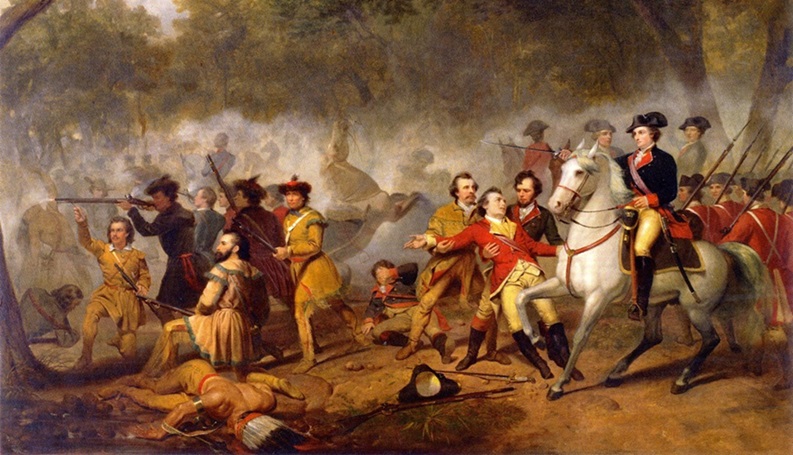
Under a watchful sky, a thick, long snake
Was slithering: red regulars and blue
Virginians groaned while dragging banners to stake
In Fort Duquesne; brown wagons splashed its crew
Of teamsters as a shallow river rippled;
Gray axes, swishing through a sea of green,
Approached a tranquil forest, strangely stippled.
A packhorse paused for water, cool and clean.
General Edward Braddock, disapproving,
Turned his back against the wilderness: “Keep moving!”
The axes stopped. Ahead, a figure dressed
In war paint bounded up. His gorget gleamed.
As Captain Thomas Gage received the guest
With triggers trained, the pale native screamed
A war cry out (in French). Within the pines,
Smoke from a thousand muskets curled and flashed.
The British troops fell into nice, neat lines.
Virginians, flying towards the forest, crashed
Through rocks and trees, abandoning formation.
Braddock struck one with his sword in wild frustration.
The captain peered through smoke and, spotting a rush
Of movement, ordered men to fire a volley—
That hit their own militia in the brush.
Blood stained the streams that fed the river valley
As bodies, red and blue, were mixed like oil
Upon a dabbling greenhorn’s canvas. Troops
Were firing cannons, wounding bark and soil.
General Braddock, under thunderous whoops,
Stormed to the front and shouted, saber glaring—
Until a bullet to the lungs cut short his swearing.
His aide, a young Virginian then unknown,
Rushed forward, cradling Braddock on the ground
As more red shepherds fell. Their flock, alone,
Was scattering before the pack of hounds.
The general held up a pair of new
Pistols, their silver scrollwork stained with blood.
“Here, colonel,” Braddock said. “It’s up to you.”
Mounting a horse, the blue coat waved his blade,
Regrouping. Seeing him, a native chief
Pointed: guns turned and fired, shaking bud and leaf.
In blissful spheres above the woes of men,
A warrior of God cast eagle eyes
To earth. Unfurling golden feathers, then,
Speeding through night and chaos, stars and skies—
His wingspan a penumbra in the sun—
Saint Michael lighted in this savage place
Where dead and dying forms lay heaped, and spun
To catch a bullet near the colonel’s face
Between effulgent fingertip and thumb.
Deflected past the colonel’s ear, it made a hum.
Ballooning chiseled cheeks, the angel puffed:
More bullets, zooming towards the colonel’s heart,
Passed through a flailing coat flap. Michael huffed:
Another round, diverted downward, hit
The colonel’s horse. He tumbled down and sprang
Up, spinning silver pistols out and aiming:
Two painted Frenchmen, running towards him. Bang.
The angel, whooshing by, unsheathed his flaming
Sword, and with a ‘tap,’ the balls of lead
Veered upwards, striking both the Frenchmen in—“I said
I didn’t want this story—it’s made up!”
Blues froze through pale glasses, polar: “Jimmy,
Why don’t you go to sleep?” He sucked a cup
And squealed: “TV! My game controller—gimme!”
His milk was taken. Little hands flew high
To heaven. Screaming. Fingers tried to grasp.
“George Washington was just a big fat li—”
(His Grammy raised an oatmeal cookie.) Gasp.
Two raisined slits began to dilate—plumbs.
Her tale continued as he nibbled, spilling crumbs.
The colonel, rounding men up as they flew,
Recalled (somewhat) two favorite plays, observing:
“What pity, that without the power to
Relieve, we still can die but once in servinggg—”
He fell—his new horse, killed. Then Michael threw
His halo like a discus—flick!—to slice
Off musket barrels. Awed, the chieftan drew
Away their fire and said a prayer, twice:
To bless this daring warrior’s retreat
And the Great Spirit guiding fortune and defeat.
Survivors fled—stampeding wild bears
Escaping trappers through the fields and woods—
Abandoning their wagons and their wares,
Dropping their banners, muttering no words
For fallen comrades plundered, scalped, and stripped.
Ascending, Michael sent a gentle wind
That cooled the mounted colonel as he slipped
Through the winding, wounded serpent (shortened, thinned).
Braddock was offered to the worms and heat,
His grave mound flattened to discourage stumbling feet.
Washington poked the holes that lined his coat—
Four fingers—as his free hand took a letter.
What news? He opened it and read a quote
From a dying speech—his own, it seemed. Who better
Than Cato to supply a beautiful death?
His lips upturning (slightly) at the humor,
He dipped his quill in ink and drew a breath.
Dear Brother, you’ve been told a widow’s rumor—
By Providence, I have been spared from harm.
The whisperings of bullets had a certain charm.
.
Poet’s Note
“The colonel… / Recalled (somewhat) two favorite plays” refers to lines from the play Cato by Joseph Addison, which features the line “What pity is it / That we can die but once to serve our country?” and
the play School for Scandal by Richard Brinley Sheridan, which features the line “To pity, without the power to relieve, is still more painful than to ask and be denied.” According to a Washington biography, “The unremitting emphasis on Joseph Addison’s Cato as being Washington’s favorite play—partly because it was performed at Valley Forge, partly because it fit the stereotype of Washington as the stoic Roman—has obscured his love of many other plays, especially ribald and sophisticated comedies. The play that he probably saw and savored the most was Richard Sheridan’s racy The School for Scandal.” (Chernow, Washington: A Life, p. 126)
.
.
Andrew Benson Brown has had poems and reviews published in a few journals. His epic-in-progress, Legends of Liberty, will chronicle the major events of the American Revolution if he lives to complete it. Though he writes history articles for American Essence magazine, he lists his primary occupation on official forms as ‘poet.’ He is, in other words, a vagabond.














Quite, quite the mock-epic genius: this is superb – and as with Byron, for all the laughter, pathos and deeper emotions bubble through. And I love the imagery: this ‘As bodies, red and blue, were mixed like oil
Upon a dabbling greenhorn’s canvas.’ is simply first-rate. Love it.
Thanks James. I actually got the idea from reading Tasso. But despite my original intentions for this excerpt, I am incapable of writing something as solemn as him.
A compelling account of Braddock’s defeat and death at the Monongahela, but I guess I’m too old to understand about computer games. I assume that the italicized section that intrudes into the middle of the text is a description of a young child’s on-line “game” that deals with the history of the French and Indian War, and of his grandmother’s efforts to put him to bed. Is there a fight over milk and an oatmeal cookie?
I’m sure there’s more to this italicized intrusion that I recognize, but I’ll have to leave it to other commenters. The coming of St. Michael to aid Colonel Washington is clear enough — it follows the old “deus ex machina” device of traditional literature, when divine help comes to someone in distress. And the references to Washington’s favorite lines from Sheridan and Addison are fitted in perfectly, and suitably to the situation.
There are two typos — in the eighth stanza, “chieftan” should be chieftain, and in the final note Sheridan’s middle name should be Brinsley, with an /s/.
Much appreciated on the feedback, Joe. In the grandma stanza, I was trying to convey that the kid is bored by her bedtime story and wants to play videogames instead. The cookie is offered as an incentive to shut up and listen. Since both you and Margaret were confused, I’ve rewritten it. Hope this version is clearer:
“This story’s dumb. It isn’t real—no way!”
A woman shut the epic poem: “Jimmy,
Why don’t you go to sleep?” — “I want to play!”
He grabbed his game controller: “Xbox—gimme!”
She pulled the power plug. His voice flew high
To heaven, screaming. Fingers tried to grasp.
“George Washington was just a big fat li—”
(His Grammy raised an oatmeal cookie.) Gasp.
Two raisined slits began to dilate—plumbs.
She opened up her book. He nibbled, spilling crumbs.
This section gives an amusing picture of what the French and Indian War might have looked like in the field. Cooperation may not have been so close, Andrew, but you bring in fullness of imagination suggested by the alliance. And the computer games later on are not the only strikingly modern touch. I see environmentalism behind some of the description in earlier stanzas here. Saint Michael is quite as celestially efficient as anyone could desire. When Grandma arrives, however, the time scheme, and the electronic device windows serving it, become hopelessly confused. At least, that’s so in the way I teach “point of view.” This work seems to be an experiment in making style the central factor of reading in a disoriented, manner that alludes to the actual reading habits of numerous persons at the present time. Whether carefully planned or totally inspired, it is multi-layered in many ways, and unique.
The event as described in Parkman’s “Montcalm and Wolfe,” from which I drew, is far more complicated, as you say. Braddock was a terrible commander who didn’t listen to anybody, and Washington clashed with him. The part about Braddock giving him his silver pistols before he dies was true, though. I wanted to keep it simple and not write something superlong. This was a story once told to every school child, and few youngsters know about it now.
The grandma stanza was an afterthought. I wasn’t consciously thinking of it at the time, but somewhere in the back of my mind was that scenario from the Princess Bride, when the kid thinks the grandpa’s story is boring and keeps interrupting.
I particularly enjoyed the stanza when Jimmie interrupts. This is the oral history to be cherished and recorded, yet unfortunately, often is not.
Thanks for the read.
Excellent work! The visual imagery of the battle creates a very poetic capture of the battle. “Survivors fled—stampeding wild bears
Escaping trappers through the fields and woods—
Abandoning their wagons and their wares,
Dropping their banners, muttering no words
For fallen comrades plundered, scalped, and stripped.”
Having just performed in The School for Scandal a few months ago (As Sir Oliver Surface) I love the reference! I did not know it was a favorite of Washington’s.
Great work!