


By Dusty Grein
Most of us enjoy poetry in one form or another. I am going to attempt to lay out the basics of writing classical style poetry in English, based on standard poetry terms and references. This discussion will focus on rhyming, metered poems.
Who am I? I am a novelist, yet the world of classical poetry has always fascinated me. My journey as an author, and I daresay a poet, is one that I hope never to complete. If you are interested in learning about classical poetry styles, methods, and patterns, then join me and let’s explore. I might have to hold your hand as we go, since some of the terms we will use are intimidating (until you learn the simple meanings of them) and they scared me for a long time.
Please keep in mind that the natural flow of poetic pronunciation and patterns will be influenced by your diction, and sometimes even your accent. This exploration will be done using the diction that comes naturally to me. I am from the Pacific Northwest in the United States, and I speak with no dialect or discernible accent (at least not to me).
Terms
In order to build a poem, and to be able to discuss, explain and look at samples of poems, we must define some terms. Some of this may sound simplistic, but there are those who struggle with the concepts and I would like to begin with some very rudimentary basics concerning words, sounds and cadence.
SYLLABLES (word building blocks)
Syllables are single sounds and the English language is comprised of words built using these sounds. Some words, ”Cone” for example, contain only one syllable (sound burst). Other words, such as “Circle” (CIR-cle) contain two syllables. We have words built from any number of syllables – “Constitutional” has five syllables (CON-sti-TU-tion-al).
STRESS (Emphasis)
Syllables are the building blocks of sound that we use to build words, but we don’t usually talk in monotone (unless you are attempting to do an impression of a robot). Instead, we vary the pitch, volume and strength of our pronunciation, or stress, of the syllables in our words.
Sometimes our meaning may be completely different, depending on how we pronounce a single word, and classical poetry is built using these emphasized syllables in patterns that allow the words to flow in noticeable almost melodic cadence.
Poetic FEET
This is one of the hardest parts of poetic patterns to grasp, but if you stay with me, and maybe try my tapping methods, you can learn exactly what these words mean, and how we use them to reference and build poems.
Classical poetry in English, is usually composed using pairs and trios of stressed and unstressed syllables, in metered rhyming patterns. These syllable pairs and trios are known as poetic feet.
Each foot contains a combination of hard (stressed) and soft (unstressed) syllables. In English poetry there are 5 basic poetic-feet used. Here they are, with their syllable counts and patterns.
iamb – 2-syllable foot: A soft syllable, followed by a stressed one, as in the word “adjust” (ah – JUST’). Used to create iambic lines.
trochee – 2-syllable foot: A hard syllable, followed by a soft one, as in the word “shatter” (SHAT’- ter). Used to create trochaic lines.
spondee – 2-syllable foot: Two equally stressed syllables, as in the word “breakdown” (BRAKE – DOWN). Used to create spondaic lines.
dactyl – 3-syllable foot: A hard syllable, followed by two soft one, as in “carefully” (KAYR’ – ful – ly). Used to create dactylic lines.
anapest – 3-syllable foot: Two softs syllables followed by a hard one, as in “comprehend” (kom – pre – HEND’). Used to create anapestic lines.
There are other patterns of poetic feet, but they are very rarely used in classic English poetry.
Here is a complete list of two and three syllable feet, with a syllable count and pattern, using ‘DUM’ for the hard syllables, and ‘dee’ for the soft ones. By tapping your finger hard on the DUM and soft on the “dee,” you will get an idea of the sound stress patterns that can be created.
Syllable Count Foot Name Pattern
2 syllables: pyrrhus: dee – dee
2 syllables: iamb: dee – DUM
2 syllables: trochee: DUM – dee
2 syllables: spondee: DUM – DUM
3 syllables: tribrach: dee – dee – dee
3 syllables: dactyl: DUM – dee – dee
3 syllables: amphibrach: dee – DUM – dee
3 syllables: anapest: dee – dee – DUM
3 syllables: bacchius: dee – DUM – DUM
3 syllables: antibacchius: DUM – DUM – dee
3 syllables: cretic: DUM – dee – DUM
3 syllables: molossus: DUM – DUM – DUM
Line METER
Poetic meter is a count of the number of feet in a line. Most poems are written with between 1 and 8 poetic feet per line. This creates the following poetic metric line types, based on how many feet are in the line:
# of feet Meter Name
1 monometer
2 dimeter
3 trimeter
4 tetrameter
5 pentameter
6 hexameter
7 heptameter
8 octameter
Perhaps the most famous type of line is that used by Shakespeare in many of his works, both prosaic and poetic, iambic pentameter – or five pairs of iambs, for a total of 10 syllables.
Often, poets will use a line with a missing first or last syllable, for emphasis and strength in their pattern. These lines are referred to as CATALECTIC (“headless”).
Rhyme Pattern / STANZAS
The final ingredient in the creation of the classic rhyming poem, is the number and pattern of rhyming lines. The final syllable or syllables in the metered lines are set to rhyme with each other in many different patterns, and the number of these lines determines the stanza length.
Stanzas are generally sets of lines that are separated by a blank line. The most common of these are stanzas containing 4 lines, also known as a quatrain, but there are many varied types of stanzas, from the simple two-line couplet, to complex forms like the sonnet or sestina.
Lines Stanza Type
2 lines: couplet
3 lines: triplet
4 lines: quatrain
5 lines: quintrain, quintet
6 lines: sestet
7 lines: septet
8 lines: octet, octave
In order to show the rhyming pattern in poetic stanzas, I will use the labeling method of describing the rhyming lines using letters , so that all lines identified with the same letter rhyme with each other.
Examples
Now that we have a vocabulary, we can examine poetry with a common language. Probably the most common form of poetry, that we learn very young, is the quatrain, in an A B C B pattern. These poems may consist of different meters and feet counts, even having them mixed, as long as the second and fourth line rhyme.
(a) I loved you before, (b) I love you still, (c) I always have and (b) I always will.
This is a simplistic form of poetry, and is not truly metered. It is still a valuable form of poetry, and the greeting card industry would be lost without it. For our purposes of exploration however, we will leave this simplistic approach behind, and look at more organized and structured poems.
** in the following samples, the HARD syllables will be capitalized, and the feet will be shown with the symbol | as a separator) **
One of the simplest structured poems ever written is a couplet of two rhyming lines titled “Fleas,” written in trochaic monometer (a single trochee per line)
(a) ADam (a) HAD ‘em.
Another very popular poem, A Visit From St. Nick, was written in anapestic tetrameter quatrains (four anapests per line, four lines per stanza) with an A A B B pattern, with the B lines missing the first syllable (catalectic)
(a) ‘Twas the NIGHT | before CHRIST | mas and ALL | through the HOUSE, (a) Not a CREA | ture was STIR | ring, not EV | en a MOUSE. (b) __ The STOCK | ings were HUNG | by the CHIM | ney with CARE (b) __ In HOPES | that Saint NICH | olas SOON | would be THERE.
The last sample lines we’ll look at for now are from Shakespeare’s A Midsummer Night’s Dream. This epic play was written in iambic pentameter quatrains (four line stanzas, with five iambs per line) in A A B B pattern:
(a) And I | do LOVE | thee: THERE | fore, GO | with ME; (a) I’ll GIVE | thee FAIR | ies TO | atTEND | on THEE, (b) And THEY | shall FETCH | thee JEW | els FROM | the DEEP, (b) And SING | while THOU | on PRESSED | flowERS | dost SLEEP;
So now we have a basic grasp on classic poetry terms and forms.
A 52 year old grandfather, Dusty has just recently become a professional author. He lives in Newberg, Oregon, where a dog named Naked, and his youngest daughter Jazzmyn keep him busy.
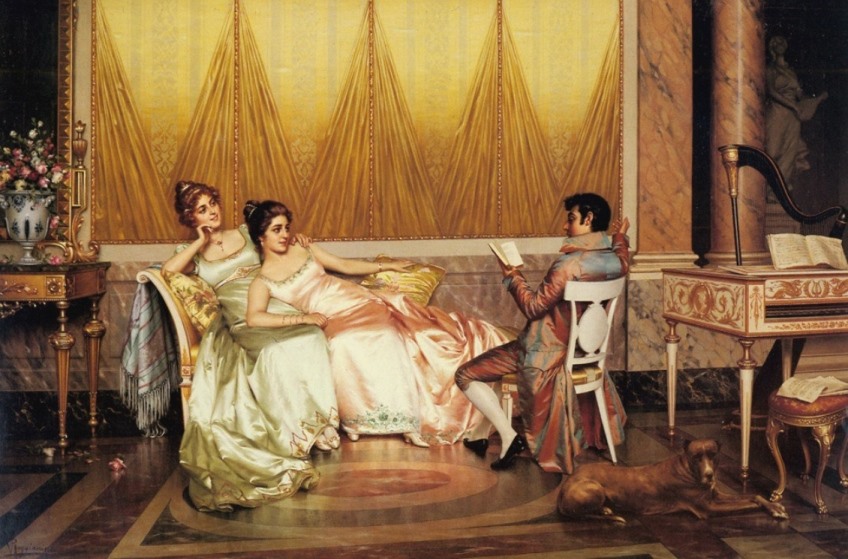
Featured Image: “The Poetry Reading” by Vittorio Reggianini.















Clear explanations here – like it.
Excellent explanation!
Bit of trivia to share: syllables in English have to contain at least one vowel/vocalic sound (like n in ‘button’, r in ‘water’, l in ‘bottle’, …). A syllable can have consonants and consonant clusters, but it has to have a vowel sound.
“Flowers” is actually a monosyllable.
while THOU | on PRESS | ed FLOWERS | dost SLEEP
I agree. I was thinking that the meter should be what you wrote!
while THOU | on PRESS | ed FLOWERS | dost SLEEP
How does one decipher between a short and a long syllable?
It is simply longer to pronounce, verging on pronouncing two distinct vowels. For example, there is the short “like” and there is the long “fire” which sounds almost like “feye-yr”.
A good explanation:
There is indeed something known as long vs. short syllables. It is a borrowing from Latin and Greek poetry. Any syllable with a long vowel, any syllable with a dipthong, any syllable with a short vowel followed by more than one consonant, is a “long syllable” – as in, it literally takes longer to pronounce. These are also known as “heavy syllables” as opposed to “light syllables.” The Latin form terms were “longum” and “brevis.”
For instance, “am” is a short syllable. “Arm” is a long one. “Aim” is a long syllable. And the first syllable of “Amy” is a long syllable. This is not the same thing as stressed vs. unstressed syllables though I think it is natural for the two phenomena to interact. (source: https://english.stackexchange.com/questions/43086/how-does-one-tell-the-difference-between-long-and-short-syllables)
More on diphthongs here: https://examples.yourdictionary.com/diphthong-examples.html
Please read my poem
Don’t ever fall in love my friend you see it doesn’t pay although it causes broken hearts that happens day after day and when you need needs get wake and then yd is starting to dance when you’re world revolves around and there’s nothing like romance so you see my friend you Have already lost in love loans fade away So you see my friend don’t fall in love you see it doesn’t pay
Hello I wanted to ask: can I use iamb, trochee and dactyl in one poem … like can I alter between them in the poetic lines I write? Or is it usually that one has to stick to one type per poem?
Dear Maab, you should only have one that you use as the overall meter of the poem. However, it is perfectly normal to have metrical variation within a poem to make your poem sound natural. So in an iambic pentameter poem, you will find trochees and dactyls and anapests, but the poem tends toward iambic and is mostly iambic.