


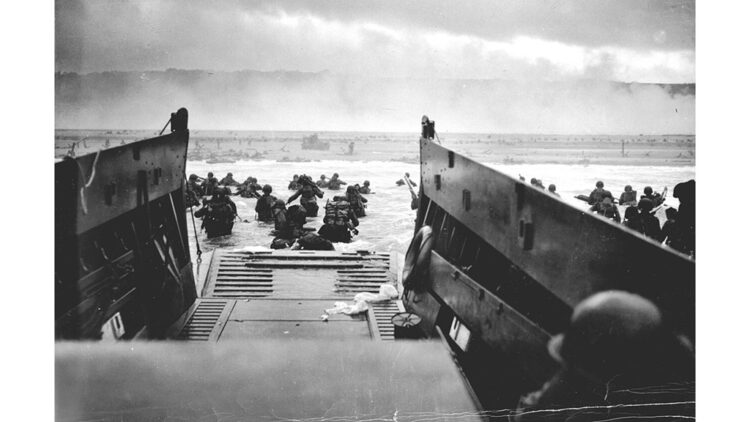
Omaha Beach
The ramp went down, and the brute din of war
Was like a furnace. Some collective will
Drew us into the water, and the air
Bloomed with sour bullets. They sank their roots in me
As if I were a rotted corpse. I fell,
And I was drowning in a sea of blood.
Then, two hands bore me up the beach, they jabbed
My arm with morphine, and I did not see his face.
At the reunions, all the strangers who
Were brothers on that day would strip their sleeves,
And I would ask my question, but he’s dead,
Or else we’re both anonymous, forever.
I see him now in everyone, as if
Absorbed into the body of the remnant.
Common Sense: Addressed
to the Inhabitants of America
—January 1776
In these pages I offer nothing more
Than simple facts, plain arguments, and common sense.
The struggle for America has now
Become a test of arms; all plans proposed
Before last April are but almanacs
Of years gone by; and reconciliation
Has passed away like an agreeable
Dream. Britain is no mother country. Even brutes
Do not devour their young, nor savages
Make war upon their families. No one
Again can love or serve a power that
Brought fire and sword into his land; no more
Can you forgive the murders of Great Britain
Than can a man forgive the ravisher
Of his wife. Hark and listen, hear the dark
Blood of the slain cry out: ’tis time to part.
O ye that love mankind, who dare oppose
Tyranny, stand forth! Freedom hath been hunted
Round the globe—Europe regards her like
A stranger—England warns her to depart.
O! Receive the fugitive, prepare
This new world an asylum for mankind.
Bradford Skow is a Professor of Philosophy at MIT. His first book of poetry, American Independence in Verse, was published in 2025. He writes about poetry, philosophy, and the arts at mostlyaesthetics.com.
















A powerful report in the sonnet, Bradford. The volta brings the experience of Omaha Beach into the entire life of the speaker, at least insofar as D-Day remains with him and returns to him, in that search for an unknown comrade. The “Common Sense” excerpt is, by contrast, a large and vivid picture of American-British relations just at that motivating moment.
Thanks!
The first word I thought of was ‘powerful’, which is also Margaret’s. The picture says it all, too, from the relative ‘safety’ of the landing craft to the utter vulnerability of wading through water with bullets and chance and Fate whizzing around you. The post D-Day part of the sonnet I found the most moving and poignant. To find the face of the the man you saved you in all the faces of the survivors reinforces their brotherhood.
And ‘Common Sense: Addressed to the Inhabitants of America’. Luckily we’re all friends again – sort of.
Happy birthday and thanks for the read, Bradford.
Thanks, Paul.