


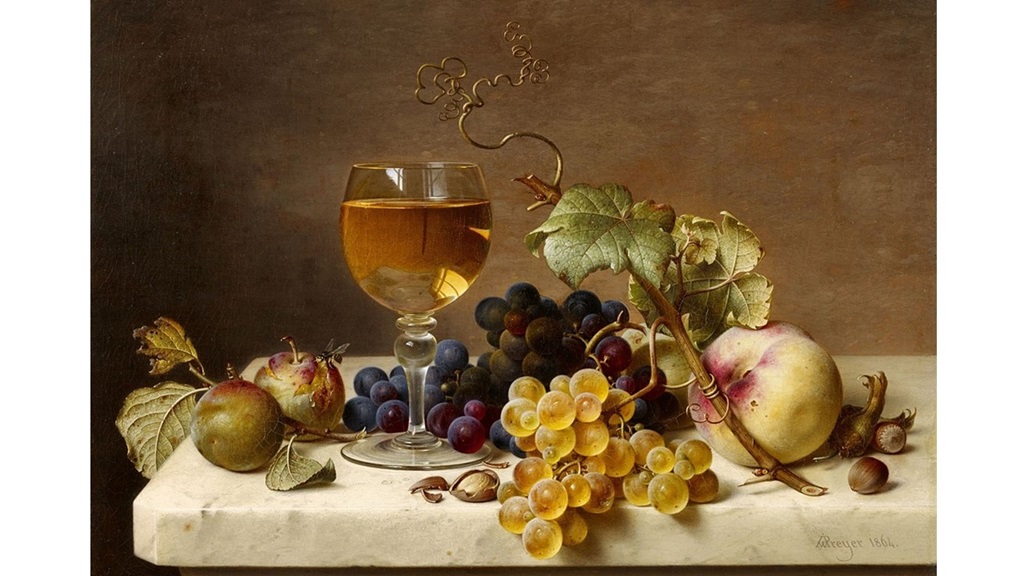
La Uva
I packed a bag of grapes into her lunch.
My hands resembled his, though not as worn;
they brought me back to what he told me once,
just days before my little girl was born.
…
“Ay, mijo, come outside,” my grandpa said.
He swung the screen door open, clacking closed.
The rays of amber sunlight reached and spread
across the leafy heads of vineyard rows.
His crooked fingers gripped a cluster’s stem.
He plucked a grape and offered, “Prueba esto.”
And when I bit into that emerald gem,
it popped with tangy juice. “It’s good, Abuelo.”
“Escucha, mijo. Mira why it’s good.”
He paused. “You’re gonna have a niña, ¿no?”
“Verdad,” I said. His smile understood.
“Regalo, mijo. Raise her like las uvas grow.”
In slanting light, his copper skin was gold.
He said, “A niña needs to feel amor,
como las uvas, they necesitan sol—
pero they spoil con demasiado calor.”
He squatted, brushed his hand atop the earth,
and gazed aside—a heavy, distant stare.
My throat grew dry, like I could taste the dirt
that drifted on the vineyard’s herbal air.
“You’ll want to give her everything… yo sé.
She doesn’t need the perfect ground abajo.
Tierra dura, you get strong roots that way.
La buena uva viene del trabajo.”
He drew the clippers hanging from his belt
with ease, as he had done a thousand times,
then thumbed a leaf to rub its downy felt.
He snipped a branch upon a wayward vine.
“A veces prune her back; a veces wait.
And let her grow—her way—you guide la viña.
How tu abuelo grows the sweetest grapes
is how el papi grows la buena niña.”
…
“Ay, mija, come inside and taste this.”
The kitchen floor received her gentle feet.
The grape was plump; its juices cold and crisp.
I asked her, “How does something grow so sweet?”
Glossary of Spanish Words
-la uva/las uvas – “the grape/the grapes”
-ay mijo/ay mija – affectionate expression for “oh son/oh daughter”
-prueba esto – “taste this/try this”
-abuelo – “grandpa”
-escucha – “listen”
-mira – “look/see”
-niña – “little girl/girl”
-verdad – “truth/true/right?”
-regalo – “a gift/a blessing”
-amor – “love/my love”
-como – “like/as”
-necesita sol – “needs sun”
-necesitan sol – “need sun”
-pero – “but”
-con demasiado calor – “with too much heat”
-yo sé – “I know/I understand”
-abajo – “below/down below”
-tierra dura – “hard ground/hard soil”
-La buena uva viene del trabajo – “Good grapes come from work.”
-a veces – “sometimes”
-la viña – “the vineyard/the grapevine”
-tu – “your”
-tú – “you”
-el papi – “Daddy/Dad”
-la buena niña – “the good girl/the well-behaved girl”
Michael Pietrack is a poet based in Grand Junction, Colorado. He is known for his narrative poetry and novels written in verse, including Legacy: The Saga Begins (2023) and Boone (2026). He has placed three times in the Society of Classical Poets International Competition with “Ballerina,” “The Loons of Colby Lake,” and “Grindstone.”


















One of my favorite poems that Michael has published. As far as bilingual poetry goes, this is certainly a work of art! The overarching analogy – as a father of a daughter myself, and as someone who has some fluency in Spanish – rings so true to real life and really sticks with a person. Nice work, my friend!
A very touching poem, Michael – very sweet indeed – and good to brush up on my Spanish!
Thank you, James. You are always so encouraging. I’m in a difficult phase of raising teenage daughters, and most of the old farmer’s advice, I need to apply, especially to let them grow “their way” and to guide them versus force them. I’m finding it difficult. Thanks again for the note.
Wonderful handling of verse — you craft in a natural flow and rhythm that makes this such a pleasure to read. Love your incorporation of Spanish for mood, tone and open up your rhyme choices. Very well done!
Thank you so much. Readability is very important to me, so I appreciate you singling that out.
Thank you. As always amazing.
Having raised two daughters, I am moved by the wisdom.
Thank you. All wisdom comes from above!
Such a beautiful story and verse. Thank you for sharing this. The weaving of two languages was skillfully done, and I was glad I still had enough Spanish in me to translate as I read.
I’m so pleased to know you enjoyed it. That the reward of poetry!
This is quite beautiful, and also touching. The mix of English and Spanish works well. This used to be called a “macaronic” poem, meaning that it made free use of two (or even more) languages.
As one of your admirers, it makes me happy to know that you liked it.
This is an absolutely lovely poem on so many levels. First of all, it teaches an important lesson about raising daughters. I’m sure every father is tempted to be softer on his daughters and harder on his sons (I know I am), but too much sweetness can spoil the vine, as you say. You present this in a very touching and personal way, in a setting that could take place in Spain as much as any Latin American country. The interweaving of Spanish, even into the end rhymes, is quite successful and demonstrates a high level of skill, without becoming awkward or preening.
I loved this comment. I have three daughters, so I don’t know how I’d treat a son…but I bet I’d be much harder on them.
As one of your admirers, it makes me happy to know that you liked it.
Brilliant.
I don’t imagine any child would really rather be a snowflake then an uva:)
“giving them a choice”
by bringing them up withoiut boundaries or training is not doing a child a favour,
warmest regards,
Karen
Great points. I’m glad you liked the poem!
Nice work, Michael. Reads and sounds like bilingual conversations we can hear in neighbor households of three generations. Used to be Italian in the winegrowing area around where I live. More Spanish now, but I imagine the advice is much the same. You have done a marvelous job of presenting the easy back-and-forth between generations using some parent language (especially those affectionate or most symbolic words) and English. The scenes in the video are beautifully selected. Here’s wishing the younger padre una buena quinceanera when strength and sweetness near the point of maturity.
Admirably crafted and heart touchingly beautiful. The scene feels so real I am standing right there listening to sage advice with a tearful smile. Thank you, Michael.
Wow, Michael. I find this poem entertaining and deeply touching. I am fluent in “Spanglish”, but had not considered the possibility of crafting a serious poem with it. You have done a masterful job! (And I appreciate the tidbit gleaned from Mr. Salemi’s comment that such a poem is “macaronic”)