


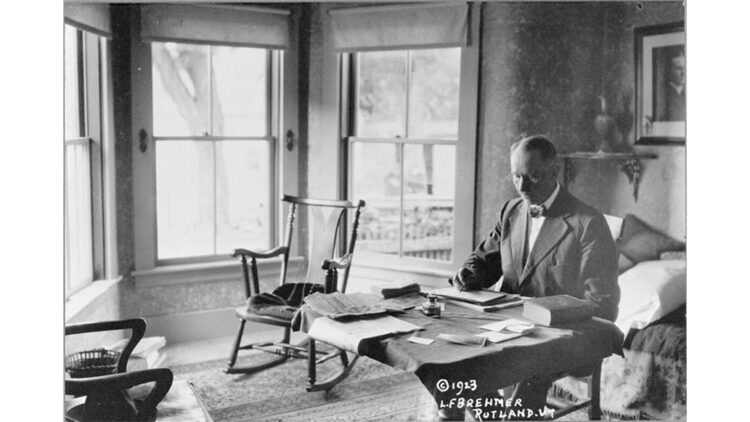
The Swearing-in of Calvin Coolidge
—Plymouth Notch, Vermont, 1923
Strange, the postman’s loud, insistent knock
(The nearest phone, in town, two miles away)
Which roused them out of bed at one o’clock,
Tired from bringing in the August hay.
And stranger still, two telegrams they read
By lantern light: official ones, and both
With urgent news from Washington, that said,
“The President is dead. Please take the oath.”
But in Vermont—where even summer skies
Can whisper that it’s time to stack the wood,
And every breath on northern air implies
You’re running out of days to do some good—
No one would be surprised, or think it odd
To see a man look up and say, “So help me God.”
Robert W. Crawford has published two books of poetry, The Empty Chair (2011, Richard Wilbur Award), and Too Much Explanation Can Ruin a Man (2005). His sonnets have twice won the Howard Nemerov Sonnet Award. He is a long-time member of the Powow River Poets of Newburyport, MA. Currently, he is the Director of the Hyla Brook Poets in Derry, NH, which includes the Hyla Brook Reading Series, the Frost Farm Poetry Conference on Metrical Poetry, and the Frost Farm Poetry Prize. He was named Derry NH’s first Poet Laureate in January 2017. He lives in Chester, NH.

















Wonderful sonnet of an historical event as told by pastoral images someone familiar both with history and the territory could share with us as a gift of poetry.
An excellently crafted sonnet on a little-known event in American history — how Calvin Coolidge received the news that Harding had died, and had to take the oath of office at his home in Vermont. From what I have read, the oath was administered to him by his father, and sworn on the family bible, by candlelight.
Having the closing line as an alexandrine was a good touch. It softens the perfect iambic fives of the rest with a small frisson of disorder, just as the news of a man’s accession to the presidency does in the carefully ordered world of New England farming.
Great poem! This is exactly how I like to receive my history lessons, thank you very much.
Very impressive storytelling that pulls the reader right in, with its clearly-described setting, and its setting-up of an immediate climax that lasts through the octet; then reflecting on another aspect of the conflict (other urgent things needing to be done) in the sestet — and a surprising double-meaning evoked with the four-word end of the oath “So help me God.” This is a wonderful poem.
With a moment of significant history in the octet, and the suddenly significant atmosphere in the sestet, this sonnet brings a single provision of the United States Constitution to life. I’ve heard of the moment before, from my mother who was a very young child in 1923. She was just old enough to understand the meaning of death, and at the time so little educated as to feel tremendous fear for her country. It was a rite of passage like the much more solemn one of President Coolidge himself, here described with such admirable New England restraint.