• Submit Poetry
  • Support SCP
  • About Us
  • Members
  • Join
Friday, October 2, 2026
Society of Classical Poets
  • Poems
    • Beauty
    • Culture
    • Satire
    • Humor
    • Children’s
    • Art
    • Ekphrastic
    • Epic
    • Epigrams and Proverbs
    • Human Rights in China
    • Music
    • Performing Arts
    • Riddles
    • Science
    • Song Lyrics
    • The Environment
    • The Raven
    • Found Poems
    • High School Poets
    • Terrorism
    • Covid-19
  • Poetry Forms
    • Sonnet
    • Haiku
    • Limerick
    • Villanelle
    • Rondeau
    • Pantoum
    • Sestina
    • Triolet
    • Acrostic
    • Alexandroid
    • Alliterative
    • Blank Verse
    • Chant Royal
    • Clerihew
    • Rhupunt
    • Rondeau Redoublé
    • Rondel
    • Rubaiyat
    • Sapphic Verse
    • Shape Poems
    • Terza Rima
  • Great Poets
    • Geoffrey Chaucer
    • Emily Dickinson
    • Homer
    • Henry Wadsworth Longfellow
    • Dante Alighieri
    • John Keats
    • John Milton
    • Edgar Allan Poe
    • William Shakespeare
    • William Wordsworth
    • William Blake
    • Robert Frost
  • Love Poems
  • Contests
  • SCP Academy
    • Educational
    • Teaching Classical Poetry—A Guide for Educators
    • Poetry Forms
    • The SCP Journal
    • Books
No Result
View All Result
Society of Classical Poets
  • Poems
    • Beauty
    • Culture
    • Satire
    • Humor
    • Children’s
    • Art
    • Ekphrastic
    • Epic
    • Epigrams and Proverbs
    • Human Rights in China
    • Music
    • Performing Arts
    • Riddles
    • Science
    • Song Lyrics
    • The Environment
    • The Raven
    • Found Poems
    • High School Poets
    • Terrorism
    • Covid-19
  • Poetry Forms
    • Sonnet
    • Haiku
    • Limerick
    • Villanelle
    • Rondeau
    • Pantoum
    • Sestina
    • Triolet
    • Acrostic
    • Alexandroid
    • Alliterative
    • Blank Verse
    • Chant Royal
    • Clerihew
    • Rhupunt
    • Rondeau Redoublé
    • Rondel
    • Rubaiyat
    • Sapphic Verse
    • Shape Poems
    • Terza Rima
  • Great Poets
    • Geoffrey Chaucer
    • Emily Dickinson
    • Homer
    • Henry Wadsworth Longfellow
    • Dante Alighieri
    • John Keats
    • John Milton
    • Edgar Allan Poe
    • William Shakespeare
    • William Wordsworth
    • William Blake
    • Robert Frost
  • Love Poems
  • Contests
  • SCP Academy
    • Educational
    • Teaching Classical Poetry—A Guide for Educators
    • Poetry Forms
    • The SCP Journal
    • Books
No Result
View All Result
Society of Classical Poets
No Result
View All Result
Home Poetry Beauty

‘Time Travel’: A Poem by Leland James

February 3, 2023
in Beauty, Blank Verse, Poetry
A A
19
poems 'Time Travel': A Poem by Leland James

.

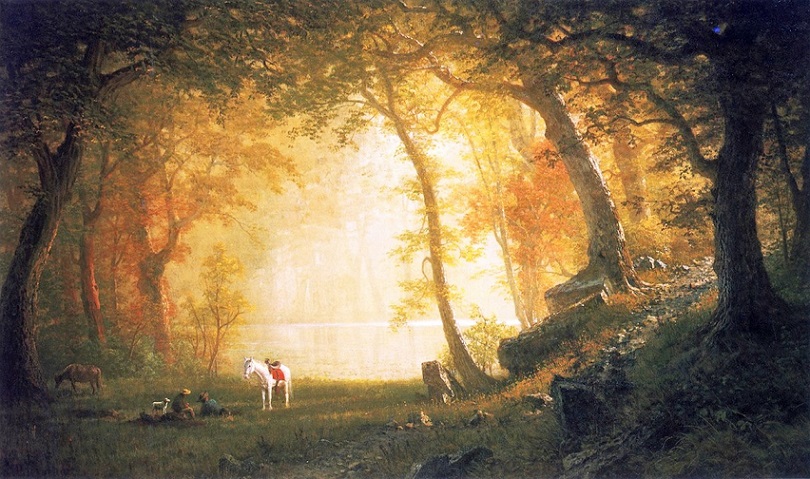
Time Travel

I chance upon a sylvan glade, an Orphic
place: moon threads, a lace of nightkin shadows.
A trill of breeze awakes the guardian trees,
live oaks in gowns of moss, tall runes of pine.

I hear the soft slow sound of fairy rings,
up from the inner earth, the sacred circle.
Fireflies, a skulk of toads; the dead come forth,
up from their graves in pagan conjuration,

sung heroes, hags, and godling visitations.
I drink the midnight dew, a witches’ brew.
Tree bark I read bard-blind, Achilles shield.
I muse upon a knot of oak, a tangled root.

I lie with Gaelic nymphs in ancient vales.
The hum of power lines a mile away.

.

.

Leland James is the author of five poetry collections, four children’s books in verse, and a book on creative writing and poetry craft. He has published over three hundred poems worldwide including The Lyric, Rattle, London Magazine, The South Carolina Review, The Spoon River Poetry Review, New Millennium Writings, The American Poetry Review, The Haiku Quarterly, The American Cowboy, and The Ekphrastic Review. He was the winner of the Aesthetica Creative Writing Award and has won or received honors in many other competitions, both in the USA and Europe. Leland has been featured in American Life in Poetry and was recently nominated for a Pushcart Prize.
www.lelandjamespoet.com & https://www.poetryfoundation.org/poets/leland-james

ShareTweetPin
The Society of Classical Poets does not endorse any views expressed in individual poems or commentary.
Read Our Comments Policy Here

RandomPoems

‘Beyond His Ken’ and Other Poetry by Peter Austin
Beauty

‘Beyond His Ken’ and Other Poetry by Peter Austin

April 25, 2020

  Beyond His Ken based on a true story The plane was in the skies above Beijing When, let us...

‘Praise the Lord and Pass the Ammunition’ and Other Poetry by Brian Yapko
Culture

‘Praise the Lord and Pass the Ammunition’ and Other Poetry by Brian Yapko

September 2, 2022

. Praise the Lord and Pass the Ammunition  Although this mad world’s headed for perdition, Don’t cower or wring hands...

Next Post
poem/bryant/free speech/pronouns

Poems on Politically Correct Churches and Language by Susan Jarvis Bryant

‘My Paola’s Love’ by Martin Rizley

'The Shadow of My Sorrow' by Daniel Howard

‘The City’ by Hans Theodor Woldsen Storm, Translated by Dusty Grein

'The City' by Hans Theodor Woldsen Storm, Translated by Dusty Grein

Comments 19

  1. Roy Eugene Peterson says:
    4 years ago

    This verbally vivid poem could have been molded into a classical beauty, but, alas, it lacks the meter and rhyme I associate with classic poetry. Maybe it is just me, but I still have a strong predilection for at least a modicum of classical discipline.

    Reply
    • The Society says:
      4 years ago

      Dear Roy,

      The general basic requirement for classical (aka traditional or formal) poetry is usually meter, and this poem does scan as iambic pentameter. Rhyming is not always necessary. English poetry traditionally has a rich history without rhyme, particularly with alliterative verse. The alliterative tradition is also reflected in Mr. James’s sonnet: “soft, slow sound” “sacred circle” “bard-blind” “heroes, hags”.

      -Evan Mantyk
      SCP Editor

      Reply
    • Cynthia Erlandson says:
      4 years ago

      There was also some good internal rhyme in lines 3 and 10.

      Reply
  2. Paul Buchheit says:
    4 years ago

    Great imagery, Leland. I thoroughly enjoyed reading your poem, feeling like part of the “sylvan glade.”

    Reply
  3. Paul Freeman says:
    4 years ago

    You set me up for that last line, Leland. Glad I wasn’t drinking coffee at the time.

    Personally, I find blank verse allows more freedom for other tools in the literary tool shed to be used.

    Thanks for the arboreal fantasy so unsuspectingly interrupted.

    Reply
  4. Joseph S. Salemi says:
    4 years ago

    One of the nice things about this poem is the use of older or more recondite English vocabulary, such as sylvan, nightkin, trill, runes, conjuration, godling, bard-blind, and vales.

    These conjure up an incantational tone, as if one were listening to a liturgy in a sacred language that has the patina of time on it. One of the deepest mistakes of modernism was to banish such diction from poetry in favor of colloquial banality. And yes — some of the best modernists like Eliot and Crane and Stevens deliberately disregarded this mistake, and reveled in the use of hieratic diction.

    The poem is in iambic fives, but I do have trouble scanning line 12:

    I muse upon a knot of oak, a tangled root.

    It doesn’t seem possible to get this into any iambic-five pattern, no matter how you substitute or elide.

    Reply
    • Paul Freeman says:
      4 years ago

      This would work in line 12, I think:

      ‘I muse upon a knot, a tangled root.’

      ‘oaks’ are mentioned earlier, so it avoids repetition by removing ‘…of oak…, and we’re told in the previous line we’re looking at ‘bark’.

      Reply
    • C.B. Anderson says:
      4 years ago

      How, Joseph, can one not read this line as iambic pentameter?

      Reply
    • C.B. Anderson says:
      4 years ago

      Oh yes, I see: one too many feet.

      Reply
    • Evan Mantyk says:
      4 years ago

      I have to wonder if Leland did it purposely, as in a “tangled r[f]oot.” Also not too different from the elongated six-foot last line of a Spenserian sonnet.

      Reply
  5. C.B. Anderson says:
    4 years ago

    At the end of the day Leland, this poem makes me want to inhabit the place it describes.

    Reply
  6. Mary says:
    4 years ago

    Leland, you have captured perfectly the ambiance of a role-playing board game. Your imagery is beautiful.

    Reply
  7. Kathy says:
    4 years ago

    wraps around in your gaze and comes with a cluster in your tone.
    takes you to that place.

    Reply
  8. jd says:
    4 years ago

    Beautiful. Begs re-reading. The final line startles with its difference and fulfills the title’s promise.

    Reply
  9. Cheryl Corey says:
    4 years ago

    Just reading this poem gives me a feeling of tranquility. A place I’d surely love to not only visit, but live. I especially like “runes of pine”, and “bard-blind” sounds like something Dylan Thomas would’ve written.

    Reply
  10. Susan Jarvis Bryant says:
    4 years ago

    An exquisite piece that lifts me from the mundane to the divine… thank you, Leland! I must admit that in my euphoric state, my ear didn’t catch the metrical variation.

    Reply
  11. Margaret Coats says:
    4 years ago

    Leland, to do time travel, you go to a place, or rather, find it. It’s what anthropologist Mircea Eliade might call a “center” where different realms of reality come together. The place has manifestations of power, some of them repulsive. Especially because I notice reference to Macbeth’s witches, the powers here are ambivalent. I thus wonder about your last line. Do you intend it to be a fragment sentence, or is “lines” a verb? Either way, it is not just a statement that your place of power is a short distance from modern power lines.

    Since the alliterative tradition was mentioned above, I hope you will not mind my giving an example of alliterative form, though it’s not what you use here. From Dream of the Rood,
    translated from Anglo-Saxon by Charles W. Kennedy:

    Wondrous that Tree, that token of triumph,
    and I a transgressor, soiled with my sins!

    There are 10 syllables in each line, but this is not pentameter! The structure requires half-lines to be linked by a sound such as “tr” in the first three half-lines here–or if not, to alliterate internally, as does the fourth half-line on the sound “s.” It’s a method of shaping poetic lines, quite different from the ornamental alliteration you and many of us use in our poems.

    Reply
  12. Leland James says:
    4 years ago

    Thanks to all for your comments.

    As to the 12th line discussion not being in pentameter:

    First of all I have no quarrel with metric purists—I have a different, more flexible, some will say heretical, point of view; there is room, with reason, sometimes, to move outside the lines (though readers will find in my poetry much that does conform without deviation from an absolute meter; see SCPs Leland James). Meter is not Rule-bound, for me. Meter, for me, is a combination of poetic feet, meaning, and sound. However—

    Notwithstanding my relatively “liberal” view—conservatives speaking among conservatives, in the landscape of poetry, current and past—this poem, Time Travel, conforms to my eye, ear, and sense to the absolute type. The final three words (“a tangled root”) within the twelfth line, the line in question above, follows a comma, a caesura. This, to my ear—accent not being by dictionary but by context—turns the article, a, into a stress, and these final three word together into a single foot. A “Third epitrite” poetic foot. Unusual, like a trochee or a headless iamb at the end of a line, but with strong precedent. This maintains the pentameter.

    I think Evan Mantyk’s solution is equally sound.

    This kind of varying analysis, and disagreement, may be frequently found among discussion of Yeats’ poetry. As John Butler Yeats said: “What can be explained is not poetry.”

    Finally, I am most heartened to hear the comments of those that heard the music of the poem without being troubled by the twelfth line, particularly Susan Jarvis Bryant who wrote, “An exquisite piece that lifts me from the mundane to the divine… thank you, Leland! I must admit that in my euphoric state, my ear didn’t catch the metrical variation.

    A quote from Robert Frost: ““The ear is the only true writer and the only true reader.”

    Again, thank you all for your interest and comments.

    Leland James

    Reply
  13. Alena Casey says:
    4 years ago

    An ethereal, beautiful poem with a delightful ending. I can’t choose a favorite line.

    Reply

Leave a Reply Cancel reply

Your email address will not be published. Required fields are marked *


  1. Theresa Werba on ‘The Mahjong Flowers’: A Set of Sonnets by Margaret CoatsOctober 2, 2026

    Margaret, I am in awe of the beauty in this set of four sonnets. I took some time to look…

  2. Theresa Werba on A Visualized Reading of The Odyssey: Book 1, Produced by Andrew Benson BrownOctober 2, 2026

    Oh Andrew, this is AMAZING. What a thrill to see Solot's translation of Homer so delightfully rendered with yours, and…

  3. Brian Yapko on ‘Rasputina Confers with Her Cohorts’: A Poem by Joseph S. SalemiOctober 2, 2026

    Joe, I apologize for coming so late to this noteworthy poem. Late but with many thoughts. The poem itself is,…

  4. Brian Yapko on ‘The Savage Moon’ and Other Poetry by Brian YapkoOctober 2, 2026

    Thank you, Kip! And thank you for the sci fi referral of Marune: Alastor 933. I see that it is…

  5. Brian Yapko on ‘The Savage Moon’ and Other Poetry by Brian YapkoOctober 2, 2026

    Dear Theresa, Mark, Roy, Martin, Laura, David, James and Kip -- thank you all for your generous comments on these…

Subscribe to Daily Poems

Enter your email address to subscribe to this blog and receive notifications of new posts by email.

Join 1,661 other subscribers
No Result
View All Result

Resources

       1. A Guide to Writing Poetry

      2. The Best Poems of 2020      

      3. Poetry and Writing Contests

      4. Journals Accepting Formal Verse

Recent Poems

  • ‘The Mahjong Flowers’: A Set of Sonnets by Margaret Coats
  • ‘The Martyrdom of Saint Cassian’: A Poem by Joseph S. Salemi
  • ‘Mind Versus Beauty’: A Poem by Johann Wolfgang von Goethe, Translated by Eric v.d. Luft
  • ‘Summer Sails’: A Poem by Paulette Calasibetta
  • ‘Aquarius’: A Poem by Patricia Rogers Crozier
  • ‘No Body Here on Earth’: A Poem by Gerard Maritato
  • A Visualized Reading of The Odyssey: Book 1, Produced by Andrew Benson Brown
  • ‘Now?’ and Other Poetry by Stephen DiLauro
  • ‘From California to Louisiana’: A Sonnet by Mark F. DeWitt
  • ‘A Pot of Tea’ and Other Poetry by Samuel Gregg
  • Eight Riddles for the 2026 Mid-Autumn Festival, by Evan Mantyk
  • ‘Swallowtails’ and Other Poetry by Mary Jane Myers
  • ‘All Flesh Is Grass’: A Poem by Cynthia Erlandson
  • ‘May a Smile Be Your Umbrella’: A Poem by Roy E. Peterson
  • ‘Flexibility’ and Other Poems by Russel Winick
  • ‘Sabin Howard’ and Other Poetry by Bruce Dale Wise
  • ‘Ode to a Dragonfly’ and Other Poetry by Adam Sedia
  • ‘Hobby Horse’: A Poem by A.R. Pereira
  • ‘Big Cat Dance’: A Poem by Paul Erlandson
  • ‘Freedom’s Wring’: A Poem by C.B. Anderson
  • ‘Island of Poets’: A Poem in Sapphic Verse by Margaret Coats
  • ‘Military Quatrains, or the Modern Archilochus’: A Poem by Joseph S. Salemi
  • ‘The Secret Rose’ and Other Poetry by Luke Perera
  • ‘The Family Archive’: A Poem by Robert Thomas
  • ‘Pedagogy’: A Poem by Jonathan Kinsman
  • ‘Who Are the Villains?’ and Other Poetry by Adam Wasem
  • ‘Isle of Romance’: A Poem by Margaret Brinton
  • ‘Professional Mourner’: A Poem by Brian Yapko
  • A Distillation of Shakespeare’s ‘A Midsummer Night’s Dream’ by Martin Briggs
  • ‘How the Mighty Fell!’: A Poem by Jeff Kemper

Categories

  • Acrostic
  • Alexandroid
  • Alliterative
  • Art
  • Best Poems
  • Blank Verse
  • Chant Royal
  • Classical Poets Live
  • Clerihew
  • Covid-19
  • Deconstructing Communism
  • Educational
  • Epic
  • Epigrams and Proverbs
  • Essays
    • Interviews with Poets
    • Poetry Reviews
  • Featured
  • From the Society
  • Great Poets
    • Dante Alighieri
    • Edgar Allan Poe
    • Emily Dickinson
    • Geoffrey Chaucer
    • Henry Wadsworth Longfellow
    • Homer
    • John Keats
    • John Milton
    • Robert Frost
    • William Blake
    • William Shakespeare
    • William Wordsworth
  • Human Rights in China
  • Limerick
  • Love Poems
  • Music
  • Pantoum
  • Performing Arts
  • Poetry
    • Beauty
    • Children's Poems
    • Culture
    • Ekphrastic
    • Found Poems
    • High School Poets
    • Humor
    • Riddles
  • Poetry Challenge
  • Poetry Contests
  • Poetry Forms
    • Curtal Sonnet
    • Haiku
  • Poetry Readings
  • Rhupunt
  • Rondeau
  • Rondeau Redoublé
  • Rondel
  • Rubaiyat
  • Sapphic Verse
  • Satire
  • Science
  • Sestina
  • Shape Poems
  • Short Stories
  • Song Lyrics
  • Sonnet
  • Symposium
  • Terrorism
  • Terza Rima
  • The Environment
  • Translation
  • Triolet
  • Video
  • Villanelle

Quick Links

  • About Us
  • Submit Poetry
  • Become a Member
  • Members List
  • Support the Society
  • Advertisement Placement
  • Comments Policy
  • Terms of Use

Welcome Back!

Login to your account below

Forgotten Password?

Retrieve your password

Please enter your username or email address to reset your password.

Log In
No Result
View All Result
  • Poems
    • Beauty
    • Culture
    • Satire
    • Humor
    • Children’s
    • Art
    • Ekphrastic
    • Epic
    • Epigrams and Proverbs
    • Human Rights in China
    • Music
    • Performing Arts
    • Riddles
    • Science
    • Song Lyrics
    • The Environment
    • The Raven
    • Found Poems
    • High School Poets
    • Terrorism
    • Covid-19
  • Poetry Forms
    • Sonnet
    • Haiku
    • Limerick
    • Villanelle
    • Rondeau
    • Pantoum
    • Sestina
    • Triolet
    • Acrostic
    • Alexandroid
    • Alliterative
    • Blank Verse
    • Chant Royal
    • Clerihew
    • Rhupunt
    • Rondeau Redoublé
    • Rondel
    • Rubaiyat
    • Sapphic Verse
    • Shape Poems
    • Terza Rima
  • Great Poets
    • Geoffrey Chaucer
    • Emily Dickinson
    • Homer
    • Henry Wadsworth Longfellow
    • Dante Alighieri
    • John Keats
    • John Milton
    • Edgar Allan Poe
    • William Shakespeare
    • William Wordsworth
    • William Blake
    • Robert Frost
  • Love Poems
  • Contests
  • SCP Academy
    • Educational
    • Teaching Classical Poetry—A Guide for Educators
    • Poetry Forms
    • The SCP Journal
    • Books

© 2025 SCP. WebDesign by CODEC Prime.