


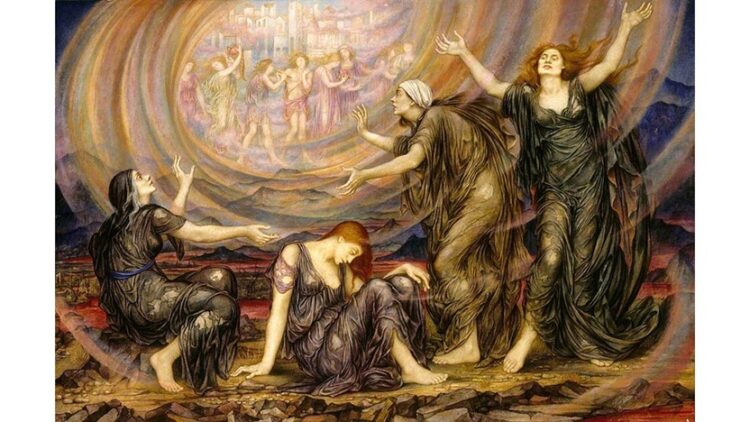
Professional Mourner
Good morning, friend. I didn’t catch your name.
Ah. Tod. So you’re the new kid on the block?
It’s good to see fresh faces now and then.
You’re nervous? Is this really your first time?
I know you’re young, but grandparents? An aunt?
Not ever? You’re a very lucky guy.
Just stick with me, Tod. I’ll show you the ropes.
Take off your hat. And next time wear a tie.
Dress dark and look bereft. Lower your eyes.
A muffled sob. Pull out the handkerchief,
Then sniffle some. Pretend to wipe a tear.
Look grave as if your life’s own light has ended.
You’ll get the hang of it. I used to practice
Before the mirror. Now it’s just routine.
You come, you view, shake hands, sit down, look sad,
And mumble in response if someone prays.
Before you know it down the casket goes.
It’s easy. Plus the pay is not too bad.
So you’re between careers? Yeah. So am I.
My field is real estate. I sold a ton.
Then values crashed. I had to make ends meet.
These funerals have really saved my butt.
It’s this and taxes, right? No likelihood
Professionals like us will get laid off.
What time is it? It’s late and no one’s here
Except the client—that frail man in black.
Before we wish him peace, do we know who
She was? His sister? Wife? Well, let’s just give
N.S.—that’s short for “non-specific solace”—
In parlor talk, “a sad sniff for the stiff.”
I’m looking forward to the eulogy.
I didn’t sleep well. Maybe I can nap.
You know, closed eyes can masquerade as grief.
But please don’t think I’m callous! I’ve shed tears
For people that I’ve never even met.
In fact, I’ve done that twice these last six months.
As for this client, let us hope and pray
He’s generous with all the incidentals;
Hard cash and no receipt so it’s tax free
(And just a small fee to the agency.)
No benefits, it’s true. Just a good deed
To make it look like there were folks who cared.
I think I hear the caterers at work.
I hear there’s chicken salad; Gouda cheese;
Potato pancakes; dip made out of lentils,
And Brie with flat-bread; also ham and beef.
Oh good, it’s starting. Tod, let’s make this real.
A sigh, a sob… and then a hearty meal!
Brian Yapko is a retired lawyer whose poetry has appeared in over fifty journals. He is the winner of the 2023 SCP International Poetry Competition. Brian is also the author of several short stories, the science fiction novel El Nuevo Mundo and the gothic archaeological novel Bleeding Stone. He lives in Bradenton, Florida.








What an original idea, Brian. And very entertaining, without losing sight of the underlying insincerity and money-grabbing which – alas – surrounds the mortality industry.
Thank you very much, Martin. I had fun writing this one. It was so shamelessly venal. I’ve never thought of it in terms of “the mortality industry.” What great — if sobering — phrasing!
Wow, Brian! Does this actually exist? Professional mourners?
Yes, Golan, as distasteful as the idea may be, this is a real thing. I had heard of this practice in ancient times and when I researched it to see if it was still relevant, I found this: https://www.rentacrowduk.co.uk/hire-a-mourner-for-funerals-and-wakes/
The world is a very strange place.
Brian, only you could come up with such an arcane subject and make it entertaining. “It’s this and taxes, right?” is a fascinating play on words. I just had to do some research on “Professional Mourners.” Here is what I came up with from a couple of sources:
1.) “Professional mourners absolutely still exist, though their form varies widely by culture and region. They are no longer universal, but the role persists in both traditional and modernized versions across the world.”
2.) They are limited in the US, but “presence mourners” may be hired in some places to sit with grieving families for “calm” moral support, “not theatrical wailing.”
3.) China: Professional mourners remain part of traditional funeral processions in some regions, with “ritual lamentation. ”
4.) Kenya: “Among the Luo people in western Kenya, mourners are hired to wail, sing, and perform ritual movements believed to honor the dead and protect the living. This is a steady job…typically paying around $80 per funeral.”
Other regions: “Variants of paid lamentation continue in parts of the Middle East, South Asia…”
5.) “Ancient professional mourners often performed dramatic lamentation — wailing, tearing garments, chanting — as seen in Egypt, Rome, and China.”
I wonder in my mind how you ever came up with this or were even aware of its existence. I would almost guess it was from the time you lived and worked in New Mexico.
Roy, I’m thrilled that you enjoyed this poem and even more pleased that you did so much research on the subject of professional mourners — where they exist today and where they have been part of history. Thank you for that!
It seems so odd that one would hire someone to pretend to mourn a deceased person. Odd and sad. But is it any stranger than hiring a clergyman to read the eulogy of someone he has never met? But on reflection, yes, it is stranger. The clergyman is not paid to offer a pretense of grief while the professional mourner truly is a hired performer — sobbing and wailing for someone they do not truly care about. Of course, we see hired performers all the time now as protesters are bought and paid for by George Soros and others — usually shouting about issues they don’t even know anything about. I think I prefer the professional mourners. At least they contribute something useful to those left behind.
The voice is exceptionally well controlled, and I love how the speaker’s numbness to death reveals itself so naturally. Beneath the satire is a sad truth about how grief can become ceremony, routine, and even transaction. The final line captures the whole poem perfectly. I wonder how anyone in this field or related fields can eat.
Thank you so much, Michael! I did have fun writing this poem, but also felt terribly guilty for it. Still, it was worthwhile I think to present a character portrait of someone who is indeed numb to death (tears shed only twice in six months?) and who is basically there for the lentil dip and roast beef. Good question about how people in this field can eat. I imagine one becomes hardened to all sorts of things. I can’t imagine how a forensic coroner can eat but I’ve seen experts in medical malpractice cases chow down even as they discuss the most gruesome of details. People are resilient in some of the strangest ways.
Brian, I couldn’t last a day in this profession if the sadness displayed had to be faked, I tend to tear-up when I even ‘hear’ the word – “died”.
At the same time, if participants were paid by the number of legitimate teardrops they shed, I’d be a billionaire by now! NEAT piece…
Thank you very much, Mark! I think it would be hard to pretend to mourn. But it’s more common than you realize. I can recall many a probate where relatives waiting on their share of the estate would put on a sad face (usually without success) so that the judge or trustee wouldn’t be scandalized by their greed. And these are relatives of people that they knew and loved! So I think I prefer the professional mourners. At least they aren’t hurting anyone.
Very clever poem, Bryan. I know of people who attend
Memorial services so they can attend the receptions. Maybe
that’s the catalyst for your very unusual but expertly crafted
poem.
Thank you so much, jd. That’s very interesting. Sort of like people who go to weddings just for the food. For some reason your comment reminds me of the old film “Harold and Maude” in which the two title characters form a friendship based on their attending the funerals of people they don’t know.
LTC Peterson has pointed out how widespread this practice of hired mourners still is in some places. He mentions the ancient world, and there I can give you the Latin name for these persons: PRAEFICAE. They were almost always women, and they did dance, weep, and tear their garments. There was no attempt to disguise the fact that they were hired for the job — all upper-class Roman funerals had them as a matter of course.
What delights me about this poem is not just its comic playfulness, and consciously colloquial language to suit the speaker. I also love the impish deceit of the whole thing — two guys attending a funeral just to get paid and have a meal, and the overall sense that there isn’t anything criminal here, only the desire to make a living by dressing up and acting in a manner culturally acceptable to the situation.
How much of human activity is totally fictive, but also necessary? Fine cuisine instead of raw food; fermented and aged wine instead of plain water; complex foreplay instead of brutish coitus, song and poetry instead of prosaic speech? All these things are manifestations of human artifice, designed to make life richer, more ornate, more interesting, and more bearable. Why not the dramatized mourning at a funeral?
Brian, this is a great piece.
Thank you so much, Joe! I’m particularly fascinated by your description of the Praeficae — they would themselves make the subject of a fascinating poem on the funeral of a Roman noble under the Caesars.
I’m so gratified that you enjoyed this poem — especially the colloquial language and the “impish deceit” (I love that phrasing.) The colloquial language is, in my view, what makes the poem work. The speaker is obviously a typical modern fellow who is just sort of nattering away under the strangest of circumstances and there is no way that formal “poesy” language would work in this context. Language in a dramatic monologue (I think this piece qualifies as one) really must be tailored to the character of the speaker. As for motivation, necessity leads to all kinds of compromises. It would seem that people down on their luck will do anything to make a buck.
I am very intrigued by your discussion of human activity and the many ways civilized beings have elevated various activities that really boil down to very basic need. Our society is structured upon fictions and artifices to stay cohesive. I imagine this is how cultures form — with a series of agreed-upon protocols to address things like birth, marriage, death. Along with things like the development of cuisine or the development of art. There is rarely anything objective about such things — just what a particular tribe or nation or ethnicity has developed through the years. It’s a rather sociological subject. And an interesting one.
A wonderfully droll poem on a subject that no one really likes to talk or think about. I really enjoyed it Brian, even without my favorite end rhymes etc., it drew me in and kept me interested.
Thank you so much, Norma! Yes, blank verse seemed like the way to go with this piece. I have a few distant rhymes here and there which you might not even notice. Like “incidentals” and “lentils” a few lines later. But not enough to qualify as a rhyme scheme. I’m glad you enjoyed this strange piece!
This is a fascinating poem indeed. A casual reading would suggest that one older and experienced professional mourner is talking to another one who’s young and inexperienced, whose name is Todd with only one D. But Tod being the German word for death, means the professional mourner is talking to death himself, which adds a whole other dimension to this poem. The idea that death is young and between careers is wickedly amusing and of course the speaker acknowledges that death and taxes are the most steady and reliable gig available.
I like this crazy tale a lot, great job! I’m going to be thinking about this one for a while, Brian.
Ah, Yael, you make me want to jump up and cheer! You absolutely nailed it and I couldn’t be more pleased! Yes, “Tod” is the German word for Death. This was very important to my conception of the piece and although I did not base it on anything per se, I did have in my head the image of Brad Pitt playing a youthful death in “Meet Joe Black.” You even got it down to the one D rather than two D’s in the name Tod (which, you’re correct, is usually spelled Todd in English.) I liked the Twilight Zone irony of the speaker nattering on and on oblivious to the identity of the person he’s actually giving pointers to. If I were filming this, I think Death would not be “between jobs” so much as making an incognito appearance to see his handiwork in person. And maybe fudging the truth a little here and there. But I’m so glad you picked up on this dimension of the piece and that it tickled you.
Along these lines, I had one other little Easter egg in here that no one has picked up on. I was rather careful about choosing “real estate” as the speaker’s line of business. I was hoping readers might notice the irony of someone who sells houses for a living now being involved in placing them into their “final” home.
Thank you again for your keen eye and spot-on interpretation.
Nice touch that “Tod” (death) is the “new kid on the block.” It nicely sets up the narrator’s clueless Rosencrantz and Guildenstern mooks-just-doin’-a-job patter. It’s even funnier when contrasted with the ultimate solemnity and finality involved with said job. I love deadpan humor, and deadpanning about the dead has to be the apotheosis of the form. Great fun.
Thank you so much, Adam! I love your reference to Rosencrantz and Guildenstern and their “mooks-just-doing-a-job patter.” That is certainly how the speaker sees his job — though I’m not quite sure about Tod. As for the Stoppard play, I think it’s brilliant! And since Hamlet happens to be one of my favorite plays, this is a most welcome reminder of a fun perspective rewrite.
As for deadpan humor, that’s one of my very favorites. In an Addams Family kind of way. I’m glad you found my poem funny because that’s sure what I aimed for.
This was an entertaining and well crafted poem. It’s surreal that the subject matter actually exists; thanks to your poem and other commenters’ research and knowledge, I know it to be true. The “a sad sniff for the stiff” is a great line.
Thank you so much, Paul! It really is surreal, but if you think about it it’s actually a rather compassionate — if inorganic — service to offer those who are grieving but, perhaps, with no families or few friends. I’m especially glad you liked that “sad sniff for the stiff” line. I almost deleted it from the poem as I was worried about how very callous it sounded. But it was true to the character so it stayed.
Great job at capturing natural speech rhythms in iambic lines. Humorous and kept my attention to the end.
Thank you very much, Luke. I enjoy writing in blank verse and using colloquial, idiomatic language — when it suits the character I’m presenting. I’m glad you found it funny enough to stick with!