


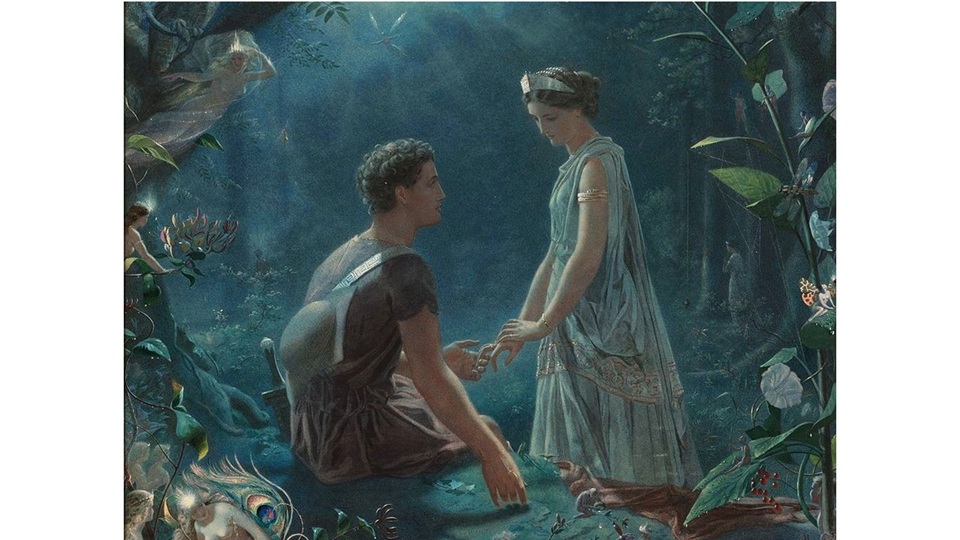
A Midsummer Night’s Dream
Whose dream are they, these four Athenian lovers
whose mad misunderstandings mock each other?
Moonstruck puppets in a fairy play,
bemused and lovesick sleepwalkers astray
across the borderlands of night and day,
manipulated wits not rediscovered
till horns halloo the dawn.
till horns halloo the dawn. Which is to say
that any pair of wit-bewildered lovers
may meet by moonlight but not know each other.
The puppeteer may ravel reveries
in Arden as in Athens if he please,
may make of sleepers under English trees
players in a play within a play;
but moons must set, and love may be discovered
if one only wakes and, waking, sees.
Martin Briggs lives in Suffolk, England. He only began writing in earnest after retiring from a career in public administration, since when he has been published in various publications on both sides of the Atlantic.








Thank you for this beautiful poetic reflection, Martin. I’m no expert on Shakespeare but can still appreciate your sensitive and skilful expression. The alliteration (so often unconscious, I’m sure) makes it even more haunting and memorable. Best wishes, Bruce
Thank you, Bruce, for your kind appreciation.
This is a lovely meditation on the play, which is one of Shakespeare’s most ethereal creations. The poem’s expert interplay between dream-illusion and waking reality reflects perfectly the essence of what Shakespeare accomplished in that drama.
Thank you, Joseph. You’ve put your finger exactly on what I was trying to achieve.
I love what you’ve accomplished here, Martin, with phrasing such as: horns halloo the dawn; wit-bewildered; sleepers under English trees; and players in a play within a play. Just for kicks, I re-read the play a few years ago, as it seemed perfectly suited to the summer season.
Thank you, Cheryl. Every midsummer I make a point of either re-reading the “Dream” or listening again to Mendelssohn’s incidental music, which encapsulates almost miraculously the spirit of the play.
Lovely, Martin. I like the “anywhere applicability” in the second part of your poem, and the moonset message at the close. For midsummer night music, I have to prefer Purcell’s “The Fairy Queen.” The most enchanting production I ever saw of Shakespeare’s play was accompanied by it–and Purcell outdid the Bard. If you’ve not heard the opera, the Prelude and the Rondeau make good short samples.
Thanks Margaret. Yes, Purcell was certainly onto something, and I do like what I’ve heard of “The Fairy Queen”. But he tinkers with the original play, and I prefer to see the two works as unrelated (illogical though that might seem)!