• Submit Poetry
  • Support SCP
  • About Us
  • Members
  • Join
Saturday, August 8, 2026
Society of Classical Poets
  • Poems
    • Beauty
    • Culture
    • Satire
    • Humor
    • Children’s
    • Art
    • Ekphrastic
    • Epic
    • Epigrams and Proverbs
    • Human Rights in China
    • Music
    • Performing Arts
    • Riddles
    • Science
    • Song Lyrics
    • The Environment
    • The Raven
    • Found Poems
    • High School Poets
    • Terrorism
    • Covid-19
  • Poetry Forms
    • Sonnet
    • Haiku
    • Limerick
    • Villanelle
    • Rondeau
    • Pantoum
    • Sestina
    • Triolet
    • Acrostic
    • Alexandroid
    • Alliterative
    • Blank Verse
    • Chant Royal
    • Clerihew
    • Rhupunt
    • Rondeau Redoublé
    • Rondel
    • Rubaiyat
    • Sapphic Verse
    • Shape Poems
    • Terza Rima
  • Great Poets
    • Geoffrey Chaucer
    • Emily Dickinson
    • Homer
    • Henry Wadsworth Longfellow
    • Dante Alighieri
    • John Keats
    • John Milton
    • Edgar Allan Poe
    • William Shakespeare
    • William Wordsworth
    • William Blake
    • Robert Frost
  • Love Poems
  • Contests
  • SCP Academy
    • Educational
    • Teaching Classical Poetry—A Guide for Educators
    • Poetry Forms
    • The SCP Journal
    • Books
No Result
View All Result
Society of Classical Poets
  • Poems
    • Beauty
    • Culture
    • Satire
    • Humor
    • Children’s
    • Art
    • Ekphrastic
    • Epic
    • Epigrams and Proverbs
    • Human Rights in China
    • Music
    • Performing Arts
    • Riddles
    • Science
    • Song Lyrics
    • The Environment
    • The Raven
    • Found Poems
    • High School Poets
    • Terrorism
    • Covid-19
  • Poetry Forms
    • Sonnet
    • Haiku
    • Limerick
    • Villanelle
    • Rondeau
    • Pantoum
    • Sestina
    • Triolet
    • Acrostic
    • Alexandroid
    • Alliterative
    • Blank Verse
    • Chant Royal
    • Clerihew
    • Rhupunt
    • Rondeau Redoublé
    • Rondel
    • Rubaiyat
    • Sapphic Verse
    • Shape Poems
    • Terza Rima
  • Great Poets
    • Geoffrey Chaucer
    • Emily Dickinson
    • Homer
    • Henry Wadsworth Longfellow
    • Dante Alighieri
    • John Keats
    • John Milton
    • Edgar Allan Poe
    • William Shakespeare
    • William Wordsworth
    • William Blake
    • Robert Frost
  • Love Poems
  • Contests
  • SCP Academy
    • Educational
    • Teaching Classical Poetry—A Guide for Educators
    • Poetry Forms
    • The SCP Journal
    • Books
No Result
View All Result
Society of Classical Poets
No Result
View All Result
Home Music

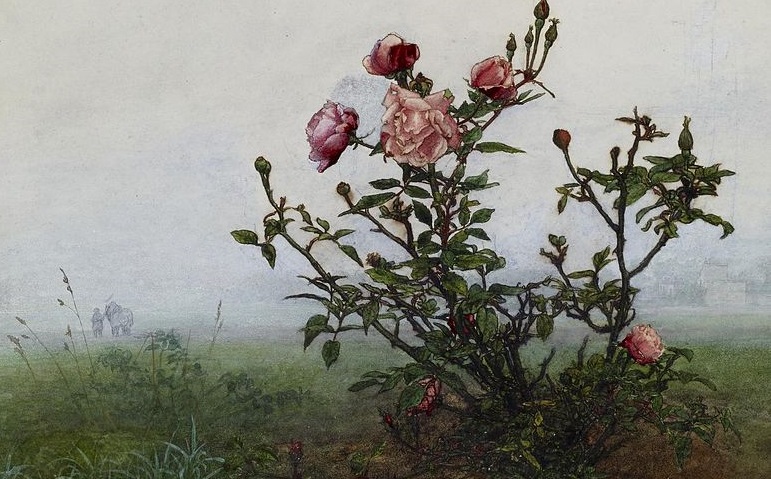
‘Lo, How a Rose E’er Blooming’: A Musical Arrangement by James A. Tweedie

December 26, 2024
in Music, Poetry
A A
5
poems 'Lo, How a Rose E’er Blooming': A Musical Arrangement by James A. Tweedie

.

Lo, How a Rose E’er Blooming

Every year I either compose new music for Christmas or create a new arrangement of a familiar carol. This year I have chosen, “Lo, How a Rose E’er Blooming,” a hymn which first appeared (without ascription) in print with German text (of two stanzas) and melody in 1599. The tune was harmonized by the German composer, Michael Praetorius, in 1609. There are three preeminent English verse translations, the most used being that written by Theodore Baker in 1894.

My version of the carol is arranged for oboe and harp, followed by the modern German text and Baker’s translation.

.

https://classicalpoets.org/wp-content/uploads/2024/12/Carol-with-melody-mp3.mp3

.

Es ist ein Ros entsprungen
aus einer Wurzel zart,
wie uns die Alten sungen,
von Jesse kam die Art.
Und hat ein Blümlein bracht
mitten im kalten Winter,
wohl zu der halben Nacht

Das Röslein, das ich meine,[a]
davon Isaias sagt,
ist Maria die reine,
die uns das Blümlein bracht.
Aus Gottes ew’gem Rat
hat sie ein Kind geboren
und blieb ein reine Magd. (“and remained a pure maidservant”) (Original version)
or: Welches uns selig macht .(“which greatly blessed us”) (Protestant Version)

.

.

Lo, how a rose e’er blooming,
From tender stem hath sprung.
Of Jesse’s lineage coming,
As men of old have sung;
It came, a flow’ret bright,
Amid the cold of winter,
When half spent was the night.

Isaiah ’twas foretold it,
The Rose I have in mind,
With Mary we behold it,
The virgin mother kind;
To show God’s love aright,
She bore to men a Savior,
When half spent was the night.

.

.

James A. Tweedie is a retired pastor living in Long Beach, Washington. He has written and published six novels, one collection of short stories, and four collections of poetry including Sidekicks, Mostly Sonnets, and Laughing Matters, all with Dunecrest Press. His poems have been published nationally and internationally in both print and online media. He was honored with being chosen as the winner of the 2021 SCP International Poetry Competition.


ShareTweetPin
The Society of Classical Poets does not endorse any views expressed in individual poems or commentary.
Read Our Comments Policy Here

RandomPoems

A Monosyllabic Poem: ‘To West’ by Adam Sedia
Beauty

‘Orpheus’: A Poem by James Sale

May 10, 2024

. Orpheus We want the heroes back so we can learn: Herakles smashed his way to hell and stormed By...

Two Courtroom Sonnets by Carl Kinsky
Beauty

Two Courtroom Sonnets by Carl Kinsky

July 19, 2022

. Self Defense When he pulled out his knife I thought I had No choice so I pulled out my...

Next Post
‘Twas the Day After Christmas’ by Roy E. Peterson

'Twas the Day After Christmas' by Roy E. Peterson

‘Catching Up’ and Other New Year’s Poetry by C.B. Anderson

'Catching Up' and Other New Year's Poetry by C.B. Anderson

‘Sentimental Song’ and Other Poetry by Angel L. Villanueva

'The Blank-Page Stage' and Other Poetry by Warren Bonham

Comments 5

  1. Murray Alfredson says:
    2 years ago

    My information on this song is that though it was first published in print in Koeln in 1599, its origin dates back to the 15th century. The variations in the final line of stanza 2 are a bit of a puzzle, though I give credence to the repeated final line of stanza 1: ‘wohl zu der halben nacht.’ (NB, capitalisation of German nouns, so far as I am aware dates from the 18th century, si I do not capitalise nouns of earlier New High German). Many stanzas were tacked on to this folk hymn during the 19th century.

    This poem rests explicitly on the book od Isaiah, the same chapters as form the text of GF Haendel’s Messiah, using the 1611 Authorised Version of the English Bible.

    Stimulated by your setting of thes hymn, Pastor Tweedie, I am inclined to post on the Classical Poets dire a poem, ‘Prince of peace’, I wrote based on this folk hymn, but with my own twist on deutero-Isaiah’s ‘prophecy’ as generally interpreted in Christian tradition. The opening of my poem reads like a pruned down version of the original, before I depart in a very different direction.

    Thank you posting your setting of a favourite and very beautiful folk hymn.

    Reply
    • James A. Tweedie says:
      2 years ago

      Murray, your notes fill in a goodly amount of information about this carol—much, but not all of which I omitted for simplicity’s sake. The twist in the final line is that there is (as I note) a Roman Catholic version that follows the original German with its emphasis on Mary and a rewritten Protestant ending that modifies it.

      Baker’s translation of the second (and final) verse avoids the ending issue by ignoring it altogether while simply repeating his ending of the first verse. As you note, I assumed the song did not appear out of thin air, but most certainly represented an earlier, pre-Reformation origin.

      As for Isaiah, I might mention that I used this hymn and the Isaiah text as the basis for my sermon on the first Sunday of Advent earlier this month. This carol text offers much to exegete.

      As for your poetic version of the text I hope you will submit it posthaste so Evan can post it asap!

      Reply
  2. Roy Eugene Peterson says:
    2 years ago

    I like your translation. I did not realize you were a German linguist. Ich wünsche Ihnen frohe Weihnachten.

    Reply
  3. James A. Tweedie says:
    2 years ago

    Lol this is Theodore Baker’s translation and I claim neither credit nor blame for it!

    While I am not at Al fluent in German I have previously posted translations of Goethe and Luther along with musical settings or arrangements to accompany them.

    Reply
  4. Jeff Eardley says:
    2 years ago

    James, beautifully crafted and a delight on the ear. The oboe/harp works perfectly and is all that is required. Thank you for this musical treat. Ein wunderbares musikalisches Unterfangen.

    Reply

Leave a Reply Cancel reply

Your email address will not be published. Required fields are marked *


  1. Paul Freeman on ‘The Story of a Plague’ and Other Poetry by Michael RobinsonAugust 8, 2026

    Unfortunately, pandemics happen, whether through a sudden mutation (Spanish flu, the Spanish king being the first prominent sufferer), man encountering…

  2. Paul Freeman on ‘Rain’ and Other Poems by Russel WinickAugust 8, 2026

    One reason I leave the Sahara every year for a month (though we do have downpours) is for some British…

  3. Paul Freeman on ‘Deliverance’ and Other Poetry by Peter VenableAugust 8, 2026

    Wow! Two contrasting pieces. We've probably all got into trouble in the water, one time or another, so Deliverance resonates.…

  4. Paul Freeman on ‘Warfare by Remote Control’: A Poem by Paul A. FreemanAugust 8, 2026

    I get the feeling that the mind can only process so much tragedy. The number of people I know who…

  5. Paul Freeman on ‘Warfare by Remote Control’: A Poem by Paul A. FreemanAugust 8, 2026

    It somehow makes it easier to torment, maim or kill our enemies if we're not doing it face to face…

Subscribe to Daily Poems

Enter your email address to subscribe to this blog and receive notifications of new posts by email.

Join 1,607 other subscribers

Recent Poems

  • ‘Deliverance’ and Other Poetry by Peter Venable
  • ‘Rain’ and Other Poems by Russel Winick
  • ‘The Story of a Plague’ and Other Poetry by Michael Robinson
  • ‘Javert Derailed’: A Poem by Zanna Barton
  • ‘People Forget’: A Poem by James Sale
  • ‘Good and Evil’: A Poem by Roy E. Peterson
  • ‘The Royal Arse Hortillery’: A Poem on the Spoonerism, by Jeff Eardley
  • ‘Who Hears a Robot’s Prayer?’ and Other Poetry by Brian Yapko
  • The Society of Classical Poets 2026 Haiku Competition
  • Four Love Sonnets by Adam Sedia
  • ‘Rasputina Confers with Her Cohorts’: A Poem by Joseph S. Salemi
  • ‘Warfare by Remote Control’: A Poem by Paul A. Freeman
  • ‘The Passing’: A Poem by Margaret Brinton
  • ‘Of Webs and Whispers’: A Poem by Susan Jarvis Bryant
  • Poetry Book Review: Petrarch’s Canzoniere, Translated by A.M. Juster
  • ‘What Folly Dares’ and Other Love Poems by James A. Tweedie
  • ‘Allegrezza’ and Other Poetry by Rob Griffith
  • ‘The Lessons of Lot’: A Poem by Adam Wasem
  • ‘Prophecy and Divine Intervention in Virgil’s Aeneid’: An Essay by Kaitlyn Brown
  • ‘The Last Voyage of Barnaby Bear’: A Poem by Tashvi Reddy
  • ‘Impressions’ and Other Poems by Russel Winick
  • ‘The Reveal of the Rocks’: A Poem by Kyle Fiske
  • ‘Art Work’: A Poem by T.M. Moore
  • ‘A Strange Sun’: A Poem by Patricia Rogers Crozier
  • ‘Shave Off Those Whiskers’: A Poem by Roy E. Peterson
  • ‘The Man from China’: A Poem by Evan Mantyk
  • ‘The Ballad of the Ghost Mountain Boys’: A Poem by Rachel Lott
  • ‘The Threat of Virtue’: A Poem by Zumwalt
  • ‘A Poet at the Tower’ and Other Poetry by Michael C. Paul
  • ‘Florence Foster Jenkins’ and Other Poetry by Brian Yapko

Categories

  • Acrostic
  • Alexandroid
  • Alliterative
  • Art
  • Best Poems
  • Blank Verse
  • Chant Royal
  • Classical Poets Live
  • Clerihew
  • Covid-19
  • Deconstructing Communism
  • Educational
  • Epic
  • Epigrams and Proverbs
  • Essays
    • Interviews with Poets
    • Poetry Reviews
  • Featured
  • From the Society
  • Great Poets
    • Dante Alighieri
    • Edgar Allan Poe
    • Emily Dickinson
    • Geoffrey Chaucer
    • Henry Wadsworth Longfellow
    • Homer
    • John Keats
    • John Milton
    • Robert Frost
    • William Blake
    • William Shakespeare
    • William Wordsworth
  • Human Rights in China
  • Limerick
  • Love Poems
  • Music
  • Pantoum
  • Performing Arts
  • Poetry
    • Beauty
    • Children's Poems
    • Culture
    • Ekphrastic
    • Found Poems
    • High School Poets
    • Humor
    • Riddles
  • Poetry Challenge
  • Poetry Contests
  • Poetry Forms
    • Curtal Sonnet
    • Haiku
  • Poetry Readings
  • Rhupunt
  • Rondeau
  • Rondeau Redoublé
  • Rondel
  • Rubaiyat
  • Sapphic Verse
  • Satire
  • Science
  • Sestina
  • Shape Poems
  • Short Stories
  • Song Lyrics
  • Sonnet
  • Symposium
  • Terrorism
  • Terza Rima
  • The Environment
  • Translation
  • Triolet
  • Video
  • Villanelle

Quick Links

  • About Us
  • Submit Poetry
  • Become a Member
  • Members List
  • Support the Society
  • Advertisement Placement
  • Comments Policy
  • Terms of Use

Welcome Back!

Login to your account below

Forgotten Password?

Retrieve your password

Please enter your username or email address to reset your password.

Log In
No Result
View All Result
  • Poems
    • Beauty
    • Culture
    • Satire
    • Humor
    • Children’s
    • Art
    • Ekphrastic
    • Epic
    • Epigrams and Proverbs
    • Human Rights in China
    • Music
    • Performing Arts
    • Riddles
    • Science
    • Song Lyrics
    • The Environment
    • The Raven
    • Found Poems
    • High School Poets
    • Terrorism
    • Covid-19
  • Poetry Forms
    • Sonnet
    • Haiku
    • Limerick
    • Villanelle
    • Rondeau
    • Pantoum
    • Sestina
    • Triolet
    • Acrostic
    • Alexandroid
    • Alliterative
    • Blank Verse
    • Chant Royal
    • Clerihew
    • Rhupunt
    • Rondeau Redoublé
    • Rondel
    • Rubaiyat
    • Sapphic Verse
    • Shape Poems
    • Terza Rima
  • Great Poets
    • Geoffrey Chaucer
    • Emily Dickinson
    • Homer
    • Henry Wadsworth Longfellow
    • Dante Alighieri
    • John Keats
    • John Milton
    • Edgar Allan Poe
    • William Shakespeare
    • William Wordsworth
    • William Blake
    • Robert Frost
  • Love Poems
  • Contests
  • SCP Academy
    • Educational
    • Teaching Classical Poetry—A Guide for Educators
    • Poetry Forms
    • The SCP Journal
    • Books

© 2025 SCP. WebDesign by CODEC Prime.