


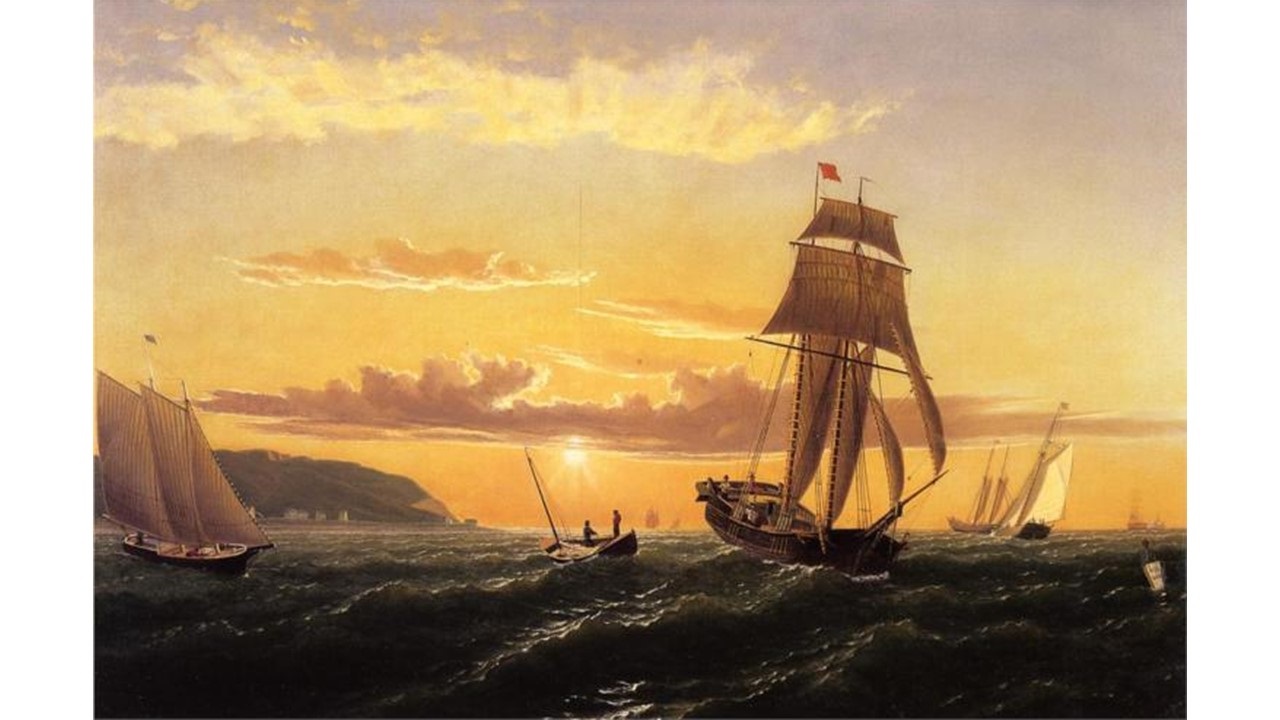
Sunrise
The world is blue at its beginning. Birth
is what we wait for, at the edge of earth.
__The vague waves lap the shore,
__swelled by an unseen oar
from where the sea and sky are blurred one blue,
a periwinkle, hazy stretch of hue,
__a bar of black collapsing
__on blacker sands. The waxing
tide is observed by empty boats; above,
the waning moon’s canoe (or wink, or dove)
__makes westward pilgrimage,
__and in the east, offstage,
the principal prepares his part. At first,
a single line is read, so well-rehearsed,
__well-timed, and flame on flame
__emerges into frame,
spreading flamingo tints. It is a lamp
raised up, or backwards tea bag, from the damp
__of waves steeping in sky
__to pink and rubify—
it is a pureness of intensity,
crowning the moment in simplicity,
__a golden coin, a portal
__ancient and elemental,
the simplest shape, and like a man bestowed
good fortune, rapid in its ascent. Its load
__of light is lifted higher—
__a sphere of suspended fire—
until hidden behind a dim and low
veiling of cloud. There is a parting now
__of sky from sea, the silver
__waving with rippling shiver,
the morning air a gradient of rose
to orange, clearish white, then blue that goes
__upwards and westwards. There
__the moon has fled the glare,
dissolved—its moonprint washed away. We turn
to breakfast, chores, news of the world, concern
__for all the humdrum things
__that daily living brings,
and soon the sun is thrust across the world
halfway, as though it had been faster hurled
__by gods who play at ball,
__a sudden, blazing call.
For this is time: the day made in a moment
quicker than what we think, dreamt and undreamt.
__And life is this brief light
__traveling to endless night.
Sweet Rose
Sweet rose, come to me with your pricks and thorns,
and prod, and scratch, and make the smooth skin bleed—
a happy matador impaled by horns,
pierced through the heart, so sweetly pained, I’ll cede.
Come with your canker and your blind white worm,
for blight at your sick hands would be a bliss—
engraft your rot upon my roots; let squirm
the unseen creature with its larval kiss.
Come riotous in red and brimmed with scent:
the red appalling, bold, rash, angry in hue,
the perfume seething with vapors that ferment
ten thousand desires and sweat-drenched nights for you.
Bring devastation, torment, grief—deplete
my life, my love, and that will still be sweet.
Ramya Yandava is a poet and writer living in Boston. She publishes a newsletter on topics like orchid-hunting and the history of tea at soulmaking.xyz











Sunrise: I really appreciated the poem’s patient, almost ceremonial attention to the moment of daybreak, and how it made me feel the vastness of time while quietly reminding me how quickly wonder gives way to ordinary life.
Sweet Rose: I was surprised by how unapologetically intense this poem is. Very tactile. Invasive but consensual.
Thank you so much, Michael! Those were the effects I was trying to go for when writing these poems, so I am very happy you felt that way when reading.
I love your exquisite description of sunrise! I’ve always loved sunrise more than sunset. You have used some beautiful metaphors: the unseen oar making the waves; the various shapes of the waning moon; the sun as the principal player; the sun’s movement likened to gods playing ball; the backwards teabag (a very unexpected and intriguing one!) “Moonprint” and “rubify” are very original and fascinating word choices. And your structure of two pentameter lines followed by two trimeter lines is creative.
“Sweet Rose” is surprisingly painful and powerful — as Michael said, “intense”!
Thank you, Cynthia! Before the experience written about in the poem, I had never quite appreciated sunrise as much as sunset (perhaps because I rarely wake up early enough), but both having this experience and making a poem out of it definitely converted me into a sunrise-lover. I’m so glad you appreciated the different metaphors, word choices, and form of the poem! It’s always nice as a poet when someone takes the time to read so closely.
The structure of the stanzas in “Sunrise” is very unusual but eerily appropriate for the elliptical narrative that could be an exchange between angels and elementals. The words washed over me like ethereal sea-foam.
“Sweet Rose” is utterly shocking in the way the words, which gather stray threads and momentum as the poem goes on, impale the mind and heart of the reader. This is a rare thing.
Both poems make me glad I got out of bed this morning.
I’m so glad that you find the structure of “Sunrise” appropriate to its narrative, and it makes me happy to know these poems affected you in the way you describe! Thank you so much for taking the time to share these kind words.
“Sunrise” is a beautiful, slow-action depiction of a maritime sunrise. You skillfully use the long form to draw out the description, allowing the reader to bask in the colors and sensations much as they would while observing a real sunset. You bring us a true painting with words, going so far as to recreate the pace of the experience.
“Sweet Rose” is a masterful Shakespearean sonnet, with a sentiment true to Shakespeare. The lover revels in the love even as he knows it brings with it rot and destruction. It speaks of a very particular and very common type of love and captures its sentiments perfectly.
Thank you, Adam! The way you describe both poems perfectly encapsulates what I was aiming at when I was writing them, and I am very happy to hear that you felt the sonnet was true to Shakespeare’s spirit.
‘Sunrise’ is a cornucopia of colour with some fantastic imagery, from ‘flamingo tints’ to ‘the moon has fled the glare, / dissolved—its moonprint washed away’ – the latter, I thought, was phenomenal.
And to ‘Sweet Rose’, where the rose is anything but – or is it. Again, some incredible imagery. My fave – ‘a happy matador impaled by horns’.
Thanks for two amazing pieces of poetry, Ramya.
I love your phrase “cornucopia of color,” and I’m so glad you enjoyed the imagery in both poems. Thank you so much for taking the time to read and leave a comment, Paul!