


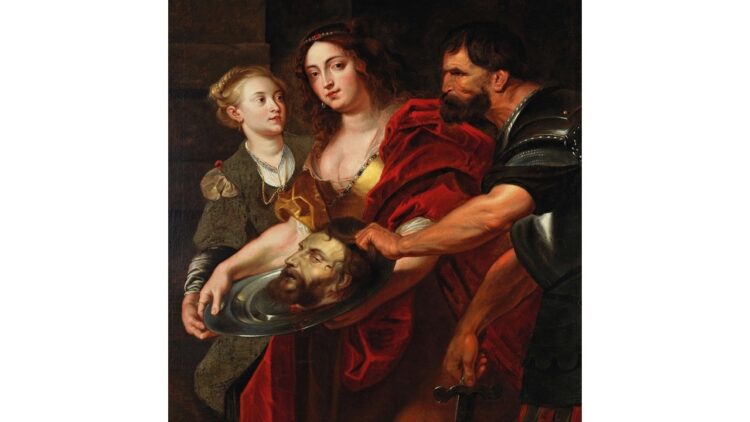
Herodias on John the Baptist
Yes, I remember him—the unwashed Jew,
The kind we hoped to leave behind with all
The ancient desert fantasies, the stench
Of goats and sheep, and long beards filled with lice.
Being a Greek is cleaner and more pleasant—
The wine more pungent, food made to our taste,
Without some pompous rabbi and “The Law”
To tell us what we can and cannot eat.
But nevertheless the rabble worshipped him,
With all his talk of Yahweh and the scriptures,
And his pretense to crackpot prophecy.
I didn’t mind all that. Who cared a fig?
Let the superstitious scum and dregs
Hold as a god some lunatic in rags,
Who lives on honey and raw locust bread
Amid the wilderness with snakes and fleas.
He didn’t come to court, or mar our feasts
With body odor and the need to preach.
None of us gave a thought to him, until…
Yes, it rankles still. He raised his voice
Against me and my husband, quoting some
Insipid strictures from forgotten texts
About a brother’s wife. As if we were
Still in tents with patriarchs and staffs!
Why should that busybody stick his nose
In business of the royal household, asking
About who slept with whom, and what they did?
It’s so un-Greek, so boorish, atavistic—
So redolent of sheep-dip and the desert:
Those wailing wastes where nomads crouch in fear
Upon some dungheap waiting for… who knows?
Some revelation, or some mystic call,
Or perhaps just the sick, prophetic urge
To tell the whole world how it ought to live.
I hated John. He wrecked what we had built,
Herod and I, here in this squalid land.
We did our best to civilize these beasts
With learning, art, fine architecture, songs
Culled from Hellenic brilliance, clothing rich,
Athletic sports, and Sybaritic dancing.
Dancing! Yes, that’s how we cut the knot
Of John’s annoyance and my husband’s fear.
My daughter knew how much I loathed that pig
Croaking about my “whoredom” and the sin
That lay upon our house. She rose and spun
Her lithe flesh in those veils of gossamer
To make my husband grant whatever wish
She chose to ask. And she restored my pride:
Give me, on a platter of pure silver,
The severed head of John, the captive prophet!
My heart near burst with love for such an act.
One hour later, soldiery arrived,
And they brought in the thing she had requested:
A foul, disgusting lump of hair and beard
From a fanatic’s corpse, still wet with blood,
Oozing saliva from its filthy lips,
The ones that besmirched my honor and my state.
So may they all end, those who speak out loud
Against what is no business of their own,
Who climb up from the gutter and presume
To speak for what they say is God’s own will.
I said this then to John’s mute, grisly head:
We cultured Greeks have lots of varied gods:
Which was the one you claimed to represent?
He didn’t answer. Not a syllable.
I poured a cup of wine to give my daughter
And we both laughed and drank each other’s health.
Poet’s Note
Herodias was the wife of Herod Antipas, one of the Jewish tetrarchs of Roman Judaea. She had previously been the wife of his half-brother, Herod Philip. It was a love match, and both of them divorced their existing spouses in order to marry. Such divorces were common among Greeks and Hellenized Jews at the time, but were considered violations of Mosaic law by rabbis and the common people.
No ordinary man in the street would have dared to say or do much about it, since the matter was between Herod and his new wife, and God. But an itinerant preacher-prophet named Iohanan (we call him John the Baptist) made several public speeches chastising Herod for his violation of Mosaic law, and in those speeches he made grossly insulting charges against Herodias and her chastity. Naturally this ignited her anger and resentment.
Herod Antipas did not want to kill Iohanan, since he believed that he might actually be a real prophet. But to please his wife he had the man arrested and imprisoned. According to the biblical story, which may be partly fictionalized, Herodias prompted her young daughter Salome to do a suggestive and provocative dance for Herod Antipas, in return for Herod’s publicly sworn promise to give her whatever she asked. She did the dance, and then insisted that she wanted the head of Iohanan brought to her on a platter as a reward. Trapped by his own oath, Herod gave orders for Iohanan to be decapitated, and his head was brought to Salome and her mother.
I have written this dramatic monologue in the voice of the mother, outlining her complaints against Iohanan for his insults to her, her contempt for his filth and unfashionability, and her general disdain for a Judaic heritage and religion that she, as a thoroughly Hellenized member of the royal family, considered backward and primitive. Iohanan’s death is seen by her as a deserved execution for disrespect and calumny against the ruling class.
The general thrust of this poem is to put forward this question: to what degree are we obliged to criticize publicly the private sexual sins of others? My own instinctive sympathies are with Herodias and Salome. The mutually voluntary acts that couples perform in the bedroom are not really the concern of anyone else.
Yahweh: One of the names of the god of the Jews in the Old Testament.
Locust bread: Although some argue that Iohanan ate actual insects, a more likely explanation is that the text refers to the sweet pods of the carob tree, which still today are referred to as “Saint John’s bread.”
Sheep-dip: Any liquid bath designed to cleanse herded animals from disease or insect infestation. Although the term was not invented until the 19th century, ancient shepherds used a variety of liquid concoctions to treat animals suffering from irritation or pests.
Sybaritic: Herodias uses this term in reference to the Greek city of Sybaris (in southern Italy) that was famous for its luxurious culture of wealth and self-indulgence. The adjective form became a watchword for extravagance, fine elegance, and sophistication.
Joseph S. Salemi has published five books of poetry, and his poems, translations and scholarly articles have appeared in over one hundred publications world-wide. He is the editor of the literary magazine TRINACRIA and writes for Expansive Poetry On-line. He teaches in the Department of Humanities at New York University and in the Department of Classical Languages at Hunter College.












Nicely done!!
Thank you, Paul.
This is brilliant! It’s like learning the old biblical tale anew. Gave me goosebumps.
Many thanks, Rohini. I always want my poems to give people intense reactions, either emotionally or physically!
So well crafted. The work is both classical and modern, providing the best of both. Using Herodias viewpoint is a very creative take and you handle it so effectively. Thanks also for the Poet’s Notes.
Thank you very much, Zumwalt. I thought the viewpoint of Herodias had not been sufficiently explored in poetry, so I took a chance.
What a superb writeup and explanation of the events surrounding the beheading of Iohanan (John the Baptist). I recognized the Sybaritic reference to self-indulgence but never thought of it being used in relation to dancing, yet it makes so much sense. The Poet’s Note was a fascinating addition including the “locust-bread.”
I’m pleased that you like it, Roy. The Herodian rulers and tetrarchs spent huge sums on fine architecture, palaces, Hellenistic artwork, Greek learning and literature, athletic shows, and lavish entertainments. And dancing was one of their favorite pleasures.
Joe, I think this is an absolutely astonishing poem – a highly entertaining and in-your-face dramatic monologue which would make Robert Browning proud. In fact, this is the quintessence of Browningesque since you take a known historical figure – an unpopular and unsympathetic one at that – and speak in her voice, letting the revelation of her character unfold with each detail and expressed attitude. Your use of highly expressive, articulate blank verse in the service of a haughty biblical villain is impressive. The narcissism of the character is palpable, much in the same vein as can be seen in “The Bishop Orders His Tomb at St. Praxed’s” or with the Duke of Ferrara in “My Last Duchess.”
Speaking purely about the poetry, your choice of blank verse was absolutely right. While Herodias may be a Queen – one who lords over her Jewish subjects the superiority of her Greek culture – one gets the impression that her “culture” is a thin veneer. A truly cultured Greek character might have spoken in rhyme, and had you presented a philosopher or dramatist, one might even have expected a complex rhyme scheme and some internal rhyme as well. Here, Herodias demonstrates the extent of her cultural attainment. Blank verse shows education… but without depth or subtlety. There is something nouveau riche about her character – something of the bored but rich housewife. The thing about Herodias is she has been treated many times in literature and films and there is inevitably something lurid about her. A “Desperate Housewives of Galilee” quality which you capture with perfection.
But you have NOT presented a character who is a cartoon. To the contrary, your Herodias is complicated, obviously narcissistic and deeply condescending. Nonetheless, she makes an interesting point which catechism tells us to ignore but which nonetheless has a domain of validity – why are we spotlighting the sexual behavior of others when it is really none of our business? Your poet’s note indicates a certain sympathy with this point of view. I think I find myself somewhere in the middle. I think the sexual behavior of others is – for the most part – none of my business. But when taken to extremes, a libertarian view can come perilously close to an anarchistic one. I would prefer for the government and the gossips to stay out of my bedroom. And I am very glad that I have been given the opportunity to wed as I see fit. But it would also seem that too much freedom has resulted in a culture where pedophilia is rampant and, in some cases, excused (many Democrats now excuse pedophiliacs as “minor-attracted persons.) The sheer aggression of the Transgender Hegemony has come about because we have taken gender theory to such an extreme that gender qua gender no longer seems to have any objective meaning. We have drag queens reading to nursery school kids and we have the Hamas sexual crimes of October 7 excused and even lauded because the victims were Israeli Jews. Finding that fine balance between sexual privacy and sexual morality may be tricky but I think it is imperative for a civilized culture. Perhaps the balance should be “stay out of my bedroom and I’ll stay out of your classroom.” From this standpoint, John the Baptist may have overreached. There is much more to say on this subject but time is limited.
One other thing I must observe about your Herodias is her utterly derogatory description of her Jewish subjects. She does indeed see the Jews as unsophisticated rubes with a backward somewhat barbaric religion (seeing the Jews as “barbaric” is ironic coming from a de facto executor of John the Baptist.) But she is herself Jewish! Her contempt and loathing for her own people is undoubtedly the way she was – qualities no doubt shared by many, many other Hellenized Jews. But what strikes me is how modern this attitude actually is. The West is rife with Jews who are so inculcated in Progressivism that they give their liberal ideas and attitudes the force of a new religion (something you yourself have frequently observed.) As part of this religion of Liberalism, these Jews embrace socialism, world-government, atheism and attendant practices like abortion, gender-transition for children, Critical Race Theory, DEI… and, inevitably, anti-Zionism and a visceral hatred for Israel. Bernie Sanders and George Soros are the premier examples of such self-loathing Jews. But you’ll find many examples from the past 200 years ranging from Karl Marx to Emma Goldman to Mandy Patinkin. It is disquieting to contemplate that your Herodias character is in some ways their progenitor. But she is indeed a modern character whose willingness to marry outside tradition and the law was so “in your face” that she could have been pulled from today’s news. (Indeed, following Ilhan Omar’s view of brotherly love has been hogging the headlines now for several days.)
I love your poem, Joe. There is so much to it and so many subjects that it raises. I could go on, but must stop here. Suffice it to say, your Herodias is fascinating and entertaining. But I do not want her over for dinner.
Brian, thank you for this detailed and appreciative response, and for the disturbing questions that you ask. If a poem can provoke that, it is in my view successful.
First off, I must publicly give thanks to you here, in this discussion thread. You were kind enough to read a late draft of this poem several weeks ago, before it was submitted to Evan Mantyk, and you made several important suggestions about vocabulary and meter that I gladly incorporated into this final text. I want everyone to know that.
Like you, I am a disciple of Robert Browning and his dramatic monologues. When I first encountered them I was bowled over by their amazing grasp of long-dead historical characters, and how Browning could resurrect their voices and thoughts and beliefs, in moving ways. I knew at once that I had to try doing the same.
Yes, I deliberately made Herodias as nasty as I could manage. She had to be proud, arrogant, and contemptuous of those beneath her level of culture. But how to get into the head of a first-century Herodian queen in Roman Judaea, a thoroughly Hellenized Jewess with contempt for her own race and hereditary religion? All I could do was model her on the self-centered, conceited, and affluent left-liberal white woman of today, living in the cocoon of her elitist gated community and looking down on the poor working-class slobs who vote for MAGA and don’t want government bureaucrats dictating how they live and believe.
Hellenized Jew? Isn’t that very like those Jews whom you mention — the ones who say that they are going to vote next week for Moslem candidates who are pro-Hamas, and who want Israel wiped off the map? Who stupidly give money to NGOs that are working feverishly to harm Israel? Last week I myself heard a Jewish woman commentator on TV say in a discussion that she wants her fellow Jews to vote for ferociously anti-semitic and anti-Israeli Moslem candidates, to prove that the Jews are not “Islamophobic,” because “Islamophobia is terrible.”
That would be like German Jews in 1933 saying “Let’s all vote for Hitler, to prove that Jews are not anti-Nazi.” Only someone living in an airtight intellectual bubble could say something like otherworldly.
As for sexual behavior, I wrote “the mutually voluntary acts that couples perform in the bedroom.” This would not include intrinsically involuntary things like rape or sex with minors or transgender aggression, or even the seduction of naive women by predatory males. In the past, punishment for such crimes was often handled by private persons, who were a lot quicker and harsher than our courts. I wish that were still true.
Thank you for correcting me, Joe. In my eagerness to talk about sexual transgressions I sort of breezed right past your clearly-stated and logical limitations on private sexual matters. I apologize for my haste and superficiality on a truly important subject. I suppose what I was getting at is the concept of the legal regulation of sex. Certainly, there is judgment of sexual behavior which is unnecessarily intrusive while there are also rightful attention to behaviors which are potentially damaging to society as a whole. My focus was on the behaviors that matter to society – or should matter – versus the behaviors that are really none of our business. As you observe, the things which happen behind closed doors between consenting adults should be kept private. But I think we are both on the same page concerning the latter category: INJURIOUS sexual behavior – whether injurious to individuals (rape, pedophilia) or injurious to society as a whole (the destruction of gender, the grooming of children.) These are the proper subject of legislation and moral discernment, while private behavior which injures no one should be respected as such. As someone who has personally faced a goodly amount of disapproval and discrimination because of my sexual orientation, I concur wholeheartedly that my private life – like yours — deserves to be free of finger-wagging, nosy self-appointed judges.
It is of interest that under Sharia law I am subject to the death penalty in 10 countries. In many other Sharia-law countries I would simply be limited to 75 to 100 lashes. And yet all those kind and good liberals who are so anxious not to appear Islamaphobic who would, in the full expression of their suicidal empathy, sell the LGB community it claims to support down the river by supporting their tormenters. And, yes, there are many self-congratulating Jews who love Democrat candidates no matter how antisemitic they are and no matter how their policies will destroy everything they claim to support: gay rights, women’s rights, freedom of worship, abortion. They hate Trump so much they would burn it all down to prove a point. What havoc will they yet cause?
Thank you for the kind mention of the few little suggestions I made to your already-excellent poem. It was a pleasure to do and a real honor to be asked.
I’m glad you brought it up, Brian. Gender feminists are now so berserk that they ferociously support Moslem extremists who want to impose the horrors of Sharia law here in the West. These feminists are now perfectly OK with the suppression of women’s rights, mandatory burqas, the stoning to death of adulteresses, clitorectomies for little girls, and the utter contempt and arrogance that men in Moslem countries typically show for one half of their population.
Crazy, right? No, not at all. Not if you recognize the real motivation behind these feminists, just as you can see it in self-hating Jews who are happy with being anti-Israel. It is sheer, overwhelming, and gut-wrenching HATRED OF THE WEST, and the West’s civilization (of which Israel is an outpost). If your ultimate desideratum is the destruction of the West, anything at all will be taken up as a weapon, even if it is suicidal. When I saw a group at a demonstration here in New York with the banner “Queers for a Free Palestine,” I realized that this hatred is now beyond cure.
You really captured the mother’s voice and viciousness, Joseph.
If only the Bible had been taught to us with such texts.
I love the ‘wailing wilderness’. It perfectly describes the desert, during a dust storm, when the ghouls and genies hold sway.
Thanks for the read.
Thank you, Paul. I’m glad the poem was successful, and that you liked it.
Joe, I just wanted to amplify a bit on your description of the name “Yahweh” as one of the Jewish Old Testament names for God. In the Hebrew Bible it is usually represented with the Tetragrammaton YHWH since the personal name of God is considered too holy to reproduce in text or to utter. Jews therefore substitute “Adonai” (Lord) for the holy name. The name derives from the ancient Hebrew for “to be” and relates directly back to God’s commssion to Moses at the burning bush — “I am that I am.” In Church Latin the “Y” will be transliterated with “J” and the “W” will be transliterated with a “V”. The resulting JHVH will be pronounced and as established as “Jehovah.”
There’s also the name “Elohim,” which seems to be an acceptable substitution in some books of the Old Testament.
“Jehovah” was of course popularized by the Jehovah’s Witnesses in the 19th century. I have seen “Adonai” (the Lord) in some medieval texts, so the Hebrew word must have been familiar to Christians as well as Jews. As for the Tetragrammaton (literally “four letters”), it came to be used in many post-medieval engravings as a symbolic figuration of God, and in fact appears on the cover of one of my books.