


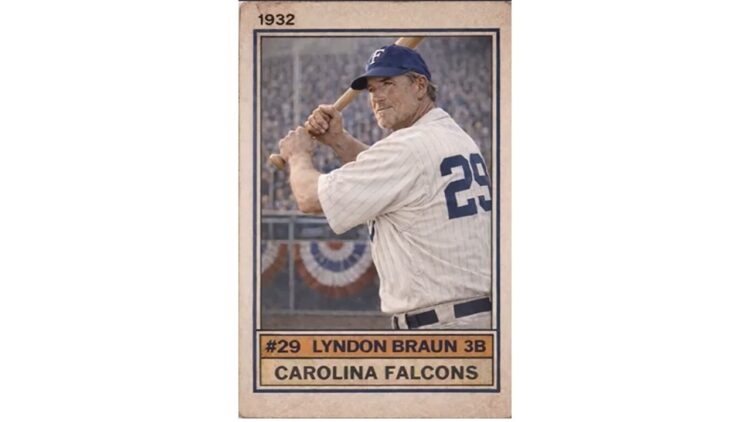
The Last At-Bat of Lyndon Braun
The crowd was on its feet because they knew
it was the last at-bat of Lyndon Braun,
the biggest name to don the Falcon blue,
but they were down by eight with no one on.
In hardened hands, he lugged an iron bar.
He swung it twice, then heaved it to the earth.
He gripped his bat, the handle tacked with tar.
An arc of darkened spit fell to the turf.
Although his whiskered chin was brushed with gray,
the moment smoothed the hitch out of his gait;
he strolled like it was any summer day
on the familiar road back to the plate.
When the announcer called his name and number
a final time in that same golden voice,
“Now batting…” was a baritone of thunder
that prickled skin of men turned back to boys.
The tall right-hander, Kelley, peering down,
rested the ball upon his belted hip.
The slugger dug his spikes into the ground;
the pitcher nodded once and cinched his grip.
When Kelley kicked and let that heater loose,
the hissing fastball slithered up and in,
and Lyndon nearly lifted from his shoes
avoiding seams that buzzed to shave his chin.
A rain of boos cascaded from the crowd,
who paid to see the legend wallop one.
He searched the grandstands—restless, packed, and loud—
then found his worried wife and hopeful son.
The second pitch came fast as arms can throw.
It popped the glove but missed the target wide.
The count was Lyndon’s now at two-and-oh.
He thought, “Dead red, let’s give this one a ride.”
Kelley’s narrowed eyes received the sign;
he grunted as he let the third one free,
and Lyndon started, checked his swing in time.
The heavy sinker dipped below his knee.
In factories and diners, people stopped
to hear the broadcast on the radio:
“Lyndon looks and gets the sign from Pop—
he’s gotta turn ‘em loose on 3-and-oh.”
As Lyndon stepped back in the box, he thought,
“Ya ain’t about to take no stinkin’ walk.”
With fastballs streaking in like rifle shots,
he crept his right foot back onto the chalk.
The three-oh pitch was grooved down Middle Street.
He swung with every ounce left in his soul.
That sacred sound when ball and barrel meet—
“A towering drive…it’s hooking…hooking…foul!”
The women brought their hands up to their mouths.
The men put palms against their hatted heads.
A gasp in every barber shop and house.
“What might have been,” the commentator said.
Lyndon—halfway up the first-base line—
trotted back and bent to grab his bat.
He grimaced at the twinge that jabbed his spine,
then saw his son who wrung his Falcon hat.
The commentator said, “It’s three-and-one.
Both Braun and Kelley know what’s coming now.
It’s power on power, folks—this should be fun.
Braun wants it up; Kelley wants it down.”
Kelley whirled, a twist of gangly limbs,
as if a funnel cloud that harnessed force,
and he released the ball with driving winds.
Yet Lyndon tracked the storm and read its course.
A belt-high fastball bolted towards the plate—
the kind the likes of Lyndon never missed.
The aging slugger’s swing was fractions late
and tipped the pitch into the catcher’s mitt.
The catcher took a trip out to the mound,
and Lyndon thought, “Ya can’t get that one back.”
He closed his eyes and silenced every sound,
except for, “See it big and take yer hack!”
The radio at Joe’s Mechanic Shop:
“Kelley’s fastball’s blazing as the sun
today and seems to have some extra hop.
At three-and-two…expect old number one.”
But when the pitch rolled out of Kelley’s hand,
Lyndon’s stride was stiff; momentum stalled.
It was the pitch that no one could have planned—
the seams made crimson circles on the ball.
The slugger’s weight was forward when he swung,
his barrel cut above the tumbling spin.
All hope exhaled from every faithful lung.
“And down goes Braun—a curveball done him in.”
For just a breath he lingered at the plate,
the bat still warm within his weathered hands.
The crowd began to clap—but far too late,
then louder, louder till it filled the stands.
His measured steps were slow; his chin still high,
yet deep within, “I should-a seen it comin’.”
He tipped his Falcon cap to say goodbye.
The chant of “Lyn-don-Braun!” became a drumming.
The man looked over to his wife and son.
His boy put on the hat that he’d been wringing,
then held his mother’s hand—the game was done.
It was his last at-bat. He went down swinging.
Michael Pietrack is a poet based in Grand Junction, Colorado. He is known for his narrative poetry and novels written in verse, including Legacy: The Saga Begins (2023) and Boone (2026). He has placed three times in the Society of Classical Poets International Competition with “Ballerina,” “The Loons of Colby Lake,” and “Grindstone.”


















What a great sports story told in poetic verse. This one is as great as the ballad, “Casey at the Bat.” It ends much the same with no joy in Mudville. The fictional baseball card gives our superb ballad an aura of authenticity. I could really feel the angst and agony of defeat.
It’s more a commentary on when life throws the unexpected curveball—which life likes to do. Sometimes the best we can do is go down…swinging.
I really enjoyed this poem, Michael. It’s a compelling, nail-biting narrative which spotlights a great character — one who shows real sportsmanship. I’m not generally a big sports fan but one of my favorite movies happens to be “Field of Dreams” and your poetic valentine to the game of baseball has reminded me of James Earl Jones’ beautiful monologue about baseball and its deep connection to American culture. And I was quite moved by the love and pride the crowd showed for this aging ballplayer. This poem is really good work.
This means a lot coming from you. Thanks!!!
I thought this was amazing! It took me to a different place! I will listen and watch frequently! Thank you, Michael for another GEM!!
Thank you. Your support means a great deal to me.
Michael, I love the way your poem captures the tension, nostalgia, and dignity of a final sporting moment. Your use of imagery is spot on. It creates a cinematic feel. I can feel the poem’s heartbeat and for someone who knows more about cricket than baseball, that’s a huge plus. Beautiful! The accompanying reading is a real treat. Thank you very much, indeed!
You know how much I look up to you, so I treasure this commentary. This is my version of “Rage. Rage against the dying of the light” moment.
You had me sitting in the stands, Michael, all fired up for a homer, and sniffling with the sad, unexpected outcome. Nothing more stimulating for ME than a long and vivid narrative, which is what this is. Super job…
I feel the same way—poems that are short stories hit me hardest. Your words are really important to me…that it was vivid and that you were emotionally moved. That’s why we write and why we read. I like your work too.
When I began reading, I thought I was reading a baseball poem, but it’s so much more. Everyone wants Lyndon to hit the homerun, but that’s not real life. At the end of our lives, we are not hitting homeruns. The best we can do is just keep swinging, even when our swings are fractions late, even at the curveballs life likes to throw. When we shuffle off this mortal coil, when the game is done, all we can do is hold our heads high, like Lyndon did, and know that, yeah, we went down. But we went down swinging. My only wish for this poem is that it becomes a canonical classic that lives on. If there are contests for this type of poem, enter it. It’s a winner.
Thank you for the kind words and the sharp insights. It’s a joy to be understood.
This is what poetry is supposed to be: understandable, relatable, emotional, grounded, sensory, timeless. Amazing work from an amazing poet. Everything you churn out is of the highest quality. My ask–keep writing!
Far too kind. A friend of mine explained that we write because he must, we can’t help it, it’s who we are. So, I’ll keep writing…I’m just not sure for whom or for what purpose. Maybe is just our footprint that shows we were here.
I like the play-by-play details here. They’re clearly rooted in the experience of someone who is himself a seasoned ball-player.
Thank you, amigo. In my mind, I think I can still play…but I can barely put on my socks!
True to life, Michael. It’s slow! I remembered spring training for a major league team in my Florida hometown, which I considered boring. You fill in what the fans would want to know, by supplying all the players’ thoughts and mental plans and even the meaning of their lookarounds. That’s more than announcers can do–and you include them. Still, one at-bat should not be much material, but you’ve made it especially significant in the life of the player, and therefore you get stadium audience hollering added. Makes a real good story!
Margaret, I’m ear-to-ear knowing you liked this poem. I thought a slugger’s last at bat would be a fitting metaphor for someone facing an end of life situation, but facing it with dignity and fight. Thanks for dropping a thoughtful note.