


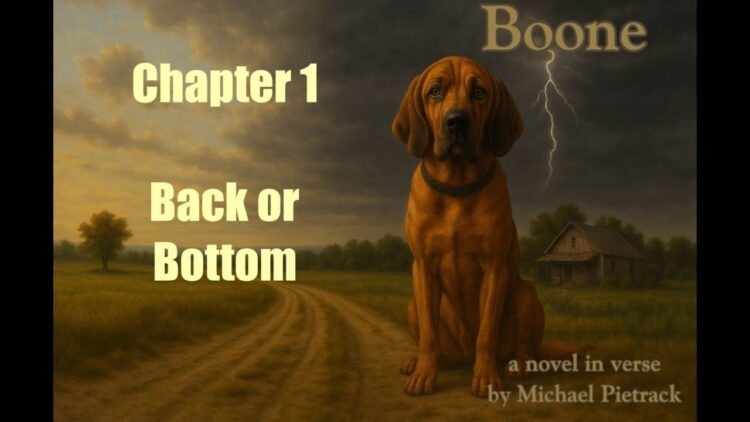
Back or Bottom?
“Your back or bottom?” Dowdy grabbed the switch,
a riding whip, from off its rusty hitch
that hung upon the wooden schoolhouse wall—
a dangling deterrent for them all.
“Macree, up front!” the teacher said with joy.
Then, inching forward, crept a red-haired boy.
His classmates’ laughs were only amplified
by pointed fingers like arrows in his side.
His freckled cheeks went flush, his shoulders curled,
as if to hide himself from all the world.
Dowdy tapped the whip against his palm
with smug assurance, powerful and calm.
Each punished student first was forced to choose
where swats would land, where swelling welts would bruise.
If they chose back, then six would be received.
If bottom, though, they would get only three.
Enduring half the lashes would entice
those choosing back or bottom to think twice,
but still the shame of being bottom-bare
was an embarrassment that few would dare.
Deacon Dowdy’s offer came once more:
“Your back or bottom?” Britches hit the floor,
but Dowdy wouldn’t act until he heard
the boy respond with a decisive word.
Though Clancy tried to answer, nothing came;
he moved his mouth, but silence all the same.
His flustered face looked upward at the man,
as tears that trembled on his eyelids ran.
He tried again to speak. The whip kept tapping.
Tapping. The room was filled with children laughing.
Laughing. In tears and sweat, a waking scream!
He gripped his sheets, relieved it was a dream.
excerpted from Boone, published by Bard Owl Publishing
Michael Pietrack is a poet based in Grand Junction, Colorado. He is known for his narrative poetry and novels written in verse, including Legacy: The Saga Begins (2023) and Boone (2026). He has placed three times in the Society of Classical Poets International Competition with “Ballerina,” “The Loons of Colby Lake,” and “Grindstone.”
















Great job, Michael, narratives are my personal favorite venue. With what I’ve penned thus far, a few 20+ minute reads, it’s scary to think about whipping up an entire novel in verse! Your audio is excellent and the ‘story’ intriguing. Have you calculated how long it takes to read ‘Boone’ straight through?
Thank you so much! Yes writing a novel in verse is quite an undertaking, but like anything, one step at a time…
Enjoyed the first verse which left me eager for the next.
Thank you for the note. I’m glad you enjoyed it!
This is a very good reading. The tension is palpable, and the rhymes, which often get lost when a poem is read aloud, rang loud and clear. Like everyone else, I’m sure, I can’t wait to see where this goes. But why is everything in the comment section suddenly in italics?
A technical problem. We are working on it.
-Evan
Thank you! It’s meaningful to me to know you listened and liked it.
The story is full of tense moments, but also funny and sad ones. You can find the entire book narrated here: https://youtube.com/playlist?list=PLqI6GHlTOtZhdU6Xqg5ZDDNbZM36mEPGZ&si=1cVIakdUSeyBrJVX
Excellent reading Michael – full of tension and drama. I can remember going to the headmaster’s office for a caning myself when I was 12 – I wasn’t tongue-tied like Clancy but certainly relate to that ominous sense of justice about to fall. Well very described – and BTW, love the pararhyme: tapping/laughing!
I’ve never known you to be tongue-tied, so I’m not surprised. Thank you for commenting on the pararhyme, I was trying to get into that dreamlike state where thing slow down. I appreciate your comments, and for endorsing the book.
Excellent work, Michael! I enjoyed your dramatic performance of a poem which captures a slice of history. I am especially fond of this type of poetry — a piece which brings the past to life and makes it human and relatable. Looking forward to more! By the way, although this excerpt stands nicely on its own, I would love to see a short summary of what “Boone” is about to get a better idea of where this fits into the narrative.
Like most of us, I write to process emotions. When I lost my brother in May of 2024, the story took a real life of its own. Initially, I wanted to write a coming-of-age story about a poor boy who falls in love with rich girl, but chooses to stay on the poor side of the divide. But when Andrew passed away, the story became more about the young boy filling his big brother’s shoes and parents dealing with loss. The dog, Boone, proves to be a boon…in fact, he helps the whole family find healing and faith. It’s a book that has all the feels.
Here are what the endorsers said:
If William Shakespeare and Mark Twain teamed up to write a
book, it would fall short of Boone.
—Theresa Dawn Sinclair, author of Children of Hamelin and The Eternal Questions
Approaching those great American classics like Little Women
and Anne of Green Gables, Boone finally gives the star‑spangled
canon a long‑needed additional star to light up the 21stcentury’s
night. Author Michael Pietrack achieves this by drawing on the
rich tradition of America’s greatest poets, Frost, Longfellow, and
Poe in his use of enchanting rhyme and meter. His tale weaves a
rich and fun cultural experience by employing a wit more delightfully Dickens than Twain. This is a literary achievement for all ages to enjoy.
—Evan Mantyk, President of The Society of Classical Poets
Wonderfully evocative—timeless storytelling, and for fans of formal poetry, Boone is a novel like no other.
—James Sale, feature writer for The Epoch Times
Boone stands in the lineage of American moral novels. It is akin
to Huckleberry Finn for its sense of boyhood and freedom. In its
compassion and courage, there are tinges of To Kill a Mockingbird. Yet it does what few modern works dare: it restores the discipline of classical poetry to the storyteller’s soil. It is traditional and new all at once, an heir to Longfellow’s cadence with the moral
clarity of Steinbeck.
—Andrew Benson Brown, author of Legends of Liberty series
Boone harks back to an era when stories burned with imagination and spoke straight to the heart—when truth, love, and the enduring bonds of family and friendship steered souls through life’s fiercest storms. At its center stands Boone, a steadfast companion whose quiet loyalty brings comfort, healing, and hope. Around him unfolds a world of unforgettable characters. Lyrical and timeless, Boone is storytelling at its purest—alive with music, meaning, and the eternal struggle between darkness and light. This is storytelling at its finest, where every word matters and every emotion feels real.
—Susan Jarvis Bryant, author of Elephants Unleashed and Fern Feathered Edges
I animated and narrated the entire book, which you can watch on YouTube if you like:
https://youtube.com/playlist?list=PLqI6GHlTOtZhdU6Xqg5ZDDNbZM36mEPGZ&si=1cVIakdUSeyBrJVX
Whippings and canings for misbehavior were standard procedure in the old English public schools, and they were taken very seriously by both whipper and whippee.
They were frequently done with a slender tree branch, chosen for toughness plus elasticity, and for the presence of hard buds that would cut into bare skin. The branches were kept wet in a brine solution, so that salt would get into the open wounds and cause more pain. And the blows were always delivered on your bare bottom, as the victim was held down in a bent-over position on a chair or some wooden kneeler.
Canings were different. They were done with a stiff cane, usually on the victim’s back, and without the removal of any clothing. But practices varied from school to school.
The whip, in the case of this story, is more of a symbol for power and oppression, especially in the eyes of a boy. The symbol comes full circle through the story, if you get a chance to read or watch it. The point I tried to make with it is that sometimes the thing we fear most is lifeless and nothing to be feared after all. As a group of poets, I know that each person who reads/watches it will recognize the amount of work that went into it. I hope you enjoy it and would welcome feedback along the way…
This book is a rare and shining gem and these YouTube chapters are beautifully done. I am certain all who read it will emerge all the better for the experience. I thoroughly recommend it!!
Thank you Susan. This means so much coming from you. I do think the all of us need to “get off the page” and bring our poetry to life via animated narration. I hate to say it, but if we live on the page, that is where our poetry will die (in my humble opinion).
Thank you for the recommendation. I do love this story with every atom of me. And I walk taller knowing you love it too.