• Submit Poetry
  • Support SCP
  • About Us
  • Members
  • Join
Friday, August 28, 2026
Society of Classical Poets
  • Poems
    • Beauty
    • Culture
    • Satire
    • Humor
    • Children’s
    • Art
    • Ekphrastic
    • Epic
    • Epigrams and Proverbs
    • Human Rights in China
    • Music
    • Performing Arts
    • Riddles
    • Science
    • Song Lyrics
    • The Environment
    • The Raven
    • Found Poems
    • High School Poets
    • Terrorism
    • Covid-19
  • Poetry Forms
    • Sonnet
    • Haiku
    • Limerick
    • Villanelle
    • Rondeau
    • Pantoum
    • Sestina
    • Triolet
    • Acrostic
    • Alexandroid
    • Alliterative
    • Blank Verse
    • Chant Royal
    • Clerihew
    • Rhupunt
    • Rondeau Redoublé
    • Rondel
    • Rubaiyat
    • Sapphic Verse
    • Shape Poems
    • Terza Rima
  • Great Poets
    • Geoffrey Chaucer
    • Emily Dickinson
    • Homer
    • Henry Wadsworth Longfellow
    • Dante Alighieri
    • John Keats
    • John Milton
    • Edgar Allan Poe
    • William Shakespeare
    • William Wordsworth
    • William Blake
    • Robert Frost
  • Love Poems
  • Contests
  • SCP Academy
    • Educational
    • Teaching Classical Poetry—A Guide for Educators
    • Poetry Forms
    • The SCP Journal
    • Books
No Result
View All Result
Society of Classical Poets
  • Poems
    • Beauty
    • Culture
    • Satire
    • Humor
    • Children’s
    • Art
    • Ekphrastic
    • Epic
    • Epigrams and Proverbs
    • Human Rights in China
    • Music
    • Performing Arts
    • Riddles
    • Science
    • Song Lyrics
    • The Environment
    • The Raven
    • Found Poems
    • High School Poets
    • Terrorism
    • Covid-19
  • Poetry Forms
    • Sonnet
    • Haiku
    • Limerick
    • Villanelle
    • Rondeau
    • Pantoum
    • Sestina
    • Triolet
    • Acrostic
    • Alexandroid
    • Alliterative
    • Blank Verse
    • Chant Royal
    • Clerihew
    • Rhupunt
    • Rondeau Redoublé
    • Rondel
    • Rubaiyat
    • Sapphic Verse
    • Shape Poems
    • Terza Rima
  • Great Poets
    • Geoffrey Chaucer
    • Emily Dickinson
    • Homer
    • Henry Wadsworth Longfellow
    • Dante Alighieri
    • John Keats
    • John Milton
    • Edgar Allan Poe
    • William Shakespeare
    • William Wordsworth
    • William Blake
    • Robert Frost
  • Love Poems
  • Contests
  • SCP Academy
    • Educational
    • Teaching Classical Poetry—A Guide for Educators
    • Poetry Forms
    • The SCP Journal
    • Books
No Result
View All Result
Society of Classical Poets
No Result
View All Result
Home Poetry Beauty

‘Ballade for Trains’ and Other Poems by John J. Brugaletta

November 23, 2012
in Beauty, Culture, Poetry
A A
9
poems 'Ballade for Trains' and Other Poems by John J. Brugaletta

Ballade for Trains

They are no more, the whistles’ longing wails,
Retreating like a stately, mournful queen.
Where are the smokestacks that left fading trails,
The blackened engine with its oiled sheen,
Imposing in its tons, unfazed, serene,
The ties in creosote, the polished rails?
I hear their bell, and there’s a death to keen.
What lasts if such tremendous power fails?

Where will we find the heavy giant’s gales
Set blowing by that massive, blunt machine?
Where are the farm boys with their silent hails,
At which the engineer will smile and lean
And wave with the importance of a dean?
Find me the cattle, timber, kegs, hay bales,
Secure and fixed, however they careen.
What can remain when such huge power fails?

And where, behind the windows and sheer veils,
Are those who dine on brook trout amandine,
On caviar, champagne and roasted quails?
Do none now bathe and dress and preen
Before they enter on the daily scene
Like those who watched the passing crags and vales,
The scree dark red, the prairies’ varied green?
No car or plane can last when trains will fail.

I never would discredit or demean
Our social conscience and foreboding tales,
But cars are skits—old trains were pure Racine.
Who will remember us if such grace fails?


Love is Not Paint or Stone

When I see oleander shrubs in bloom,
those lovely hedges blossomed overmuch,
their commonness evoking critics’ doom,
I leave aside those onions of the Dutch.
Why would I spend my lifelong cache for one
when I might have a thousand pennyeach,
a pound of brass to purchase me a ton,
or none by chance for all my eye may reach?

So when I haunt museums for a week,
I hunger for a moving, blushing cheek.
Give me the child, the matron or the man;
I am the common lifeling’s foremost fan.
Enough of striving to catch beauty’s breath;
I would catch sight of one before its death.


Letter to Metellus

You write, good friend, that my production’s small,
And ask if I am lacking oak tree gall,
Or if papyrus does not reach my farm.
My output need not cause you such alarm.
Its meagre volume stems from having shied
Away from competition with the tide
Of elegant decantings and trim feats
That charm mammalians in the cluttered streets.
With public education’s burst of light,
Blake’s chimney sweep can manage now to write
A free-verse recitation that offends
Alike his troops of enemies and friends;
And she who lived alone in Wordsworth’s wild
Declaims her molestations as a child.
With such adepts, the rushing fool competes;
I’m daunted merely by the odes of Keats.
If actuaries practice well their trade,
Eight years remain to me before I’m laid
As out of sight as I was out of mind
To think the Deity himself assigned
The gift of language as my one true skill,
Not time enough to learn to write good swill.
And so I leave this as my final will:
That fires be laid with all my verse and prose,
That lazy beggars take my needless clothes,
That all my tools be given my good son
Along with every book and knife and gun,
That God and wife forget when they forgive,
And you, good friend, who scarcely knew me, thrive
As blissfully as when I was alive.


John J. Brugaletta is a poet living in McKinleyville, California. He is a retired professor of English at California State University, Fullerton, where he taught the writing of poetry among other subjects. He was publisher and editor of South Coast Poetry Journal for about ten years.

These poems are among the entries for the Society of Classical Poets’ 2012 Poetry Competition.

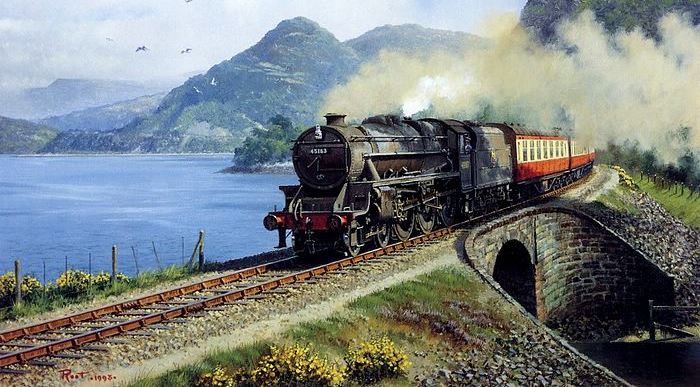
Featured Painting: “Steam Train” by Howard Fogg.
ShareTweetPin
The Society of Classical Poets does not endorse any views expressed in individual poems or commentary.
Read Our Comments Policy Here

RandomPoems

‘The Backwards Romantic’ and Other Poetry by Reid McGrath
Beauty

‘The Backwards Romantic’ and Other Poetry by Reid McGrath

September 4, 2015

The Backwards Romantic “Most of those once common occasions for poetry seem embarrassingly old fashioned now that piped-in tunes and...

‘ Which Is the Grandest Name of All?’ and Other Poetry by Ted Hayes
Beauty

‘ Which Is the Grandest Name of All?’ and Other Poetry by Ted Hayes

February 20, 2018

Which Is the Grandest Name of All? Which is the grandest name of all? Churchill, Churchill, Churchill! Winter sere or...

Next Post
‘Why Beauty Matters’: BBC Documentary

'Why Beauty Matters': BBC Documentary

'The River Villanelle' and Other Poems by Samuel East

'The Colour of Dying' (a Sestina) by Maroula Blades

Comments 9

  1. Poetry E Train says:
    14 years ago

    Love this poem, strong and spirited… The Poet Julie Catherine Vigna found the poem, and posted link on my wall… Thank you, much appreciated, and if you are on facebook, let’s connect…

    Reply
    • John J. Brugaletta says:
      14 years ago

      Sorry but I try to stay off of facebook. My email address is [email protected].

      Reply
  2. Julie Catherine Vigna says:
    14 years ago

    Wonderful poems, John – I’ve given the link to this page to a friend of mine who has a passion for trains; I think he will really appreciate reading your ‘Ballade for Trains’! ~ Julie

    Reply
  3. Mary Williams says:
    14 years ago

    I thought the Ballade for Trains was magnificently regal and slow; just right in fact, esp. ‘stately, mournful queen’, which fits exactly. The refrain is powerful, elegaic and completes each stanza in a different way. The rhymes are clever and unobtrusive, all in all a very accomplished poem. Thank you for giving it to us.

    Reply
  4. Mary Williams says:
    14 years ago

    Letter to Metellus. I loved this. One word jarred a little – mammalians- but I’m stuck for an alternative. The gift of language is certainly yours.

    Reply
  5. Sally says:
    14 years ago

    What a wonderful ballade. Beautifully done. One small query – do they not traditionally end with an address to a “Prince”? A pleasure to read your work.

    Reply
  6. John J. Brugaletta says:
    14 years ago

    Thank you, Sally. As to the prince in the envoy: Francois Villon had an actual prince and framed his ballades so that he could easily address that prince in the envoy. But Chaucer, having addressed the main part of his ballade to his purse, had no means of using the repeat line in his envoy, so the form seems somewhat malleable. In our day, we have a definite shortage of princes, especially those who could mandate an answer to our request, so I feel that part of the formula (if that’s what it is) would only seem outdated, artificial, and forced. In any case, Lewis Turco, whom I respect in such matters, makes no mention of the envoy-prince in his New Book of Forms.

    Reply
    • Sally says:
      14 years ago

      Thanks, and sorry I took so long to reply. I have now worked out how to do so. Thanks for sharing thoughts on this. All makes perfect sense. Thank you. I learned something new.

      Reply
  7. Lew Icarus Bede says:
    12 years ago

    On Ballade for Trains by John J Brugaletta

    All poetry is flawed; much in the same way as no science or mathematical insight is perfect; but amidst all the human rubble, one can find diamonds—some small and unrefined, yet still exquisite. One such fairly polished stone is Brugaletta’s Ballade for Trains.

    Its structure is three eight-lined stanzas with a final four-lined stanza. Its rhyme scheme is ababbaba for the first three stanzas, and abab, for the final. Its form neatly fits the topic, which is the “melancholy, long, withdrawing roar” of trains, with the rhymes in the poem going forward and falling back. The question “What can remain when such huge power fails?” only used in the first two stanzas, is an excellent, albeit imperfect, refrain choice. Brugaletta’s meter, the iambic pentameter, is nearly flawless;
    and as such it is an agreeable rarety not only in our era.

    Brugaletta’s handling of poetic elements, at times, is excellent as well. He begins with vivid figurative language, the simile, “Retreating like a stately, mournful queen,” the metaphor, “the smokestacks that left fading trails,” and description, “The blackened engine with its oiled sheen.” For me line 7 flounders, but perhaps the author can address that.

    In the second stanza, his series of questions continues. Note the neat alliteration of “Where will we find the heavy giant’s gales/ Set blowing by that massive, blunt machine?” His farm boys here, more innocent than Sandburg’s in Chicago, have a refreshing, unassuming naiveté about them; but even his wealthy passengers of the third main stanza are painted with loving details.

    The final envoi, if such it is, because it develops the train-car contrast, though not without flaws of its own, contains Bragatella’s masterstroke, “But cars are skits—old trains were pure Racine.”

    Although many poets have written about aspects of the train, from Henry Thoreau to Claude McKay to myself, Emily Dickinson’s quaint lyric remains my favorite.

    I like to see it lap the Miles—
    And lick the Valleys up—
    And stop to feed itself at Tanks—
    And then—prodigious step

    Around a Pile of Mountains—
    And supercilious peer
    In Shanties—by the sides of Roads—
    And then a Quarry pare

    To fit its Ribs
    And crawl between,
    Complaining all the while
    In horrid—hooting stanza—
    Then chase itself down Hill—

    And neigh like Boanerges—
    Then—punctual as a Star
    Stop—docile and omnipotent
    At its own stable door—

    Reply

Leave a Reply Cancel reply

Your email address will not be published. Required fields are marked *


  1. Ruddy Gordon on The Society of Classical Poets 2026 Haiku CompetitionAugust 27, 2026

    1. What would you offer The scales of time for one last Moment in the Sun 2. From the lowest…

  2. Marija Katic on The Society of Classical Poets 2026 Haiku CompetitionAugust 27, 2026

    Cicadas pierce the air Early morning already hot- Sweat beads on my lip.

  3. Marija Katic on The Society of Classical Poets 2026 Haiku CompetitionAugust 27, 2026

    Fanning tail feathers, the peacock struts across the garden: a raucous cry.

  4. Carmenchita Coloma on The Society of Classical Poets 2026 Haiku CompetitionAugust 27, 2026

    Revised with settings included: The Summit at Snoqualmie, WA 1) ambling on white snow eager to slide down the hill…

  5. MaryJane Myers on ‘Solitude’ and Other Poems by Mary Jane MyersAugust 27, 2026

    Paul I am a bit overwhelmed by your praise! In 'Solitude' I was trying to do honor to one of…

Subscribe to Daily Poems

Enter your email address to subscribe to this blog and receive notifications of new posts by email.

Join 1,626 other subscribers

Recent Poems

  • ‘Government Issue’ and Other Poems by Joseph S. Salemi
  • ‘Chaucer Announces His Desire to Retire’: A Poem by Paul A. Freeman
  • ‘Advantages of Restaurants’ and Other Poems by Russel Winick
  • ‘Bone China’: A Poem by Mary Gardner
  • ‘On the Death of One Too Young to Die’: A Poem by Jeffrey Essmann
  • ‘This Too Shall Pass’ and Other Poetry by Justin Dasher
  • ‘Humdrum and Harum-Scarum’: A Lecture on Free Verse, by Robert Bridges (1922)
  • ‘Unrest On the Floodplain’: A Poem by Bhikkhu Nyanasobhano
  • ‘Latitude and Loss’: A Poem by Martin Briggs
  • ‘Act III’ and Other Poetry by C.B. Anderson
  • ‘God’s Funeral’: A Poem by James Sale
  • ‘Star Festival’: A Poem by Margaret Coats
  • ‘Song of the Frog Princess’: A Poem by Scharlie Meeuws
  • ‘The Odyssey: Nolan and Solot Compared’: An Essay by Michael Curtis
  • ‘Solitude’ and Other Poems by Mary Jane Myers
  • ‘The River Not Taken’ and Other Poetry by Brian Yapko
  • ‘Totentanz’: A Poem by James A. Tweedie
  • ‘In God Is Our Trust’: A Poem by Roy E. Peterson
  • ‘Confession’: A Poem by Jeffrey Essmann
  • ‘Religious Poetry, and Religionist Poetry’: An Essay by Joseph S. Salemi
  • The Zingers of Adam Sedia: A Review by Theresa Werba
  • ‘A Paradox’: A Poem by Shamik Banerjee
  • ‘A Prayer of Aristotle’: A Poem by Margaret Coats
  • ‘The Sparrow’: A Poem by Michael Pietrack
  • ‘Chemo Refusal’ and Other Poetry by Golan Shahar
  • ‘Deliverance’ and Other Poetry by Peter Venable
  • ‘Rain’ and Other Poems by Russel Winick
  • ‘The Story of a Plague’ and Other Poetry by Michael Robinson
  • ‘Javert Derailed’: A Poem by Zanna Barton
  • ‘People Forget’: A Poem by James Sale

Categories

  • Acrostic
  • Alexandroid
  • Alliterative
  • Art
  • Best Poems
  • Blank Verse
  • Chant Royal
  • Classical Poets Live
  • Clerihew
  • Covid-19
  • Deconstructing Communism
  • Educational
  • Epic
  • Epigrams and Proverbs
  • Essays
    • Interviews with Poets
    • Poetry Reviews
  • Featured
  • From the Society
  • Great Poets
    • Dante Alighieri
    • Edgar Allan Poe
    • Emily Dickinson
    • Geoffrey Chaucer
    • Henry Wadsworth Longfellow
    • Homer
    • John Keats
    • John Milton
    • Robert Frost
    • William Blake
    • William Shakespeare
    • William Wordsworth
  • Human Rights in China
  • Limerick
  • Love Poems
  • Music
  • Pantoum
  • Performing Arts
  • Poetry
    • Beauty
    • Children's Poems
    • Culture
    • Ekphrastic
    • Found Poems
    • High School Poets
    • Humor
    • Riddles
  • Poetry Challenge
  • Poetry Contests
  • Poetry Forms
    • Curtal Sonnet
    • Haiku
  • Poetry Readings
  • Rhupunt
  • Rondeau
  • Rondeau Redoublé
  • Rondel
  • Rubaiyat
  • Sapphic Verse
  • Satire
  • Science
  • Sestina
  • Shape Poems
  • Short Stories
  • Song Lyrics
  • Sonnet
  • Symposium
  • Terrorism
  • Terza Rima
  • The Environment
  • Translation
  • Triolet
  • Video
  • Villanelle

Quick Links

  • About Us
  • Submit Poetry
  • Become a Member
  • Members List
  • Support the Society
  • Advertisement Placement
  • Comments Policy
  • Terms of Use

Welcome Back!

Login to your account below

Forgotten Password?

Retrieve your password

Please enter your username or email address to reset your password.

Log In
No Result
View All Result
  • Poems
    • Beauty
    • Culture
    • Satire
    • Humor
    • Children’s
    • Art
    • Ekphrastic
    • Epic
    • Epigrams and Proverbs
    • Human Rights in China
    • Music
    • Performing Arts
    • Riddles
    • Science
    • Song Lyrics
    • The Environment
    • The Raven
    • Found Poems
    • High School Poets
    • Terrorism
    • Covid-19
  • Poetry Forms
    • Sonnet
    • Haiku
    • Limerick
    • Villanelle
    • Rondeau
    • Pantoum
    • Sestina
    • Triolet
    • Acrostic
    • Alexandroid
    • Alliterative
    • Blank Verse
    • Chant Royal
    • Clerihew
    • Rhupunt
    • Rondeau Redoublé
    • Rondel
    • Rubaiyat
    • Sapphic Verse
    • Shape Poems
    • Terza Rima
  • Great Poets
    • Geoffrey Chaucer
    • Emily Dickinson
    • Homer
    • Henry Wadsworth Longfellow
    • Dante Alighieri
    • John Keats
    • John Milton
    • Edgar Allan Poe
    • William Shakespeare
    • William Wordsworth
    • William Blake
    • Robert Frost
  • Love Poems
  • Contests
  • SCP Academy
    • Educational
    • Teaching Classical Poetry—A Guide for Educators
    • Poetry Forms
    • The SCP Journal
    • Books

© 2025 SCP. WebDesign by CODEC Prime.