


Violin Vengeance
In circumstances that exist no more,
A rickety old mill stood near the border
Of provinces in Poland and Ukraine,
And there a Jewish miller ground the grain
Of peasant farmers whose good land and weather
Produced enough to eat or sell or trade,
And pay tax when the overarching order
Intruded on folk thereabout. Together
They met when any need upon them weighed;
Despite one spacious house, the place was poor.
The miller earned a portion of the flour;
His wife raised vegetables and flax and geese,
Tended by their daughter and a son.
The boy’s voice, with uncanny modulation,
Could sing the words of any song he’d heard;
He carved a flute, intent on imitation
Of music made by instrument or bird.
This hamlet, with no school of any kind,
Had yet a tuneful teacher generous,
Who gave the eager lad a violin
And lessons, till contented years were done.
The Nazis came to requisition food.
They took the offered bread and eggs, then killed
Three geese. “We want the meat within an hour!”
The mother of the family sensed their fate,
And weeping for her children, cooked the birds.
An officer arrived to close the mill.
“We’re boarding every door and window shut!”
The son, called Motele, hid in the loft;
He heard the hammering, three shots, and silence.
From a vent hole on the roof, he clambered down
Decaying walls of the decrepit mill,
The violin held tight beneath one arm.
He hid again while neighbors robbed his home.
On entering, he saw them on the floor:
His father, mother, sister, lay face down.
A booklet fallen from his father’s jacket
He couldn’t read, but put it in his pocket.
“Mama! Batyale, your hands outstretched!”
Motele walked and walked into the woods,
Where he lay frozen, violin for pillow.
“A boy asleep! Shh! What’s he doing here?
Hungry, sure, and cold. Don’t wake him till
The soup is ready.” Motele opened an eye
And closed it quick. The leader of the troop
Said, “Boy, you’re safe with partisans. Don’t fear!
Do you know what we do? Don’t lie so still.
Get up and warm yourself and tell us why
You’ve come.” “I’m looking for you! Please, some soup.
I hate the Germans and I volunteer
To help in any way I can. Yes, fill
The cup.” “You know we’re Jews?” “And so am I.”
“You’ve come to Uncle Misha’s Jewish Group,
To go where we can’t go, young buccaneer,
Find out the things we need to know, use skill
To entertain our enemies, as spy
And saboteur. Welcome to the troupe!”
After success in many a smaller mission,
Motele thought of stunning demolition.
He played his violin at The Soldiers’ Club,
Cheap restaurant changed to military hub.
The kitchen storeroom was a place where he
Had taken breaks, and found the walls to be
Fit for explosives to blow the building up
(Fuse stretched along a fire-resistant rug).
In a barrel there, he left his violin,
To use its case so he could smuggle in,
Night after night, the needed dynamite
And detonator parts to set alight.
His group approved, and planned his getaway,
Scheduling for an SS holiday,
When forces would arrive by transport cars
For liquor, sausage, music, and cigars.
The Club was packed with officers of rank;
Into the early morning hours, they drank.
More than at battle, rooms were overloaded,
And none retreated as the whole exploded.
Motele stopped at the horrific boom,
Looked fiercely back at fireball flames of doom.
At home, damned men went on a deadly binge.
Mama, Papa, Batyale! Here’s revenge.
Not long thereafter, Motele himself
Met death at age thirteen, accompanied
By warrior friends, who could not tell him if
He’d finally be with Batyale again.
One of them took his violin and story
To Amnon Weinstein’s shop in Tel Aviv.
With “Violins of Hope” it tours the world
To comfort and encourage us who grieve.
Poet’s Note: The poem condenses Chapter 6 from Violins of Hope: Violins of the Holocaust—Instruments of Hope and Liberation in Mankind’s Darkest Hour (2014) by James A. Grymes. Mordecai Schlein (1930-1943) was known by the nickname “Motele” throughout his life. The restored violins have been exhibited in museums and played in several concerts.
Margaret Coats lives in California. She holds a Ph.D. in English and American Literature and Language from Harvard University. She has retired from a career of teaching literature, languages, and writing that included considerable work in homeschooling for her own family and others



















What an amazing story, so well and compassionately told.
Thanks, Cynthia. The compassion comes in the details, I think. To know them is to suffer with him, and I’m grateful to the companion who listened to them, then re-told them to preserve them.
Very nice, Margaret. A remarkable story of fitting revenge!
Thank you for appreciating it, Paul. This is the only story from the cited book in which revenge is what a violin helps achieve. Considering the profound suffering of the heretofore innocent young avenger, and the larger evil of which it is part, the vengeance surely seems fitting.
An unusual tale, which grabs and holds the reader’s attention. And what a satisfying final quatrain. Thank you, Margaret.
Yes, thank you, Martin. The present tense in the final lines indicates the ever-present need to grieve the innumerable stories of the Holocaust.
And I did find it an awe-inspiring comfort to see the many Holocaust-era violins restored by Amnon Weinstein, the most skilled luthier in Israel.
I can’t imagine the horrors contained in that book if this is only one of several such stories. Thank you for keeping stories like this alive and doing so in such a beautiful way. We need to be constantly reminded of what supposedly civilized people are capable of doing.
I highly recommend the book as a thorough treatment of Holocaust aspects I had never realized existed, all associated with violin music. The full range of stories is devastating to read–but there are many ways violin music contributed to survival, starting with Jewish violinists and their families emigrating from Germany in the early ominous years. See the instruments and hear a concert if you ever get the chance. There are a number of videos on YouTube.
How brilliant to condense a portion of a book into a tragic poem, Margaret C.
From Margaret B.
Thank you, Margaret B. I chose this one because it is the particularly tragic tale of a murdered childhood.
It was quite a feat to carry out his mission at such a tender age.
Motele obviously had natural talent and resourceful quickness in areas other than music. It’s hard for us to imagine an uneducated boy doing all he did. Thanks for the comment, Cheryl.
A devastating story, Margaret, and so well told. We are blessed to live
in a better environment, at least for the time being.
Yes, jd, and thank you for reading and commenting. The poem is intended for Holocaust Remembrance Day, and memory does help maintain the good we’ve learned.
Well told, Margaret. You’ve conveyed the feeling of an era in this, one of the tens of millions of stories of suffering from that dark period, and personalised Motele’s story beyond the generic (which unfortunately mass suffering often leads to).
Thanks for a read that makes us pause and reflect.
Yes, Paul, it is tens of millions of stories, counting very many who survived the suffering. Motele died as an insurgent in paramilitary action, and thus was not directly a victim of extermination programs against the Jews–though he was driven to insurgency by the extermination of his family. Thank you for appreciating the unique human value of his story, as I was able to sketch it.
Dear Margaret,
Thank you for keeping the memory fresh. So many Moteles never had a chance for anything at all, not for holding a violin in their hands, nor for exacting revenge for their families murdered by the Nazis and their willing local helpers. Motele was lucky, baruch haShem, that he could join a Jewish partisan group: Jews were murdered and betrayed by partisans as well. Svetlana Aleksievich, the 2015 Nobel prize winner, wrote in her nightmarish “Secondhand Time” about that. “Why do we need the little kike,” – they asked when came across a boy who escaped bullets that murdered his whole family along with the Minsk ghetto. In that group, there were “11 Jews… then five.” “There was, in out partisan group, Rozochka [this is a diminutive of “Roza”, Rose], a pretty Jewish girl, she’d carry books with her. Sixteen years old. The commanders took turns sleeping with her… ‘She still has kid’s little hair there… ha-ha…’ Rozochka ended up pregnant. So they took her farther into the woods and shot her like a little dog…” Jew-hate has been endemic in Eastern Europe, not that Western Europe has been much better. These days, filled with followers of murderous Islam, it’s supporting Hamas with the recognition of the nonexistent but terrorist “Palestinian state.” I can’t help thinking that there are may more violins of despair that those of hope. You are blessed, Margaret, that you keep hope alive.
Thank you, Michael, on this Holocaust Remembrance Day, for adding the memorial story of Rozochka to that of Motele. Indeed, the partisans, although they resisted the Nazis, could be as inhumane and cruel as war and oppression often make men. In Eastern Europe, many of them were already (as you point out) quite familiar with anti-Semitism. As Motele did espionage in the countryside for his group, he sometimes encountered suspicion because of his looks. However, his few childhood companions, other than his sister, had taught him Christian prayers they regularly recited, and knowing these helped him avoid danger and find little jobs playing the violin. Sad to say, though he was of bar mitzvah age, he never had an opportunity to acquire appropriate Jewish learning. The booklet I mention in the poem was a small Hebrew prayer book his father carried. Motele kept it as a memento, but knew nothing of its contents until Uncle Misha’s partisans told him what it was. They were tough soldiers, but maybe they also taught him, “Baruch hashem adonai!”
I admire you for your ability to turn these historic stories into verse. Clearly a germ was planted by that exhibition that blossomed into an engaging narrative.
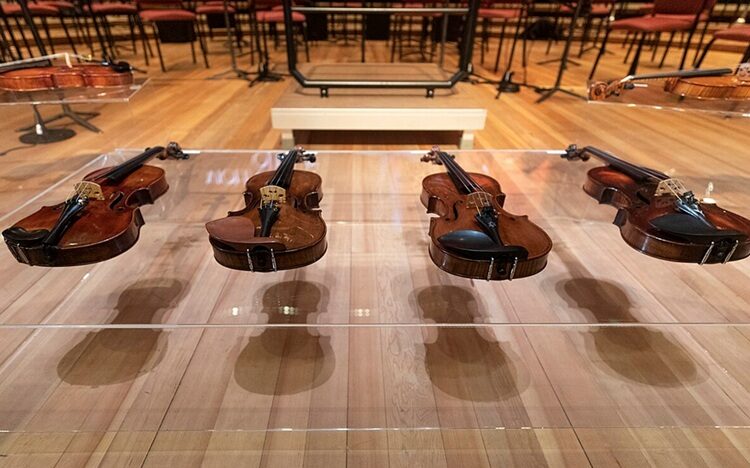
Thanks, Adam! The narrative came from a much fuller 60-page account in the book, but the exhibition was magnificent. One violin has been left unrestored (on purpose) but the others are beyond beautiful, considering what they and their owners went through. Some are klezmer instruments, used in traditional Jewish celebrations, and elaborately ornamented with as many as five Stars of David. Most amazing is the clear concert-hall sound of many that had been damaged or neglected for years.
Quite nicely done in every aspect. Truth is stranger than fiction, and fiction is no stranger to truth.
Thanks, C. B. The stories of the Violins of Hope and their owners qualify as stranger than fiction, if we think only of the survival of instruments, violinists, and those stories that might well have been lost. Who would have thought Auschwitz inmates marched to work every day, and returned, to the music of a string orchestra? One of the violins bears specific witness to that!
If I am not wrong, today is Holocaust Memorial day, this is a very fitting tribute, masterfully told.
Thanks so much for remembering, Maria. January 27 is indeed Holocaust Remembrance Day, and I appreciate your thinking my tribute, as one of millions of stories, is well told.
Evan, thank you for choosing the illustration, in which each violin and its shadow are clearly visible. Each of these historic instruments has a ghost that played in the past, traveling through an agonizing period of time with a violinist who has now passed away. Some musicians survived the miseries of the Holocaust years, others did not. The violins may have been packed away and not played because they were repositories of painful memories. To become a Violin of Hope, they had to arrive at the Weinstein shop in Israel, where no one wanted German instruments for a long span of years. The Weinsteins bought some of them to save them from destroyed–but now they are restored to concert capability. The illustration shows them on display in front of chairs arranged for an orchestra. They are ready to be picked up and to sing again in memory of musicians who carried them long and far.
Amnon Weinstein believes music itself constituted a brief escape in the midst of Holocaust miseries.
Margaret, there are so many heart-rending stories of the holocaust and you presented this one with dignity and great sensitivity. This one captures the horrors of the time while presenting us with the powers of preservation of small things worth saving that continue to make a great impact on lives and hope. I have a personal story that you may find relevant. As a member of the U.S. Army Russian Institute in Garmisch, Germany, our class toured Poland and visited Auschwitz. One of the buildings was like a grain storage unit divided into bins. As I looked at the segregated belongings (shoes, bags, etc.) in bins of those who died there, a LTC friend was staring at a bin filled with luggage with names painted on them and he had tears in his eyes. I asked him why he felt so sad. He turned to me and told me his grandparents perished there and he was looking to see if he could find their names on any of the bags.
Roy, that is one sad example of lasting effects of the Holocaust. I’m glad you find my remembrance effort dignified and sensitive. You’re right about small things worth saving, including the violins nobody wanted for years. Amnon Weinstein said his violin repair shop began to buy them because otherwise some might have been trashed or destroyed. As a luthier, he considered it sacrilege to smash a violin–and he turned them into valuable reminders of loss and instruments of hope.
Ms. Coats’ condensation is an informative and heart-felt poem worthy of contemplation, whose title is especially applicable to the young boy who never got to live out his life.
Indeed, Bruce, it is a sad life where vengeance, even if justified, is the most memorable accomplishment. I am especially touched by Motele’s yearning for his sister in his last words, as we know them from a surviving member of his partisan group.
Margaret, you have turned this moving tale into its own music through your poetry. This stirs feelings of sorrow and compassion in us that we need all the more to invoke in the context of the present troubles in the Middle East and around the world.
Thank you so much.
Thank you, Tom, for appreciating the sorrowful violin. I quite agree that we need to invoke such stories as Motele’s long-ago loss of family and childhood during the present troubles. Too many come to feel they and their lives have no value to others.