


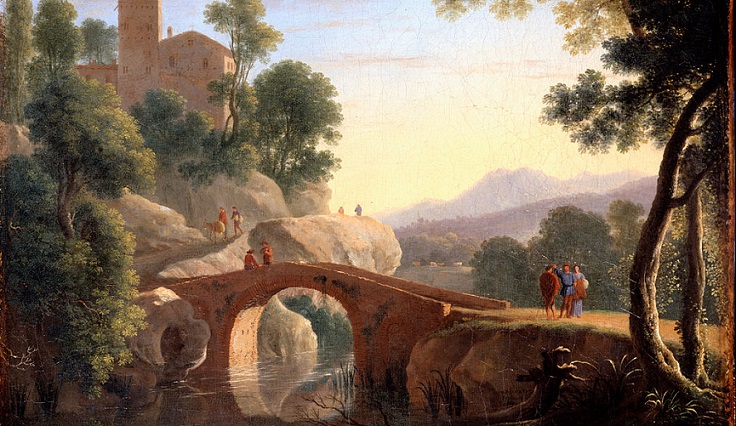
Bridge of Memories
a symmetrelle in mixed syllabic meter
A bridge built of memories
spans the gap between future and past.
Although life may speed by us too fast,
from every experience, knowledge we gain.
Each second of happiness, boredom and pain;
far too many moments for us to retain
the best and the worst are the ones that remain.
In the end, what we’ve actually amassed
on this foundation, crafted to last,
a bridge built of memories.
Clouds
a pantoum in iambic pentameter
Clouds drift across the peaceful azure sky.
As I sit quietly under this tree,
I think of life’s big questions and then sigh.
I wonder if someday I’ll truly see.
As I sit quietly under this tree,
the sun is warm shining upon my face.
I wonder if someday I’ll truly see
the beauty hidden deep inside this place.
The sun is warm shining upon my face.
I stretch out, gladly soaking up the light,
the beauty hidden deep inside this place,
as arms of golden warmth embrace me tight.
I stretch out, gladly soaking up the light.
I think of life’s big questions and then sigh;
as arms of golden warmth embrace me tight,
clouds drift across the peaceful azure sky.
Dusty Grein is an author, poet and graphics designer from Federal Way, Washington. He currently lives in the Pacific Northwest, where his 15 year old daughter is hard at work securing her college degree while still in high school, and raising him right. When he is not busy writing, he donates a great deal of his time and graphics talent. In honor of his grandson Eddy, lost to SIDS at 13 weeks old, he creates free memorial images for bereaved families, with a special focus on infant and pregnancy loss. His blog, From Grandpa’s Heart… is followed by fans around the world.

















These are lovely.
Well-done, Dusty!
Thank you for these, Dusty. On “Clouds,” the iambic pentameter works well, except for two lines: “I wonder if someday I’ll truly see,” and “The sun is warm shining upon my face.” Both the words “someday” and “shining” usually carry their emphasis on the first syllable, so the iambs are not carried through without the reader forcing each of those words to emphasize their second syllable.
I would suggest that “I wonder if someday I’ll truly see” be changed to “I wonder if one day I’ll truly see, ” or I wonder someday if I’ll truly see,” both of which would keep the iambs rolling along smoothly.
And, perhaps, the other repeated line, “The sun is warm shining upon my face,” could be changed to “The sun is warm and shining on my face.”
Just some thoughts . . . to make it easier and unforced for the reader. 🙂
Amy,
I just realized that my reply to your comments here was written in my notes, but I never actually sent it… Here is what I wrote:
**Amy, Thank you so much for your kind words and attention to the details in my poems. As to your suggestions, the first one — “I wonder if someday, I’ll truly see.” — was an intentional stress flip to force a slow down during reading – as I found myself speeding along on read-through. Your second suggestion is spot on, and at some point after submitting to the SCP, I actually changed it, switching “warm shining” in favor of “shining warm” — probably during the polish that all my work goes through when adding it to my collected works archive. Thanks again so much, I love the fact that my metric musings were read deeply enough to catch this error. You have validated my habit of polishing my work months after writing (in order to approach it with fresh eyes).**
“Both the words “someday” and “shining” usually carry their emphasis on the first syllable, so the iambs are not carried through without the reader forcing each of those words to emphasize their second syllable.”
Yes, “someday” has a very light stress on “some,” if we pronounce the word outside the poem, but not a very large one. The stress on “day” in the poem is what is called metrical inheritance. The momentum of the previous line begs us to put a stress on “day” rather than some.”
“The sun is warm shining upon my face” is fine with its spondee substitution, though I’d add a comma after “shining” to make the spondee more pronounced.
That is: put a stress after “warm” to make the spondee more pronounced.
“The sun is warm, shining upon my face”
And by the way: “The sun is warm, shining upon my face” is a fine line. If you want to write metrical verse that does not offend the ear you must introduce substitutions and metrical variation. What is metrical variation? Stresses that do not thump with the same intensity.
In no way is a poem “good” because it can easily be scanned by metre maids.
These are both pretty good poems.
Of course, Mr. Grein is welcome to leave his poems the way they are. Those were simply my suggestions to help the rhythm roll along more smoothly, in what seemed to me to be a gentle line within the poem, not necessarily a critical or rapturous moment, when a spondee might normally be employed.
Certainly, we will all have differing opinions on when spondees might be used to the greatest effect, but my overall feeling is that the spondee should break the meter for a specific reason, to stop the reader’s “scanning,” and force him/her to “wake up” from the comfortable rhythm to notice something special that the poet wishes to emphasize.
With that in mind, ” The sun is warm shining upon my face” seemed to me to be an uncomfortable use of spondee. I agree with you, Mr. Yankevich, that adding a comma would make it more pronounced, but I think the words evoke such a light softness, that perhaps a spondee might not be what this poem asks for at that particular moment. Again, though, that is only my perception of the tone of the poem.
If, in fact, a spondee “wake up call” was what Mr. Grein was purposefully writing, then I would definitely agree that a comma should be employed, so that the reader understands that the break in rhythm is intentional. And I would suggest possibly even using different words, such as “The sun shines warm, so warm upon my face,” in which the spondee is the second, third, and fourth syllable of the line or “Shine, on, oh sun! so warm upon my face,” in which the spondee includes the first four syllables.
Symmetrelle? I never heard of it, but I see what it is. Are the lengths of the stanzas a requirement, or just the symmetry? Also, I am pleased that people are taking a greater interest in meter. It can get quite complicated, and whole books have been written on the subject. The worst of it is that there are often different ways to analyze a line in terms of metrical feet.
Well, C.B., your comments on meter a few days ago helped give me the “guts” to weigh in on the meter of these poems! So, thank you for that! 🙂
When I first began submitting to SCP, Blake Elliot and James Sale had several comments/criticisms/observations on my poem, “Tapestry.” Their lively discussion and their willingness to share their opinions helped me, as a beginner poet, and I think the alterations that I made to “Tapestry” in response to their suggestions improved both that poem and my overall writing.
“As iron sharpeneth iron, so a man sharpeneth the countenance of his friend.”
Thanks for mentioning me, Amy: I may have made a comment or an observation, but criticism – never! I really like your poetry. The question of meter/metre is tricky, but then so is rhyme if one wants to get it right. In all situations the question is not is the meter right, but does the meter convey or mirror the sense of what is being said? When meter exists in the vacuum of ‘meter maids/men’ or just counting, then it is not so much poetry, as verse, and verse in varying degrees of quality (I like good verse, but it is easy to write prolific bad verse!). And let’s not forget Pope’s observation: even Homer nods! The best of us can fail – not reach that sublime expression that the likes of Shakespeare and Milton showed was possible. But it is true we can all benefit from studying the topic more, so Leo’s link is very useful and I shall follow it myself. All the best – and yes, enjoyed your poems, Dusty – thank you.
Actually, James, I think that, at the time, you were defending “Tapestry” as it originally stood, and Blake was the gentle critic. 🙂 But I learned and grew as a poet from both of your observations!
For me, poetic verse, like music, should fall naturally and easily on the ear, unless the intent of the composer/writer is to alter the cadence for a specific purpose or effect.
Personally, I can hear the music of, say, Stravinsky, and I can understand his genius and possibly even his message, . . . and yet, his constantly changing meter, or even “senza misura” makes his work uncomfortable to my ear, like much of modern, meter-less poetry. Even if it carries the most lofty sentiment or beautiful imagery, without a steady-ish meter, a piece of music or a line of poetry won’t want to “stick” in my head and heart.
I am not likely to hum “The Rite of Spring” nor to have the words of Ammon’s “Identity” running through my mind while I am busy at my daily tasks. However, I may easily hum Bach’s “Adagio” or Watts’ “I Sing the Mighty Pow’r of God” or Lynyrd Skynyrd’s “Simple Man,” each of which moves forward in measured rhythm. The words to Frost’s “Stopping by Woods on a Snowy Evening” or Poe’s “Annabelle Lee” or even Edgar Guest’s “It Couldn’t be Done” might–and have–run naturally through my mind, over and over, their structured cadences comfortably fitting into the pattern and rhythm of my day.
A steady, measured meter is what makes a poem or a song instantly palatable to my senses, which are governed by steady rhythms of their own, my breathing, my heartbeat. And the occasional disruption of that steady meter in song or poem affects me in the same way that a “catch in my breath,” or a “skip of my heart” would.
As such, those metrical irregularities, for me, should have some MOMENT, some reason, some purpose. Otherwise, they become like unwarranted heart palpitations, instead of the natural responses of the heart to happiness, sorrow, shock, or delight.
Rightly applied disruptions of the meter in music and in poetry can be as effective as any physical surprise of joy or fear or pain that momentarily interrupts the normal rhythm of living. The key, I believe, is making those metrical violations different, special, set apart, even pivotal.
When they are not, it merely confuses and jars the listener/reader.
Introduction to Meter: http://learn.lexiconic.net/meter.html
Excellent explanations and examples of meter to be found at this site. Thank you for sharing this.
I am just happy that this has all ended well. And you are welcome, Amy.
Yes, Amy, I agree with you about the principle point: the absence of form or formal elements – sustained form – is a major deficiency of most contemporary poetry. Which is why the work of the SCP is so vital.