


.
.
Father And John: How It Once Was
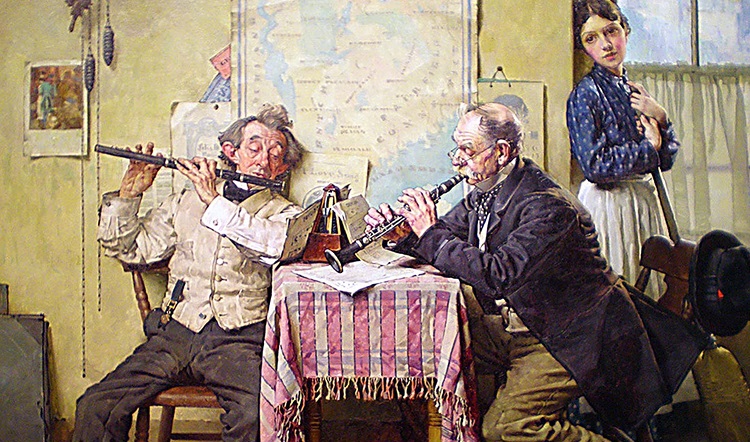
Before self-righteous rules, brash and insistent,
There was a natural rhythm, quite unspoken.
So when my father hired an assistant
Traditionalist, he followed rules unbroken.
There was no power-structure interference—
No lying résumés, self-serving spinning
By quasi-moral snoops. Avoiding nonsense,
He struck the soul of it. John’s violining
Had raised the bar for father on John’s scoring.
Those entertaining tales he spun with ease
Moved him up higher. He was never boring.
A man of Renaissance proclivities,
He then confessed that once, inebriated,
He’d fallen on his violin and spun
Across the street. My father celebrated—
Exclaimed in joyous tones You are the one!
A kindred spirit hired there, in spades!
They listened every afternoon to soaps.
As organ music swelled through the decades
Each wondered at why others were such dopes.
Past turkeys, Christmas, holiday parades—
Creative souls in bondage to the way
Those others lived. I see them still—sweet shades—
Vibrant, alive, eternally at play.
.
.
Tribute
My mother was a demon for the truth.
I often thought her harsh, outspoken, brusque.
My thoughts now often turn to her at dusk—
Her gracious laboring with the uncouth,
That struggle homeward through the teeming mix
Of slicing snow against her weary eyes,
Hoping I would be there—a nice surprise—
A nap with the white cat. The clock struck six
When clouds grew faint, transparent in dark skies.
She’d scrub potatoes, and excise their eyes
Just in the same way that she would devise
True answers that could counter specious lies.
One lesson learned from her when in my youth—
Potato eyes cannot distinguish truth.
.
.
Edible Landscape
A cookie disk, the moon is frosted white—
It hangs atop a sky of sticky pine.
Closed cones hold all the promise of the night
And more. The popcorn stars string out and shine.
As I search out each planetary site
To sprinkle on this dream and grow a vine
Of silver baubles in this crusty night,
I take a bite of the horizon line.
.
.
Sunset And Morning
I think of summers when an orange glaze
Lit up each window like a lightning rod,
And those around us followed the old ways,
Pronouncing crick for creek, and Gawd for God.
Oh for the splendor of those simple days
When warmed by sun, a creature of the sod,
I loved the world for all its bright arrays
Of grass and blossom, tangled vine and pod.
My father and his cat watched from their chaise
As that orange orb dimmed the whole façade.
Their lives were short; still, in a beer-dimmed haze
They shared a pretzel and some brew, were awed
By sunset as my books thrilled me. Each phrase
Made these, their sunsets and my mornings, flawed
As I saw I had entered in a maze,
A pretzeled path, caught in a strange aubade.
.
.
A former Wilbur Fellow and six-time Pushcart nominee, Sally Cook is a regular contributor to National Review, and has appeared in venues as varied as Chronicles, Lighten Up On Line, and TRINACRIA. Also a painter, her present works in the style known as Magic Realism are represented in national collections such as the N.S.D.A.R. Museum in Washington, D.C. and The Burchfield-Penney, Buffalo, NY.

















Ah, another Sallytrey of irreplaceable words and thouht – Thank you, Sally, for this glance into your chest-full of lovely words, to beautify our daily habits and chase away the emptiness of modern life. Serious and funny too, you write the best, yes, the best. Thank you!
Dear Leo –
You understand the difference between nonsense posturing and civilization.
Sounds simple, doesn’t it, and yet it is the basis of everything. Thank you so much.
A wonderful respite from the NOW!
Favorite lines:
“Renaissance proclivities” and “potato eyes cannot distinguish truth.”
To Tonia –
While it is good and necessary to speak out against the NOWS, it is equally urgent that we speak up for civilization, which includes a defence of meaning,
Grace, culture, beauty, truth.
WORDS MEAN THINGS. There is no meaning without truth. All I paint and anything I write is based on these precepts. Thanks for your positive respons; you obviously know this, too..
Sally, three of your poems provide a glimpse into times past, complete with the rich detail bringing them to life.
“Edible Landscape” stands alone as lesson in creating a poem from the simplest of ingredients.
Dear David Watt – ..
Certainly the simplest poems are the best, if the message resonates. In the case of “Edible Landscape”, I had to simmer the ingredients down until the flavor reached the desired pungency. Glad you enjoyed it ! As my great aunt used to say, “Take a lot ~ Take TWO !! (Thia became a staple of our family vocabulary.) But if you really wanted ten? Sorry – and what if your sister wanted twelve? Then there would be none for anyone else !! Sorry, but after all, there are rules.
Sally, as you speak about Father and John’s “natural rhythm,” I think of the “natural music” in your words, and how it calls to other senses. The taste of “Edible Landscape” depicts at once a night sky and a Christmas tree beautified with old-fashioned edible ornaments. A strong orange sunset unites sunset and morn in a painterly aubade to be enjoyed with beer and pretzels at any time of day. Delicious!
Dear Margaret Coats –
You have a wonrful way of just coming out and saying what I try to convey in my poems; thanks for that – I love hearing from you !
Here’s another one:
Self-Definition.
Seems we are caught up in what once defined
Past principles that worked, for they outlined
A way of life, secure and varied; good,
Because we always knew just where we stood…
When Germans kissed one way, the French another
And poodles followed suit. And each dog’s mother
Reminded him that he was just a dog
A clipped and curly white and sculpted log.
But now it seems all this is canceled and
Hyphen is just the same as ampersand
A dog, you say? I am a dude today —
Can lift my leg upon the nearest tree
Or kiss the hostess’ cherry lips the way
That some would like to do, but cannot say.
Sally, you have (and have always had) the ability to take something small and plain and turn it into something large and vivid. You are the brilliant pigment; you are the spice of life. And sometimes it seems as if you were the axis on which the world turns. Your house (by which I mean your mind) has more than seven gables, and I am happy that you allow me (or rather, us) now and then to eavesdrop there.
Oh, CB– Your praise astounds me ! And it is so great to see it coming from your pen, which seems to have been dipped in liquid silver !
Please know that you are welcome in Sally’s Seven Gables any time, and please would you send the poem of which we spoke, as I want to read and respond to it.
Sally Cook’s poems are always “painterly.” They are rich in imagery and color.
Dear Joe –
Thanks for showing up. Everything I know about poetry comes from my mother, my father and you. My mother for reading me the classics, my father for showing me by example what not to write, and you, who seem to know everything.
Thanks again for all you’ve shared.
Sally i dont understand the last part of the poem:
By sunset as my books thrilled me. Each phrase
Made these, their sunsets and my mornings, flawed
As I saw I had entered in a maze,
A pretzeled path, caught in a strange aubade.
What phrases made your mornings and their sunsets flawed?
What made the aubade strange?
Dear Benjamen,
First of all, thanks for the honesty of your question. I want my work to be clear. Though dissecting work, especially my own, is distasteful to me (for it implies a failure of communication) I feel I owe you a reciprocal honesty. So —
The last four lines of this poem are the conclusion of a poem about two types of aesthetic experience. Consider my father and his cat. Their reaction is primarily visual and emotional. They don’t discuss it – one can hardly enter into a discussion on aesthetics with one’s pet, yet everyone knows the close communication that can develop with a cat or dog. To both, the delicious warmth of an aesthetic experience is, as Margaret Coats has said, simply part of what goes along with beer and pretzels while viewing a lovely sunset.
The poem in its entirety is about how what is learned from from one’s surroundings can translate into a literary or artistic medium. An adult and an animal bond in an emotional way. But the narrator, having already been influenced by both nature and books, has taken it one step further.
One learns from from one’s surroundings. Eve ate the apple; then problems arose. The child narrator translates sunsets and mornings into words with flawed results. Color often translates to a song, the aubade is “strange”, becase she foresees a clouded future ahead for her. And yes, the cat, bonding with the father, drinks beer from a saucer.
Thank you Sally. And to all present, may I ask, is it just me or does a reader typically need to read a poem several times to understand it. I’m not referring to your poems specifically but the general poetry experience.
It depends, Benjamen. Ideally, I suppose, a poem should be transparent on the first reading of it. But this is not always the case. Sometimes an author will deliberately insert allusions that must be ferreted out by the reader. Sometimes things appear in a poem that are beyond the author’s control; it has been pointed to me, in regard to my own poems, that they meant something, or pointed toward something, of which I had been unaware. And sometimes, sadly, the author has simply failed to communicate clearly. A bit of mystery is usually a good thing, but obscurity should be avoided as much as possible. There is always a text, and there can also be a subtext lurking beneath the surface. There is no fixed rule about this; it depends on the poem and on the reader. Consider this poem:
FAITH AND FORTITUDE
We shy at worms
and are afraid
of septic germs,
while in our thoughts,
however tox-
ic, we are staid-
ly orthodox
The Argonauts
of ancient Greece,
impatient for
the Golden Fleece,
against all odds
would wade ashore
with pagan gods.
The text is fairly clear, if somewhat elliptical, but what is it really saying? Let me know what you think, and then I will tell you what I think it means.
The first paragraph is about how we accept our own toxic thoughts. The second documents the voyage of the argonauts.
Benjamen, on the surface you are correct, but taken together it is a comment on the fears we have even though we subscribe to some sort of monotheistic orthodoxy, whereas the polytheistic Greeks were able to be brave with lesser gods, whom we today describe as mythological. “Faith and Fortitude”. This is not to take anything away from Abraham et al. or the Christian martyrs; it’s just how things seem to go with us today.
C.B. Anderson,
Thank you! I see there is a connection there from the stanza about orthodoxy to that of the Argonauts but it’s implied, of which there is a lot in poetry. And I can see how that connection between “orthodox” and “pagan gods” is made.
We shy at worms
and are afraid
of septic germs,
while in our thoughts,
however tox-
ic, we are staid-
ly orthodox
The Argonauts
of ancient Greece,
impatient for
the Golden Fleece,
against all odds
would wade ashore
with pagan gods.
Sometimes it is only a matter of vocabulary. Poets who value rhyming are in need of an ever increasing supply of words. Other times, the poem revolves around a new or unusual idea. Since, as Dr. Joseph Salemi has said, a poem is a fictive artifact, both clarity and fantasy can exist in a poem at the same time. Bottom line: poetry is an art and has many levels. That’s my take on it.
Sally, your poems hypnotize me… they send me into sensual realms that transcend the mundane. I particularly like “Edible Landscape” and love those “popcorn stars”. From here on in stars will always be edible, and when I’m in the gutter, I’ll know a delicious meal awaits me if I only look up.
Dear Susan –
How marvelous that I have been able to hypnotize a poet of your quality! And then you have had the nerve to say in print that I am not mundane !! I love it !!
That portion of your comment where you look up from the gutter (where you will never be) to see a delicious meal is such a grand compliment. Poetry should – among other things – nourish.
When I think of things your poems (and those of others) have taught me, I know why I am on this site.
Thank you, dear friends, and thank you, Evan, for making it all possible…