


Clonmacnoise
(Cluain Mhic Nóis)
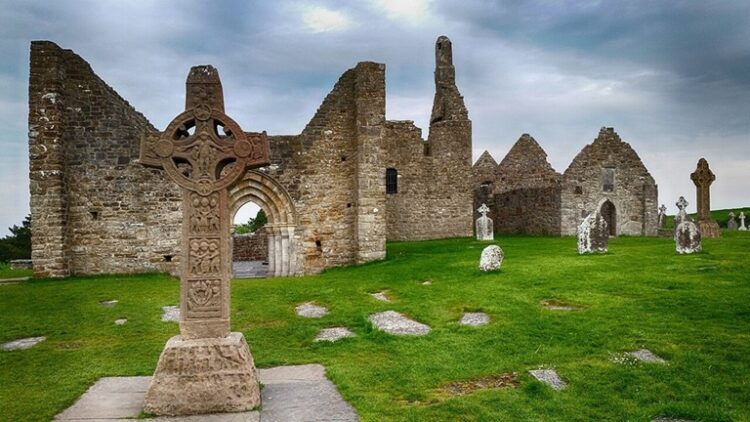
Rocky gray ruins, round tower stronghold,
speckling a wide expanse of green,
residuum of a fabled scene:
fine flourishment of monasteries,
communes in strict ascetic mold,
launched by godly visionaries.
Saint Ciaran found this perfect site:
the Shannon meets a key trade route.
High kings lent friars their martial clout.
Craftsmen worked metals, sculpted stone,
star scholars came to think and write:
a partnership of monks and throne.
Flann Sinna hacked a bloody path
through rival clans. To save his soul
he funded the shrewd abbot’s goal,
propelling this sacred fief to fame:
cathedral to appease God’s wrath;
grand cross, blest ambit to proclaim,
some ten feet tall. Its Celtic ring
still wreathes the intersection of
the beam and arms, as if Christ’s love
envelops this monastic place.
Pagan motifs—a curious thing—
scriptural scenes they interlace.
Skilled masons vied to be selected
to carve the sandstone front and back.
The settlement sustained attack
from raiders. Peaceful life in time
collapsed; it never resurrected.
Structures sank, besmeared with grime.
We amble through the grounds, moonstruck.
Can this be real, or do we dream?
Afar, glides Shannon’s lazy stream,
a painter’s landscape interlude:
phlegmatic cattle, rafts of ducks,
tableau of ideal quietude.
Fortitude
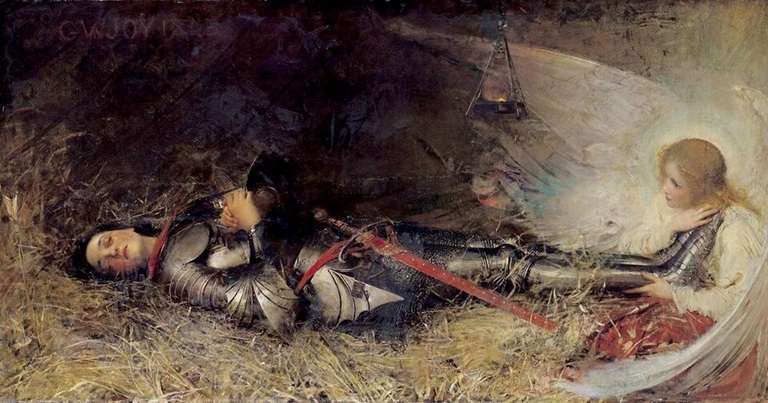
A peasant maid sleeps in a field.
An angel hovers near, to shield
her as she dreams. Slip of a girl,
strange voices urge her to unfurl
a banner sewn with lilies white,
to lead her countrymen to fight.
In steel-plate armor nobly dressed,
she snatches a few hours of rest,
ready to beat down Orleans’ gates.
Alas, the Dauphin vacillates.
Our saint has slept six hundred years.
Commands from heaven still she hears,
inspiring us to watch and pray,
instructing us to note and weigh
encroachments on our liberties.
As she enshrined the fleur-de-lis,
our stars and stripes must billow high.
We must not let our freedoms die.
Mary Jane Myers resides in Springfield, Illinois. She is a retired JD/CPA tax specialist. Her debut short story collection Curious Affairs was published by Paul Dry Books in 2018.
















Mary Jane, you are a marvel! Such intricate weaving of poetic tales that dazzle with historical context and shimmering words of wonder. I salute your intrinsic intellect and deft handling of both French-related and Celtic based subjects. Both poems were entrancing and entertaining.
Roy
Thank you for your kind comments. I was fortunate to visit Clonmacnoise last August. The ruins are an apt subject for poetry.
Most sincerely
Mary Jane
Beautiful language, Mary Jane, especially in Clonmacnoise. I read and re-read!
Paul
Thank you for your kind comments. I visited Ireland for the first time last August. I was impressed by the ruins of the Clonmacnoise and Glendalough monasteries. In Dublin, I saw the Book of Kells as well as other 7th to 10th century manuscripts copied by Irish monks. The achievements of this monastic culture is a rich subject for poems.
Most sincerely
Mary Jane
I’m not sure why these two poems affected me so strongly. It might be because of my Celtic/Gaelic heritage, or it might be due to something else entirely — perhaps the universal draw of evocative transcendent themes. Either way, you have set the table where happily content congregants may dine.
Dear C.B.
Thank you for your kind comments. I visited Clonmacnoise last August–my first trip to Ireland. A traveler is compelled to write a poem after seeing such an impressive place. I read the Mark Twain 1895 biography of Joan of Arc recently. I was struck by his sincere admiration for her, as I thought he was a committed skeptic. I shamelessly stole the idea for the poem from his comment:
A slender girl in her first young bloom, with the martyr’s crown upon her head, and in her hand the sword that severed her country’s bonds – shall not this, and no other, stand for PATRIOTISM through all the ages until time shall end?
Mark Twain, Joan of Arc (1895)
Most sincerely
Mary Jane
“Fortitude” breathes inspiration to Americans as we celebrate our country’s 250th anniversary, Mary Jane. And you do this by invoking a saint who was a most unlikely soldier, called to maintain the freedoms and the Frenchness of her nation. She did it with real warfare which was at the same time ideal warfare waged by one nation under God, with manly virtue demanded of the combatants. This is a tall order, but as your contribution to the national spirit at this time, it’s unique and very valuable.
“Clonmacnoise” looks back at a truly legendary location, yet a real one built on ideals that carried it through time into memory. It is a place of peace and grand achievement–a worthy redemptive dream to treasure.
Dear Margaret
Thank you for your kind comments.
Re: Joan of Arc. See quote above from Mark Twain that I copied out for C.B. Anderson. This quote inspired me to think about Joan’s relevance to our own country. Though Twain was an avowed “skeptic” (atheist? agnostic?) he researched Joan’s biography, and wrote a book about her life. The tone of that book is respectful, not at all like Twain’s typical sarcasm (except when he is criticizing those who persecuted her–but even then, the tone seems sincerely indignant, rather than at all flippant). Twain also (how mysterious are the ways of heaven) gave financial support to the convent founded by Rose Hawthorne Lathrop, the daughter of Nathaniel Hawthorne, and a Catholic convert.
Re: Clonmacnoise. I visited Ireland for the first time last August. The ruins of Clonmacnoise overwhelmed me with emotion. It is a place I’ve always “imagined”–and yes, it is real, and those monks really did build an enduring legacy.
Most sincerely
Mary Jane
Great poems using history, they are worthy of learning from. Thanks a lot for sharing.
Dear Paul
Thank you for your kind comments.
Most sincerely
Mary Jane