


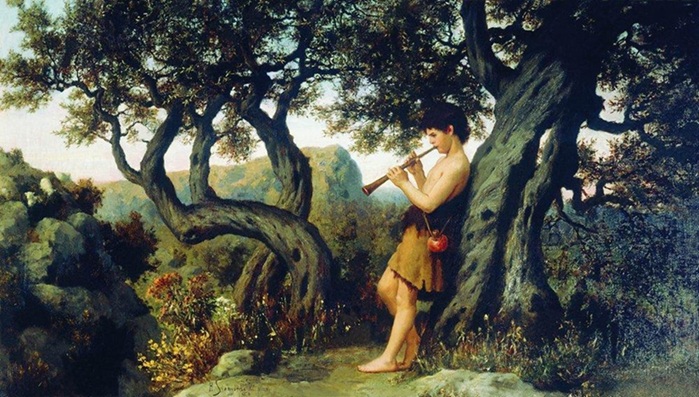
The Vault
_The turning sky enwraps the world.
Each day, entreating eyes wide-open to
This circling vault shall earn a benefaction,
A grain of living salt; and over time
Ensues discerning capability
To separate inconsequential things
_From those that absolutely matter.
_Autumnal rains quell squirrel chatter,
The leaves grow wetter with each fallen drop
And, when it stops, a father leads his daughter
By the hand into the forest where
He shows her how the trees shed water
Even after the disburdened clouds
_Have packed their things and moved away.
_Some days, a lad can master boulders
Rising from the woodland floor and carry
On his shoulders the weight of many worlds:
He marries well, and from that heady gladness
Lives long enough to see his children grow
And thrive and feel their own sweet sadnesses,
_The same he’d known when they were young.
_Songs sung by birds are ancient ones,
And yet their nests are built from shreds of which
A town divests itself; their hopes are brief,
A season’s span at most, and even when
An egg is barren or the fledgling fails,
_Their grief is relatively short.
_Disordered dreams at night may move
A soul to comb the vault for lives unlived—
A sad mistake, for consequential dreams
Arise by day … though lives so dreamt but never
Dared are impoverished shadows of the ones
_That vanish come the dawning light.
Below the Fold
___Below the fold,
_The overgrazed and dung-pounded ground,
With scanty grasses bitten to the root,
___Entreats the air
_To carry back that dream-drowning sound
And stir the shepherd from his feckless flute.
___The ewes must eat,
_Or else the lambs will suffer this night
From lack of milk. Where is that watchful master
___Whose only charge,
_To stand alert and buffer their fright,
And lead them to a farther verdant pasture.
___Above the ground,
_But far beyond the dust-churning fold,
An ether blows that’s wild with tongueless voices
___Enjoined to speak
_For voiceless tongues whose yearnings, untold,
Are for a life not shorn of decent choices.
___They too are lost,
_Those vagrant spirits trusted to make
Things right, distracted by seductive songs
___From other spheres—
_Old iron vows, when rusted, will break,
Permitting yet another thousand wrongs.
___Below the fold,
_The headlines spell disasters and deep
Denials from the recently indicted;
___No help is on
_The way, because the master’s asleep—
No one is left to see that wrongs are righted.
C.B. Anderson was the longtime gardener for the PBS television series, The Victory Garden. Hundreds of his poems have appeared in scores of print and electronic journals out of North America, Great Britain, Ireland, Austria, Australia and India. His collection, Mortal Soup and the Blue Yonder was published in 2013 by White Violet Press.








“Below the Fold” displays a mastery of a rare rhyme form of writing replete with consummate enjambment. The topic reminds me of the nursery rhyme, “Little Boy Blue,” but an outstanding adult version with additional imagery and with the perfect ending: “because the master’s asleep—No one is left to see that wrongs are righted.”
Yes indeed, Roy, BtF is as nonce as nonce can get. With sheep in the meadow and cows in the corn, nothing is as it should be. I struggled — and still struggle — over that last line.
I found these very rewarding. They recall The Mortal Soup and the Blue Yonder. The like differences in lines 2, 4 from the tidy meter of the others in each stanza of “Below the Fold” makes for an enjoyable texture.
Texture as an element of prosody, Stephen, is something I hadn’t considered previously. Perhaps I should have titled the book Turtle Soup and the Blue Fondue. It’s good to “hear” from you again.
C.B.
These two well-written, creatively constructed, deeply moving, thought-provoking works contain subtle hints that they represent a of self-reflection on your own life. The final stanza of The Vault certainly spoke to my own life as you contrast night-time pipe dreams which vanish at the dawn with the more consequential day dreams, full of possibilities that all-too-often are never brought to fruition. I also resonate (don’t we all hate that word, “resonate!”) with the danger of over-ruminating on “lives unlived.” In every life there are ill-made decisions, loves lost, and regrets piled on top of regrets. Good advice is to listen to yesterday but talk to tomorrow. These poems show me a slightly different side of your thoughts and how you are able to express them with such eclat.
Self-reflection or reflection simpliciter, James, are or should be a big part of every life. As Rudolf Steiner wrote: Every idea that does not become an ideal slays a force in your soul. I don’t mind “resonate,” but I think the word has become something of a cliche’. At this point in my life I must come to terms with the fact that I have far more yesterdays than tomorrows to come.
Birdsong, on account of its antiquity, elevates the birds over and above the other animals; that sense of grandeur is beautiful contrasted with the birds’ humility in fashioning nests out of materials abandoned by man. The season-long duration of the hopes of so grand and humble a species adds ample pathos to the stanza.
Also memorable is the image of dreams as storehouses of lives unlived.
There must be a reason, Daniel, why we spend so much effort to attract birds to our yards. Mammals and birds, it is theorized, share a reptilian lineage, but if things had gone another way, just imagine what it would be like if we had to teach our offspring how to fly. Teaching them to walk and talk is already hard enough. I think we like birds because they are our distant cousins.
I love both of these poems, Kip, and yet I’m a bit tongue-tied in trying to articulate precisely what it is about them that I find exceptionally moving. In fact, I find the tone elusive, ephemeral and to some degree even ethereal. The Vault is a (mostly) blank verse piece with the occasional rhyme which appears almost haphazard. The structure is also varying: the first three stanzas are 7 lines; the last two are 6. In each of the stanzas the first and last lines are tetrameter rather than pentameter. The result is a piece which strikes me as solidly classical yet infused with a meditative quality and even a touch of stream of consciousness – and which dares the reader to consider your own theme: “is this material or immaterial”? Here, then, is the written word as corollary to those “disordered dreams” referenced in stanza five combing the vault “for lives unlived.” It’s a beautiful and haunting progression of imagery from the sky which encircles the Earth to the disparity of the bird songs which are ancient though their nests are made of new scraps, to the dream-world of the imagination. It’s a while since I’ve seen a piece I would describe as metaphysical but this is precisely that. At least for me.
“Below the Fold” has a rigorous structure – but one which is so unusual and which also strikes me as almost Browningesque (he played with lines of multiple feet in several poems like “Love Among the Ruins.”) Here we have stanzas arranged as a line of dimeter, of tetrameter and then a pentameter with the 2-4-5 pattern immediately repeated. The dimeter lines do not rhyme, the 4s and the 5s do rhyme. It’s a unique form (a nonce form?) which I’ve not before encountered but which I find truly intriguing. The imagery of the shepherd, the ewes and the lambs is well-developed into a deeper discussion of humans, souls and sinners. This raises a question for me: the lambs and the shepherd are frequently seen as Christian symbols. I get the feeling, however, that this is not what you are after. I don’t see this as a religious poem but one which addresses the absence of leadership and justice in our Earthly realm. But here’s where I’m hesitant. You could certainly be casting your gaze beyond our sordid world to ask the question of “where is the good shepherd when we need him?” I incline towards a mostly-secular poetic interpretation but nonetheless with a subtle Christian aura – primarily because you have created a parable and have taken the word “shepherd” and the word “master” – two words which are associated with Jesus – and linked them thematically. A discussion of Christian influence here seems unavoidable to me — BUT I want to avoid reading into your piece so I am content to contemplate (rather than solve) the mystery of the sleeping master.
Contrary to conventional folk theology, Jesus can’t be everywhere at once, Brian. Bad stuff happens in this fallen world, and God better have a good reason for permitting physical and moral disasters. Some Jewish theologians, following the Holocaust, wondered how it came to be that YHWH no longer intervened in worldly affairs or even spoke directly to His People. To some extent, this poem instantiates the awakening of my inner Jew. In previous iterations, the last line was more like:
There’s only you to see that wrongs are righted
but I felt that was a bit too moralistic. So yes, this is very much a nonce form, the likes of which you might never see again.
Up with Metaphysics!
Yes, C. B., up with metaphysics. Self-reflection tends to go beyond physics. I like the poems as a personal self-reflection, for I find it difficult to imagine that Everyman, even with wide-open eyes and the tears therefrom, comes in time to discern the things that absolutely matter. That might take not just well-developed perception, but a gift that could be accepted or ignored.
And as for righting the myriad thousands of wrongs by anyone, metaphysics would go beyond us in considering the power to do so, and perhaps even more significantly, the time (point of time and length of time) it appears to require.
Your considerations are refreshing, and the forms in which you present them correspond.
Someone once told me, Margaret, and I don’t know whether this is true or not, that Aristotle came up with the term “metaphysics” simply because that section came just after his section titled “Physics.” Everyone has revelations, and it is for persons like us to find ways of expressing these ideas, but many people rightly wonder whether either philosophers or poets are anything other than madmen. That’s something I try not to worry about. Are the tears of a blind person any different from those of the sighted?
C.B., I love these poems for their form, imagery, musicality, and wisdom – a wisdom which is tangible and earned. For me, they speak with a clarity of vision with their spiritual and moral contrast – “The Vault” looking to the heavens and celebrating life’s cycles and the lessons they bring. And “Below the Fold” looking to the earth and a troubled world of human neglect and decay. Both are beautiful, but I am particularly taken with “The Vault” – it moved me to tears with its mellifluous magic. It’s an instant favorite.
Constance Hunting, Susan, who once edited The Puckerbrush Review, though she declined to publish it, went to great lengths to make red-ink comments on the returned manuscript. Her comment on the title was: Nice pun? Of course, if she had accepted the poem, or any of its later iterations, you most likely would never have read it. The “clarity of vision” you mention is surely accidental. If the tears you mentioned are real, please don’t let them fall into your keyboard, lest all of us suffer a great loss.
The Vault has a mystical, magical feel to it to go with its wide-ranging imagery.
Below the Fold seems to be a message to dreamers that ‘fine words don’t butter parsnips’, that it’s all well and good to live in a dreamy state, but reality is there to bite back.
Thanks for the reads.
You may well be correct, Paul, in all of your surmises. We write this stuff, and it’s all jolly good fun.
Appreciate the use of the word vault. Tolkien liked it. Vault brought back the Tennessee farm near the Appalachians where I lived and worked; the sky there was a royal blue vault. Mantyk’s image selection brings back the Rhodesian’s Sheep Farm near Athens where my first job was much enjoyed. CB, your mention of “scanty grasses bitten to the root” is accurate. Sheep biting disallows fescue clumps. Hilton Bik’s Ga Sheep Enterprises was morphing into diagonal-blade emerald colored grass. A good third of it resembled a putting green. All to say: I really appreciated Below the Fold, so thanks.