


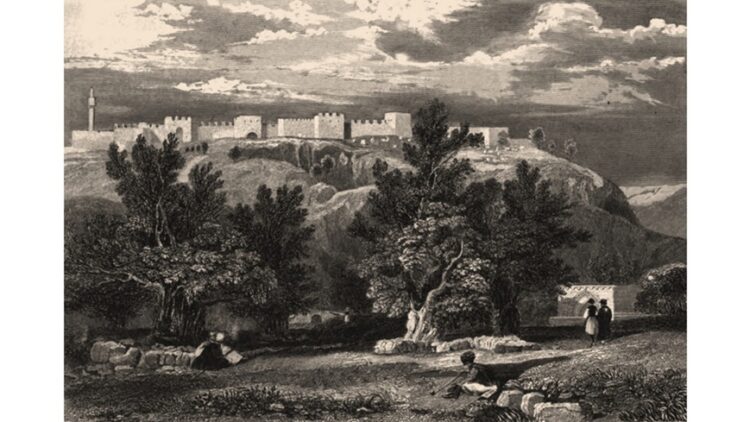
King Cyrus Issues an Edict
“Thus saith Cyrus king of Persia: ‘All the kingdoms of the earth
hath the Lord, the God of heaven, given me; and He hath
charged me to build Him a house in Jerusalem, which is in
Judah. Whosoever there is among you of all His people—his
God be with him—let him go up to Jerusalem, which is in
Judah, and build the house of the Lord, the God of Israel, He is
the God who is in Jerusalem.’” —Ezra 1:1–4
Naomi, leave your loom and come outside!
Have you not heard the cheering from the square?
The messenger brings news—like none before!
Praise God, we’re going home! No longer slaves
Held captive in a foreign land, removed
From all we love. O, let us kneel in thanks!
Praise Cyrus, King of Persia, Friend of Jews—
A pagan who transforms our lives for good.
He vanquished Babylonia and now
This gentle, gentile ruler bows to God
And issues a decree which says that we
May soon return to Judah, our true home!
But greater still, he bids us to rebuild
The Temple of Our God, the very heart
Of who we are! Proud Babylon had thought
Destroying it would crush us with despair—
That Israel would give up; that we would fall
Just as the temple stones were all hurled down.
You ask why Cyrus grants the Jews this boon
Since monarchs are not usually so kind?
Perhaps, dear wife, our new king fears the Lord!
When God fills someone’s heart, I think we’re fools
To question it. Let us not disobey
The will of Him who made the earth and sky.
Jerusalem, my heart! Jerusalem!
We’ll live to see our Temple rise again
Secured by mighty walls to cradle all!
King David’s City, City of God’s Peace—
The holy place where Abraham bound Isaac
And set the firm foundation of our home.
Remember how we groaned when we were chained
And driven as if cattle in vast herds
To Babylon—how many of us fell?
We drowned when we were marched across the Tigris!
Death came for us, young children ripped away
From parents, wailing husbands torn from wives.
Kept here in exile in this foreign land
Our captors mocked us with their cruel demands
To sing to them our weeping songs of Zion.
Two generations later we still mourned
For home, the land that God Himself had promised,
Where prophets augured we would dwell again.
Yes, we survived these endless, painful years
Among barbarians who lived to kill.
We clung to every memory of home—
The earth, the olive groves, the hallowed hills,
The Rose of Sharon, lilies of the field,
The balm of Gilead. Judean sage.
The Mount of Olives and the Kidron Vale
Where thousands of our ancestors rest still;
Jerusalem! Where David brought the Ark
And changed this place of death to one of life.
The desert bloomed through muscle and God’s will
Into a land where milk and honey flowed.
Dear wife, I cannot seem to stop my tears.
Those strangers who enslaved us fed upon
Our agony—we saw our sacred land
Besieged and burned, then wrongly claimed by those
Who helped themselves to what our nation built,
Then lied about the history we lived.
Our tormentors usurped Jehovah’s role
And wounded us with words and metal blades.
They made us bleed—but those fools cursed themselves.
Now they are gone, dear wife. And we’re still here
As Cyrus—a new Moses—sends us home!
Naomi, let us pray this peace shall last!
Poet’s Note: The Edict of Cyrus refers to the biblical proclamation by Cyrus the Great, the founding king of the Ahaemenid Persian Empire, in 539 B.C. It was issued after the Persians conquered the Neo-Babylonian Empire upon the fall of Babylon as described in the Hebrew Scriptures. Cyrus issued a decree authorizing and encouraging the Jews to return to Zion and rebuild the Temple in Jerusalem.
Jerusalem of Gold
—a rondeau
Jerusalem hosts countless prayers.
While here, I plead for Man’s affairs
And beg God not to turn His back.
I cry for courage (which I lack)
And proof that Heaven cares.
O, God, please help me face the glares
Of hate-filled thugs who put on airs,
Who cheer to see Your foes attack
__Jerusalem.
Let me not fall into their snares.
I’ll live out loud despite their stares
For I am strong and shall not crack.
This holy place is gold, not black.
Your temple stands and none compares:
__Jerusalem.
Brian Yapko is a retired lawyer whose poetry has appeared in over fifty journals. He is the winner of the 2023 SCP International Poetry Competition. Brian is also the author of several short stories, the science fiction novel El Nuevo Mundo and the gothic archaeological novel Bleeding Stone. He lives in Wimauma, Florida.
















Great blank verse retelling of a very dramatic time in Hebrew history, Brian. And a lovely rondeau, too.
Thank you very much, Cynthia! I frequently find echoes of Biblical experience and emotions to be as relevant today as they ever were.
Thank you, Brian, for these two interesting and well-written poems honoring the Jews and Jerusalem and faith in the God of Israel.
Thank you so much, Theresa. I’m pleased that you enjoyed them and their investigation of the relationship between the Jewish people and the City of Jerusalem.
A wonderfully detailed poem – lovingly detailed poem in fact – that reminds me of Pascal and his Pensées, arguing explicitly that the continued existence of the Jewish people—despite dispersion, persecution, and the loss of political sovereignty—is a living historical witness to the truth-claims of the Hebrew Scriptures and, by extension, Christianity. For Pascal, the Jews function as unwilling but persistent custodians of prophecy. There are simply no other peoples like the Jews – what other nation has been homeless for 2000 years and yet still returned to its homeland (which of course Pascal did not know would – or could – happen when he wrote)? – and to account for their remarkable story in purely naturalistic terms is, to my mind, an act of wilful blindness.
Thank you very much indeed for this powerfully evocative comment, James. I love the idea of Blaise Pascal arguing about the truth of the Bible by invoking the Jews — not their actions or words but simply their existence. The fact that they exist after all these millenia and the most extraordinary challenges. Your phrase “persistent custodians of prophecy” is an extraordinarily succinct and yet evocative description of the Jewish role in history. Forgive me if I start using this in future discussions. It’s brilliant. That act of wilful blindness which you mention — it is unfortunately ubiquitous. But that makes me appreciate a comment such as yours all the more. More is at work here than can be weighed, measured and graphed. Thank you so much, James. The depth of your words means a lot to me.
Both of these poems are really about the status of Jerusalem as central to Jewish identity — the first in regard to the edict of Cyrus that sent exiled Jews back to their land, and that authorized the rebuilding of the Temple; and the second as a defense of the Jewish presence in and sovereignty over the city.
Both have contemporary resonances, since the liberal-left is still making a fuss about East Jerusalem, calling it “occupied territory” and demanding that it be the site of an illusory Palestinian state’s capital. That won’t happen, since right after the 1967 war the Israelis declared that they were back in Jerusalem forever, and would “never leave.” But you know the left — they never accept reality if it interferes with an ideological narrative.
How ironic that a Persian king made post-captivity Judaism possible, while the current rulers of Persia (Iran) are now dedicated to the destruction of Israel.
Thank you so much, Joe, for your perceptive comment. You have explained perfectly both spotlight and subtext concerning these poems. They are indeed about the centrality of Jerusalem to Jewish identity. It is mentioned 669 times in the Old Testament. It is mentioned 146 times in the New Testament. It is central to both Judaism and Christianity. (It is interesting to compare the number of times Jerusalem appears in the Koran — not once.)
The liberal left’s fuss about East Jerusalem is, as you point out, purely ideological. But these are the science deniers who refuse to look at the archaeology of Jerusalem which documents 3000 years of Jewish presence. These are the history deniers who claim that Jews came to Israel in 1948.
As for Iran, the abomination that is the Ayatollah regime cannot fall fast enough. This Iranian despising of Jews and hatred of Israel is actually a rather new phenomenon. There was a huge Jewish community in Tehran up until the time the Shah fell. I went to school with many Iranian Jewish refugees in Los Angeles. When the Shah was in charge, Israel and Iran had excellent relations, El Al Airlines flew to Tehran, there was much commercial intercourse and mutual tourism. The tombs of Esther and Mordechai are in Iran and received pilgrim visits from Israeli Jews. The Shah’s crown prince has indicated that Iran and Israel would resume their cordial relationship when the Islamic regime falls.
Brian, you powerfully retold the eternal and repeated story – powerfully especially because it is also personal for you, because it has been repeated in every place where Jews have tried to create a semblance of peaceful return, and because ever since 1948, we have been witnessing a return to Zion that is yet to be crowned as it was under Cyrus. Thank you for reminding what we are dealing with, over and over again – and now, when the descendants of invaders and usurpers want to take Jerusalem away again, the city that must be brought up at the head of every joyous occasion..
“By the rivers of Babylon, there we sat, we also wept when we remembered Zion.
On willows in its midst we hung our harps.
For there our captors asked us for words of song and our tormentors [asked of us] mirth, “Sing for us of the song of Zion.”
“How shall we sing the song of the Lord on foreign soil?” If I forget you, O Jerusalem, may my right hand forget [its skill].
May my tongue cling to my palate, if I do not remember you, if I do not bring up Jerusalem at the beginning of my joy.” – Tehillim (Psalms 137: 1-6).
Michael, your comment has brought tears to my eyes. It is indeed personal — every year since the Romans conquered Jerusalem, renamed it and tried to ethnically cleanse Judea of its Jewish identity — Jews celebrating Passover have prayed earnestly for a return to Jerusalem. It is mentioned in prayers throughout our various liturgies. I know of no comparable longing in other faiths for a return to its holy center. The Hewish people would rather worship at a ruined wall of stone in their holy city than build the grandest of edifices elsewhere.
Thank you for quoting the language of Psalm 137. This was, of course, much on my mind as I wrote this poem — particularly the “weeping songs of Zion.”
There is also an echo to current events and the horrors of October 7th. In particular the following lines:
Those strangers who enslaved us fed upon
Our agony—we saw our sacred land
Besieged and burned, then wrongly claimed by those
Who helped themselves to what our nation built,
Then lied about the history we lived.
I have no tolerance or sympathy whatsoever for those who have helped themselves to what our nation built, then lied about the history we lived. Justice and peace cannot exist — nor should they — until the lies, distortion and propaganda end and reality — historical, archaeolical, sociological — is accepted. It is impossible to interact with people whose version of reality is completely made up.
The 1980 Israeli law once again making Jerusalem the “complete and united” capital of Israel was of massive historical significance. The United States official opening of its embassy in Jerusalem on May 14, 2018, followed President Donald Trump’s December 6, 2017 announcement recognizing Jerusalem as Israel’s capital. The parliament, Supreme Court, and official residences of Israel’s leaders are all in Jerusalem. Brian, Jerusalem as capital is crucial to present day world politics and to Jewish identity. This may be of interest to you, but in 1995, I sang a song on stage in Russia with the Jamaican born European singing group, Boney M, “Down by the rivers of Babylon, where I sat down one day—wo,wo,wo,wo—and I remembered Zion. (the words had slightly changed to this over 20 years). “By the Rivers of Babylon” is one of the all-time biggest hits in the UK. Part of that song is based on Psalms 137, as you referenced. Citing Persian King Cyrus and his recognition of Jerusalem and Zion almost 2,500 years ago is a great historical anchoring date and must infuriate todays anti-Israelis and enemies of the Jews. Such references as yours are continually needed for the world to read and be aware.
Thank you so much for this appreciative and informational comment, Roy! Yes, Jerusalem is unified both legally and de facto, and it shall remain so. It is, of course, historically right that this should be so. And God bless Donald Trump for finally recognizing Jerusalem as Israel’s capital and moving the American embassy there in 2018. Congress had voted to do so in the 1990s and every president since Bill Clinton promised to effectuate the move. It took someone like Trump — a willingness to act boldly ad decisively — to finally make it happen.
“Down by the rivers of Babylon” is a fantastic song. Would I be right to characterize it as gospel? Another great song on the theme of Psalm 137 is “By the Willows” from the musical Godspell.
And thank you for appreciating my focus here on reminding a hostile world of the uninterrupted Jewish presence in the Holy Land going back 3000 years. Jews have not been in the majority for a part of that time, but they were ALWAYS there. To think of them as recent arrivals would be as absurd as thinking of a Navajo family moving from New York back to Arizona as being newcomes when their entire ancestral history is there. Jews come from Judea. Graves and DNA do not lie.
Powerful stuff, Brian, that speaks to and awakens my inner Jew. A day or two ago a friend of mine who lives in Seattle sent me this article, the first part of which is particularly eye-opening:
https://www.hudson.org/politics-government/jewish-test-michael-doran
Mark Twain was nobody’s fool.
Thank you for this comment, Kip, which is really eye-opening in terms of the reality of Jewish history (including Jewish genetic markers) and Jewish achievement, all vilified with the antisemitic nonsense spouted not only by the ignorant yet aggressive Hamassholes out there but also by the disingenuous likes of Tucker Carlson and Candace Owens, both of whom have a special place in hell for the bald-faced lies they engineer and then propogate. Once again, Qatar has much to answer for. Soros, too.
An impressive pair of “songs of ascents,” Brian. This kind of Biblical psalms tells of the upward pilgrimage to Jerusalem, Mount Zion, and the Temple. This is an ascending journey, geographically and spiritually. “King Cyrus Issues an Edict” offers an outburst of emotional anticipation, spoken with exultant yet humbly thankful hope by a Jewish man immediately upon hearing the edict. It is difficult to express how much feeling pours out, because it seems the man and his wife had themselves experienced the captivity and exile to Babylon 70 years earlier. That would make them elderly survivors. The joy the man wishes to convey to his wife becomes all the more wonderful, especially as he recalls Psalm 137 as if he were one of its original singers. His memory in your poem, and in Michael Vanyukov’s quotation, present it as a lament. It is that, but the final verses also curse Babylon fiercely. That appears forgotten in the triumph of Cyrus becoming a triumph for the Jews. Indeed, your speaker freely accepts the wonder of the Gentile Cyrus as God’s instrument of good will.
“Jerusalem of Gold” comes from a later (or maybe earlier) time than the edict, when the incomparable Temple is standing. As a short and more formally structured song, it better resembles the songs of ascents. Perhaps there is also a reference to “Jerusalem the Golden,” a famed 19th century hymn translating a Latin Christian masterpiece of the 12th century.
Fine work, Brian, in re-presenting Jerusalem as the universal draw to hearts that the city remains to all of us who pray for her peace.
Thank you for this generous comment, Margaret. I would not have thought of these as “songs of ascents” and yet that’s a beautiful way of characterizing them. It is always difficult to put oneself into the position of a Biblical figure — here it is someone who must speak for all Israel to describe the horrors that have been experienced and witnessed. Since he is a representative figure rather than an authentic historical one, I gave him the benefit of all of the experiences of Israel in Babylon. He certainly could be an elderly man who literally lived through the destruction of the Temple. But he could also be a simple allegorical representative of the Jewish people, in which case his age doesn’t matter. I believe a collective “we” allows for people to discuss historical events even before they were born. “We fought at Bunker Hill, we fought at Gettysburg, we liberated Paris, we tore down the Berlin Wall…” That poetic “we” has great imaginitive power.
I love what you have to say about “Jerusalem of Gold” and I thank you for giving me the opportunity to discuss the title and its significance. I did not know about the Medieval masterpiece you mention. My reference point was actually more contemporary: There is a beautiful song which in Hebrew is called “Yerushalayim Shel Zahav” — Jerusalem of Gold. It was written in 1967, shortly before Jerusalem was reunified. It has become an unofficial anthem for both the City of Jerusalem and the State of Israel. So much so, that it was featured at the very end of “Schindler’s List” when the survivors and progeny of the Schindlerjuden visit Oskar Schindler’s grave. For the deep longing that it expresses, I believe it is worth a listen. There are dozens of covers of it. Here (perhaps improbably), is a version by Andre Rieu during a concert in Tel Aviv in 2018: https://www.youtube.com/watch?v=Im5lh2kJWTI
I won’t produce the original Hebrew here, but f you are interested in the English translation of the Hebrew words, they are as follows:
Jerusalem of Gold
The mountain air is clear as wine
And the scent of pines around
Is carried on the breeze of twilight,
With bells resounding.
While the trees and stones softly slumber,
The city is caught in a dream
So solitary lies the city,
And at its heart a wall.
Oh, Jerusalem of gold,
and of light and of bronze,
I am the violin for all your songs.
We came back to the water wells
to the market place and the square.
On the Temple Mount within the city,
The shofar rings out loud.
Within the caverns in the mountains
A thousand suns glow,
Again, we will go down to the Dead Sea road,
That runs through Jericho.
Oh, Jerusalem of gold,
and of light and of bronze,
I am the violin for all your songs.
But as I sing to you, my city,
And you with crowns adorn,
I am the least of all your children,
Of all the poets born.
Your name scorches my lips,
Like a seraph’s kiss,
If I forget thee, golden city,
Jerusalem of gold.
Oh, Jerusalem of gold,
and of light and of bronze,
I am the violin for all your songs.
Thank you, Brian, for this translation and for YouTube links. I notice Michael Vanyukov’s includes the Hebrew text (thanks, Michael). I recall the 1967 war clearly, but did not know this song from it. It was a different world then, with young non-Jewish volunteers clamoring to help defend the land.
Since you say below that Biblical associations help appreciation, please allow me to make literary citations here. The book of Jeremiah’s Lamentations over destruction by the Babylonians is five alphabetic poems. The aleph verse for chapter 4, the best of them, reads
How darkened is the gold, its finest color dim;
The sanctuary stones lie strewn in every street.
Chapter 21 of the book of the Apocalypse or Revelation contains the vision of the New Jerusalem by John the Apostle and Evangelist. The 12th century work I referred to earlier, by Bernard of Cluny (not of Clairvaux), is sometimes called De Contemptu Mundi, but more properly Laus Patriae Coelestis (Praise of the Heavenly Fatherland). It is book length; the English book title is often The Celestial Country, and the hymn taken from it is the famed Jerusalem the Golden, best in the version by John Mason Neale. One not so easy to find is the full text (26 quatrains) of Jerusalem, My Happy Home, original English, early 17th century. It is lament and vision at once. Here are modernized verses 6 to 9 from a British Museum manuscript, with gold and gems reminiscent of Lamentations 4.
Jerusalem, Jerusalem, God grant I once may see
Thy endless joys, and of the same partaker aye to be.
Thy ways are made of precious stones, thy bulwarks diamonds square;
Thy gates are of right orient pearl, exceeding rich and rare.
Thy turrets and thy pinnacles with carbuncles do shine;
Thy very streets are paved with gold, surpassing clear and fine.
Thy houses are of ivory, thy windows crystal clear,
Thy tiles are made of beaten gold–O God, that I were there!
Thank you very much indeed, Margaret, for bringing up these additional Biblical associations. They show how large Jerusalem looms in the heart of both Christians and Jews, how the Bible references Jerusalem literally hundreds of times, how deeply loved it is.
Brian, “King Cyrus…” is both elegiac and commanding, marrying historical sweep with intimate devotion, rendering the arc from exile to deliverance both credible and profoundly moving. Thank you for this deeply felt meditation on survival, faith, and the restoration of a people that honors its subject with restraint and eloquence.
“Jerusalem of Gold” really struck a personal nerve, as “Yerushalayim Shel Zahav” is my favorite Israeli song. Your solemn and urgent poem blends devotional intensity with civic plea. This reader feels both the communal burden and the speaker’s private courage. Your meditation on faith under duress should command everyone’s attention.
Thank you so much, Laura! I love the contrasts in your description — “historical sweep/intimate devotion.” You grasp perfectly what I was going for. And I agree with you about “Yerushalayim Shel Zahav” (Jerusalem of Gold.) It’s a magnificent song which never fails to move me. Sadly, these are days when far too many experience faith under duress. Fortunately, faith is stronger. Not necessarily painless, but stronger.
Brian, I admire and appreciate both poems for their craft and their erudite engagement with the scriptural and historical. I especially like the excellent use of figurative imagery in “King Cyrus Issues an Edict”. One of my favorite lines is: “The desert bloomed through muscle and God’s will / Into a land where milk and honey flowed”. I love how theology and landscape meet to create the feel of a much-loved home, not just the political territory many have come to view it as. This poem draws forth emotions. The heartfelt recollection of loss and homecoming in this poem gives it a profound human touch that makes it very powerful indeed.
I just love the use of one of my favorite forms in “Jerusalem of Gold” – it reads as a hymn with an impassioned plea. I find the lines: “O, God, please help me face the glares / Of hate-filled thugs who put on airs” especially effective. For me, these lines speak of vulnerability and bravery – a combination that spurs the persecuted to stand up and sing out “Jerusalem” in savage times of silence. Very well done indeed!
Thank you so much for this generous comment, Susan — how keenly you recognize that intersection of “theology and landscape” which is a fundamental aspect of the Jewish soul. I know of few other faiths which are as geographically-centered. The political territory looms large in contemporary discussions, but the deep spiritual and heart-connection is too often glossed over. Frankly, the Jewish commitment to the Holy Land is incomprehensible without it. The indoctrinated propagandists who claim Jews are colonizers (in their own land!) never bother to think it through. What a poor country Israel is for colonizing. The one place in the Middle East that has no oil. No gold. No particular mineral wealth, and a most hostile roster of enemies. The one thing Israel has that other countries don’t is that unbroken Jewish connectin going back 3000 years. If all Jews wanted was to colonize territory, virtually any other place on the planet would have served them better.
I’m particularly pleased that you enjoyed the rondeau since all of my rondeau-craft is a direct result of your influence. It is doubly pleasing to me that you relate to the need to stand tall and proud in a crowd full of bullies. You know this stress only too well. The persecuted must stand up and sing. And those who can speak the truth and bear witness must — absolutely must! — do so. Thank you, Susan, for consistently showing us how it is done!
My favorite cover of Yerushalayim shel zahav, after Naomi Shemer, its author, is by Ofra Haza: https://youtu.be/aG2s9Sp7tKg?si=Vh8zdR6iA1tCpz2i.
Michael, this is a most beautiful rendition of “Yerushalayim Shel Zahav.” Thank you for sharing it.
Brian, thanks for these two all-too topical poems. The second is obviously a direct reference to the modern antizionist (ie Jew-hating) frenzy in the world now. The first is just as relevant for today, with its penultimate stanza:
… then wrongly claimed by those
Who helped themselves to what our nation built,
Then lied about the history we lived.
You just described what “Palestinians” and their daft supporters do.
David, thank you for this. Iran is even now being held to account — finally! – by the USA and Israel. The time of the evil regime of the Ayatollahs is drawing to a close. And, by no historical accident, on the eve of the Jewish holiday of Purim, which celebrates the story of Esther and Jewish survival in the face of Haman’s attempts to eradicate the Jews. Given current events and the imminent holiday, I am particularly pleased that you have recognized the topicality of these poems. I had written “King Cyrus” in the hope of reminding the reader of times when Israel and Persia were aligned in spiritual goals and mutual respect. I hope and pray that a new day will dawn when a new Iran which does not sponsor the world’s terrorism can take its place in a more rational community of nations.
And yes, you read that penultimate stanza as dissing Palestinian historical revisionism perfectly. I have had enough of lies in the service of woke, selectively bigoted ideology
Thanks again Brian. If I may quote again from your work, yes we face “the glares Of hate-filled thugs who put on airs,” but we can’t lose heart. I think a battle just as vital as the one in Iran is the battle for western society to stop deceiving itself about the nature of Islamism (by no means all Muslims) and to reject the woke nonsense that refuses to acknowledge its threat.
Win some, lose some: very recently in the UK, a local election was won by a party that shamelessly pushed an antizionist agenda. As Jews, we cannot afford the luxury of naivety: hopefully the wider society will see we are right. I just hope it isn’t too late.
David, there is a deep problem not just with Islamism but with the suicidal empathy woke people in the West have embraced. We are now in the most bizarre of historical circumstances in which Westerners who call Trump “Hitler” are literally siding with — and mourning for — a vicious tyrant who murdered tens of thousands of his own people for opposing this barbaric theocracy, a tyrant who unleashed and funded terrorism as a disease on the civilized world, who has repressed women in the most horrible ways, who has hanged gay men from cranes in public squares. This MONSTER is what the Left mourns for. Trump has liberated millions of people who are deeply grateful, but to the Left it is Trump who is the fascist. These morally bankrupt fools hate Trump that much.
Persia has always been a major problem for the West. From the Greek city states to Alexander of Macedon to the Romans to right now, the Iranians have given us grief. The evil was compounded when they were converted to Shiite Islam, and became a hotbed of theocratic insanity, and a plague even on their Moslem neighbors.
The Democrats and the liberal-left in general now find themselves in an ideological bind. They realize that it is impossible to defend the Iranian regime publicly after its horrendous history of utterly non-liberal policies, and its open support for terrorism all over the planet. But secretly they loved Iran, because it was a major force of armed opposition to the West and to western civilization (this is certainly the case with that prick Obama).
So what are they forced to do now? Simple — they make pro forma statements about how bad the Iranian regime was, but then attack Trump for destroying it, because he didn’t follow “proper protocols” and “procedures” and “due process” in ordering our forces into action. When liberals call for “protocols, procedures, and due process,” you know that all they are seeking is to stymie and delay something.
What lying scumbags! If Trump had foolishly asked for a congressional declaration of war (which hasn’t been used since 1941), the left-liberals would have turned the whole thing into a media circus of debate and argument and op-ed bullshit lasting forever, and giving the Iranians plenty of warning.
God bless Trump and Netanyahu. I only hope that they will not stop this war until they have totally degraded Iran’s military capacities, and their industrial bases of support. We have tolerated the Persian arrogance for too damned long.
Thank you, Joe, for this historical information. It’s a fascinatingly dysfunctional and yet aggressive history. I’m in full accord regarding the “lying scumbags” who are hypocrites and who seem to despise our country and its interests more and more each day. I am sickened by the fawning eulogies the Washington Post and New York Times gave to the Ayatollah Khamenei who was killed. It’s as if they were rhapsodizing Stalin. The extent to which they have been compromised cannot be overstated.
God bless Trump and Netanyahu indeed! Daring action in the service of moral clarity is a great thing. Churchill had it. Eisenhower had it. Patton had it. I wish it was seen more in this age of moral flaccidity.
I enjoy your narrative poems, like Cyrus…This one feels epic in scope but intimate in voice, which is not easy to pull off. Kudos!
Thank you very much indeed, Michael! I’m grateful to know the attempt to balance epic and intimate has worked here. I find myself drawing closer to the Bible when I try to relate to the humanity of the people within its pages.