


.
.
Late Bloomers
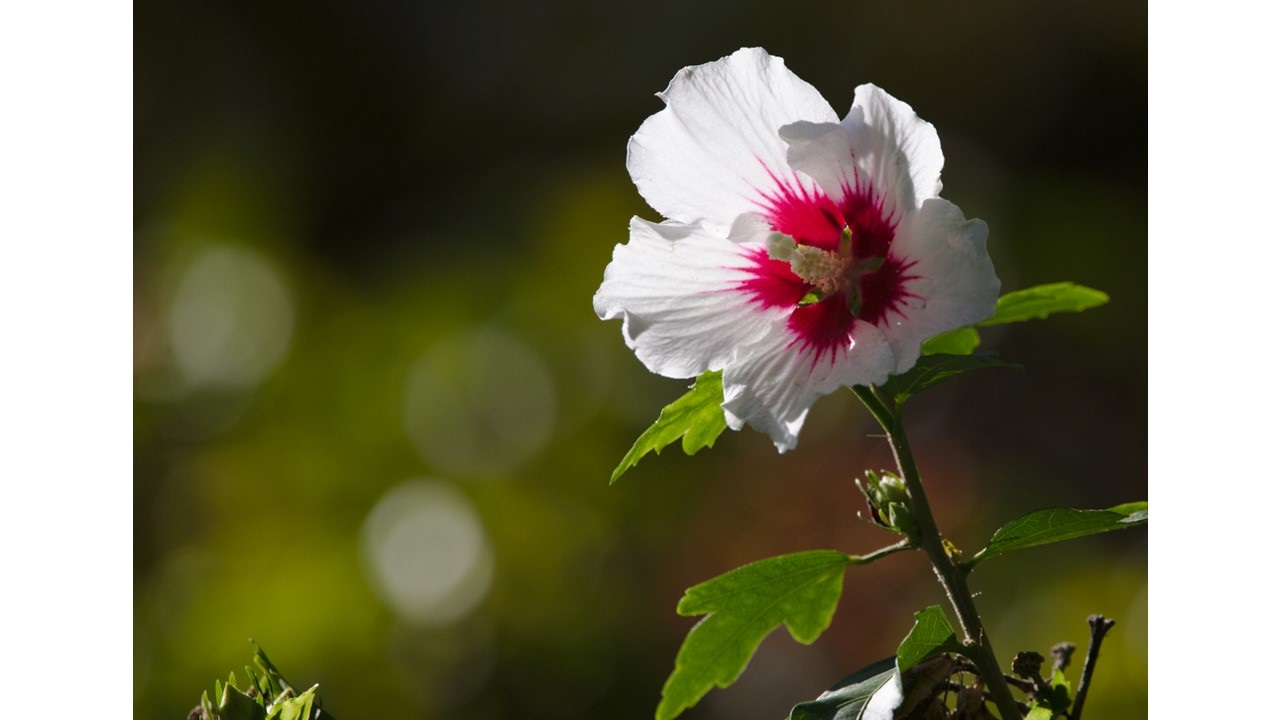
My last red rose-of-sharon
__Is slowly curling closed,
Each giant shell-shaped petal
__Beginning to turn in,
The five of them a pinwheel,
__Crepe-paper veins exposed
To August’s reminiscence
__Of the summer that has been.
.
Today it holds its brightness;
__Tomorrow it will fall—
Frail, old, already rotting,
__After one dazzling day
Of reigning in the garden,
__Crowned king by size, like Saul—
And lie unburied on the grass
__With others, and decay.
.
Huge five-point blossoms, meanwhile,
__Herald the pumpkin, queen
Of autumn’s golden garden.
__Their vines like giants’ veins
Have overlapped the chainlink fence
__To tangle in between
Two yards, to join two seasons
__At the seam where summer wanes.
.
They weave the raveled sentiments
__Of August and September,
Portending things we almost know
__But never quite remember.
from Notes on Time
.
.
.
.
Cynthia Erlandson is a 2023 Top Four winner in the Maria W. Faust Sonnet Competition. Her poems have appeared in The Society of Classical Poets, First Things, Modern Age, The North American Anglican, The Book of Common Praise Hymnal, and The Catholic Poetry Room. Her collections are These Holy Mysteries and Notes on Time.

















How beautiful a poem, Cynthia. The rose of Sharon and the pumpkin blossom, both of them large and five-petaled, speak of different seasons overlapping. The rose-of-sharon flower reigns in summer, and the pumpkin’s fruit rules Fall.
Thank you, Mary! I love the way that perennial flowers tell us what time of year it is. And I’m fascinated with Time, and aspects of it that seem to overlap.
Beautiful Cynthia, how you capture the transitioning of seasons, and those moments when the two seasons are joined at the seam.
Best regards,
Paddy
Thank you, Paddy! The “seam” joining summer and autumn seems mysterious to me. Autumn is my favorite season; and yet, I am still sad to see the summer end.
Wonderful.
Thanks for the read, Cynthia.
You’re welcome, Paul! Thank you for reading and commenting.
I’m always a bit jealous about people who can write so well and lyrically about flowers. They seem so impractical to me.
Perhaps I can write about Venus fly traps, or something.
Cynthia, such a beautifully worded poem encapsulating the move from summer to fall with the transition represented by the blossoms and then to reference the naming of the rose-of-sharon and the demise of King Saul is masterful. Great work.
Thank you for your generous comment, Roy! This poem is from the section called “Transition Times” in my book “Notes on Time”.
This is a glorious seasonal poem, I enjoyed it very much, thank you. Right now my yard is displaying the exact scene you are describing.
Thank you, Yael! I don’t have pumpkin blossoms in my yard, but some of my neighbors do. I love great big flowers and blossoms. My giant red rose-of-sharon is blooming very well this year.
Absolutely beautiful, Cynthia. I especially like “the seam where summer wanes.”
I’m so glad you like it, Brian. Thank you!
Cynthia, I’m very glad to see one of your “transition” pieces with what is really a mythic interpretation in the final lines. As you say to Paddy above, there is mystery in it. I would say it works as follows. The dying of the rose of Sharon while the pumpkin grows is an occurrence with meaning. Much of what happens has no particular significance, but this does, and therefore it is a moment when sacred time irrupts into relatively meaningless profane time. It reminds us of the original time when cycles of nature began, and it repeats that time, enabling us to take part in it. That’s why it represents to you “things we almost know but never quite remember.” It is part of that primal setting of the world in order before we existed, but in which we nevertheless take part in potential and in the annual repetitions. The rose of Sharon and the pumpkin also have their meanings as symbols of vegetative life, but time is the most profound dimension in the poem. I have been interpreting literature this way for more than 40 years, based on the writings of Mircea Eliade, anthropologist of religion. Whenever I loaned his “Patterns in Comparative Religion” to any of my fellow literature students, I would have great trouble to get it back! But the 1949 English translation was republished in the 1990s, so if you are interested you can get one cheap. If you don’t know it, I think you’d love it. The conclusion says that modern disorientation results from a lack of openness to sacred time, which is really the only time frame where human beings can fully live.
That is all very fascinating, Margaret. Thank you so much for taking time to discuss ideas about the mystery of sacred and profane time, and how they are reflected in nature, and the connection between modern disorientation and lack of openness to sacred time. And thank you for the book recommendation.
Thanks very much for these thoughts, Margaret!
(The book seems to me a good birthday or anniversary gift idea. Shhhh! Don’t tell Cynthia!)
Good idea, Paul. (Just wanted to let you know I noticed your meaningful thought process concerning time.)
Cynthia, what a beautiful poem that shimmers like a sun kissed lake on the surface… and envelops and enriches any reader who dips into its smoothly sagacious and satisfying depths. I particularly like, “Two yards, to join two seasons / At the seam where summer wanes.” – how eloquent and clever. Wonderful stuff!
Thank you so much, Susan! It always makes me happy to know you’ve enjoyed my poetry.
Read Cynthia’s Maria Faust winning sonnet here: https://sonnetcontest.org/2023-winners-sonnets/
Thank you very much for the promotion, Cheryl!
This is such a beautifully melancholy poem that touches so wonderfully an emotional pensiveness, and yearning sadness for the loss of such a lovely time of year, and its creation. Lovely Cynthia
Thank you, David!
I love the final quatrain, a simple but mysterious closing that lingers like a fine wine.
Thank you, Philip!