• Submit Poetry
  • Support SCP
  • About Us
  • Members
  • Join
Tuesday, May 12, 2026
Society of Classical Poets
  • Poems
    • Beauty
    • Culture
    • Satire
    • Humor
    • Children’s
    • Art
    • Ekphrastic
    • Epic
    • Epigrams and Proverbs
    • Human Rights in China
    • Music
    • Performing Arts
    • Riddles
    • Science
    • Song Lyrics
    • The Environment
    • The Raven
    • Found Poems
    • High School Poets
    • Terrorism
    • Covid-19
  • Poetry Forms
    • Sonnet
    • Haiku
    • Limerick
    • Villanelle
    • Rondeau
    • Pantoum
    • Sestina
    • Triolet
    • Acrostic
    • Alexandroid
    • Alliterative
    • Blank Verse
    • Chant Royal
    • Clerihew
    • Rhupunt
    • Rondeau Redoublé
    • Rondel
    • Rubaiyat
    • Sapphic Verse
    • Shape Poems
    • Terza Rima
  • Great Poets
    • Geoffrey Chaucer
    • Emily Dickinson
    • Homer
    • Henry Wadsworth Longfellow
    • Dante Alighieri
    • John Keats
    • John Milton
    • Edgar Allan Poe
    • William Shakespeare
    • William Wordsworth
    • William Blake
    • Robert Frost
  • Love Poems
  • Contests
  • SCP Academy
    • Educational
    • Teaching Classical Poetry—A Guide for Educators
    • Poetry Forms
    • The SCP Journal
    • Books
No Result
View All Result
Society of Classical Poets
  • Poems
    • Beauty
    • Culture
    • Satire
    • Humor
    • Children’s
    • Art
    • Ekphrastic
    • Epic
    • Epigrams and Proverbs
    • Human Rights in China
    • Music
    • Performing Arts
    • Riddles
    • Science
    • Song Lyrics
    • The Environment
    • The Raven
    • Found Poems
    • High School Poets
    • Terrorism
    • Covid-19
  • Poetry Forms
    • Sonnet
    • Haiku
    • Limerick
    • Villanelle
    • Rondeau
    • Pantoum
    • Sestina
    • Triolet
    • Acrostic
    • Alexandroid
    • Alliterative
    • Blank Verse
    • Chant Royal
    • Clerihew
    • Rhupunt
    • Rondeau Redoublé
    • Rondel
    • Rubaiyat
    • Sapphic Verse
    • Shape Poems
    • Terza Rima
  • Great Poets
    • Geoffrey Chaucer
    • Emily Dickinson
    • Homer
    • Henry Wadsworth Longfellow
    • Dante Alighieri
    • John Keats
    • John Milton
    • Edgar Allan Poe
    • William Shakespeare
    • William Wordsworth
    • William Blake
    • Robert Frost
  • Love Poems
  • Contests
  • SCP Academy
    • Educational
    • Teaching Classical Poetry—A Guide for Educators
    • Poetry Forms
    • The SCP Journal
    • Books
No Result
View All Result
Society of Classical Poets
No Result
View All Result
Home Poetry Beauty

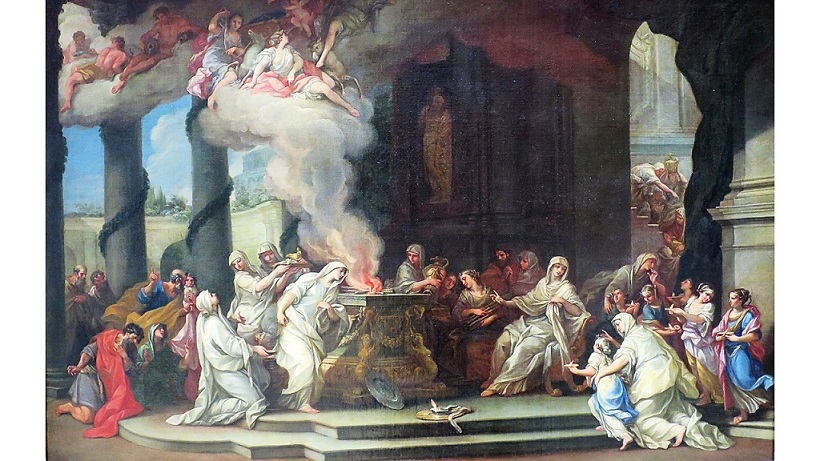
‘On the Traditional Latin Mass’ by Sasha A. Palmer

July 30, 2021
in Beauty, Culture, Poetry
A A
20
poems 'On the Traditional Latin Mass' by Sasha A. Palmer

.

in response to Traditionis custodes (“Guardians of the tradition”)—the new motu proprio issued by Pope Francis on July 16, 2021.

She has been scarred before. She knows the sting
Of scorn and ostracism. She has been poor
And homeless. Hunted, hiding from a string
Of angry mobs, she lived, escaping sure
Death. She survived. O, pray she can withstand
The desecration of St. Peter’s grave,
The inside persecution, the command
To silence her for good. On rocks, in caves,
Pray she endures, clandestine if need be,
And grows, and draws the faithful to her side
With her majestic beauty. History
Of holiness and martyrdom abides
__In her. Do not despair, for popes are men.
__“Trust in the Lord with all your heart.” Amen.

.

.

Sasha A. Palmer is a Russian-born writer and translator, who currently lives in Maryland. Sasha is the recipient of international awards in poetry and translation. Her work appeared in Writer’s Digest, Slovo/Word, Cardinal Points, and elsewhere. 
ShareTweetPin
The Society of Classical Poets does not endorse any views expressed in individual poems or commentary.
Read Our Comments Policy Here

RandomPoems

Share Your St. Patrick’s Day Poetry (with Music by Jeff Eardley)
Beauty

Share Your St. Patrick’s Day Poetry (with Music by Jeff Eardley)

March 17, 2022

. Happy St. Patrick's Day! Share your St. Patrick's Day Poetry in the comments section below. While writing and posting,...

Nocturnal Litanies I & II: Poems by Cynthia Erlandson
Beauty

‘Prayer as an Antidote for Unbelief’ and Other Poetry by C.B. Anderson

October 27, 2024

. Prayer as an Antidote for Unbelief Just imagine if, while you’re entreating the sky, You were met with the...

Next Post
‘Silence Is Not Golden’ by Roy E. Peterson

'Silence Is Not Golden' by Roy E. Peterson

‘The Bivocational Burden’ by Guy Warner

'The Bivocational Burden' by Guy Warner

‘Incense’ by Adam Sedia

'Incense' by Adam Sedia

Comments 20

  1. Peter Hartley says:
    5 years ago

    Sasha, a very moving and very well written poem which shows what the Roman Catholic Church has suffered and survived in penal times past from the death of those Carthusian monks in Henry VIII’s day to Oliver Plunkett’s martyrdom in the late seventeenth century to show how she “knows the sting of scorn and ostracism”, that she rose to that crisis and she will rise again to defeat this. It is sad but full of hope.

    Reply
    • Eric says:
      5 years ago

      Beautiful. In the last days the true Church will be a catacomb church, with the Divine Liturgy
      “On rocks, in caves”, just like in Russia under the godless communists. Her “majestic beauty” will be heartbreaking! This poem is a foretaste, and is utterly inspiring. God bless you.

      Reply
  2. Paul Erlandson says:
    5 years ago

    Dear Sasha,

    Thank you very much for this beautiful offering. It evoked very strong emotions in me, and even a physical shudder at the beauty and sadness of it.

    I am in your debt.

    -Paul

    Reply
  3. Margaret Coats says:
    5 years ago

    Amen, Sasha, and thank you for this spiritual work of mercy. Attacks have been mounting from the inside during recent decades. But as one college chaplain told students, “Ultimately there is only one Roman rite.”

    EXAUGURAL HEXAMETERS

    Tyrannical self-serving sentences portend
    Prodigious numbers learning how old rites transcend
    The modernistic idiosyncratic blend
    Of ambiguities exhausted that offend
    Lucidity. Mammon’s manmade mass will end.
    Hell threatens those whom curs in shepherds’ vesture tend.

    Reply
  4. Sally Cook says:
    5 years ago

    A stern but beautiful verse. Thank you.

    Reply
  5. Joseph S. Salemi says:
    5 years ago

    Bergoglio is an open heretic and an antipope, so nothing that he says and no documents that he issues carry any real authority whatsoever. Unfortunately, this doesn’t mean that he can’t make life a torment for Roman Catholics.

    Reply
  6. Paul Freeman says:
    5 years ago

    Thanks for a well-written, thought-provoking piece, Sasha.

    Reply
  7. Cynthia Erlandson says:
    5 years ago

    This is exquisite, and dense with both true pathos and true hope.

    Reply
  8. Sasha A. Palmer says:
    5 years ago

    Thank you all very much for reading the poem, and for your kind words. Let us pray for the preservation of the Traditional Latin Mass, and continuing to have access to it. God bless.

    Reply
  9. Julian D. Woodruff says:
    5 years ago

    Thank you, Ms Palmer. A very fine and moving piece of writing.
    It might seem like a strange exercise, but I find myself wondering how much of what we can experience in the Tridentine Mass might be “imported” into the N.O. form–celebration ad orientem, the presence and use of an altar rail, the discarding of the kiss of peace, the post-missal prayers, the use of Latin (maybe the least important thing to me except insofar as it admits to the “pride of place” authorized by V.II Gregorian chant, as well as other forms of chant and Renaissance sacred polyphony) etc. I don’t know where a violation of the letter of the N.O. Mass would begin if such were to happen. Oh, but then there’s the spirit of the N.O. Mass …

    Reply
    • Margaret Coats says:
      5 years ago

      Julian, the parishes where some “importation” has been done, and an atmosphere of greater reverence created, tend to be those that have the Traditional Mass as well. Their pastors are among the best. But you are quite right that the spirit and indeed the very structure of the rite created in the 1960s, and updated several times since then, naturally favors novelty. And there is the fundamental difference between a rite that has always been a real and visible sacrifice to God in myriad words and gestures, and one designed to focus on human beings sharing a meal. Trying to change that modern focus is where you get into violating the letter of the Novus Ordo, above all in the Offertory, which in new terms is usually called the Presentation or Preparation of the Gifts.

      Reply
      • Julian D. Woodruff says:
        5 years ago

        Margaret,
        In my 1st response I must have been half asleep. If you are thinking of laymen processing to the sanctuary with the gifts to the tune of some wretched congregational hymnal instead of an offertory within the sanctuary involving properly vested and trained servers, with prayer translated (not adapted) from the psalms (usually) and optionally sung to music granted “pride of place,” you are quite right.

        Reply
      • Margaret Coats says:
        5 years ago

        Julian, I was not thinking of the undignified ceremonies you describe. They are so little attractive to Mass-goers that few volunteer to perform them, and sometimes the priest must wait in the sanctuary, and call out to demand that someone bring up the gifts.

        I was thinking of the required prayers. As one priest who helped write them later confirmed, they are nothing but a table blessing, even in the Latin original that is almost never heard.
        Nothing in them anticipates the most awesome of all sacrifices that is shortly to be immolated (if the ritual taking place is actually a Catholic Mass). And the Offertory is one of three essential parts of the rite, along with Consecration and Communion. The bad translations of the Consecration were finally corrected by Pope Benedict after decades of questionably valid Masses in most vernaculars. I have stopped paying attention to the numerous revisions and additions to the New Order Mass, so I cannot say whether its original Offertory text has been so violated as to be improved in the last twenty years.

        Reply
      • Margaret Coats says:
        5 years ago

        Julian, I made a reply to you that got swallowed by the system. I have found sometimes that it gets released if I make another one. Here goes.

        Reply
  10. Julian D. Woodruff says:
    5 years ago

    Thank you, Margaret. I am not very observant, nor have I ever studied the rubrics for either form or any other relevant documents, so to this day I’m fuzzy about the whole issue. I am aware of the gross lapses in dignity and depth that have become an ordinary part of celebrating the “ordinary” form. Whether these were implicit in the design of the N.O. or extraneous accretions that rushed in through the doings of overly zealous, under-educated “liturgists,” I don’t know.
    I do think there is a direct correlation between the rise of the N.O. as we see it normally and the current state of things generally in the Western world.

    Reply
    • Sasha A. Palmer says:
      5 years ago

      One of the first things a newcomer to the Latin Mass notices is the number of young families, with lots of children. A whole new generation has emerged that is hungry for reverence, mystery, and beauty. That gives me hope that TLM will survive the persecution, and come out of it stronger.

      Reply
    • Margaret Coats says:
      5 years ago

      You are certainly correct, Sasha. Some young couples choose the TLM for their wedding because it is more beautiful, and others start to think seriously, around the time for a child’s First Communion, about the kind of teaching and impressions they want their children to receive. And during the past year and a half, it has proved that TLM people are the ones who most want to be at church. My parish, which had had one Sunday TLM, went to three as the demand grew.

      Reply
      • Joseph S. Salemi says:
        5 years ago

        My wife and I were married in a Tridentine Rite Latin nuptial mass, but the celebrant (an elderly Monsignor) had to get permission from the local bishop to perform the ceremony.

        I doubt if such permission would be granted today.

        Reply
  11. James Sale says:
    5 years ago

    Sasha, the enjambement leading into the penultimate line creates a powerful caesura that charges the remaining tetrameter, which is then balanced with another tetrameter – and the caesura now coming (chiasmatically) at the end of the fourth foot. Leaving – a brilliant rhyme ending whereby the ‘the popes are men’ is wholly undermined by ‘Amen’ (and there is a great pun there too!) Fabulous writing – simple, but really complex, Love it.

    Reply
    • Sasha A. Palmer says:
      5 years ago

      James, thank you.

      Reply

Leave a Reply Cancel reply

Your email address will not be published. Required fields are marked *

  1. Susan Jarvis Bryant on ‘Spontaneous Conjugal Combustion’ and Other Poems by Susan Jarvis BryantMay 12, 2026

    Awww, what a beautiful comment, Mark. It's lovely to hear of the joys of marital bliss after 53 years. Congratulations!…

  2. Susan Jarvis Bryant on ‘Spontaneous Conjugal Combustion’ and Other Poems by Susan Jarvis BryantMay 12, 2026

    C.B., it's always interesting to read your take on my poems, and I've got to say I agree with you…

  3. Roy Eugene Peterson on A Poem on Coach “Black Mike” Castronis from Athens Y Camp, by Alec ReamMay 12, 2026

    Alec, this is a touching tribute to a camp coach/counselor. I had my own at Camp Paisano near Alpine, Texas.…

  4. Roy Eugene Peterson on ‘Creation of Mom’: A Mother’s Day Poem by Roy E. PetersonMay 12, 2026

    Margaret, I was thinking about the vast variety of Moms when I wrote it. Thank you for pointing that out…

  5. Alec Ream on A Poem on Coach “Black Mike” Castronis from Athens Y Camp, by Alec ReamMay 12, 2026

    Margaret, thank you for the read and remarks. First Presbyterian is still there. As is Emmanuel Episcopal, which started at…

Subscribe to Daily Poems

Enter your email address to subscribe to this blog and receive notifications of new posts by email.

Join 1,593 other subscribers

Recent Poems

  • A Poem on Coach “Black Mike” Castronis from Athens Y Camp, by Alec Ream
  • A Poem on the Zambian National Park Mosi-oa-Tunya, by Paul A. Freeman
  • ‘Creation of Mom’: A Mother’s Day Poem by Roy E. Peterson
  • ‘Spontaneous Conjugal Combustion’ and Other Poems by Susan Jarvis Bryant
  • ‘The Man in the Moon Was a Very Round Man’: A Poem by Lauren V. Leon
  • ‘Fibromytrauma’: A Poem by Golan Shahar
  • ‘A Lonely Sliver’: A Poem by Katie Tencza
  • ‘Higher Gas Prices Are a Small Price to Pay’: An Iran War Poem by Mark F. Stone
  • ‘Always Ahead’: A Poem by Scharlie Meeuws
  • ‘Hamlet’s Lawyer’ and Other Poetry by Brian Yapko
  • ‘On An Old Photograph’: A Poem by Joseph S. Salemi
  • ‘Faust Foresees His End’: A Poem by Martin Briggs
  • ‘À la Carte’ and Other Poetry by C.B. Anderson
  • ‘Where the Sweet Bluebonnets Bloom’: A Poem by Roy E. Peterson
  • ‘The Waters’: A Poem by Margaret Brinton
  • ‘The Pinnacle of Poetry’ and Other Poems by Russel Winick
  • The First American Sonnets: An Essay on David Humphreys, by Margaret Coats
  • ‘The Holy Rollers on Poetry’: A Poem by Joseph S. Salemi
  • Sappho’s ‘Poem 1’ Translated by Bruce Phenix
  • ‘The Cautionary Tale of Phone Addicted Mimi’: A Poem by Paul A. Freeman
  • ‘Look Away’: A Poem for America’s 250th Anniversary, by Roger Crane
  • ‘Sunday Morning in Canada’: A Poem by Jeffrey Essmann
  • ‘Bean’: A Poem by Jan Mennite
  • ‘The Swan’s Song ’: A Poem for Shakespeare’s Birthday, by Susan Jarvis Bryant
  • ‘The Gravedigger’: A Poem by Marie Burdett
  • ‘Waiting for the Perfect Man’: A Poem by Janice Canerdy
  • ‘The George-A-Saurus’ and Other Poetry by Brian Yapko
  • ‘When Asked: What’s Your Favorite Season?’: A Poem by Paul Millan  
  • ‘The Last At-Bat of Lyndon Braun’: A Poem by Michael Pietrack
  • ‘The Perpetual Battle’ and Other Poetry by Adam Sedia

Categories

  • Acrostic
  • Alexandroid
  • Alliterative
  • Art
  • Best Poems
  • Blank Verse
  • Chant Royal
  • Classical Poets Live
  • Clerihew
  • Covid-19
  • Deconstructing Communism
  • Educational
  • Epic
  • Epigrams and Proverbs
  • Essays
    • Interviews with Poets
    • Poetry Reviews
  • Featured
  • From the Society
  • Great Poets
    • Dante Alighieri
    • Edgar Allan Poe
    • Emily Dickinson
    • Geoffrey Chaucer
    • Henry Wadsworth Longfellow
    • Homer
    • John Keats
    • John Milton
    • Robert Frost
    • William Blake
    • William Shakespeare
    • William Wordsworth
  • Human Rights in China
  • Limerick
  • Love Poems
  • Music
  • Pantoum
  • Performing Arts
  • Poetry
    • Beauty
    • Children's Poems
    • Culture
    • Ekphrastic
    • Found Poems
    • High School Poets
    • Humor
    • Riddles
  • Poetry Challenge
  • Poetry Contests
  • Poetry Forms
    • Curtal Sonnet
    • Haiku
  • Poetry Readings
  • Rhupunt
  • Rondeau
  • Rondeau Redoublé
  • Rondel
  • Rubaiyat
  • Sapphic Verse
  • Satire
  • Science
  • Sestina
  • Shape Poems
  • Short Stories
  • Song Lyrics
  • Sonnet
  • Symposium
  • Terrorism
  • Terza Rima
  • The Environment
  • Translation
  • Triolet
  • Video
  • Villanelle

Quick Links

  • About Us
  • Submit Poetry
  • Become a Member
  • Members List
  • Support the Society
  • Advertisement Placement
  • Comments Policy
  • Terms of Use

Welcome Back!

Login to your account below

Forgotten Password?

Retrieve your password

Please enter your username or email address to reset your password.

Log In
No Result
View All Result
  • Poems
    • Beauty
    • Culture
    • Satire
    • Humor
    • Children’s
    • Art
    • Ekphrastic
    • Epic
    • Epigrams and Proverbs
    • Human Rights in China
    • Music
    • Performing Arts
    • Riddles
    • Science
    • Song Lyrics
    • The Environment
    • The Raven
    • Found Poems
    • High School Poets
    • Terrorism
    • Covid-19
  • Poetry Forms
    • Sonnet
    • Haiku
    • Limerick
    • Villanelle
    • Rondeau
    • Pantoum
    • Sestina
    • Triolet
    • Acrostic
    • Alexandroid
    • Alliterative
    • Blank Verse
    • Chant Royal
    • Clerihew
    • Rhupunt
    • Rondeau Redoublé
    • Rondel
    • Rubaiyat
    • Sapphic Verse
    • Shape Poems
    • Terza Rima
  • Great Poets
    • Geoffrey Chaucer
    • Emily Dickinson
    • Homer
    • Henry Wadsworth Longfellow
    • Dante Alighieri
    • John Keats
    • John Milton
    • Edgar Allan Poe
    • William Shakespeare
    • William Wordsworth
    • William Blake
    • Robert Frost
  • Love Poems
  • Contests
  • SCP Academy
    • Educational
    • Teaching Classical Poetry—A Guide for Educators
    • Poetry Forms
    • The SCP Journal
    • Books

© 2025 SCP. WebDesign by CODEC Prime.