


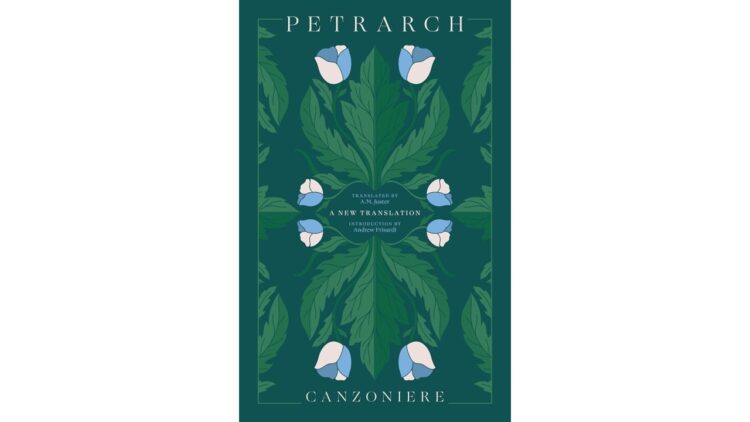
Reviewed Poetry Book: Canzoniere by Petrarch, Translated by A.M. Juster, Liveright (Norton) Publishing, 2026
by Margaret Coats
A.M. Juster, longtime member of the Society of Classical Poets, has completed the only full English translation of Petrarch’s Canzoniere in formal verse corresponding to the Italian original.
Why read it? In reading Petrarch, we read some of the most memorable and most imitated poems of the Western lyric tradition. These poems influenced Chaucer (who may have met Petrarch), Shakespeare, Sidney, Michelangelo, Ariosto, Tasso, Ronsard and the Pléaide, Louise Labé, Vittoria Colonna, Gaspara Stampa, Lope de Vega, Camoes, Longfellow, and perhaps yourself, even without your knowing it. Learn from Juster’s thirty years of work how a contemporary of ours can make an ever-vibrant tradition new.
Petrarch is the first writer anywhere to provide a profound, prolonged, and intimate look at the poet’s self, in relation to the overarching love of his life. He neglects nothing of his emotional or spiritual or moral or political or cultural or creative nature. He moves passionately from youthful energy through the growth and aging of a classic figure in poetry, one seriously engaged with antiquity, who through his own library and companions developed the ideal of studying the humanities. Petrarch is Europe’s prototypical poet laureate. His Laura remains a timeless symbol of beauty and virtue. Love for her transformed the poet as he learned to recognize and clear away obstacles between himself and God.
Petrarch’s Canzoniere of 366 lyrics, exquisitely crafted and carefully arranged, is the origin and model of the Western lyric sequence. Its stylistic virtuosity and considerable variety of tone and topic reveal Petrarch as a cultural innovator of epoch-making proportions.
It could be said that the now-weary modernist rebellion against formal verse ultimately opposes the perfection of Petrarchan fluency. A.M. Juster masterfully conveys that fluency, particularly when he presents Petrarch’s finest poems. It could be said of him, as he has Petrarch say, “I know to wrap my praise in poetry” (Canzoniere 29). The Italian master’s freshness stays fresh in Juster’s English. “My laurel, whose soft shade destroys within my heart all less appealing joys” (23). Note the smooth-spoken complaints: “you who divide me from the human race” (17) and “every ear is deaf but mine” (294). And the contrasts: “This hard and earthly heavy weight on me like snowfall in September melts away” (32). “Replete with sweetness and morality, so near these love nests of such gaiety” (260). Some clear contrasts are meant to be taken as drama in sequence. “I’m consumed by wanting what is right” (163) is followed in the next poem by “My own salvation is a distant goal” (164).
Contemporary wording suits a Petrarch for contemporaries: “Just for her sake I changed identity” (119). Iambic rhythm sustains conversational variations within it: “I don’t see one ray of virtue—which worldwide has burned so low—and no one is ashamed of evil deeds” (53); “What’s up? What do you think? Why keep returning to a time that we cannot restore?” (273). See the full poem below:
Poem 273
What’s up? What do you think? Why keep returning
to a time that we cannot restore?
Dejected soul, why toss the logs once more
upon the very flames where you are burning?
Those gentle words and glances sweetly turning,
which you described and said what each was for,
were snatched from Earth, and since you know the score,
it’s late and ill-timed to pursue such learning.
Ah, don’t let what was killing me progress!
Instead of vague, deceptive thoughts, pursue
one sound, safe one that leads to your success.
Let me seek Heaven if my joy is through,
because I hardly saw that loveliness,
alive or dead, would steal the peace I knew.
Italian Original
Che fai? che pensi? che pur dietro guardi
nel tempo, che tornar non pote omai?
Anima sconsolata, che pur vai
giungnendo legne al foco ove tu ardi?
Le soavi parole e i dolci sguardi
ch’ad un ad un descritti et depinti ài,
son levati de terra; et è, ben sai,
qui ricercarli intempestivo et tardi.
Deh non rinovellar quel che n’ancide
non seguir più penser vago, fallace,
ma saldo et certo, ch’a buon fin ne guide.
Cerchiamo ‘l ciel, se qui nulla ne piace:
ché mal per noi quella beltà si vide,
se viva et morta ne devea tôr pace.
Juster makes excellent (but never excessive) use of countless well-deployed literary devices, as in these monosyllabic lines. “I lose hope more sweet times will come to pass” (124); “May God now smell the stench your life has made” (136). That stinking example comes from the splendid sharpness of a group of three sonnets, ending thus: “But since Hell shields him, may it take you too” (138). Many lines show the master poet’s facility with words by achieving a proverbial quality: “Understanding more would be less sweet” (125); “Surely no rage or scorn is heavenly” (340).
Beginning the book, readers meet a poet-lover unexpectedly forthright and unrefined, compared to the traditional Francesco whom readers of Italian encounter when hearing him in his native language. Juster creates a vivid individual, much in love and often aware his love is misdirected. That’s a dominant theme: “What thrills the world is but a dream too brief” (1). Juster’s Petrarch reveals himself as a lover surrendering to the world, as much as he does to the virtuous beauty Laura, herself capable of overcoming the world. He calls himself “jerk” and “dope” and “wise guy” and often, when things get tough, “bastard.”
These words are shocking—and does indeed alter the mood found in the Italian verse. Juster’s reason is that earlier translators have neglected the full sense of “misero,” a word used over and over by Petrarch. This does not just mean “miserable,” but expresses a responsibility for one’s own miserable condition. “Wretch,” a frequent choice of other translators, also presents the wretched individual as one whose wretchedness is simply his fate, or imposed on him by others. Juster’s Petrarch is a full-blooded man with self-knowledge, and at least on the way to healthy self-evaluation.
The truth of this reading is evident to those thoroughly familiar with the Italian, though Juster’s method of showing it seems edgy. The Italian Petrarch is self-aware but impeccably self-disciplined in language. Juster’s Petrarch, on the other hand, berates himself awkwardly. He uses awkward English enjambment too frequently, though this is to be excused by the needs of translation into rhymed formal verse.
Readers who preserve a fine sense of English will be irritated at Juster’s decision not to use the objective case pronoun “whom” in situations where it would be correct. This is not an error on his part; rather, it is a deliberate choice to conform to current usage he believes will become entirely acceptable. This may be so. However, in special circumstances he allows “whom,” which demonstrates that the word would never be misunderstood by those who don’t use it in conversation. And “whom” by no means looks archaic to readers who can see that Petrarch’s Italian usage is ignored.
Other readers have been disappointed by the slow start of the English sequence. Juster provides eloquent lines throughout, but sonnets satisfying as a whole aren’t there at first. In Italian these early poems introduce the Canzoniere convincingly, with specific kinds of poems once so popular that they came to be expected in love sonnet sequences. Numerous sonneteers met the challenge of an expressive proem, an inventive innamoramento with accompanying descriptions of falling in love from different angles, and a significant discourse on the beloved’s name. These lyric kinds may be frustrating to readers unfamiliar with the tradition. They are admittedly difficult to the translator, who bears the additional weight of staying near the original. Juster declares in his Notes that one at least is “less successful.”
Where are Juster’s masterpiece poems? They appear most prominently among the last hundred of the Canzoniere, where the poet-lover deals with his lady’s death. Here Petrarch expands and exalts his concerns, and a translator naturally follows. Happily for the reader, lyrics in sequence are meant to be independent as well as sequential. Little is lost by starting anywhere, and growing into the whole. In fact, reading mainly selected lyrics may have been the practice of readers and poets encountering the Canzoniere in Petrarch’s time and during the following centuries.
Therefore I offer below a choice of Juster’s best poems (in my opinion) from both sections of the Canzoniere (during Laura’s life and after her death). This list was created for a well-educated reader who pre-ordered the book, began with enthusiasm at the beginning, and stopped reading in disappointment at Poem 25. The list may also serve those less interested in Petrarch than in learning from Juster’s articulate and expressive English. His skill is greatly worth the study.
For those fascinated by Petrarch and his tradition, the book boasts a substantial introduction by Andrew Frisardi. Its thirty pages condense a wealth of information in a reader-friendly approach. The book includes, too, a Glossary of names, things, and concepts to which Petrarch refers, but which the reader may find unfamiliar. Juster’s Notes at the end of the book offer explanations useful in understanding individual poems, with a convenient classification of each poem that is not a sonnet.
The book itself is a handsome hardcover with poems well laid out, but not including the Italian on facing pages or anywhere else. It seems sturdy enough not to fall into pieces with use, as does the 1976 paperback volume of all Petrarch’s lyrics, with translation into English prose by Robert Durling, which is accompanied by the Italian.
All in all, Juster’s translation is a significant and erudite literary achievement, a new chapter in Petrarch translation, an essential read for the lay reader seeking Petrarchan fluency, and ultimately an accessible journey of romantic and spiritual love.
Poems to read first for appreciation of Juster’s finer work:
1 sonnet providing an essential overview
110 sonnet
118 sonnet in iambic tetrameter, one of several anniversary poems
127 a lengthier canzone
133 sonnet
134 sonnet with its own tradition of many imitations
136–138 group of three satiric sonnets
144 sonnet
190 another sonnet with its own long tradition of imitations
196 sonnet
199–201 a three-sonnet sensual fantasy on finding a glove lost by Laura
239 the Laura sestina
245 a May Day sonnet
The second part of the sequence begins at 264
273 sonnet
277 sonnet
282–284 group of three sonnets
299 sonnet
309 sonnet
310 spring sonnet
312 sonnet in iambic tetrameter
313 sonnet
324 a ballata, or popular song equivalent
326 sonnet
332 double sestina
341 sonnet
360 law court canzone, in which the poet files suit against Love
362 destiny sonnet predicting the remaining length of Petrarch’s life
Margaret Coats lives in California. She holds a Ph.D. in English and American Literature and Language from Harvard University. She has retired from a career of teaching literature, languages, and writing that included considerable work in homeschooling for her own family and others.


















Nice work, especially since it’s quite a job to keep rhyme in the ad quem version. I have never forgotten one of Petrarch’s famous lines : “Mille piaceri non valgono un tormento” and always unsheathe it when someone criticises Sophocles’ (et al.) famous quote about best never having lived at all.
Thanks, Eugenio. Juster’s translation is indeed such a nice job it’s never been done before. I too have a favorite Petrarch phrase (from the canzone “Italia mia”): “vertu contra furore”! Manhood against fury! The maestro goes on to identify fury with hatred, anger, and disdain, hoping that the better lords of a divided Italy set themselves to labor for her peace.
Yes, that dreadful furore that exiled Dante from Florence.