• Submit Poetry
  • Support SCP
  • About Us
  • Members
  • Join
Tuesday, May 12, 2026
Society of Classical Poets
  • Poems
    • Beauty
    • Culture
    • Satire
    • Humor
    • Children’s
    • Art
    • Ekphrastic
    • Epic
    • Epigrams and Proverbs
    • Human Rights in China
    • Music
    • Performing Arts
    • Riddles
    • Science
    • Song Lyrics
    • The Environment
    • The Raven
    • Found Poems
    • High School Poets
    • Terrorism
    • Covid-19
  • Poetry Forms
    • Sonnet
    • Haiku
    • Limerick
    • Villanelle
    • Rondeau
    • Pantoum
    • Sestina
    • Triolet
    • Acrostic
    • Alexandroid
    • Alliterative
    • Blank Verse
    • Chant Royal
    • Clerihew
    • Rhupunt
    • Rondeau Redoublé
    • Rondel
    • Rubaiyat
    • Sapphic Verse
    • Shape Poems
    • Terza Rima
  • Great Poets
    • Geoffrey Chaucer
    • Emily Dickinson
    • Homer
    • Henry Wadsworth Longfellow
    • Dante Alighieri
    • John Keats
    • John Milton
    • Edgar Allan Poe
    • William Shakespeare
    • William Wordsworth
    • William Blake
    • Robert Frost
  • Love Poems
  • Contests
  • SCP Academy
    • Educational
    • Teaching Classical Poetry—A Guide for Educators
    • Poetry Forms
    • The SCP Journal
    • Books
No Result
View All Result
Society of Classical Poets
  • Poems
    • Beauty
    • Culture
    • Satire
    • Humor
    • Children’s
    • Art
    • Ekphrastic
    • Epic
    • Epigrams and Proverbs
    • Human Rights in China
    • Music
    • Performing Arts
    • Riddles
    • Science
    • Song Lyrics
    • The Environment
    • The Raven
    • Found Poems
    • High School Poets
    • Terrorism
    • Covid-19
  • Poetry Forms
    • Sonnet
    • Haiku
    • Limerick
    • Villanelle
    • Rondeau
    • Pantoum
    • Sestina
    • Triolet
    • Acrostic
    • Alexandroid
    • Alliterative
    • Blank Verse
    • Chant Royal
    • Clerihew
    • Rhupunt
    • Rondeau Redoublé
    • Rondel
    • Rubaiyat
    • Sapphic Verse
    • Shape Poems
    • Terza Rima
  • Great Poets
    • Geoffrey Chaucer
    • Emily Dickinson
    • Homer
    • Henry Wadsworth Longfellow
    • Dante Alighieri
    • John Keats
    • John Milton
    • Edgar Allan Poe
    • William Shakespeare
    • William Wordsworth
    • William Blake
    • Robert Frost
  • Love Poems
  • Contests
  • SCP Academy
    • Educational
    • Teaching Classical Poetry—A Guide for Educators
    • Poetry Forms
    • The SCP Journal
    • Books
No Result
View All Result
Society of Classical Poets
No Result
View All Result
Home Music

‘Pythagoras, Man of Music’ and Other Poetry on Music, by Cheryl Corey

December 1, 2023
in Music, Poetry
A A
15
poems 'Pythagoras, Man of Music' and Other Poetry on Music, by Cheryl Corey

.

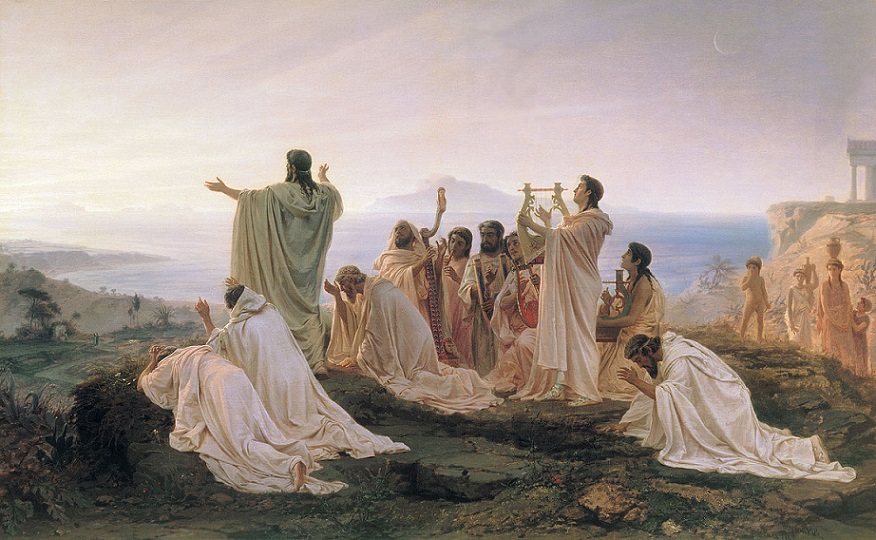
Pythagoras, Man of Music

Pythagoras was of mathematical mind.
No matter where he went, he’d often find
Relationships to numbers. For example,
The clangorous peal of blacksmith hammers’ metal
On metal gave him cause to train his ear.
That different weights made different tones was clear.

He tested weighted strings of equal tension,
And soon discovered proof of correlation
Between the different lengths and sounds produced;
Results of which, he logically deduced,
Were ratios. Having solved a probing query,
By happy chance he furthered music theory!

.

.

The Musical Scale

Before Beethoven tickled the ivories,
Then wrote the Fifth and other symphonies;
Before Mozart ever scrawled a note
From chords and keys he learned by ear and rote;
Before there was a Brahm’s lullaby,
Tchaikovsky’s Suite, or Handel his Messiah;
Orchestral scores and movements operatic
As written by composers, most Germanic;
Who gave us classical music, so refined,
Which to this day appeals to humankind;

A Christian Benedictine monk, whose name
Was Guido d’Arezzo, thought about a hymn
To John the Baptist by scholar Paul the Deacon,
Which syllables were like a shining beacon;
Where each successive tone, in rising steps,
Agreed as well with seven holy concepts.
The most important, being Dominus,
For Lord, begins the scale with “Do”; thus
Began the art of musical notation,
Thanks to Guido’s ear for solmization!

.

Poet’s Note: In the early Middle Ages, around 1025 A.D., Guido d’Arezzo used opening syllables of the “Ut Queant Laxis” hymn to create a system for reading music. The hymn’s first stanza reads:

Ut queant laxis
Resonare fibris
Mira gestorum
Famuli tuorum
Solve polluti
Labii reatum
Sancte Iohannes

The seven concepts are: dоminus, rerum, miraculum, familias, solis, lacteal via, and siderae. In the 17th century, “Ut” became “Do”. Around 1827, “Si” was changed to “Ti” by English music educator Sarah Glover so that each syllable would begin with a different letter.  While d’Arezzo didn’t invent notation per se (attempts date back to Mesopotamia, the ancient Greeks, and even Indian Sanskrit), he’s considered the founder of the modern musical staff, which led to the emergence of classical music.

.

.

Cheryl Corey is a poet who lives in Connecticut. “Three Sisters”, her trio of poems about the sisters of Fate which were first published by the Society of Classical Poets, are featured in “Gods and Monsters”, an anthology of mythological poems (MacMillan Children’s Books, 2023).

ShareTweetPin
The Society of Classical Poets does not endorse any views expressed in individual poems or commentary.
Read Our Comments Policy Here

RandomPoems

Humorous Poetry by Don Shook
Humor

Humorous Poetry by Don Shook

November 21, 2013

I Think Therefore “I think,” said Descartes, “and therefore I am.” declared many years ago, way before spam. It predated...

‘The End of the Party’ and Other Poetry by Damian Robin
Beauty

Haiku by Evan Mantyk

January 3, 2014

  The Persecution of Falun Gong I. Meditating group One clear crisp day at Shanghai In earth’s sunny loop II....

Next Post
‘Tampering with Permanence’: A Seattle Pantoum by Alison Jennings

'Tampering with Permanence': A Seattle Pantoum by Alison Jennings

‘Insouciance’ and Other Poetry by C.B. Anderson

'Insouciance' and Other Poetry by C.B. Anderson

‘Lee in the Furnace’: A Poem on Robert E. Lee by Monika Cooper

'Lee in the Furnace': A Poem on Robert E. Lee by Monika Cooper

Comments 15

  1. Paul Erlandson says:
    2 years ago

    I LOVE the Pythagoras poem, Cheryl!

    Any time you can bring together and harmonize Physics, Math, and Music … that’s a winning combination!

    Reply
    • Cheryl Corey says:
      2 years ago

      Thank you, Paul. The inspiration for the poems began with my reading of music-related poetry here at SCP. For some oddball reason I began to wonder who “invented” the scale, sheet music, etc., and so began the research which led me to learn about Guido d’Arezzo. I stumbled upon Pythagoras as I’m currently reading up on ancient Greece (d’Arezzo was familiar with the work of Pythagoras), and I wanted to write a second poem to accompany the one about d’Arezzo.

      Reply
  2. Roy Eugene Peterson says:
    2 years ago

    As a singer, I have so often thought of do, re, mi…yet never realized how that came to be. This is such a wonderful set of poems to explain how we got here musically. Pythagoras of all persons began the process. Your poems are a treasure.

    Reply
    • Cheryl Corery says:
      2 years ago

      Whether Pythagoras began the process or not, I don’t know; but I’m always fascinated by those individuals who have the lightbulb moments which result in huge leaps forward for civilization.

      Reply
  3. Julian D. Woodruff says:
    2 years ago

    Thank you for this pair, Cheryl. The seven concepts, in association with Guido, are new to me. The connection between “ut”and “dominus” must be related to a lack of words beginning with u-t … Dominus, being “primus” is a convenient replacement, almost as if foreordained.
    As an aside, there is a MacDonald’s on I-680 north of San Jose with a Guidonian hand painted on the wall.

    Reply
    • Cheryl Corery says:
      2 years ago

      As I understand it, the early Christian monks were very instrumental in the progression of our music.

      Reply
      • Julian D. Woodruff says:
        2 years ago

        They were indeed, and not only monks (singing, adapting, and writing chants for the Mass and Divine Office, eventually composing polyphony as well, and also active as theorists), but also other Church figures, many of them prominent, viz. Pope Gregory I, Isidore of Seville, Herman the Lame, Hildegard of Bingen et al.

        Reply
  4. Philip L Flott says:
    2 years ago

    Pythagoras is so musical.

    Reply
    • Cheryl Corey says:
      2 years ago

      He had very keen powers of observation and a good ear!

      Reply
  5. Rohini says:
    2 years ago

    I enjoyed both and learnt much, thank you for these two delightful poems

    Reply
    • Cheryl Corey says:
      2 years ago

      I’m glad you like them.

      Reply
  6. Mary Gardner says:
    2 years ago

    Cheryl, thank you for these uplifting and educational poems. Through them I appreciate both men more than ever.

    Reply
    • Cheryl Corery says:
      2 years ago

      There are a great many men (and women) who throughout history have contributed so much, yet whom we appreciate too little!

      Reply
  7. Margaret Coats says:
    2 years ago

    How wondrous is the musical scale, and the great variety of information conveyed by a score in modern notation! Certainly worthy of your poem considering how classical composition depends on it. I still rely on my ear for melody and resist solmization, but the map of the staff helps me listen to other voices and refine my own part. Good memorials to Pythagoras and Guido, Cheryl, and like Julian, I thank you for noticing Guido’s seven concepts.

    Reply
  8. Ds says:
    2 years ago

    As the “Man of Music,” Pythagoras saw the world through the lens of harmony and balance. He believed that music, like mathematics, revealed the underlying order of the universe, providing a pathway to understanding both the cosmos and the human soul. His legacy lives on in the melodies that continue to move and inspire us, reminding us of the profound connection between music and the human experience.

    Reply

Leave a Reply Cancel reply

Your email address will not be published. Required fields are marked *

  1. Susan Jarvis Bryant on ‘Spontaneous Conjugal Combustion’ and Other Poems by Susan Jarvis BryantMay 12, 2026

    Joe, I love your interpretation - as far as I'm concerned" a gold-digging young gigolo who attaches himself to a…

  2. Roy Eugene Peterson on National Poetry Month Limerick ChallengeMay 12, 2026

    Urszula, what an imaginative limerick! That is something Poe might have done! Sorry to be so late seeing this.

  3. Roy Eugene Peterson on National Poetry Month Limerick ChallengeMay 12, 2026

    Agreed, Urszula! Thank you for commenting.

  4. Joseph S. Salemi on ‘Spontaneous Conjugal Combustion’ and Other Poems by Susan Jarvis BryantMay 12, 2026

    When I was in the U.K. I heard that "poodle" could mean a henpecked or subservient husband, and by extension…

  5. Susan Jarvis Bryant on ‘Spontaneous Conjugal Combustion’ and Other Poems by Susan Jarvis BryantMay 12, 2026

    Yael, it's always lovely to hear from you. I'm thrilled you enjoyed the poems. I did have people in mind…

Subscribe to Daily Poems

Enter your email address to subscribe to this blog and receive notifications of new posts by email.

Join 1,593 other subscribers

Recent Poems

  • A Poem on Coach “Black Mike” Castronis from Athens Y Camp, by Alec Ream
  • A Poem on the Zambian National Park Mosi-oa-Tunya, by Paul A. Freeman
  • ‘Creation of Mom’: A Mother’s Day Poem by Roy E. Peterson
  • ‘Spontaneous Conjugal Combustion’ and Other Poems by Susan Jarvis Bryant
  • ‘The Man in the Moon Was a Very Round Man’: A Poem by Lauren V. Leon
  • ‘Fibromytrauma’: A Poem by Golan Shahar
  • ‘A Lonely Sliver’: A Poem by Katie Tencza
  • ‘Higher Gas Prices Are a Small Price to Pay’: An Iran War Poem by Mark F. Stone
  • ‘Always Ahead’: A Poem by Scharlie Meeuws
  • ‘Hamlet’s Lawyer’ and Other Poetry by Brian Yapko
  • ‘On An Old Photograph’: A Poem by Joseph S. Salemi
  • ‘Faust Foresees His End’: A Poem by Martin Briggs
  • ‘À la Carte’ and Other Poetry by C.B. Anderson
  • ‘Where the Sweet Bluebonnets Bloom’: A Poem by Roy E. Peterson
  • ‘The Waters’: A Poem by Margaret Brinton
  • ‘The Pinnacle of Poetry’ and Other Poems by Russel Winick
  • The First American Sonnets: An Essay on David Humphreys, by Margaret Coats
  • ‘The Holy Rollers on Poetry’: A Poem by Joseph S. Salemi
  • Sappho’s ‘Poem 1’ Translated by Bruce Phenix
  • ‘The Cautionary Tale of Phone Addicted Mimi’: A Poem by Paul A. Freeman
  • ‘Look Away’: A Poem for America’s 250th Anniversary, by Roger Crane
  • ‘Sunday Morning in Canada’: A Poem by Jeffrey Essmann
  • ‘Bean’: A Poem by Jan Mennite
  • ‘The Swan’s Song ’: A Poem for Shakespeare’s Birthday, by Susan Jarvis Bryant
  • ‘The Gravedigger’: A Poem by Marie Burdett
  • ‘Waiting for the Perfect Man’: A Poem by Janice Canerdy
  • ‘The George-A-Saurus’ and Other Poetry by Brian Yapko
  • ‘When Asked: What’s Your Favorite Season?’: A Poem by Paul Millan  
  • ‘The Last At-Bat of Lyndon Braun’: A Poem by Michael Pietrack
  • ‘The Perpetual Battle’ and Other Poetry by Adam Sedia

Categories

  • Acrostic
  • Alexandroid
  • Alliterative
  • Art
  • Best Poems
  • Blank Verse
  • Chant Royal
  • Classical Poets Live
  • Clerihew
  • Covid-19
  • Deconstructing Communism
  • Educational
  • Epic
  • Epigrams and Proverbs
  • Essays
    • Interviews with Poets
    • Poetry Reviews
  • Featured
  • From the Society
  • Great Poets
    • Dante Alighieri
    • Edgar Allan Poe
    • Emily Dickinson
    • Geoffrey Chaucer
    • Henry Wadsworth Longfellow
    • Homer
    • John Keats
    • John Milton
    • Robert Frost
    • William Blake
    • William Shakespeare
    • William Wordsworth
  • Human Rights in China
  • Limerick
  • Love Poems
  • Music
  • Pantoum
  • Performing Arts
  • Poetry
    • Beauty
    • Children's Poems
    • Culture
    • Ekphrastic
    • Found Poems
    • High School Poets
    • Humor
    • Riddles
  • Poetry Challenge
  • Poetry Contests
  • Poetry Forms
    • Curtal Sonnet
    • Haiku
  • Poetry Readings
  • Rhupunt
  • Rondeau
  • Rondeau Redoublé
  • Rondel
  • Rubaiyat
  • Sapphic Verse
  • Satire
  • Science
  • Sestina
  • Shape Poems
  • Short Stories
  • Song Lyrics
  • Sonnet
  • Symposium
  • Terrorism
  • Terza Rima
  • The Environment
  • Translation
  • Triolet
  • Video
  • Villanelle

Quick Links

  • About Us
  • Submit Poetry
  • Become a Member
  • Members List
  • Support the Society
  • Advertisement Placement
  • Comments Policy
  • Terms of Use

Welcome Back!

Login to your account below

Forgotten Password?

Retrieve your password

Please enter your username or email address to reset your password.

Log In
No Result
View All Result
  • Poems
    • Beauty
    • Culture
    • Satire
    • Humor
    • Children’s
    • Art
    • Ekphrastic
    • Epic
    • Epigrams and Proverbs
    • Human Rights in China
    • Music
    • Performing Arts
    • Riddles
    • Science
    • Song Lyrics
    • The Environment
    • The Raven
    • Found Poems
    • High School Poets
    • Terrorism
    • Covid-19
  • Poetry Forms
    • Sonnet
    • Haiku
    • Limerick
    • Villanelle
    • Rondeau
    • Pantoum
    • Sestina
    • Triolet
    • Acrostic
    • Alexandroid
    • Alliterative
    • Blank Verse
    • Chant Royal
    • Clerihew
    • Rhupunt
    • Rondeau Redoublé
    • Rondel
    • Rubaiyat
    • Sapphic Verse
    • Shape Poems
    • Terza Rima
  • Great Poets
    • Geoffrey Chaucer
    • Emily Dickinson
    • Homer
    • Henry Wadsworth Longfellow
    • Dante Alighieri
    • John Keats
    • John Milton
    • Edgar Allan Poe
    • William Shakespeare
    • William Wordsworth
    • William Blake
    • Robert Frost
  • Love Poems
  • Contests
  • SCP Academy
    • Educational
    • Teaching Classical Poetry—A Guide for Educators
    • Poetry Forms
    • The SCP Journal
    • Books

© 2025 SCP. WebDesign by CODEC Prime.