


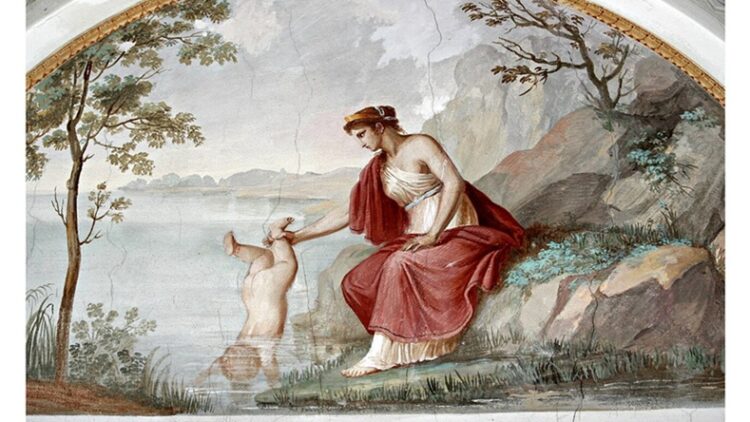
Faux Pas
after Don Paterson
When I decanted red, not white, and she called me a fool
I bit my tongue, remembering that bird from Liverpool
who kept her infant near the cooker while a cauldron boiled
for sanitising nappies that the darling child had soiled
and how the wine chat on the telly must have turned her head
and caused her to immerse not laundry but the babe instead.
Sobriety Test, for All Ages
“Say when,” she said, while pouring whisky from
A bottle filled in Scotland. I, pretending
Not to have heard her speak, remained as dumb
As stone, reluctant to effect an ending
To generosity that seemed near boundless.
She filled my beaker almost to the top
And smiled as if to say my doubts were groundless,
Then frowned as though unable to estop
Indifference she’d affected earlier.
I did some sipping, loath to risk a spill,
And noticed that her hair seemed curlier
Than it had been before. By force of will,
I set the beaker down and summoned talents
I hadn’t used in more than twenty years,
For, after all, the night hung in the balance—
I did my best to quell her latent fears.
The curling hair, I thought, was just a sign
That she was frightened by the sudden dawn
Of cognizance, and I contrived benign
Supports for her to lean her feelings on.
Quite soon, I guessed I’d turned her heart, and so
Unloosed my own upon the perfect weather
Her fresh approach ordained, and let her know
That consummation is the vital tether
Connecting young desire with what can be.
But I’d guessed wrong. She told me I should drain
My cup and find another fantasy,
Go home and rest my old befuddled brain.
C.B. Anderson was the longtime gardener for the PBS television series, The Victory Garden. Hundreds of his poems have appeared in scores of print and electronic journals out of North America, Great Britain, Ireland, Austria, Australia and India. His collection, Mortal Soup and the Blue Yonder was published in 2013 by White Violet Press.









These are wonderfully raucous tales of humor and intrigue that are extraordinarily delightful and stimulate the imagination. Then to place the first in Liverpool, of all things! Slight inebriation certainly can affect the senses and stimulate the thought process, not to mention temptations that can change introverted thinking to extroverted efforts. The ending, of course, came as a surprise in the last verse.
I thank you for your thoughts, Roy. That bird from Liverpool was just a memory of a news report. Isn’t the lack of inhibition due to inebriation what they call Dutch courage? I’m glad the ending was a surprise to you; some readers saw it coming.
Two such clever poems and so well expressed. Droll is a word that comes
to my mind.
I’ll gladly accept “droll,” jd. Anything but “dull.”
Your old, befuddled brain still seems be functioning in tip-top condition.
A wince for the end of one poem, a guffaw (autocorrect wants ‘buffalo’) for the other.
Writing verse, Paul, is something like riding a bicycle — you can’t unlearn how to do it. I’m glad you had your buffalo.
“Faux Pas” is very cute, and shows that heptameters can be written without sounding like the dull clip-clop of a horse.
“Sobriety Test…” illustrates the truth that you shouldn’t try seducing a younger woman when you’re past the age of 50, unless you happen to be very wealthy. Even then, let her do the heavy drinking.
Solid work as usual, Kip.
The best thing, Joseph, that one can say about heptameters is that they are not as awkward as octometers. In regard to what you wrote about seduction, I would add: Unless you’re Al Pacino. Furthermore, it is better to be rich and unhappy than it is to be poor und unhappy.
I really enjoyed Faux Pas, especially when I saw my birth city mentioned. But I do hope it is not a true story. Sobriety Test for All Ages is very funny.
It could have been Manchester, Norma, or even Newcastle, but I needed a rhyme. I made the story up, and I don’t know whether something like that ever happened. It was a response to this poem:
https://frombooksofpoems.blogspot.com/2007/03/gift-by-don-paterson.html
Bear in mind that as originally published in The New Republic it was formatted as three heptameter couplets. It is altered here (and elsewhere) because heptameter lines are too wide for some pages.
I figured, if he’s going after Alaska, then I’ll go after Great Britain.
If you thought the second poem was funny, then it was funny.
“Faux Pas” is a brilliant allegory for our human tendency to catastrophize trivial issues, while ignoring crises. It reminded me of Aesop’s Fable of “The Mountain in Labor.”
I won’t make that mistake again, David. I didn’t know the poem was what you said it is, and it wouldn’t have mattered even if I had known.
As regards boiling babies (Swift, in A Modest Proposal, prefers them baked or roasted) Azucena in Il Trovatore makes a similar error, confusing her own child in one hand with the son of her arch-enemy in the other, without, as I recall, the excuse of inebriation.
Killing children is a motif that runs through much Western literature, from the Medea story to the Atreus and Thyestes dispute to Tantalus to Macbeth. Even in the bible Jehovah orders the mass murder of infants when certain cities or peoples are conquered.
Some fairy tales (Hansel and Gretel) involve witches who want to fatten up kids for eating, or ogres who kill their own children by accident when trying to kill other kids to add fresh meat to their larder. Many of such stories were useful for scaring kids, and keeping them in line.
That is funny, Mike. And sobriety isn’t all it’s cracked up to be.
Kip, I always marvel at the wry, strikingly understated tone of your poems and wonder how you manage to keep a straight face when writing them. You do not present humanity at its best, but you are honest and offer the truth — warts and all. There are parents who are not so great at parenting. And there are suitors who should really think twice about age and experience compatability.
You are also a master of enjambment which certainly can make a poem seem conversational, but also has the potential to give a poem a certain manic quality, as if the thoughts cannot be contained in sentences or stanzas but must use all the space available. I hope that doesn’t sound like a criticism, because it’s not — it’s a quality I treasure in your work and it is a technique few poets can handle as effectively as you. I have tried to write this way once or twice and found it extremely difficult. You make the nigh-impossible look easy.
I’ve always liked wry bread, Brian, especially with carry-away seeds. Persons like you and me cannot help but be true to ourselves, because otherwise we have nothing. I don’t want to examine my methods and quirks too closely, lest I cripple the goose. As far as enjambment goes, as far as I can tell the whole goddamned world is enjambed. Who am I to dispute that?
“Faux pas” is an interesting juxtaposition of consequences of seemingly small lapses, all tied together by wine. “Sobriety Test” gives us an extended inner narrative with a humorous and edifying twist at the end. A wonderful pairing of wine and whiskey.
The only thing better, Adam, is good whisky finished in old wine casks.
Glenmorangie or Glenallachie, so I’ve heard, though I prefer the wine itself to its flavor imparted. You’ve winely flavored these works, C. B.
I hold nothing against wine, Margaret. I like a chill vinho verde with seafood and other light dishes, and I love a robust red with red meat or anything marinara. At least a decade ago I bought a pricey (for that time) Glenmorangie finished in Fino Sherry casks. It was wonderful. Glenallachie is hard to come by, and I’ve tasted it only twice in my life. I haven’t had any Teaninich in at least a decade.
C.B., your poems have turned my head and I’m now interested in the poet you have given a nod to. I must check Don Paterson out. I am a fan of poetry from the North of the UK – that Tony Harrison sharp-eyed, gritty wit. “Faux Pas” is dark and unsettling with a warped humor that makes me feel guilty for laughing – a tough combination to pull off. I especially like “Sobriety Test, for All Ages” – what a great title! The conversational feel and the speaker’s self-delusion is revealed cleanly without overt moralizing. I love the curls getting curlier after swilling that brimming elixir. Oh, how life looks so much better with a medicinal sip of sauce. Excellent stuff!
As for Don Paterson, Susan, check out the link I provided after Norma’s comment, for starters. As for the rest, always keep in mind A.E. Housman’s famous 4-liner:
Oh, many a peer of England brews
Livelier liquor than the Muse,
And malt does more than Milton can
To justify God’s ways to man.
Never quit self-medicating.
Susan, about the poet Don Paterson: he’s the guy who gave the very best definition of what a poem is, bar none. He said “A poem is just a little machine for remembering itself.” That is the purest and most concise statement of aestheticism and art for art’s sake that I have ever read.
I liked that, Joseph, and I agree completely. Paterson lives up to what he claims. It was reading his poem (as referred to above) that first got me started on this crazy venture.
C.B., I like the Housman 4-liner – I have a strong suspicion this cheery little ditty fueled some of Dylan Thomas’s finest works.
And Joe, you are right! Don Paterson’s definition of what a poem is, is the “purest and most concise statement of aestheticism and art for art’s sake” – thank you for sharing it.
The comments threads on the SCP have sent me on some wonderful journeys, and I’m thoroughly enjoying the Don Paterson trip.
I do not know, Susan, whether DT preferred Irish whiskey or Scotch whisky. Either way, he was well informed.