• Submit Poetry
  • Support SCP
  • About Us
  • Members
  • Join
Tuesday, May 12, 2026
Society of Classical Poets
  • Poems
    • Beauty
    • Culture
    • Satire
    • Humor
    • Children’s
    • Art
    • Ekphrastic
    • Epic
    • Epigrams and Proverbs
    • Human Rights in China
    • Music
    • Performing Arts
    • Riddles
    • Science
    • Song Lyrics
    • The Environment
    • The Raven
    • Found Poems
    • High School Poets
    • Terrorism
    • Covid-19
  • Poetry Forms
    • Sonnet
    • Haiku
    • Limerick
    • Villanelle
    • Rondeau
    • Pantoum
    • Sestina
    • Triolet
    • Acrostic
    • Alexandroid
    • Alliterative
    • Blank Verse
    • Chant Royal
    • Clerihew
    • Rhupunt
    • Rondeau Redoublé
    • Rondel
    • Rubaiyat
    • Sapphic Verse
    • Shape Poems
    • Terza Rima
  • Great Poets
    • Geoffrey Chaucer
    • Emily Dickinson
    • Homer
    • Henry Wadsworth Longfellow
    • Dante Alighieri
    • John Keats
    • John Milton
    • Edgar Allan Poe
    • William Shakespeare
    • William Wordsworth
    • William Blake
    • Robert Frost
  • Love Poems
  • Contests
  • SCP Academy
    • Educational
    • Teaching Classical Poetry—A Guide for Educators
    • Poetry Forms
    • The SCP Journal
    • Books
No Result
View All Result
Society of Classical Poets
  • Poems
    • Beauty
    • Culture
    • Satire
    • Humor
    • Children’s
    • Art
    • Ekphrastic
    • Epic
    • Epigrams and Proverbs
    • Human Rights in China
    • Music
    • Performing Arts
    • Riddles
    • Science
    • Song Lyrics
    • The Environment
    • The Raven
    • Found Poems
    • High School Poets
    • Terrorism
    • Covid-19
  • Poetry Forms
    • Sonnet
    • Haiku
    • Limerick
    • Villanelle
    • Rondeau
    • Pantoum
    • Sestina
    • Triolet
    • Acrostic
    • Alexandroid
    • Alliterative
    • Blank Verse
    • Chant Royal
    • Clerihew
    • Rhupunt
    • Rondeau Redoublé
    • Rondel
    • Rubaiyat
    • Sapphic Verse
    • Shape Poems
    • Terza Rima
  • Great Poets
    • Geoffrey Chaucer
    • Emily Dickinson
    • Homer
    • Henry Wadsworth Longfellow
    • Dante Alighieri
    • John Keats
    • John Milton
    • Edgar Allan Poe
    • William Shakespeare
    • William Wordsworth
    • William Blake
    • Robert Frost
  • Love Poems
  • Contests
  • SCP Academy
    • Educational
    • Teaching Classical Poetry—A Guide for Educators
    • Poetry Forms
    • The SCP Journal
    • Books
No Result
View All Result
Society of Classical Poets
No Result
View All Result
Home Poetry Beauty

‘Quasimodo’ by Theresa Rodriguez

November 12, 2019
in Beauty, Culture, Poetry
A A
12
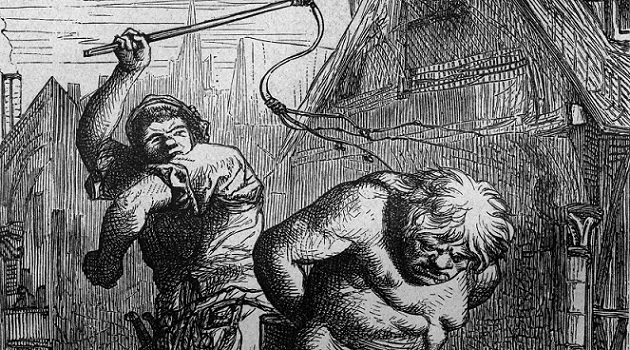
UNSPECIFIED - FEBRUARY 06:  Quasimodo is flogged, engraving by Von perrichon, illustration for book "Notre-Dame de Paris" by Victor Hugo, 1877  (Photo by Apic/Getty Images)

UNSPECIFIED - FEBRUARY 06: Quasimodo is flogged, engraving by Von perrichon, illustration for book "Notre-Dame de Paris" by Victor Hugo, 1877 (Photo by Apic/Getty Images)

“Look not on the face, young girl, look at the heart.”

—Quasimodo, The Hunchback of Notre Dame

A vile, lumbering mass, so hideous,
Rejected and despised by every eye
That fears and is repulsed by odious
Perversions of our kind. You horrify
And shock the average sensibility
For which all imperfection is rejected
And avoided. You are ugliness,
A limping lump of flesh. How you are affected
By the body of your wretchedness!

But souls, come look beyond the skin
And see a difference from within the heart!
Quasimodo, you are kind within
Your stricken, broken body. Counterpart
To your condition is this rarity
Of spirit and mind. Embodiment of good,
Self-sacrifice, compassion—for the love
That gives all from a place of charity
In spite of every pain is understood
To form within as well as from above.

It only took a single, cooling cup
Of water, but you drank with thankfulness;
And as La Esmeralda lifted up
Your sorry head, you looked with gratefulness
To one who chose a good deed on the day.
Oh, how this changed your lonely, saddened state
To gratitude and love from emptiness—
For now you loved her. Banished and away
All forms of mockery—a better fate
Because your form was touched by loveliness.

And then what? In her time of utmost need
You aided her. You rescued her, you saved
Her, sheltered her, protected her. Indeed
You gave back hundredfold for what she braved
In giving you that drink. But all in vain;
The gallows waited for her neck. You tried
To keep her from her date with hungry death
But all for naught. For you could not obtain
Her liberty. You watched her as she died,
And let a howl out with woeful breath.

You cried and no one heard your bitter groans,
But ’round your love were found your noble bones!


Theresa Rodriguez is the author of Jesus and Eros: Sonnets, Poems and Songs, a chapbook of thirty-seven sonnets, and Longer Thoughts (Shanti Arts, 2020). She is a retired classical singer and voice teacher who has written for Classical Singer magazine. She recently released an album entitled Lullabies: Traditional American and International Songs which is available on all streaming services.


 

ShareTweetPin
The Society of Classical Poets does not endorse any views expressed in individual poems or commentary.
Read Our Comments Policy Here

RandomPoems

‘The Teacher to His Students’ and Other Poetry by David Galef
Beauty

‘The Teacher to His Students’ and Other Poetry by David Galef

July 30, 2019

  The Teacher to His Students The traffic light turns green. Your car won’t budge. You’re either texting or completely...

‘Ode to Hidden Splendor’ and Other Poetry by Susan Jarvis Bryant
Beauty

‘Ode to Hidden Splendor’ and Other Poetry by Susan Jarvis Bryant

March 29, 2021

. Ode to Hidden Splendor I heard your rolling croon beyond my vision Blooming in the balm of winter’s breeze--- A thrilling spill of crystalline precision Amid the Spanish moss draped...

Next Post
Write a Poem on One of These Hong Kong Protest Images

Write a Poem on One of These Hong Kong Protest Images

poem/graham/culture

'Moloch' and Other Poetry by Richard Jordan

‘Still Going’ and Other Acrostic Poems by Anna J. Arredondo

'Still Going' and Other Acrostic Poems by Anna J. Arredondo

Comments 12

  1. Theresa Rodriguez says:
    7 years ago

    Thank you Evan, for the excellent illustration to go with the poem. I was inspired to write this ode to Quasimodo after the Notre Dame Cathedral fire in the spring. The novel is one of my favorite books of all time!

    Reply
  2. Leo Zoutewelle says:
    7 years ago

    Beautiful, Theresa! Thank you.
    Leo

    Reply
    • Theresa Rodriguez says:
      7 years ago

      You are very welcome Leo, I’m glad you liked it!

      Reply
  3. James Sale says:
    7 years ago

    Very beautiful, yes, thank you, Theresa.

    Reply
    • Theresa Rodriguez says:
      7 years ago

      You’re welcome James, so glad you liked it!

      Reply
  4. Paul Oratofsky says:
    7 years ago

    What’s odd about this is that it’s a text about other text. Or it’s a text about how the writer is affected by other text, as opposed to about [real] life.

    Of the richness of life and nature, I’m just wondering how deep[ly] you can go when a piece of writing is about the emotions triggered by another piece of writing. That stage (arena) would be limited to and by the imagination, and I’m not sure how much room there is for real discovery. So the arena here is more mind than heart, or if it’s heart, it’s the heart that’s conjured up by the mind. Not that feelings about fiction aren’t real, but they’re real once or twice removed from reality.

    I’ve seen excellent work by you, Theresa, and I’m just looking for [wondering] why this doesn’t meet up to it.

    And you may also say that this post therefore is a piece of text about text that’s about text. And if you comment on this comment, it will be text about text about text about text. And so on.

    Reply
    • Joseph S. Salemi says:
      7 years ago

      Many literary works are about other earlier literary texts. There is even a cliche about the phenomenon in contemporary criticism — the thing is called “intertextuality.” Virgil’s Aeneid is clearly a deliberate riff on Homer’s Iliad and Odyssey; Milton’s Paradise Lost does the same with the Book of Genesis; and God only knows how many writers have used Conan Doyle’s Sherlock Holmes as a character in their own independent works.

      Your dichotomy of “mind” and “heart” is not useful, and betrays an Romantic mindset. Literature is the creation primarily of intelligence, wit, verbal fluency, and rhetorical tropes and figures. Everybody has “heart.” Only the gifted few have the other things.

      Reply
  5. James Sale says:
    7 years ago

    Hi Paul, whilst it is true that Theresa may have written better poems, and my review of two of her books on SCP is due this month, so see that for more, yet your other point is, I think, contentious; for we can empathise and identify with fictional characters in the same way we can with real ones. Indeed, in one sense dead historical characters are like fictional characters in that they are not physically present. But if I take Odysseus or Prospero, or seek to respond to the marvellous Abdiel in Book 5 of Paradise Lost, I find my emotions aflame. Yet … yet … I take your point: there is really nobody quite as inspiring as my real wife! Suffice to say, then, I think Theresa’s methodology sound, though it may not appeal to everyone in the way writing about a ‘real’ person might.

    Reply
  6. James A. Tweedie says:
    7 years ago

    Paul, Your comment is a miasmal mix of sense and nonsense that I found most amusing. I immediately thought of Samuel Time or Coleridge’s opium-induced poem, Kubla Khan, a clearly imaginative, fantasy involving a historical character. Does Kahn, being historical, provide a more legitimate basis for an empathetic poem than Quasimodo? Is a portrait of Aristotle to be considered more authentic and legitimate than one depicting Hamlet holding the skull of “poor Yorick” or the Fall of Icarus? Is the “Rime of the Ancient Mariner” less of a poem than the “Charge of the Light Brigade” because one involves real people and one does not?

    The emotions and issues related to our common humanity that Theresa explores so movingly in her poem re Esmeralda and the “Hunchback of Norte Dame” are every bit as “real” and “true” as one might find in an equally inspired attempt to write a poem based on what Marie Antoinette may have been feeling as she mounted the scaffold and placed her head beneath the blade—a poem whose subject matter would interest me far less than that ofTheresa’s. Thanks for the smile.

    Reply
  7. C.B. Anderson says:
    7 years ago

    Well said, James (and the same to the other James, above). All writing is a commentary on one thing or another, and no matter how far removed from the original figure or how ekphrastic the work might be, the important thing is the feeling it evokes in the reader. But I DO wish that Theresa would quit trying to rhyme “-ness” with “-ness.” I’ve tried to explain, several times, on this site why the practice is a bad one, but it seems that no one has paid much attention. To reiterate, its like trying to rhyme “-ly” with “-ly,” where the prior syllables do not rhyme at all. For example, “comely” rhymes with “dumbly,” but “lovely” is not a good rhyme with “slovenly.” “Thankfulness” is a poor rhyme with “gratefulness,” but “platitude” goes well with “gratitude.” And so forth.

    Reply
  8. Paul Oratofsky says:
    6 years ago

    Thanks, all – for your reflections on my notion that a poem about a text might somehow be less. Actually, about the contents of a text.

    I myself feel the most important issues in [generating] a poem are the language, music, sound, playfulness, and its general and specific aesthetics, regardless of its content. So I myself should feel it shouldn’t matter whether the subject is in the world or in another’s writings.

    So you all seem to be saying that our relationships with things depicted in others’ texts are as rich – insofar as influencing our poems – as our relationships with things in the world. How can that be? I can see being moved by others’ writing – even by its contents – but that can only be a one-way relationship.

    I have no final position here. I’m just tossing this around, exploring it.

    Reply
    • Joseph S. Salemi says:
      6 years ago

      Dear Mr. Oratofsky —

      I understand what you are saying. And yes, a mutual relationship between living human beings is more powerful (and ultimately more important) than a fictionalized relationship between texts, or our aesthetic enjoyment of texts.

      But the essence of literature (and all the arts, whether verbal or plastic) is that they are the furniture of what I call “a licensed zone of hyper-reality.” This means that they exist on their own terms, only tangentially connected to what we call “real life.” They need not follow any laws, or obey any morality, or act in ways that we would expect a human being to act. They are purely imaginative constructs, and can only be judged on how well they entertain us or move us.

      That’s why literary texts can be about other literary texts, or about utterly unreal situations, or about purely imaginary characters and places. They are examples of “fictive mimesis,” which means “not real life, but a made-up imitation of life.” Or to put it more simply, literature is artificial.

      Reply

Leave a Reply Cancel reply

Your email address will not be published. Required fields are marked *

  1. Susan Jarvis Bryant on ‘Spontaneous Conjugal Combustion’ and Other Poems by Susan Jarvis BryantMay 12, 2026

    Yael, it's always lovely to hear from you. I'm thrilled you enjoyed the poems. I did have people in mind…

  2. Susan Jarvis Bryant on ‘Spontaneous Conjugal Combustion’ and Other Poems by Susan Jarvis BryantMay 12, 2026

    James, I'm hoping you enjoyed the villanelle and it hasn't worried you too much. Mike often suffers for my art…

  3. Susan Jarvis Bryant on ‘Spontaneous Conjugal Combustion’ and Other Poems by Susan Jarvis BryantMay 12, 2026

    C.B. I just love the Queen Elizabeth II and Welsh Corgis scene... I would have claimed that one had I…

  4. Susan Jarvis Bryant on ‘Spontaneous Conjugal Combustion’ and Other Poems by Susan Jarvis BryantMay 12, 2026

    Brian, thank you so much for this extremely generous and perceptive reading. I thoroughly appreciate your take on my quirky…

  5. Susan Jarvis Bryant on ‘Spontaneous Conjugal Combustion’ and Other Poems by Susan Jarvis BryantMay 12, 2026

    Awww, what a beautiful comment, Mark. It's lovely to hear of the joys of marital bliss after 53 years. Congratulations!…

Subscribe to Daily Poems

Enter your email address to subscribe to this blog and receive notifications of new posts by email.

Join 1,593 other subscribers

Recent Poems

  • A Poem on Coach “Black Mike” Castronis from Athens Y Camp, by Alec Ream
  • A Poem on the Zambian National Park Mosi-oa-Tunya, by Paul A. Freeman
  • ‘Creation of Mom’: A Mother’s Day Poem by Roy E. Peterson
  • ‘Spontaneous Conjugal Combustion’ and Other Poems by Susan Jarvis Bryant
  • ‘The Man in the Moon Was a Very Round Man’: A Poem by Lauren V. Leon
  • ‘Fibromytrauma’: A Poem by Golan Shahar
  • ‘A Lonely Sliver’: A Poem by Katie Tencza
  • ‘Higher Gas Prices Are a Small Price to Pay’: An Iran War Poem by Mark F. Stone
  • ‘Always Ahead’: A Poem by Scharlie Meeuws
  • ‘Hamlet’s Lawyer’ and Other Poetry by Brian Yapko
  • ‘On An Old Photograph’: A Poem by Joseph S. Salemi
  • ‘Faust Foresees His End’: A Poem by Martin Briggs
  • ‘À la Carte’ and Other Poetry by C.B. Anderson
  • ‘Where the Sweet Bluebonnets Bloom’: A Poem by Roy E. Peterson
  • ‘The Waters’: A Poem by Margaret Brinton
  • ‘The Pinnacle of Poetry’ and Other Poems by Russel Winick
  • The First American Sonnets: An Essay on David Humphreys, by Margaret Coats
  • ‘The Holy Rollers on Poetry’: A Poem by Joseph S. Salemi
  • Sappho’s ‘Poem 1’ Translated by Bruce Phenix
  • ‘The Cautionary Tale of Phone Addicted Mimi’: A Poem by Paul A. Freeman
  • ‘Look Away’: A Poem for America’s 250th Anniversary, by Roger Crane
  • ‘Sunday Morning in Canada’: A Poem by Jeffrey Essmann
  • ‘Bean’: A Poem by Jan Mennite
  • ‘The Swan’s Song ’: A Poem for Shakespeare’s Birthday, by Susan Jarvis Bryant
  • ‘The Gravedigger’: A Poem by Marie Burdett
  • ‘Waiting for the Perfect Man’: A Poem by Janice Canerdy
  • ‘The George-A-Saurus’ and Other Poetry by Brian Yapko
  • ‘When Asked: What’s Your Favorite Season?’: A Poem by Paul Millan  
  • ‘The Last At-Bat of Lyndon Braun’: A Poem by Michael Pietrack
  • ‘The Perpetual Battle’ and Other Poetry by Adam Sedia

Categories

  • Acrostic
  • Alexandroid
  • Alliterative
  • Art
  • Best Poems
  • Blank Verse
  • Chant Royal
  • Classical Poets Live
  • Clerihew
  • Covid-19
  • Deconstructing Communism
  • Educational
  • Epic
  • Epigrams and Proverbs
  • Essays
    • Interviews with Poets
    • Poetry Reviews
  • Featured
  • From the Society
  • Great Poets
    • Dante Alighieri
    • Edgar Allan Poe
    • Emily Dickinson
    • Geoffrey Chaucer
    • Henry Wadsworth Longfellow
    • Homer
    • John Keats
    • John Milton
    • Robert Frost
    • William Blake
    • William Shakespeare
    • William Wordsworth
  • Human Rights in China
  • Limerick
  • Love Poems
  • Music
  • Pantoum
  • Performing Arts
  • Poetry
    • Beauty
    • Children's Poems
    • Culture
    • Ekphrastic
    • Found Poems
    • High School Poets
    • Humor
    • Riddles
  • Poetry Challenge
  • Poetry Contests
  • Poetry Forms
    • Curtal Sonnet
    • Haiku
  • Poetry Readings
  • Rhupunt
  • Rondeau
  • Rondeau Redoublé
  • Rondel
  • Rubaiyat
  • Sapphic Verse
  • Satire
  • Science
  • Sestina
  • Shape Poems
  • Short Stories
  • Song Lyrics
  • Sonnet
  • Symposium
  • Terrorism
  • Terza Rima
  • The Environment
  • Translation
  • Triolet
  • Video
  • Villanelle

Quick Links

  • About Us
  • Submit Poetry
  • Become a Member
  • Members List
  • Support the Society
  • Advertisement Placement
  • Comments Policy
  • Terms of Use

Welcome Back!

Login to your account below

Forgotten Password?

Retrieve your password

Please enter your username or email address to reset your password.

Log In
No Result
View All Result
  • Poems
    • Beauty
    • Culture
    • Satire
    • Humor
    • Children’s
    • Art
    • Ekphrastic
    • Epic
    • Epigrams and Proverbs
    • Human Rights in China
    • Music
    • Performing Arts
    • Riddles
    • Science
    • Song Lyrics
    • The Environment
    • The Raven
    • Found Poems
    • High School Poets
    • Terrorism
    • Covid-19
  • Poetry Forms
    • Sonnet
    • Haiku
    • Limerick
    • Villanelle
    • Rondeau
    • Pantoum
    • Sestina
    • Triolet
    • Acrostic
    • Alexandroid
    • Alliterative
    • Blank Verse
    • Chant Royal
    • Clerihew
    • Rhupunt
    • Rondeau Redoublé
    • Rondel
    • Rubaiyat
    • Sapphic Verse
    • Shape Poems
    • Terza Rima
  • Great Poets
    • Geoffrey Chaucer
    • Emily Dickinson
    • Homer
    • Henry Wadsworth Longfellow
    • Dante Alighieri
    • John Keats
    • John Milton
    • Edgar Allan Poe
    • William Shakespeare
    • William Wordsworth
    • William Blake
    • Robert Frost
  • Love Poems
  • Contests
  • SCP Academy
    • Educational
    • Teaching Classical Poetry—A Guide for Educators
    • Poetry Forms
    • The SCP Journal
    • Books

© 2025 SCP. WebDesign by CODEC Prime.