


While walking through the Grand Bazaar
In Istanbul, I came upon
A man whose name was Al-Jafar.
His friendly face was thin and drawn,
A misbaha* was in one hand.
And in the other, a Qur’an.
He stood within his vendor’s stand
Surrounded by Venetian glass
And pottery from Samarkand.
I didn’t stop, and meant to pass—
But then, by fate, I chanced to see
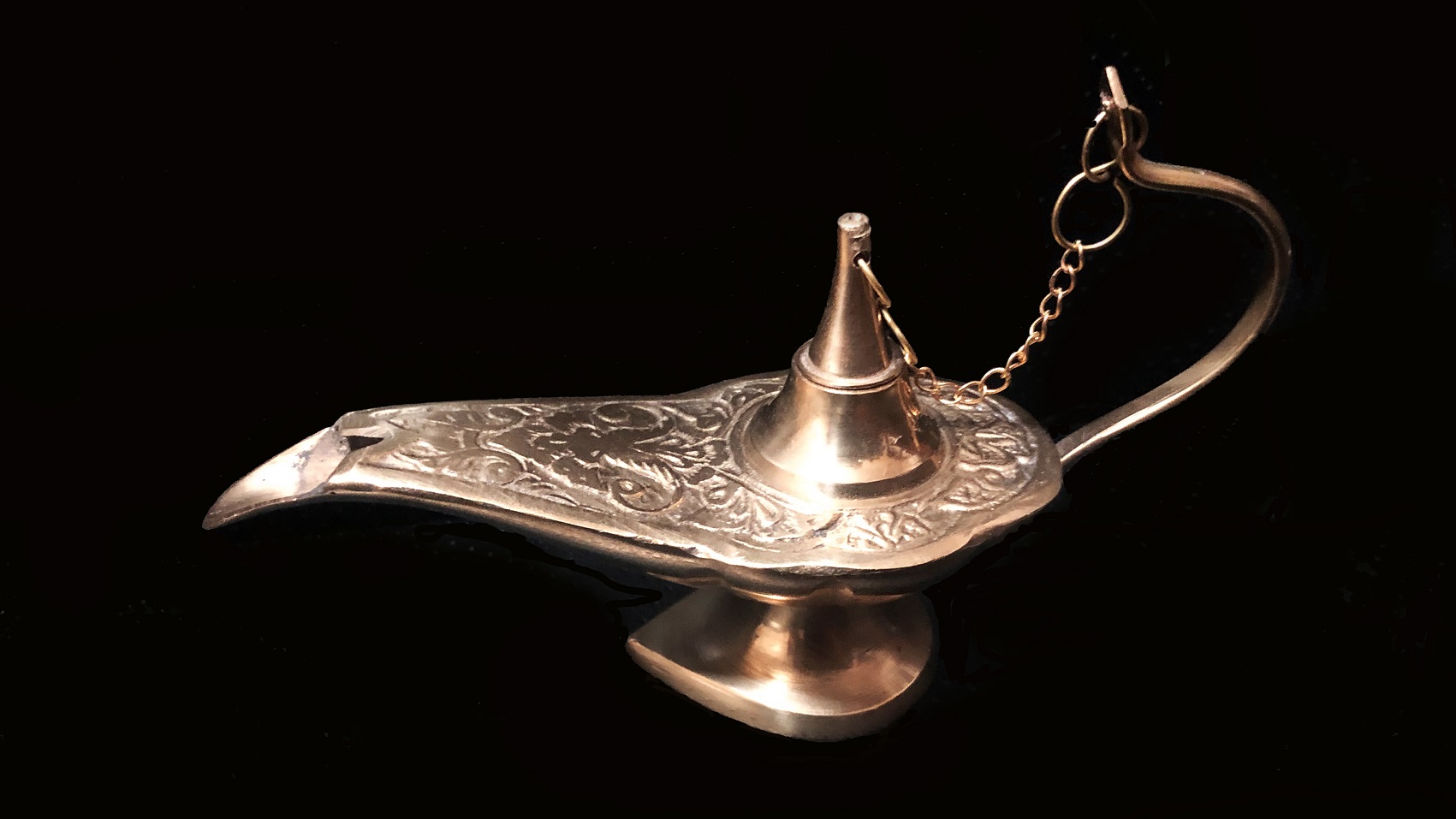
A lamp made out of burnished brass.
He saw the pause, and waved at me.
“Come in, my arkadaᶊ,”* he said,
And deftly poured two cups of tea.
He gestured to a table spread
With curried lamb kebab, a pot
Of hummus, and fresh pita bread.
“Please sit and join me for a spot
Of tea and share a bite or two
Of lunch while the kebabs are hot.
“And if there’s business we can do
Let’s talk about it as we eat.
My name is Al-Jafar, and you?”
I settled in a cushioned seat
And said, “I’m Michael Simpson-Thrum.
My yacht has just sailed in from Crete.”
“Then welcome to Byzantium,”
I heard my host, and new friend, say.
“What brought you here? Why did you come?
“I doubt you traveled all this way
To sit and share a bit of food
And tea with old Jafar, today!”
I laughed, and said, “I’m in the mood
For finding treasures, old and rare.
A ‘magic lantern’ would be good!”
“So that is why you paused to stare!
You spied my lamp! I’m not surprised;
It’s beautiful beyond compare.
“And ancient, too; a lamp once prized
By emperors, caliphs, and kings,
And now by me, who recognized
“It in a box of metal things
Collected to be sold as scrap . . . .
For those with hearts to hear, it sings!”
He placed it gently on my lap.
“Now hold it closely to your ear
And give the lamp a gentle tap.”
The fine-etched brass rang true and clear,
And from within there came a song
As sweet as I shall ever hear.
A tenor voice, both pure and strong,
Intoned a haunting melody
That drew my heart and soul along
The shoreline of a mystic sea
Into which flowed a mighty stream
Whose waters were tranquility.
And as that magic, museful theme
Came to a wistful, whispered end
I wakened as if from a dream.
“It may be hard to comprehend,”
Said Al-Jafar, “but like or not,
The djinn has claimed you as a friend.”
“A djinn?” I asked. “I always thought
Aladdin’s lamp was just a tale
Like Noah’s flood or Camelot!”
“And yet, like Jonah and the whale,”
Jafar replied, “reality
Is often found beyond the pale.”
My mind inclined to disagree;
My heart, however, claimed as true
The song the djinn had sung to me.
“As owner of the lamp, have you
Had wishes granted?” I enquired.
“Three wishes? One? Or maybe, two?”
“Ah, yes. Three wishes are acquired
By those so honored by the djinn.
But granting them is not required.
“For no one owns the one within
The lamp or orders him about.
And this is how it’s always been.
“In vain you rub the lamp or shout
For no one in all history
Has ever made the djinn come out.”
“What wishes did the djinn agree
To grant you? I would like to know,”
I asked while sipping on my tea.
“I’ve chosen three to ask, although
Thus far I’ve asked for only two,
And that was many years ago.
“The first I wished the djinn to do
Was keep my enemies at bay.
The second was to ask him to
“Supply, prepare and serve each day
Three meals for me to eat and share.
He seemed quite eager to obey.”
“And what about the third? Is there
Some reason you have put it off?
Or could it be you just don’t care?”
Jafar responded with a cough.
“A curse will fall on those who cling
To wealth, and so, though men may scoff,
I’ll choose, in place of gold or bling,
To wish the genie’s lamp away
And bless the next who hears him sing.”
“Could that be me? What must I pay
To own the lamp? Just name your price!
I have the means, show me the way!”
“If all the wide world’s wealth were twice
Increased and offered in exchange,”
Replied Jafar, “’twould not suffice.
“Instead, although it may seem strange,
My final wish is to release
The lamp to you and so arrange
“A blessing for both love and peace
To follow each of us in turn.
May—inshallah*—our joy increase.”
He gave what I could never earn,
This merchant in the Grand Bazaar.
I took the lamp and in return
I bid “Salaam*” to Al-Jafar,
A wiser man than I, by far.
Misbaha: Muslim recitation beads representing the 99 names of Allah (Arabic)
Arkadaᶊ: “Friend” (Turkish)
Inshallah: “If Allah wills” (Arabic)
Salaam: “Peace” (Arabic)
James A. Tweedie is a recently retired pastor living in Long Beach, Washington. He likes to walk on the beach with his wife. He has written and self-published four novels and a collection of short stories. He has several hundred unpublished poems tucked away in drawers.


















The lamp is beautiful, James, and the poem quite amusing. Thank you!
Leo
I’d like to turn your quote back on yo by saying, Thank you! Leo.
This is really fine terza rima. And it does what terza rima is especially suited for: a sustained narrative, with a steady pace. The story never lags, never rushes, never ceases to hold the reader’s interest.
The closure is perfect. And the variation made on the story of the djinn, whereby he is not required to grant the requested wishes, is an unexpected but nice touch.
I also felt the poem turned out well and it pleases me greatly to see that others (meaning you, in particular) feel the same. It Represents my first attempt at terza rima, a form usually written in iambic pentameter. I’m not sure if my tetrameter is easier or more difficult than pentameter. My guess is, since there is less wiggle room for padding the narrative, tetrameter is probably the more challenging of the two.
Perhaps so, James, but I am secure in my opinion that you would have managed tetra- or penta- equally well, because you are invariably attentive to detail.
Thanks very much. I too met al-Jafar at the Bazaar, but he didn’t offer me tea or a lamp and I took the tram back to our cruise ship for a swim, with, alas, no thought of writing a poem.
James, your imaginative take on the Genie of the Lamp theme is an absorbing tale. In employing the terza rima form for narrative verse you’re in good company with the likes of Milton and Dante.
Extremely well written and engaging piece of poetry; and you use the tetrameter version of the terza rima to great effect – propelling your story forward. I like this very much indeed; well done. Great writing.
I only learnt of terza rima a cuppla years ago, James, through these very pages (after which, there was a lengthy spell when I was referring to it as terza rime, before learning better), and have since read a handful of such poems here at SCP: none of which, from what I remember, grabbed me. Either I couldn’t relate to the subject-matter (religious, maybe), or I felt some of the diction/rhymes had been forced in order to make the poem fit the difficult form. Thus I’ve remained indifferent.
Your offering above has changed all that. This is the first time I’ve ever been able to grasp and absorb the true beauty of terza rima as a specific form, so much so that it’s also the first time I’ve ever felt of a poem: “This could only’ve been written in terza rima; no other form could’ve afforded it the same justice”. Your lightness of touch seems to make the words dance all the way through: and at a pace which always acquiesces with the dialogue/narrative. It’s so intricately crafted.
And then we get to another set of skills: those of keeping the narrative bubbling along; letting the story gradually build from a chance encounter to a mildly-profound, philosophical conclusion; holding the reader in perpetual anticipation (these skills were explained perfectly by another commenter above: “The story never lags, never rushes, never ceases to hold interest”.); and giving the reader a sense of being a fly-on-the-wall within the vendor’s stand . . . You’ve done it all with ease, James.
‘Twas a pleasant surprise to encounter the word ‘inshallah’ on these pages. We paid a few visits to Marrakesh in the 80’s, and upon learning of it’s meaning, we adopted it.. and still use it today occasionally (mostly as banter between ourselves).
Well, I bow to you, James, for showing me what terza rima is REALLY all about, and how the form can be made to dance if the poet possesses the right skill, imagination and deftness of touch. I now feel that I know what a quality terza rima poem is all about . . and any others I might read in this life will be judged against yours.
Thank you, Monty. I am glad my attempt to tell a good story in terza rima was successful for you (and others, apparently). Your comment also suggests that fiction, in any form, is generally more compelling when it is grounded in the author’s (and reader’s) personal experience. I believe this to be true.
As it happens, James, until you mentioned it I hadn’t paid a single thought as to whether you’d experienced the story or conceived it. And now you’ve planted the thought in my mind . . I still don’t care! My feelings for your poem are such that it’d make no difference to me one way or the other. There are so many other aspects of it to marvel at, the reader doesn’t need to know the author’s motives for writing it.
If, as you say, my previous comment suggested that “fiction is more compelling when grounded in the author’s personal experience”.. then it was purely unintentional. The thought never entered my mind. But now you mention it, if I understand that sentiment correctly then I’d have to disagree with it. If we’re talking about the difference between a/ An author writing about something they’ve actually experienced.. or b/ Writing about something they’ve conceived in their mind . . . then provided the author possesses an untamed and vivid imagination, there should be nothing to prevent them making a ‘conceived’ story as “compelling” as an ‘experienced’ story. Further, and loosely-speaking: if a piece of fiction is “grounded in the author’s personal experience”.. does it not then transfer from pure-fiction to ‘based on a true story’?
I ask as one totally inexperienced in fiction, given that I don’t read any. And I mean literally ANY! I never read novels: I just can’t do it. My whole reading life is probably 80% poetry, 10% auto-biographies, and 10% essays. The only fiction I HAVE read is that of Wilde: I’ve read everything the man ever wrote (I hope). All of his plays; short-stories; critiques; essays; poems; private-letters.. and still I want more! That man’s had a bigger influence on my life – my views, my outlook, my beliefs – than any other single person (I never had a dad). And he keeps getting even better, ‘coz much of what he said in his time (especially his aphorisms) rings more true today than it did then! What a visionary.
This is pure perfection! Thoroughly enjoyed it.