


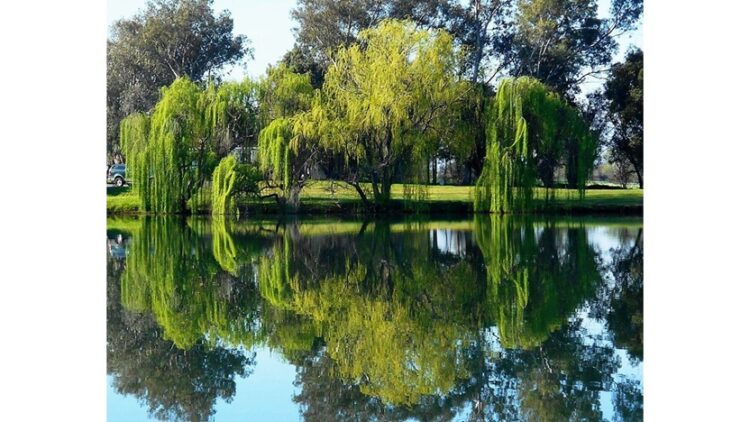
The Willow Guard
Beneath a willow weeps a girl,
All hidden by green fronds that furl
And stretch and wave and fondly curl
__Upon the stream.
The tree’s her oyster; she the pearl
__Cannot be seen.
Amongst the water, leaves and birds
She whispers woe and wistful words.
Between gasped breath she steely girds
__A crumpled heart.
Swift flowing love she stops and curbs
__Now he must part.
For mud and trench her boy must leave;
To march in mires and manly heave
The bayonets that stab and cleave
__A gaping gash.
Grass fields will bleed a sticky weave
__of blood and ash.
If this first war takes love away,
Inside the Willow she will stay;
Amidst the branches she will sway
__Until she dies.
Unless all leading men cease play
__With losing lies.
Beneath the willow pearls are lost;
The green fronds hang with hoary frost.
The weeping tree and girl are tossed
__By winter winds.
A battle ground by ice is glossed;
__And no one wins.
Poet’s Note: Written in Burn’s stanza and inspired by the song “O willow waly.”
Isabella Simmonds is a British musician and piano teacher living in London.

















Isabella, this is an exquisite song, and adds to the long and tearful tradition of willow literature. Congratulations on your achievement, and thanks for sharing it.
Thank you so much for the lovely comment Martin.
A melancholy song of lost love, the rhythm and rhyme carried me along. The rhymes are very impressive and faultless despite a high degree of difficulty.
If by ‘this first war’ you mean the First World War, maybe substitute ‘great’ for ‘first’ (it was originally known as the Great War) since it wouldn’t have been known then there would be another World War.
Thanks for the read.
Thanks so much Paul. Yes “Great war” is a great suggestion!
I used First war as I wanted to convey a sense of the mystical and supernatural which I associate with willow trees. Like a foretelling, but maybe it only makes sense to me and not the reader.
Isabella, I like the phrase “this first war.” It indicates that war will always be with us, and the girl under the willow is aware that “her boy,” if he returns from this war, may see another.
Thanks so much Mary. I really did want to indicate the interminable presence of war in the penultimate and last stanza, so I’m very pleased you interpreted it, in that way.
Very nicely done Burns stanza, one of many forms that I aspire to write. Am I correct that it’s also called a “habbie”? I like the alliteration and rhyme of “fronds that furl” and “fondly curl”.
Thanks so much for reading and commenting Cheryl.
I didn’t know that it was also called a “habbie”. What a great name for a poetry form!
I have only written a handful of poems in Burns stanza, but I do find it a very enjoyable form to write in.
I enjoyed reading this, Isabella. You painted a vivid image of the woman beneath the willow tree caught in her despair about the state of affairs of her lover having to go to the brutal battles. Thanks for sharing.
Thanks so much Paul for reading and commenting. I am so glad you enjoyed the poem.
A very beautiful but sad poem. Thank you Isabella.
Thank you very much Norma for reading my poem and commenting.
Very impressive! Emotionally poignant (especially “she steely girds a crumpled heart”); lovely rhythm in this mesmerizing form; and great imagery and alliteration. “A sticky weave of blood and ash” is another very powerful phrase.
Thank you very much Cynthia for your wonderful comments.
A very pearl of a poem, Isabella. Maybe inspired by “O willow waly,” but quite different. It incorporates traditional symbolism of willow and pearl, yet sings a lament contemporary in tone, with logical reasoning for the girl’s sorrow. You make exquisite choices of word and image; the song rhythm is superb.
Thank you so much Margaret for this absolutely wonderful comment! It is greatly appreciated.
I loved this poem. The form is unusual, the diction is simple, and the ideas flow like water from a pitcher. The ending left me aghast. I wonder whether the author might have been harking back to “Willow Weep for Me”, sung by Chad & Jeremy. What’s also interesting is that salicylic acid, named after the genus Salix, is found in willows and is a key component of aspirin.
Thank you, I am so glad you loved the poem! Yes “Willow weep for me” is also a beautiful and inspiring song. ” O willow waly” is the song written for the 1961 film with Deborah Kerr “The Innocents”.
Thanks also, for sharing those very interesting facts about willows.
The form is beautiful, born of a true musician.
Daniel.
The first stanza in particular is gorgeous – the mind is enchanted away from the meaning to the music.
Thank you so for the lovely comment Daniel.