


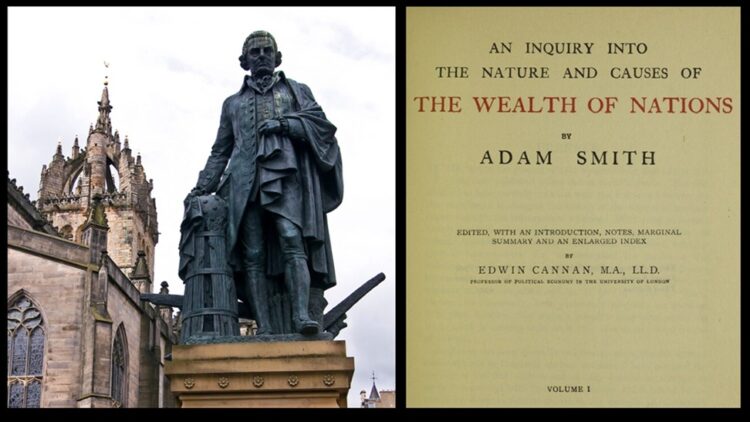
250 Years of the “Invisible Hand”
We should all want to shake the invisible hand,
since it knows how to balance supply and demand
which creates a free market, so everyone knows
their decisions will optimize capital flows.
As the hand guides producers, they fiercely compete,
then each buyer will selfishly vote with their feet
to reward those who best met their personal need,
which means only efficient producers succeed.
Some now want to exchange the invisible hand
for a socialist system that’s centrally planned.
Once we’ve traded the hand, and it’s thrown out the door,
we will all have the same but be equally poor.
There’s a special exception for planners, of course.
They decide who gets what, and if need be, by force.
They’re more equal than we are, and prove that the cream
doesn’t rise to the top of a pyramid scheme.
Poet’s Note: The concept of the “invisible hand” was popularized by father of economics, Adam Smith, 250 years ago in The Wealth of Nations, published 1776. This metaphor was used to describe how the combination of many individuals pursuing their own self-interest unintentionally creates broader social and economic benefits, as if guided by an unseen coordinating force. His idea became the core idea that drove modern free-market economies and, in combination with property rights and the rule of law, unleashed economic growth in the West on a scale never matched by any other economic system.
Warren Bonham is a private equity investor who lives in Southlake, Texas.


















Warren, the invisible hand definitely works better than anything else, and the poem is a standout! Adam Smith made it plain and simple, just like you have in the poem.
Today’s economists are all about models and managed outcomes. Smith understood and explained human nature, while our new economic powerhouses steer, stimulate and correct it.
I guess the invisible hand needs very visible and well-compensated overseers that punish it into oblivion.
It becomes a self-sustaining doom-loop. When the overseers try to manipulate things, the outcomes are inevitably awful, they then blame it on a failure of the invisible hand and then grab even more power resulting in larger and larger failures that they need to fix for us. Distressing stuff.
Warren, you brought back my memories of my Economics minor at my university. Having read Adam Smith’s book as well as Marx and others, Adam Smith had by far the most logical approach to how an economy should be of the free market variety. As an observer in various assignments over seven years in the Soviet Union and later Russia, even those with consummate skills still lived poorly. I will never forget when at Christmas time I saw boxes of rotting Nefertiti brand oranges being sold to everyone. The Communist Party higher-ups on the other hand had access to party commissaries that still were miserable by our grocery store standards. I know because I had access to them as a diplomat. As a diplomat (Army Attache), I was able to order fresh produce and frozen meat from Finland for transport to Moscow for weekly delivery. I only used the Communist sponsored commissary for emergencies. Later as Portal Monitor Commander in Votkinsk, we received almost all our food on flights once every three weeks from the military commissary in Frankfurt as part of our 30-member personnel rotation of military and civilians who would remain for nine weeks. Early in our time there we tried to purchase eggs locally, but the Soviets complained we bought out the market for our small 30-member group. The problem was Russian farmers and farm hands were indolent. Why work when they got the same low pay as everyone else regardless of how hard they might try. Great contribution, Warren.
That’s a fantastic real world example of how centrally planned economies always turn out. Unfortunately, the real world is never taught in Econ 101 courses.
And Warren… I recently learned of Michael Hudson… a very interesting take on economics…
I had never heard of him, but just looked him up. Fascinating background and I will take a deeper dive. Thanks.
Warren, I love this poem as it romps along, satisfying my love of perfect rhyme and meter, with a spot-on message of, why work hard when slackers get the same rewards as hard workers. Thank you.
Thanks! That’s a great summary. People who push these systems always see themselves as the ones who get to dole out the rewards so they never end up with the meager rewards that everyone else gets.
Thanks, Warren, for your usual good measure of verse and thought. In this 250th centennial of our nation, it’s good to commend the free market system by which we’ve benefited. You and Roy Peterson have indicated huge problems with planned economies, namely that they tend to be unfair and poverty-stricken at the same time. Another is that it can be very difficult to return things to good order after the planners are gone. I spoke with a Slovak man who said that when communist power lapsed in Slovakia, the means of production were rapidly stolen by anyone who could seize them. Some Eastern European countries did better. Adam Smith, earlier than 1776, had posited a “moral sentiment” needed for social order, such that human sympathy, along with self-interest governed by law, had a role in social relations. I can see this having grown in the Polish Solidarity movement.
Econ 101 in four hurrying stanzas. That’s genius. Thanks, Warren.
“Only efficient producers succeed”. — yes. Great summary of how good economics works, Warren.
“We should all want to shake the invisible hand”!
This is such a fantastic line. Could you add a 5th stanza or alter the 4th so that the poem ends with this line too? It so thoroughly deserves repetition.