


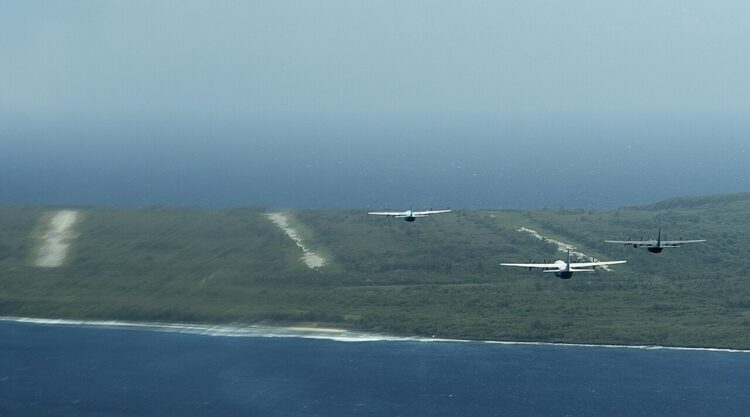
Tinian
Tucked into the corner of the sea,
Birthed in fire, volcanic history,
A stepping stone across the ocean wide,
Battered by the ever-flowing tides,
Bobbing on the slow pacific swell,
An island which unleashed the hounds of hell.
This runway covered up by jungle vines,
Was where we launched the famous 509,
And with them went the fair Enola Gay.
With war drums growing louder every day,
We arrive to slash the creeping jungle back.
With every tree we fell and inch we hack
We advance, entrenching thus a forward pawn
In a game of chess. The prize? A free Taiwan.
M.D. Skeen works as an attorney in Denver, Colorado.
















My father was a P-52 Mustang repairman on Tinian among other islands to which he was assigned in WWII. This is an outstanding poem with visual imagery of a wartime scene and much like he described it, but in more exquisite detail.
Actually, my dad was an engine mechanic on the P-51 Mustang not P-52. I checked and noted that the two numbers are often confused in references to the celebrated Mustang airplane of WWII. He told me he was with the first crews going into such islands and sometimes was shot at by Japanese still there.
We get a lot of history here at this site, and military history is especially welcome. My father was stationed on Attu during WWII, but we could never get him to tell us the more harrowing details. How much longer will Taiwan be free?
The clues in the poem ask the reader to identify the speaker and his location in history. We recognize the Enola Gay and the famous 509 as ending World War II with the atomic bomb, but the guy advancing on his island square of the chessboard apparently does not. His military aim of freeing Taiwan became irrelevant once the Japanese had surrendered. The poem’s little slice of life pictures one laborious moment experienced by so very many men who would soon be relieved of what they considered their objectives. It’s good to enter his thoughts for a moment, and try to imagine how quickly and dramatically they would be changed–without our discovering what that change would be. Enigmatic geographical and psychological painting.
An interesting subject: an island with a name having a poetic beauty that I have always found striking. You remind us how the small “stepping stone” supported giants in world-changing events, and by ending on “Taiwan” you allude to the current situation and remind us of Tinian’s continuing strategic importance.
Thank you for your comments. Extra points if you caught the nod to Yvor Winters. An air force officer at my church recently returned from Tinian where he had gone to facilitate the re-opening of the runways for potential future conflict in the Pacific theater. I had never heard of the island before and was fascinated to learn of its history and the renewed interest in its strategic importance. The idea of a mysterious island hidden in the vastness of the ocean harboring the instruments of mass death and destruction captured my imagination. Two years ago I was in Taipei and it is easily in the top ten cities I have ever spent time in. I fell in love with the friendliness, diversity and beauty of the people, the traditional culture and historical artifacts which were saved from Mao’s desecration, and the absolutely outstanding cuisine. I hope we continue to see the value in their on-going freedom from communist tyranny and in keeping deterrence a priority.
The title of Mr. Skeen’s “Tinian” is neatly alliterated in the final crucial revelatory word “Taiwan”. The poem is not far from Yvor Winter’s “An Epitaph for the American Dead”:
Who should dare to write their praise
Do so in the plainest phrase.
Few names last where many lie;
Even names of battle die.
These will stand for many more:
Wake, Bataan, Corregidor,
Attu, and the Coral Sea,
Africa, and Sicily;
Callihan, who ran his ship
To the very cannon’s lip.
Men devoid of name and hour
With direction gathered power;
Stripped of selfhood, each must be
Our hostage to Eternity.