


Fireship
—August 7, 1588. The English Channel.
Since William’s conquest England has not faced
Such danger of defeat—so dire a maze
It calls for setting our own ships ablaze.
I’ve stowed away, a naval pyre embraced,
To steer this burning ship to ram El Rey.
I can’t conceive a finer course to death—
By churning sea as well as smoke-choked breath
To serve a Queen as glorious as day.
There’s no escape now. My weak flesh is doomed.
But when the Hastings strikes the Spanish ship
The gale which I inspire shall fan its grip
Till the Armada shall be full consumed
With flame and hotter flame and flame entire.
Aye, History’s forever lit by fire.
Poet’s Note: In the middle of the night of 7–8 August, 1588, the English set alight eight fireships, sacrificing warships by filling them with pitch, brimstone, gunpowder and tar, and cast them downwind among the closely anchored vessels of the Spanish Armada. The Spanish feared that these uncommonly large fireships were “hellburners,” specialized fireships filled with large gunpowder charges that had been used to deadly effect at the Siege of Antwerp. They were not, but the Spanish Armada broke formation in fear of being set afire and was unable to recover its position paving the way for England’s famous victory over the Spanish armada’s invasion.
Thermopylae
The battle starts. The warriors brave pain,
Ignore their wounds and taunt death with a smile.
They mock the dross of dread and scorn the stain
Of weeping. They march forward even while
They groan. I watch them rise and sword-slash through—
Rough lives which scorn all enemies and fears.
I marvel that they fight and fight anew,
Defying loss through bitter blood-soaked years.
Such souls disdain serenity in death,
Embracing valor, stifling painful cries.
Unfazed by horror, they prize every breath.
So brave they are! Or is it that they’re wise?
I cannot say but that they die and grow.
I’d give my life to learn the things they know.
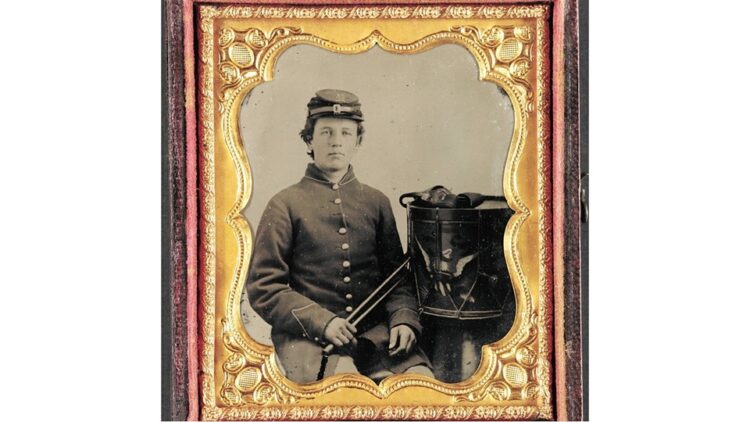
Child Soldier of the Civil War
The boy is born in 1849—
A dozen years before the Civil War.
His name is Charlie King of Pennsylvania—
A lad who is exceptionally bright
And proves to be adept at beating drums.
When he is only 12, the South secedes,
Fort Sumter falls and Lincoln issues forth
A call for men to help preserve the Union.
Charlie—a mere boy—entreats his parents
To let him fight. “You’re far too young,” they say.
But come July of 1861,
As Pennsylvania’s Infantry is formed,
Young Charlie tries enlisting once again.
A Union captain who hears Charlie drum
Assures his parents Charlie will be safe
If he just beats out time while the men drill.
And drum he does! So well he is promoted:
Drum-Major of the Regimental Band.
When war burns close to home in Maryland
Despite his age, the die is cast. He marches
Along with Pennsylvania; Charlie beats
Support for Union troops through many battles.
He tastes real combat and is even there
At Bull Run when they fight Robert E. Lee.
But at Antietam soldiers for the South
Attack. They shoot young Charlie in the chest.
The ball rips through his lungs—a mortal wound.
He somehow lasts three days but by the time
His father comes to take the brave lad home
Young Charlie King is dead. He’s just thirteen.
We now salute him as the youngest soldier
To perish in the War Between the States.
Poet’s Note: Charles (“Charlie”) Edwin King (1849-1862) was a Union drummer boy during the Civil War. Having been mortally wounded at the Battle of Antietam, he is the youngest soldier from either side to die during the war. Buried anonymously in a mass grave, a monument has been erected for him at Green Mount Cemetery in West Goshen, Pennsylvania.
Brian Yapko is a retired lawyer whose poetry has appeared in over fifty journals. He is the winner of the 2023 SCP International Poetry Competition. Brian is also the author of several short stories, the science fiction novel El Nuevo Mundo and the gothic archaeological novel Bleeding Stone. He lives in Wimauma, Florida.
















These excellent endearing stories of valor and self-sacrifice stir the soul of one such as myself attuned to the history of warfare and its exigencies. I am amazed at the range of your historical knowledge and your ability to encapsulate it in vivid detail.
Thank you very much indeed, Roy. Given your strong military background, this comment means a lot to me. Since valor seems to be in short supply these days, this struck me as an apt and timely subject for poetry. I know that you have shown great valor in your own life and I thank you for your service to our country.
Readers: an additional poet’s note concerning “Child Soldier of the Civil War”: I learned from my research that throughout the American Civil War approximately 250,000–420,000 males under the age of 18 were involved in both Union and Confederate forces. It is estimated that 100,000 Union soldiers were 15 years of age or younger. By one estimate, approximately ten percent of Union soldiers were underaged (the Confederate army likely had a similar proportion of underage soldiers).
When I learned of this, I was immediately struck by the contrast between the self-sacrificing and courageous youth in the 1860s versus the more narcissistic values embraced by youth in the 21st Century.
Three excellent poems, Brian. The two sonnets are vignettes of sacrifice and bravery — the speaker in “Fireship” making a kamikaze-type attack on the enemy fleet, and the hoplites at Thermopylae fighting in full knowledge that they will die to the last man.
The longer unrhymed piece is an example of pathos in poetry — the quality of deeply felt sorrowful pity, in this case for a young kid who freely gave up his own life, and who serves as a representative of all the underage soldiers who died on both sides during the War Between the States.
Your poems brought back to memory a film that impressed me as a boy. I believe it was “The Enemy Below.” In a German submarine under American attack, one sailor loses his nerve and freaks out with fear. The tough submarine captain stares him down, brings him back to attention, and says “It is part of our job to die. Maintain yourself at your post.” This scene had a powerful effect on me.
Thank you very much indeed, Joe! I will make a point of checking out “The Enemy Below.” The idea that our lives exist in the service of something greater is very moving to me.
Three excellent poems Brian – my favourite being the first. Your comment “Since William’s conquest England has not faced / Such danger of defeat—” is historical and contemporary: measuring 1066 to 1588 is 522 years; from 1588 to +522 takes us to 2110 – only 84 years away! But the point is: England is in deadly peril now – the danger factor has accelerated. Perhaps only America can save us: the real enemy – as with America too – is within. Thanks for reminding us of these moments when civilisations fall so that we may be strengthened in our own small ways to resist these evils.
Thank you so much, James — especially for reading between the lines in “Fireship”. England’s present predicament is not per se the focus of this poem, but it was certainly on my mind. I’ve found myself wondering where are England’s great patriots? A tradition which goes back to Alfred the Great (at least!) and includes great figures such as Henry V, Lord Nelson and Winston Churchill is being frittered away in real time. I hoped my poem would be a reminder of the valor men once exercised to protect their homeland. Perhaps it’s not too late.
3 deeply thought provoking pieces, Brian, each emphasizing the vast decline in patriotism around the world, particularly among the youth of centuries ago and
those of today that are satisfied to live as they do in China, South Korea, etc., etc., etc. Authentic ‘War Heroes’ have declined in number since the 1960s as the “No Kings”-ers try to convince themselves they’re struggling in a dictatorship. Nice work –
Thank you so much, Mark. Heroes need not necessarily die in battle, but having the guts and willingness to do so for a higher cause may well make all the difference. Timidity is fatal. Especially among leaders.
These are impressive across the board. There’s a real command of voice and tone in each piece, but what stands out most is how differently you approach each subject while keeping them equally engaging. Fireship carries a strong sense of resolve and purpose, Thermopylae captures a thoughtful awe toward courage, and Child Soldier of the Civil War delivers a deeply moving and grounded narrative. You handle history with confidence, and more importantly, you make it feel alive rather than distant. There’s a consistency in craftsmanship here that’s impressive.
Thank you so much, Michael! I have always been fascinated by history and as a child liked to engage in time travel fantasies. I very much enjoy trying to develop characters from different centuries — to imagine what they might think or feel. So your generous words about “command of voice and tone” is incredibly gratifying to me. I do try. And thank you for the beautiful description of the second piece: “thoughtful awe toward courage.” That is very much how I feel.
Brian, thank you for this meticulously crafted trilogy of courage throughout history —the firelit defiance of the first, the disciplined valor of the second, and the heartbreakingly tragic loss of the third, which does the most to expose the human cost beneath heroism’s glory. Your chosen form for each works very well.
I am intrigued by the second poem. like the way Thermopylae wonders whether courage is not only bravery but a kind of wisdom – though one might sense that even the wisest warriors are seldom told the full truth of why they fight. Most soldiers, brave yet trusting, enter battle with hearts full of duty but minds veiled from war’s deeper motives. And in the end, the closing line from Fireship, “Aye, History’s forever lit by fire,” speaks for them all: each flame of valor burns brightly, even as its true purpose flickers in the shadows of history.
I believe all brave souls called to fight have something of Charlie King in them – the loyal and naïve child who isn’t fully aware of the bigger picture. If they knew all, our history would look very different.
Brian, thank you for your talent, your sensitivity to your subject, and for always making me think long and hard – my favorite pastime.
Thank you so much, Susan! I’m thrilled that you enjoyed this set and — especially — Thermopylae. I had been raised to think of a huge dichotomy between “brains” and “brawn.” Intelligence was for one set of people. Courage for a different set. I don’t know if other people have this sort of prejudice, but the older I’ve gotten the more apparent to me that this mindset is wrong. First of all, I’ve learned that there’s a huge difference between intelligence and wisdom. Second, I’ve learned that there are all kinds of bravery — including the kind that stands up to authority, or the kind that understands that self-sacrifice may be the only thing that can save people. In other words, there is a synthesis of courage and deep understanding and respect for duty which I would consider “wise.” Wisdom — like faith — has muscle.
As for Charlie King, it’s impossible to determine what he did or did not know. But the future of his country was at stake and he wanted to do something to help preserve it. He wanted to fight, despite parental disapproval and without ever fully knowing what he was in for. A patriotic boy, I think, who deserves to be remembered.
These poems all reflect a deep understanding of events and research into their subjects. One of the greatest failings of “contemporary” poetry is its sloppiness — filling the work with sentimentalized cliché and tropes instead of real research. You fight against that here, and give us a case study in responsible writing.
Thank you very much indeed, Adam! I share your dismay with contemporary poetry which can be sloppy in form and content. I do try to research the historical pieces I write about carefully. My modus operandi is to try to “fill in the blanks” with fictional thoughts and situations, but to endeavor to not write anything that is contrary to the historical record. Ideally, I like to see history come alive without being rewritten or retconned.
Great storytelling, Brian.
Thank you so much, Cynthia!
History made 3D. Should be in the textbooks – better than pictures.
I really appreciate that, Michael! Thank you!
Though I have sometimes thought or said that I would be willing to kill for my country, I have never thought that I would be willing to die for it. Valor just isn’t my thing. I know, however, something of self-sacrifice, having just filed my federal and state income tax forms. If you want to know more about valor and honor, just read a few pieces by Gordon Dickson.
Thank you for your witty comment, Kip! Taxes aside (our appointment’s set for tomorrow) you broach a very serious subject — the willingness to die for one’s country. No, it’s not for everyone. Martyrdom of any kind is an act of extraordinary faith and courage. I’m not sure I could do it. I know of few who could. But the decision is so circumstances-dependent that I would not say “never” for any of us. Plus, valor need not mean death. It may simply bespeak that combinatinon of courage and integrity that is capable of bending history in new directions. Atticus Finch displays valor in To Kill a Mockingbird and he doesn’t die. I place valor among the very highest of character assets. It is a rare quality upon which nations and values are built.
I don’t know Gordon Dickson but will look him up. Thank you. I appreciate the recommendation!
Brian, thanks for these very readable poems. There was an excellent series on British TV a few years ago about the Armada. Effectively, it was doomed from the start. The Spanish plan – to embark thousands of troops from the Low Countries and ferry them to England – would have needed perfect weather conditions, even without the intervention of the English fleet. Also, many of the Spanish ships were not built for northern waters, and, after the event you describe, were sunk by weather before the English were even in shooting range.
That series was made when BBC (the state broadcaster) was worth watching. I don’t give it house room now.
Thank you very much indeed, David! I’ve long been fascinated by the whole Spanish Armada story and Queen Elizabeth’s famous speech at Tilbury in which she pledged herself to the preservation of England and its unwillingness to cede to invaders. I would that the good people of England would re-read her pre-Armada speech and recognize what it is they have thrown away with both hands. The speech is short, so I reproduce it here:
Queen Elizabeth I, 9 August 1588
My loving people,
We have been persuaded by some that are careful of our safety to take heed how we commit ourselves to armed multitudes, for fear of treachery. But I assure you, I do not desire to live to distrust my faithful and loving people.
Let tyrants fear. I have always so behaved myself that, under God, I have placed my chiefest strength and safeguard in the loyal hearts and good-will of my subjects; and therefore I am come amongst you, as you see, at this time, not for my recreation and disport, but being resolved, in the midst and heat of the battle, to live and die amongst you all; to lay down for my God, and for my kingdom, and my people, my honour and my blood, even in the dust.
I know I have the body of a weak and feeble woman; but I have the heart and stomach of a king, and of a king of England too, and think foul scorn that Parma or Spain, or any prince of Europe, should dare to invade the borders of my realm: to which rather than any dishonour shall grow by me, I myself will take up arms, I myself will be your general, judge, and rewarder of every one of your virtues in the field.
I know already, for your forwardness you have deserved rewards and crowns; and We do assure you on a word of a prince, they shall be duly paid. In the mean time, my lieutenant general shall be in my stead, than whom never prince commanded a more noble or worthy subject; not doubting but by your obedience to my general, by your concord in the camp, and your valour in the field, we shall shortly have a famous victory over these enemies of my God, of my kingdom, and of my people.