• Submit Poetry
  • Support SCP
  • About Us
  • Members
  • Join
Thursday, May 14, 2026
Society of Classical Poets
  • Poems
    • Beauty
    • Culture
    • Satire
    • Humor
    • Children’s
    • Art
    • Ekphrastic
    • Epic
    • Epigrams and Proverbs
    • Human Rights in China
    • Music
    • Performing Arts
    • Riddles
    • Science
    • Song Lyrics
    • The Environment
    • The Raven
    • Found Poems
    • High School Poets
    • Terrorism
    • Covid-19
  • Poetry Forms
    • Sonnet
    • Haiku
    • Limerick
    • Villanelle
    • Rondeau
    • Pantoum
    • Sestina
    • Triolet
    • Acrostic
    • Alexandroid
    • Alliterative
    • Blank Verse
    • Chant Royal
    • Clerihew
    • Rhupunt
    • Rondeau Redoublé
    • Rondel
    • Rubaiyat
    • Sapphic Verse
    • Shape Poems
    • Terza Rima
  • Great Poets
    • Geoffrey Chaucer
    • Emily Dickinson
    • Homer
    • Henry Wadsworth Longfellow
    • Dante Alighieri
    • John Keats
    • John Milton
    • Edgar Allan Poe
    • William Shakespeare
    • William Wordsworth
    • William Blake
    • Robert Frost
  • Love Poems
  • Contests
  • SCP Academy
    • Educational
    • Teaching Classical Poetry—A Guide for Educators
    • Poetry Forms
    • The SCP Journal
    • Books
No Result
View All Result
Society of Classical Poets
  • Poems
    • Beauty
    • Culture
    • Satire
    • Humor
    • Children’s
    • Art
    • Ekphrastic
    • Epic
    • Epigrams and Proverbs
    • Human Rights in China
    • Music
    • Performing Arts
    • Riddles
    • Science
    • Song Lyrics
    • The Environment
    • The Raven
    • Found Poems
    • High School Poets
    • Terrorism
    • Covid-19
  • Poetry Forms
    • Sonnet
    • Haiku
    • Limerick
    • Villanelle
    • Rondeau
    • Pantoum
    • Sestina
    • Triolet
    • Acrostic
    • Alexandroid
    • Alliterative
    • Blank Verse
    • Chant Royal
    • Clerihew
    • Rhupunt
    • Rondeau Redoublé
    • Rondel
    • Rubaiyat
    • Sapphic Verse
    • Shape Poems
    • Terza Rima
  • Great Poets
    • Geoffrey Chaucer
    • Emily Dickinson
    • Homer
    • Henry Wadsworth Longfellow
    • Dante Alighieri
    • John Keats
    • John Milton
    • Edgar Allan Poe
    • William Shakespeare
    • William Wordsworth
    • William Blake
    • Robert Frost
  • Love Poems
  • Contests
  • SCP Academy
    • Educational
    • Teaching Classical Poetry—A Guide for Educators
    • Poetry Forms
    • The SCP Journal
    • Books
No Result
View All Result
Society of Classical Poets
No Result
View All Result
Home Poetry Beauty

‘To Nicholas Wilton’ by Joseph Charles MacKenzie

December 2, 2018
in Beauty, Culture, Poetry
A A
19
poems 'To Nicholas Wilton' by Joseph Charles MacKenzie

Traditional Sacred Polyphonist of England

Wilton! Could music make the dead to rise,
Spare life its toil, move wills from sloth,
Bind happy lovers in their troth,
Or lift a heart to soar upon the skies,

Rather would I your holy strains to hear,
That breathe of the eternal life
And free the spirit of its strife,
As if to sanctify the human ear.

Our times find balance in your measured tones
That raise the sweetness of your lays
To heights of consecrated praise
Resounding in the far celestial zones!

Through you the souls of Tallis and of Byrd
Respire the chaste sobriety
Of England’s antique piety
In youthful melodies before unheard.

May you, who snatched from Orpheus his lyre,
To play it at Our Lady’s feet,
Forever make man’s heart to beat
With love of Him who fuels your music’s fire!

© Joseph Charles MacKenzie


Joseph Charles MacKenzie is a traditional lyric poet, the only American to have won Scottish International Poetry Competition. His poetry has appeared in The New York Times, The Scotsman (Edinburgh), The Independent (London), US News and World Report, Google News, and many other outlets. He writes primarily for the Society of Classical Poets (New York) and Trinacria (New York). MacKenzie has been nominated for the Pushcart Prize.

ShareTweetPin
The Society of Classical Poets does not endorse any views expressed in individual poems or commentary.
Read Our Comments Policy Here

RandomPoems

Sonnet ‘07.03.18’ by Edward Hoke
Beauty

Sonnet ‘07.03.18’ by Edward Hoke

August 14, 2018

The constancy of change is to be wished; To find a partner and to settle down, To build a life,...

‘King Cyrus Issues an Edict’ and Other Poetry by Brian Yapko
Beauty

‘King Cyrus Issues an Edict’ and Other Poetry by Brian Yapko

February 23, 2026

  King Cyrus Issues an Edict “Thus saith Cyrus king of Persia: ‘All the kingdoms of the earth hath the...

Next Post
‘The Threads’ by Evan Mantyk

'The Threads' by Evan Mantyk

‘Here Comes the Hybrid Bus’ by K.G. Jackson

'Here Comes the Hybrid Bus' by K.G. Jackson

‘Let Them Go’ by Mickey Kulp

'Let Them Go' by Mickey Kulp

Comments 19

  1. Joseph S. Salemi says:
    7 years ago

    I like the use of two tetrameter lines between the first and last pentameter lines of each couplet. This emphasizes MacKenzie’s choriambic rhyme scheme. And MacKenzie did well to use the modern “you” and “your” pronouns here, instead of the older “thou” and “thy” forms, which would have added too much of an antique cast to the poem, which is addressed to a living person.

    And although this is a profoundly Christian poem, it makes perfect use of the classical myth of Orpheus descending to the netherworld with his lyre to summon back his beloved to the land of the living. Nicholas Wilton is bringing back an endangered tradition of sacred polyphonic music — one that many persons may have despaired of ever hearing again.

    Reply
    • Joseph S. Salemi says:
      7 years ago

      Did I say “couplet”? I meant quatrain, of course.

      Reply
      • Joseph Charles MacKenzie says:
        7 years ago

        Oh yes, this was understood.

        Reply
    • Joseph Charles MacKenzie says:
      7 years ago

      Thank you, Dr. Salemi, for your appreciation. Indeed, the theme of Orpheus is prepared in the very first line of the poem, “Could music make the dead to rise…”

      And you could not be more on point in relating to this theme the resurrection of England’s proud traditions of sacred polyphony, especially as Wilton’s various Mass settings are increasingly performed not only by traditionalist choirs for liturgical purposes, but also by quite a number of other kinds of choral groups throughout the world.

      Reply
      • Nicholas MacKenzie Wilton says:
        5 years ago

        Fantastic poem–gave me a hoot too, considering my name!

        Reply
        • Nicholas Wilton says:
          5 years ago

          Dear MacKenzie,

          I just revisited your very fine poem about my little sub-creations which I do not often do as I don’t think a very good idea for me.

          I am pleased that the gentleman in question liked it. I guess, judging by his name, that he is both a poet and composer.

          We’d better look out!

          In the Holy Name of Mary,

          Wilton

          Reply
        • Ben Whitworth says:
          5 years ago

          This is an exquisite tribute to one of our most talented living composers. Bravo!

          Reply
  2. Buceli da Werse says:
    7 years ago

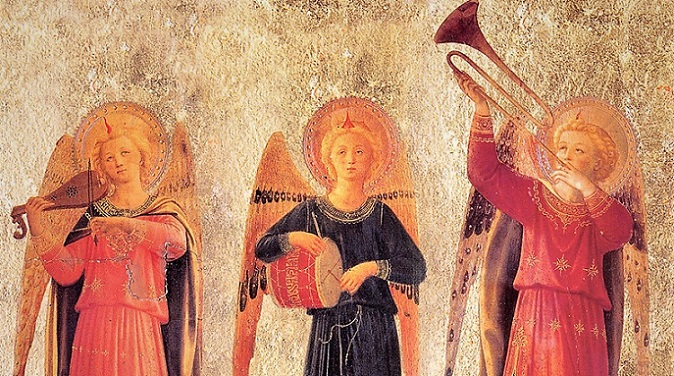
    1. Mr. MacKenzie’s poem, Wilton’s music, and the paintings of Fra Angelico bring to mind some of the meanings of the word classical.

    2. As Mr. Salemi has pointed out, Mr. Mackenzie uses the classical literary myth of Orpheus in “To Nicholas Wilton”. What I like about the poem is its drawing attention to the music of a contemporary of ours, Nicholas Wilton, a polyphonist of England.

    3. Ironically, it was the classical period in music (c. 1770-1800) that disregarded the complexities of polyphonic Baroque music, and introduced, what perhaps could be called a grander simplicity.

    4. In painting, the classical period of Da Vinci, Michelangelo, and Raphael, gives way to the Mannerists;
    but somewhat earlier, Fra Angelico (1395-1455), from the opening of the Renaissance, demonstrates a purity in his painting that is breathtaking in its simplicity; at moments one feels as if one is with Giotto, and then the later it is as if one has stepped into a newer world.

    5. A painting of Fra Angelico’s that inspired me some years ago with the following bilding was The Deposition from the Cross.

    Completed on the Death of Lorenzo Monaco

    The Deposition by Fra Angelico is grand.
    As in a triptych there are three divided parts.
    The cross is in the center, where two ladders stand,
    as Jesus Christ is taken down by sturdy hearts.
    The vivid reds and pinks in gowns and hats entwine
    with dark green grass and trees. Wherever the eye darts
    one sees contrasts. Around, the golden haloes shine,
    while skies of blue are bright with angels, clouds and light.
    The kissing of the feet by Mary Magdalene
    anchors the left with women; men fill up the right.
    At left the castled town; at right are hills and land;
    the x holds Jesus’ blood-touched body wrapped in white.

    Reply
    • Joseph Charles MacKenzie says:
      7 years ago

      Yes, it is truly gratifying to have in our midst a composer who possesses virtually everything Byrd possessed, but who goes well beyond in so many ways, always remaining true to the best principles of tradition in everything he does.

      Reply
  3. James A. Tweedie says:
    7 years ago

    Mr. McKenzie, This poem is yet another fine example of your personal style of lyric verse. I particularly like the way you begin the poem with an off-iambic, emphatic “Wilton!” This is unexpected and very effective, I think.

    It is not as effective, however, when the word “Rather” is used to introduce the second stanza. An iamb is called for here. Perhaps something like, “Yet I would choose your holy strains to hear” although using the contraction “I’d” would offer other alternatives.

    As usual, you save the best for the last. Your closing stanza brings your paean to Wilton to a triumphant conclusion, serving the same function as the closing couplet in a sonnet.

    Also, thank you for introducing us to a young composer who, in the same spirit as SCP, seeks to celebrate, nourish and resurrect old form and styles for the edification of a culturally-starved generation.

    Reply
    • Joseph Charles MacKenzie says:
      7 years ago

      Yes, Mr. Tweedie, I certainly share your sense of gratification in the knowledge that we of the SCP are not alone. I am moreover convinced that the return to classic principles of art is a movement of international significance, not by any means limited to the Anglo-American world.

      Reply
  4. James Eliot says:
    7 years ago

    The poem’s purity of style and formal perfection pay just tribute to Nicholas Wilton. This poem does honor to England.

    Reply
  5. Joseph Charles MacKenzie says:
    7 years ago

    Indeed, Mr. Eliot, England is justifiably proud of so faithful a composer. Some of the best musicians in London whom I know personally will tell you the same.

    I thank you for your most kind and generous compliment, but must assure you that the merits of my poem owe everything to Mr. Wilton.

    Reply
  6. Nicholas Wilton says:
    7 years ago

    I am not quite sure whether I am allowed to join in this discussion as Joseph Charles MacKenzie’s poem is about my music but I should like to express my sincere gratitude to him for his very fine poem. There is something of the Divine in all MacKenzie’s poems which might go to explain why they are so very good.

    I am also extremely touched and humbled by the gracious comments which have been made about my little sub-creations.

    Reply
    • The Society says:
      7 years ago

      Dear Mr. Wilton,

      You are absolutely welcome to join the discussion! Thank you for sharing your sublime music through the creation of the video that has been posted and for inspiring Mr. MacKenzie to produce such a rousing poem.

      A new era of artistic achievement lies before us and the convergence of artistic disciplines is a natural outcome and something we encourage.

      Kind regards,
      Evan Mantyk
      SCP President & Editor

      Reply
      • Nicholas Wilton says:
        7 years ago

        Dear Mr Mantyk,

        I should like to thank you for posting on the Society of Classical Poets web site the video presentation of four of my sacred choral pieces in relation to Mr MacKenzie’s fine poem about my music, which was kindly made for me by the American composer and pianist, Jack Gibbons, to whom I am very grateful.

        If any members of the Society of Classical Poets like traditional classical piano music I have a CD of my own entitled “Music for Piano”, played by the virtuoso pianist, Alexei Knupffer, which can be listened to here: https://store.cdbaby.com/cd/nicholaswilton and the physical CD purchased here: https://www.tutti.co.uk/cds/music-piano-nicholas-wilton-NSWIN-CDNW2-R3

        Reply
      • Joseph Charles MacKenzie says:
        7 years ago

        Dear Mr. Mantyk,

        May I please draw to your kind attention and that of our readers to the fact that some of Mr. Wilton’s finest compositions have been recorded by the internationally celebrated choral ensemble, Magnificat (Philip Cave director), and are available in the form of a beautifully produced CD, entitled, “Sacred Choral Music by Nicholas Wilton” here:

        http://bit.ly/2UgK3ad

        Members and readers of the Society of Classical Poets would do well to acquire this harbinger of what you have rightly called a “new era of artistic achievement”—the ideal Christmas gift for family, friends, and loved ones.

        Reply
  7. C.B. Anderson says:
    7 years ago

    It is appropriate that the words of two masters of rhythm and tone should appear contiguously here. I should feel grateful that I am subscribed to the comments at SCP.

    Reply
    • Joseph Charles MacKenzie says:
      7 years ago

      You are very kind, Mr. Anderson. I realize that you and I and many others throughout the world stand together in defending the immemorial principles of the beautiful in human arts and letters.

      Reply

Leave a Reply Cancel reply

Your email address will not be published. Required fields are marked *

  1. Cynthia L Erlandson on ‘To May, the Prince of Months’ by Eustache Deschamps, Translated by Margaret CoatsMay 14, 2026

    So beautiful! I was enjoying all of your wonderful slant rhymes for “nature”, and then saw that those in the…

  2. Joseph S. Salemi on ‘To May, the Prince of Months’ by Eustache Deschamps, Translated by Margaret CoatsMay 14, 2026

    A very nice rendering of Eustache, and one that must have taken a great deal of work to maintain the…

  3. Roy Eugene Peterson on ‘To May, the Prince of Months’ by Eustache Deschamps, Translated by Margaret CoatsMay 14, 2026

    Margaret, your translation talents are amazing. Your manipulation of each line is masterful to achieve such effective rhymes in English…

  4. Margaret brinton on ‘To May, the Prince of Months’ by Eustache Deschamps, Translated by Margaret CoatsMay 14, 2026

    This is very beautiful, Margaret C., and it brings to mind the wisteria and jacaranda blossoms that greet me on…

  5. Alec Ream on A Poem on Coach “Black Mike” Castronis from Athens Y Camp, by Alec ReamMay 14, 2026

    Col Roy, you got it. Places like Alpine Texas and Tallulah Falls Georgia are not just places, they are formation…

Subscribe to Daily Poems

Enter your email address to subscribe to this blog and receive notifications of new posts by email.

Join 1,593 other subscribers

Recent Poems

  • ‘To May, the Prince of Months’ by Eustache Deschamps, Translated by Margaret Coats
  • Winners of Friends of Falun Gong 2026 Poetry Competition Announced
  • A Poem on Coach “Black Mike” Castronis from Athens Y Camp, by Alec Ream
  • A Poem on the Zambian National Park Mosi-oa-Tunya, by Paul A. Freeman
  • ‘Creation of Mom’: A Mother’s Day Poem by Roy E. Peterson
  • ‘Spontaneous Conjugal Combustion’ and Other Poems by Susan Jarvis Bryant
  • ‘The Man in the Moon Was a Very Round Man’: A Poem by Lauren V. Leon
  • ‘Fibromytrauma’: A Poem by Golan Shahar
  • ‘A Lonely Sliver’: A Poem by Katie Tencza
  • ‘Higher Gas Prices Are a Small Price to Pay’: An Iran War Poem by Mark F. Stone
  • ‘Always Ahead’: A Poem by Scharlie Meeuws
  • ‘Hamlet’s Lawyer’ and Other Poetry by Brian Yapko
  • ‘On An Old Photograph’: A Poem by Joseph S. Salemi
  • ‘Faust Foresees His End’: A Poem by Martin Briggs
  • ‘À la Carte’ and Other Poetry by C.B. Anderson
  • ‘Where the Sweet Bluebonnets Bloom’: A Poem by Roy E. Peterson
  • ‘The Waters’: A Poem by Margaret Brinton
  • ‘The Pinnacle of Poetry’ and Other Poems by Russel Winick
  • The First American Sonnets: An Essay on David Humphreys, by Margaret Coats
  • ‘The Holy Rollers on Poetry’: A Poem by Joseph S. Salemi
  • Sappho’s ‘Poem 1’ Translated by Bruce Phenix
  • ‘The Cautionary Tale of Phone Addicted Mimi’: A Poem by Paul A. Freeman
  • ‘Look Away’: A Poem for America’s 250th Anniversary, by Roger Crane
  • ‘Sunday Morning in Canada’: A Poem by Jeffrey Essmann
  • ‘Bean’: A Poem by Jan Mennite
  • ‘The Swan’s Song ’: A Poem for Shakespeare’s Birthday, by Susan Jarvis Bryant
  • ‘The Gravedigger’: A Poem by Marie Burdett
  • ‘Waiting for the Perfect Man’: A Poem by Janice Canerdy
  • ‘The George-A-Saurus’ and Other Poetry by Brian Yapko
  • ‘When Asked: What’s Your Favorite Season?’: A Poem by Paul Millan  

Categories

  • Acrostic
  • Alexandroid
  • Alliterative
  • Art
  • Best Poems
  • Blank Verse
  • Chant Royal
  • Classical Poets Live
  • Clerihew
  • Covid-19
  • Deconstructing Communism
  • Educational
  • Epic
  • Epigrams and Proverbs
  • Essays
    • Interviews with Poets
    • Poetry Reviews
  • Featured
  • From the Society
  • Great Poets
    • Dante Alighieri
    • Edgar Allan Poe
    • Emily Dickinson
    • Geoffrey Chaucer
    • Henry Wadsworth Longfellow
    • Homer
    • John Keats
    • John Milton
    • Robert Frost
    • William Blake
    • William Shakespeare
    • William Wordsworth
  • Human Rights in China
  • Limerick
  • Love Poems
  • Music
  • Pantoum
  • Performing Arts
  • Poetry
    • Beauty
    • Children's Poems
    • Culture
    • Ekphrastic
    • Found Poems
    • High School Poets
    • Humor
    • Riddles
  • Poetry Challenge
  • Poetry Contests
  • Poetry Forms
    • Curtal Sonnet
    • Haiku
  • Poetry Readings
  • Rhupunt
  • Rondeau
  • Rondeau Redoublé
  • Rondel
  • Rubaiyat
  • Sapphic Verse
  • Satire
  • Science
  • Sestina
  • Shape Poems
  • Short Stories
  • Song Lyrics
  • Sonnet
  • Symposium
  • Terrorism
  • Terza Rima
  • The Environment
  • Translation
  • Triolet
  • Video
  • Villanelle

Quick Links

  • About Us
  • Submit Poetry
  • Become a Member
  • Members List
  • Support the Society
  • Advertisement Placement
  • Comments Policy
  • Terms of Use

Welcome Back!

Login to your account below

Forgotten Password?

Retrieve your password

Please enter your username or email address to reset your password.

Log In
No Result
View All Result
  • Poems
    • Beauty
    • Culture
    • Satire
    • Humor
    • Children’s
    • Art
    • Ekphrastic
    • Epic
    • Epigrams and Proverbs
    • Human Rights in China
    • Music
    • Performing Arts
    • Riddles
    • Science
    • Song Lyrics
    • The Environment
    • The Raven
    • Found Poems
    • High School Poets
    • Terrorism
    • Covid-19
  • Poetry Forms
    • Sonnet
    • Haiku
    • Limerick
    • Villanelle
    • Rondeau
    • Pantoum
    • Sestina
    • Triolet
    • Acrostic
    • Alexandroid
    • Alliterative
    • Blank Verse
    • Chant Royal
    • Clerihew
    • Rhupunt
    • Rondeau Redoublé
    • Rondel
    • Rubaiyat
    • Sapphic Verse
    • Shape Poems
    • Terza Rima
  • Great Poets
    • Geoffrey Chaucer
    • Emily Dickinson
    • Homer
    • Henry Wadsworth Longfellow
    • Dante Alighieri
    • John Keats
    • John Milton
    • Edgar Allan Poe
    • William Shakespeare
    • William Wordsworth
    • William Blake
    • Robert Frost
  • Love Poems
  • Contests
  • SCP Academy
    • Educational
    • Teaching Classical Poetry—A Guide for Educators
    • Poetry Forms
    • The SCP Journal
    • Books

© 2025 SCP. WebDesign by CODEC Prime.