• Submit Poetry
  • Support SCP
  • About Us
  • Members
  • Join
Sunday, August 30, 2026
Society of Classical Poets
  • Poems
    • Beauty
    • Culture
    • Satire
    • Humor
    • Children’s
    • Art
    • Ekphrastic
    • Epic
    • Epigrams and Proverbs
    • Human Rights in China
    • Music
    • Performing Arts
    • Riddles
    • Science
    • Song Lyrics
    • The Environment
    • The Raven
    • Found Poems
    • High School Poets
    • Terrorism
    • Covid-19
  • Poetry Forms
    • Sonnet
    • Haiku
    • Limerick
    • Villanelle
    • Rondeau
    • Pantoum
    • Sestina
    • Triolet
    • Acrostic
    • Alexandroid
    • Alliterative
    • Blank Verse
    • Chant Royal
    • Clerihew
    • Rhupunt
    • Rondeau Redoublé
    • Rondel
    • Rubaiyat
    • Sapphic Verse
    • Shape Poems
    • Terza Rima
  • Great Poets
    • Geoffrey Chaucer
    • Emily Dickinson
    • Homer
    • Henry Wadsworth Longfellow
    • Dante Alighieri
    • John Keats
    • John Milton
    • Edgar Allan Poe
    • William Shakespeare
    • William Wordsworth
    • William Blake
    • Robert Frost
  • Love Poems
  • Contests
  • SCP Academy
    • Educational
    • Teaching Classical Poetry—A Guide for Educators
    • Poetry Forms
    • The SCP Journal
    • Books
No Result
View All Result
Society of Classical Poets
  • Poems
    • Beauty
    • Culture
    • Satire
    • Humor
    • Children’s
    • Art
    • Ekphrastic
    • Epic
    • Epigrams and Proverbs
    • Human Rights in China
    • Music
    • Performing Arts
    • Riddles
    • Science
    • Song Lyrics
    • The Environment
    • The Raven
    • Found Poems
    • High School Poets
    • Terrorism
    • Covid-19
  • Poetry Forms
    • Sonnet
    • Haiku
    • Limerick
    • Villanelle
    • Rondeau
    • Pantoum
    • Sestina
    • Triolet
    • Acrostic
    • Alexandroid
    • Alliterative
    • Blank Verse
    • Chant Royal
    • Clerihew
    • Rhupunt
    • Rondeau Redoublé
    • Rondel
    • Rubaiyat
    • Sapphic Verse
    • Shape Poems
    • Terza Rima
  • Great Poets
    • Geoffrey Chaucer
    • Emily Dickinson
    • Homer
    • Henry Wadsworth Longfellow
    • Dante Alighieri
    • John Keats
    • John Milton
    • Edgar Allan Poe
    • William Shakespeare
    • William Wordsworth
    • William Blake
    • Robert Frost
  • Love Poems
  • Contests
  • SCP Academy
    • Educational
    • Teaching Classical Poetry—A Guide for Educators
    • Poetry Forms
    • The SCP Journal
    • Books
No Result
View All Result
Society of Classical Poets
No Result
View All Result
Home Epic

‘Washington Departs from Mount Vernon’: from the Mock Epic Poem by Andrew Benson Brown

July 28, 2024
in Epic, Humor, Poetry
A A
20
poems 'Washington Departs from Mount Vernon': from the Mock Epic Poem by Andrew Benson Brown

.

Washington Departs from Mount Vernon

from Legends of Liberty, Volume 3

“Wouldn’t you rather stay?” Watching her dove
Of sixteen summers, Martha’s hazels, tearing
Away from patriarchal pupils, dove
Below to scan the roses. Turning, tearing
Up, she observed the clear Potomac wind.
Pale bluish grays, so often hard as lead,
Had softened, tracking her in gentle wind.
She’d follow where her husband’s voice would lead,
But cast a piercing gaze when he said, “Aye,”
To catch what differs to the ear, but not the eye.

Jason’s appearance to the sorceress,
Medea, had less radiant appeal:
Alluring in his bearing and his dress,
George towered over Martha’s form, the steel
Of steady eyes aglow with inner fire.
His reddish hair was burning in the dawn.
“Of course I’d like to stay. Even retire
Into the backwoods, rather, and be done
With this.” His smile decayed. His pocked complexion
Was scarred with tenderness. His sharp eyes shot affection.

George had been wounded deep by Cupid’s aero-
Dynamic archery just once—and that
Had happened long ago. When Martha’s aura
Appeared, the chubby cherub, dozing, sat
On clouds and didn’t set his bow in motion.
This world was far from heaven’s high abode.
Life’s cup was not a honeyed lover’s potion,
But full of wolfsbane, eye of newt, and toad—
A witches’ brew. Not tales that poets sing.
Good livelihood, nice dispositions—that’s the thing.

“The backwoods?” Martha grimaced as she smoothed
A wrinkle on his azure riding cloak.
“What nonsense.” Small and dainty fingers soothed
Huge hands made coarse from thorns and oxen yokes,
Seeding a charm within. —“What’s this, my beauty?”
Palms, blooming sunward, glowed—a golden locket?
—“To warm you with your mistress.” (Madame Duty’s
Mattress is cold.) He slipped it in his pocket.
“Don’t make me plant you under this rosebush.”
—“Have faith in providence.” The matron muted: “Shush.”

His lips drew close to hers…then Billy Lee,
His valet, rode in view, pulling the reins
Of a white stallion close behind. As she
Puckered, he paused, then kissed the summer plains
That spanned her head—dry grasses, brown and blowing.
From the piazza, Jacky (Martha’s last
Dear child) approached. She sighed. “Alright, get going.”
Washington climbed his horse and trotted past.
“Virginian!” (Turning.) “Don’t forget to write.”
With a graceful nod, he rode into the morning light.

His splendor sank from view as Sirius,
The Dog Star, hanging low and faint behind
Them, glimmered in the south, mysterious
Above the bright and ripened groves that lined
The paths to the estate. As a frontier
Woman will stoke small flames and sing a hymn
About the Virgin, hoping her austere
Hearth will be favored, nestling warm at home,
Then feels the fire die without a blessing,
So Martha’s thoughts turned dark, her smile a window dressing.

.

.

Andrew Benson Brown has had poems and reviews published in a few journals. His epic-in-progress, Legends of Liberty, will chronicle the major events of the American Revolution if he lives to complete it. Though he writes history articles for American Essence magazine, he lists his primary occupation on official forms as ‘poet.’ He is, in other words, a vagabond.
ShareTweetPin
The Society of Classical Poets does not endorse any views expressed in individual poems or commentary.
Read Our Comments Policy Here

RandomPoems

‘Time for the B.S.:  Susie and Johnny Go to College’ by Amy Foreman
Culture

‘Time for the B.S.: Susie and Johnny Go to College’ by Amy Foreman

January 7, 2019

a sequel to “Let’s Take the Other Bus” Welcome, young friends, to this great university. I am your counselor, Dr....

‘L O V E…’: and Other St. Valentine’s Day Poems by Susan Jarvis Bryant
Culture

‘February 14, 2024’: An Ash Wednesday-Valentine’s Day Poem by Cynthia Erlandson

February 13, 2024

. . February 14, 2024 A heart of burning love, an ashen cross Converge today: the marriage of two kinds...

Next Post
‘Questions of Legacy’: A Poem by Carey Jobe

'Questions of Legacy': A Poem by Carey Jobe

‘If You Want to Get Someone’s Attention’ and Other Poems by Daniel Kemper

'If You Want to Get Someone’s Attention' and Other Poems by Daniel Kemper

‘Evensong’: A Poem by Jeffrey Essmann

'Evensong': A Poem by Jeffrey Essmann

Comments 20

  1. Michael Pietrack says:
    2 years ago

    Blue-gray, lead, piercing, steel, steady, sharp — all descriptions of Washington’s eyes. These are particularly powerful and help frame the character in the reader’s mind. Good on ya mate.

    Reply
    • ABB says:
      2 years ago

      Aye-aye, captain!

      Reply
  2. James Sale says:
    2 years ago

    We learn from great poetry – all sorts of things – but technique is not the least of them: But cast a piercing gaze when he said, “Aye,” / To catch what differs to the ear, but not the eye. That mimetic effect – rhyming Aye with eye – is stunning; and for an extract from a mock-epic poem the final couplet too is genius: Then feels the fire die without a blessing, / So Martha’s thoughts turned dark, her smile a window dressing. Suddenly the humour is semi-consumed with an ominous aftertaste. Marvellous imagery.

    Reply
    • ABB says:
      2 years ago

      Thanks, James. Got the idea from reading Stephen Fry when he starts talking about eye rhymes in OLT. A treasure trove there. And ending with a good epic simile mixes in some poignancy to the comedy.

      Reply
  3. Mary Gardner says:
    2 years ago

    Andrew, as before, you have employed uplifting poetic form and brilliant wording. I look forward to reading Volume 3.
    I think “Legends of Liberty” is an epic, rather than a mock epic.

    Reply
    • ABB says:
      2 years ago

      Glad you appreciate the epic elements, Mary. There are a lot of absurd scenes and characters, though, so it does tilt in the ‘mock’ direction. With Washington’s presence, it’s kind of like how in comedies you will have the one character who plays it straight to give a relief from the zaniness.

      Reply
  4. Brian A. Yapko says:
    2 years ago

    This is a hugely enjoyable excerpt from Legends of Liberty, part 3 which makes me want more. What I especially like about this piece is the carefully described relationship between George and Martha — their humanness with no indication that they are to become national icons. The poetry is first-rate. I especially liked the observent, cynical lines: “This world was far from heaven’s high abode./Life’s cup was not a honeyed lover’s potion,/But full of wolfsbane, eye of newt, and toad—/A witches’ brew…” Cynical, yes, but not unearned or inaccurate. And deeply unexpected. The story you depict is not without mythology — it’s just not the mythology we’re used to. And that makes it so very fresh. One thing I admire about your work — we always see what we thought was familiar through fresh eyes.

    Reply
    • ABB says:
      2 years ago

      Much thanks for your observations, Brian. Regarding the not inaccurate cynicism, I embellished Washington’s own view on marriage—that it should be a bond rooted in practicality rather than the flights of romantic love. I have several pages of footnotes to these sections that I omitted in sending to Evan, but perhaps should not have. But in a letter to his step-grandchild, Elizabeth Parke Custis, 14 September 1794, Washington gave this advice:

      “Do not … look for perfect felicity before you consent to wed. — Nor conceive, from the fine tales the Poets and lovers of old have told us, of the transports of mutual love, that heaven has taken its abode on earth. — Nor do not deceive yourself in supposing, that the only mean by which these are to be obtained, is to drink deep of the cup, and revel in an ocean of love.”

      He then writes that the most necessary ingredient for matrimonial happiness is “good sense, good dispositions, and the means of supporting you in the way you have been brought up.”

      Reply
  5. Susan Jarvis Bryant says:
    2 years ago

    ABB, I always look forward to the twists and turns in a poetic tale from your good self… and in this one, it’s those flamboyant flourishes and linguistic winks I’m drawn to. Your deft use of homonyms in stanza one (with the only rhyming homonyms in the closing couplet) has me smiling. “To catch what differs to the ear, but not the eye.” is a cheeky and charming touch that reveals the marvel of your magic. Very well done, indeed!

    Reply
    • ABB says:
      2 years ago

      Thanks, Susan. Flamboyant flourishes are essential to making literature pleasurable, as you know.

      Reply
  6. Roy Eugene Peterson says:
    2 years ago

    I am running out of accolades for your amazing heroic epic. Words like “fantastic,” “fabulous,” and “phenomenal” barely scratch the surface. Maybe there is a better word for “mock.” A first glance by an uninformed reader might make them think of “mocking” George Washington. Maybe something like “mythical,” “fabled,” or “creative” would be a better fit.

    Reply
    • ABB says:
      2 years ago

      That’s exactly what modern people tend to think when they hear the term ‘mock-epic.’ Don’t like it, but it is the established term. When I’m talking with people I just dispense with hair-splitting and say ‘epic’ for convenience.

      Reply
  7. Joseph S. Salemi says:
    2 years ago

    Beautiful Spenserian stanzas, to be sure. Many of the rhymes are quite daring as well as striking: “dove – dove” (same spelling but different meaning and sound), “dawn — done”, “aero — aura”, “rosebush — Shush”, “Sirius — mysterious”. There’s just enough of this near-rhyme to add a slight asymmetrical buzz to the narrative.

    Reply
    • ABB says:
      2 years ago

      Great observations as always. I think a bit of asymmetry keeps the lines from becoming too predictable. Also, in a long poem I’m faced with the problem of trying to avoid repeating rhymes, and near rhymes help this. I do prefer to keep the near rhymes near. I especially like the ‘perfect-imperfect’ rhymes of the sort Wilfred Owen used.

      Reply
  8. Margaret Coats says:
    2 years ago

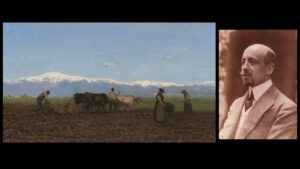
    Andrew, this is “mock” with the vengeance of your unique personal style. Here you call to mind the classic mock epic “Rape of the Lock,” with a sharp focus revising those eyes so central to love poetry in almost any era. And the picture of George and Martha reveals far more than all-too-common imperfections of “American Gothic.” Retiring to the backwoods is a classic American dream, but you can build Mount Vernon itself, not just a log cabin, from ramshackle cliches, and paint historical morning light in the background.

    Reply
    • ABB says:
      2 years ago

      Love Pope, glad it brings to mind the association. The number of possible ways to talk about eyes can never be exhausted.

      Reply
  9. Cynthia Erlandson says:
    2 years ago

    “Cupid’s aero- / Dynamic archery” . . . What could be more clever and fun? It almost seems like there should be a name for that kind of syllabic division. Anyway, great poem, with ineresting psychological analysis of the Washingtons.

    Reply
    • ABB says:
      2 years ago

      I think the term is ‘enjambment with a split rhyme,’ but that does cry out for something punchier.

      Reply
  10. Daniel Kemper says:
    2 years ago

    Much discussion we have had offline and much to come, so I’ll just flit around this a bit.

    I really enjoy how you wander from primitive America back into the realm of ancient legend and bring it back again via cupid.

    Bringing the reader round to the conclusion of the section via the Dog Star was a great story-teller’s touch. I also found something quite Miltonic about it.

    Finally, it’s just great to relax and appreciate what wonderful human beings these people were.

    Reply
  11. Sally Cook says:
    2 years ago

    Dear ABB =

    The mix of reality and delight make a perfect poem. Perfect!
    Thanks for communing with us mere mortals. Nothing mock here.

    Reply

Leave a Reply Cancel reply

Your email address will not be published. Required fields are marked *


  1. Martin Briggs on ‘The Savage Moon’ and Other Poetry by Brian YapkoAugust 30, 2026

    All rather menacing; but very imaginative, Brian, and with some inventive and entertaining rhymes. I enjoyed both pieces.

  2. Roy Eugene Peterson on ‘The Savage Moon’ and Other Poetry by Brian YapkoAugust 30, 2026

    Brian, the mystical nature of these poems is chilling and would fit well in October with Halloween. Your mind seems…

  3. Mark Stellinga on ‘The Savage Moon’ and Other Poetry by Brian YapkoAugust 30, 2026

    Brian, I'll never again gaze at the moon in quite the same 'light' - if you get my 'drift', and…

  4. Theresa Werba on ‘The Savage Moon’ and Other Poetry by Brian YapkoAugust 30, 2026

    Excellent as per usual Brian. I especially like the way you personify the moon as a maleficent horse/mare, a spider,…

  5. Roy Eugene Peterson on ‘When Opportunity Knocks’: A Poem by Roy E. PetersonAugust 30, 2026

    Russel, I learned from you that sometimes the most succinct poems can pack a punch. I appreciate your comment. Thank…

Subscribe to Daily Poems

Enter your email address to subscribe to this blog and receive notifications of new posts by email.

Join 1,631 other subscribers

Recent Poems

  • ‘The Savage Moon’ and Other Poetry by Brian Yapko
  • Poetry Book Review: Love Found, Yearned For, and Lost by James A. Tweedie
  • ‘When Opportunity Knocks’: A Poem by Roy E. Peterson
  • ‘Legend of the Griffin’: A Poem by Iryna Hall
  • ‘Government Issue’ and Other Poems by Joseph S. Salemi
  • ‘Chaucer Announces His Desire to Retire’: A Poem by Paul A. Freeman
  • ‘Advantages of Restaurants’ and Other Poems by Russel Winick
  • ‘Bone China’: A Poem by Mary Gardner
  • ‘On the Death of One Too Young to Die’: A Poem by Jeffrey Essmann
  • ‘This Too Shall Pass’ and Other Poetry by Justin Dasher
  • ‘Humdrum and Harum-Scarum’: A Lecture on Free Verse, by Robert Bridges (1922)
  • ‘Unrest On the Floodplain’: A Poem by Bhikkhu Nyanasobhano
  • ‘Latitude and Loss’: A Poem by Martin Briggs
  • ‘Act III’ and Other Poetry by C.B. Anderson
  • ‘God’s Funeral’: A Poem by James Sale
  • ‘Star Festival’: A Poem by Margaret Coats
  • ‘Song of the Frog Princess’: A Poem by Scharlie Meeuws
  • ‘The Odyssey: Nolan and Solot Compared’: An Essay by Michael Curtis
  • ‘Solitude’ and Other Poems by Mary Jane Myers
  • ‘The River Not Taken’ and Other Poetry by Brian Yapko
  • ‘Totentanz’: A Poem by James A. Tweedie
  • ‘In God Is Our Trust’: A Poem by Roy E. Peterson
  • ‘Confession’: A Poem by Jeffrey Essmann
  • ‘Religious Poetry, and Religionist Poetry’: An Essay by Joseph S. Salemi
  • The Zingers of Adam Sedia: A Review by Theresa Werba
  • ‘A Paradox’: A Poem by Shamik Banerjee
  • ‘A Prayer of Aristotle’: A Poem by Margaret Coats
  • ‘The Sparrow’: A Poem by Michael Pietrack
  • ‘Chemo Refusal’ and Other Poetry by Golan Shahar
  • ‘Deliverance’ and Other Poetry by Peter Venable

Categories

  • Acrostic
  • Alexandroid
  • Alliterative
  • Art
  • Best Poems
  • Blank Verse
  • Chant Royal
  • Classical Poets Live
  • Clerihew
  • Covid-19
  • Deconstructing Communism
  • Educational
  • Epic
  • Epigrams and Proverbs
  • Essays
    • Interviews with Poets
    • Poetry Reviews
  • Featured
  • From the Society
  • Great Poets
    • Dante Alighieri
    • Edgar Allan Poe
    • Emily Dickinson
    • Geoffrey Chaucer
    • Henry Wadsworth Longfellow
    • Homer
    • John Keats
    • John Milton
    • Robert Frost
    • William Blake
    • William Shakespeare
    • William Wordsworth
  • Human Rights in China
  • Limerick
  • Love Poems
  • Music
  • Pantoum
  • Performing Arts
  • Poetry
    • Beauty
    • Children's Poems
    • Culture
    • Ekphrastic
    • Found Poems
    • High School Poets
    • Humor
    • Riddles
  • Poetry Challenge
  • Poetry Contests
  • Poetry Forms
    • Curtal Sonnet
    • Haiku
  • Poetry Readings
  • Rhupunt
  • Rondeau
  • Rondeau Redoublé
  • Rondel
  • Rubaiyat
  • Sapphic Verse
  • Satire
  • Science
  • Sestina
  • Shape Poems
  • Short Stories
  • Song Lyrics
  • Sonnet
  • Symposium
  • Terrorism
  • Terza Rima
  • The Environment
  • Translation
  • Triolet
  • Video
  • Villanelle

Quick Links

  • About Us
  • Submit Poetry
  • Become a Member
  • Members List
  • Support the Society
  • Advertisement Placement
  • Comments Policy
  • Terms of Use

Welcome Back!

Login to your account below

Forgotten Password?

Retrieve your password

Please enter your username or email address to reset your password.

Log In
No Result
View All Result
  • Poems
    • Beauty
    • Culture
    • Satire
    • Humor
    • Children’s
    • Art
    • Ekphrastic
    • Epic
    • Epigrams and Proverbs
    • Human Rights in China
    • Music
    • Performing Arts
    • Riddles
    • Science
    • Song Lyrics
    • The Environment
    • The Raven
    • Found Poems
    • High School Poets
    • Terrorism
    • Covid-19
  • Poetry Forms
    • Sonnet
    • Haiku
    • Limerick
    • Villanelle
    • Rondeau
    • Pantoum
    • Sestina
    • Triolet
    • Acrostic
    • Alexandroid
    • Alliterative
    • Blank Verse
    • Chant Royal
    • Clerihew
    • Rhupunt
    • Rondeau Redoublé
    • Rondel
    • Rubaiyat
    • Sapphic Verse
    • Shape Poems
    • Terza Rima
  • Great Poets
    • Geoffrey Chaucer
    • Emily Dickinson
    • Homer
    • Henry Wadsworth Longfellow
    • Dante Alighieri
    • John Keats
    • John Milton
    • Edgar Allan Poe
    • William Shakespeare
    • William Wordsworth
    • William Blake
    • Robert Frost
  • Love Poems
  • Contests
  • SCP Academy
    • Educational
    • Teaching Classical Poetry—A Guide for Educators
    • Poetry Forms
    • The SCP Journal
    • Books

© 2025 SCP. WebDesign by CODEC Prime.